Practical ideas from FARM SHOW MagazineSubscribe · Free issue · Send us your shop tip
Subscribe to FARM SHOW
Issues / Vol. 24, No. 4 (2000)

Vol. 24, No. 4 (2000)

Money-Saving Repairs & Maintenance Shortcuts · Printed section pp. 38–41

30 selected entries · Complete text of selected entries

This issue’s section includes reader tips and feature-length shop stories. Held items and editorial notices are not reproduced.

Archive text: prices, coupons, availability and contact details reflect the original publication, not current offers. Reader methods are not universal instructions; follow manufacturer guidance and proper safety practices.

Reader shop tips

From the archive · Full text
Reader shop tip 1 of 3

Cliff Brandenburger

Individual tip 1 of 3 from this reader’s published contribution.
Cliff Brandenburger, Beecher City, Ill.

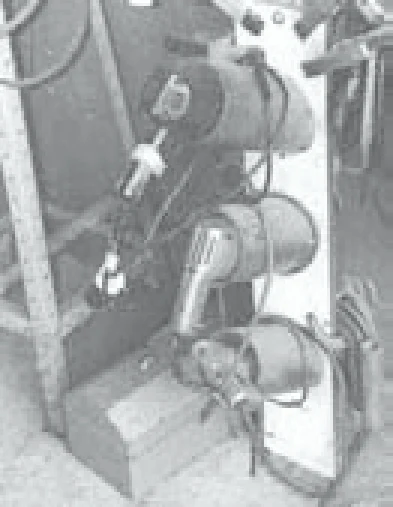
These “holsters” are a handy way to organize drills. Just screw short lengths of large dia. pvc pipe to a board. Cut them at an upward angle so the drills stay in. Works for other tools, too.

From the archive · Full text
Reader shop tip 2 of 3

Cliff Brandenburger

Individual tip 2 of 3 from this reader’s published contribution.
Cliff Brandenburger, Beecher City, Ill.

Brandenburger also came up with a nifty way to store saw blades. He uses a lot of different circular saw blades and wanted a way to keep them in good order. He came up with a wall-mounted storage bracket with twenty swinging arms that each hold a blade. The arms hang freely from a long bolt that runs through a plywood brace at the center of the bracket. The blade hangs loosely on a peg at the middle of each arm. The arms extend down below the blade so you can grab it with your hand, swing it up, and pull the blade off. The entire blade holder takes up only about 2 sq. ft. of wall space.

From the archive · Full text
Reader shop tip 3 of 3

Cliff Brandenburger

Individual tip 3 of 3 from this reader’s published contribution.
Cliff Brandenburger, Beecher City, Ill.

Another idea that works well for Brandenberger is a vertical plywood cutting table. It gives him fast and accurate cuts every time. The power saw slides up and down inside an angle iron track. It’s held by a cable that runs up over a pulley at the top. A weight on the cable is slightly heavier than the saw so it moves easily up and down. A bit of down pressure is all that’s needed.

From the archive · Full text
Reader shop tip

Avene Doering

Avene Doering, Hubbard, Iowa

“I have a 1370 Case which has a problem. The fuel gauge continually shows full, which has caused us to run out of fuel several times. I’d sure appreciate it if anyone has a way to track down the problem.”

From the archive · Full text
Reader shop tip

Robert E. Sanner

Robert E. Sanner, York, Neb.

“To replace U-joints on ag power shafts and some automotive shafts, I’ve found a conventional vice works best. I made this tool that hangs on a vice and leaves both hands free. It consists of two pieces of strap iron 5 in. long by 1 in. wide. You bend them over with a hammer to fit the jaws of the vice. Then weld a 1 1/4-in. nut on one side and a 3/4-in. dia. by 1/2 in. long rod on the other side. It works best to put the nut on the front side of the vice. I’ve never seen a tool like this in any service catalog but it works good.”

From the archive · Full text
Reader shop tip

Chad Burnett

Chad Burnett, Girard, Ill.

Chad was tired of replacing the air filters on his Wheelhorse garden tractor. He didn’t feel that it did a good enough job filtering out dirt and dust. He decided to solve the problem permanently by equipping the tractor with a “million mile” K&N air filter which is normally used on over-the-road trucks.

The main K&N filter element is made from boiled cotton and gauze and is cleaned with a special filter cleaner. A foam rubber filter surrounds the element to act as a precleaner. (K&N Engineering, P.O. Box 1329, Riverside, Calif. 92502 ph 800 992-3000)

From the archive · Full text
Reader shop tip

Raymond B. Cameron

Raymond B. Cameron, Fort Benton, Mont.

“I bought a converter which changed my AC welder to DC, which gives you smoother welds, a bigger selection of welding rods, less splatter and other advantages,” says Raymond. The converter, built and sold by Kansan Melvin Carlson (Rt. 1, Box 66, Buffalo, Kan. 66717), consists of Bridge diodes mounted on a panel that can be mounted inside a steel frame and fitted with caster wheels so the welder can mount on top of it. Sells for $225. The panel alone (without the frame and caster wheels) sells for $125 to mount on the side or top of the welder.

From the archive · Full text
Reader shop tip

Bill Soursky

Bill Soursky, Sioux Falls, S.Dak.

“A few years ago, FARM SHOW featured a ‘Super Drill’ which would drill large-size holes in all kinds of metal. I lost the address and would like to get more information.”

Editor’s Note: The Super Drill was invented in Australia. What makes it unique is that the one bit will cut holes from 1/2 to 3 in. dia. You simply drill a starter hole with a normal bit and then set up the Super Drill for whatever size hole you need. It’s fitted with a couple tool steel cutters that are adjusted in and out with an allen wrench. It operates at slow speed – so you can use a less powerful drill – and costs about the same as a large twist bit but will do the job of multiple bits. A 3/4 hp. drill will drill a 2-in. hole in hard steel. In many cases, the drill eliminates a trip to a machine shop. Prices range from $40 for a Super Drill with a single cutter up to $180 for a boxed set with accessories. It has been distributed in the U.S. for years by Peter Schofield, Super Drill Sales West, 2240 Meadow Creek Rd., Lincoln, Calif. 95648 (ph 916 645-3198; Web site: www.superdrill.com). In Canada, contact: Super Drill Sales, RR3, Waterford, Ontario NOE 1Y0 Canada (ph 519 426-7886).

From the archive · Full text
Reader shop tip 1 of 2

Myron Hebbert

Individual tip 1 of 2 from this reader’s published contribution.
Myron Hebbert, Chadron, Neb.

“A simple and practical way to prevent leaks along tire beads on tubeless tires is to seal the beads with a bit of castor oil around the rim.

From the archive · Full text
Reader shop tip 2 of 2

Myron Hebbert

Individual tip 2 of 2 from this reader’s published contribution.
Myron Hebbert, Chadron, Neb.

You can also prevent slip and squeal on belts by adding a small amount of castor oil.”

From the archive · Full text
Reader shop tip 1 of 2

Bill Reeks

Individual tip 1 of 2 from this reader’s published contribution.
Bill Reeks, Cromwell, Ky.

“This is a simple idea but it helps me keep my tools in order. Most box end wrenches end up in a pile because the holders that come with them don’t work well. I just thread them onto a 12-in. piece of #12 copper wire. The wire is soft enough to bend easily, yet strong enough to hold its shape and hook together.

From the archive · Full text
Reader shop tip 2 of 2

Bill Reeks

Individual tip 2 of 2 from this reader’s published contribution.
Bill Reeks, Cromwell, Ky.

“Another idea that has worked out well for me is installing a second battery in one of my tractors that has always been difficult to start. I just hooked the second battery up in parallel with the original battery. The added cranking power has solved my starting problems.”

From the archive · Full text
Reader shop tip

Bill Hester

Bill Hester, Waukee, Iowa

“When the heater on my Deutz Allis 6260 tractor went out, I learned that it would cost a lot to replace. The tractor is powered by an air-cooled engine and doesn’t have a radiator. The factory-built heater uses fuel oil. To solve the problem, I bought an old electric heater for $110 and mounted it on the floor of the cab so that it blows across my feet. It keeps the cab nice and warm. I used a ‘back seat heater’ that’s sometimes used to heat vans and old pickups. I wired the heater directly to the tractor battery.”

From the archive · Full text
Reader shop tip

Ron Beaty

Ron Beaty, 13921 W. St. Rd. 38, Hagerstown, Ind. 47346 (ph 765 489- 6321)

“We make an all-aluminum radiator that’s specifically designed for Farmall M tractors. It weighs about 45 lbs. less than the tractor’s original radiator, which makes a big difference to anyone who participates in antique tractor pulls. The original radiator core weighs almost 60 lbs. with brackets, whereas our aluminum radiator weighs only 14.7 lbs. The reduced weight helps get the tractor down to the lowest weight class allowed, which is 4,500 lbs.

“We use a process called controlled atmosphere brazing to make the radiator. It sells for $450 plus S&H. Another advantage is that it won’t rust out. Also, aluminum is a better heat reducer. We also plan to soon offer aluminum radiators designed for Oliver 88 tractors and also Moline tractors.”

From the archive · Full text
Reader shop tip 1 of 2

Jim D. Hansen

Individual tip 1 of 2 from this reader’s published contribution.
Jim D. Hansen, 11386 147 th Ave., Bloomer, Wis. 54724 (ph 715 568-1175)

“I was using a skid steer loader to haul haylage from a bag silo about 200 ft. to my stanchion barn, where I shoveled the feed into a cart and fed it to my cows. To make the job easier I mounted a 5 hp electric motor on an old 250-bu. manure spreader. I also cut a hole in the barn floor. I dump feed into the spreader at the bag silo and then pull it up into the barn and start the motor. The spreader drops the silage through the hole and directly into the feed cart. I don’t have to run my tractor back and forth to the barn all the time just to fill the feed cart.

“I’ve been using this idea for five years. It works so good that several implement dealers in my area have copied the idea. One dealer mounted an electric motor on a self-unloading feed wagon. The motor is geared down to run the spreader at 350 rpm’s instead of the standard 540 rpm’s.

From the archive · Full text
Reader shop tip 2 of 2

Jim D. Hansen

Individual tip 2 of 2 from this reader’s published contribution.
Jim D. Hansen, 11386 147 th Ave., Bloomer, Wis. 54724 (ph 715 568-1175)

“Here’s another idea. When the stator ring burned out on the Onan engine in my Hydro Matic skid steer loader, I found out that in order to replace the ring I would’ve had to remove the entire engine from the loader. The stator ring is used to charge the battery and all electrical components on the skid steer loader. It consists of coils that wrap around the flywheel and there’s a voltage regulator attached to it.

“Instead of replacing the stator ring, I disconnected it from the engine and bought a new alternator. Then I mounted a pulley on the engine’s crankshaft so that the engine belt-drives the alternator. I paid $67 for the alternator and about $4 for the pulley. I saved a lot of money because the stator ring alone would’ve cost $200 and the voltage regulator about $85. What’s more, it took only about a half hour to install the alternator. It would’ve taken at least six hours to replace the stator ring.”

From the archive · Full text
Reader shop tip 1 of 2

Randy Althouse

Individual tip 1 of 2 from this reader’s published contribution.
Randy Althouse, Castalia, Iowa

“Using mostly junk steel, I built my own portable, heavy-duty 20-in. dia. chop saw that’s powered by a 5 hp electric motor. The motor belt-drives the blade.

“The chop saw mounts on four wheels and weighs about 300 lbs. It has more power and can cut through bigger material than most commercial models. The machine will cut right through a 10 by 13-in. piece of steel, and I made it big enough that I can use a bigger 26-in. dia. blade if I want. I used 8-in. channel iron to build a pivoting arm that supports the motor and saw arbor. A threaded lever is used to tighten the vice to hold material in place. Pulling down on another lever brings the blade into the material for cutting. I built it so that the 3-ft. sq. work table is a little taller than my shop workbenches. As a result, I can cut a 20-ft.

long piece and keep the material above the work bench.

“I already had the motor and control box and bought a new blade. My total cost was about $100, whereas most commercial models sell for about $300.

From the archive · Full text
Reader shop tip 2 of 2

Randy Althouse

Individual tip 2 of 2 from this reader’s published contribution.
Randy Althouse, Castalia, Iowa

“I also used junk steel and a length of heavy duty well pipe to build my own two-wheeled, pressurized sand blaster. I closed up each end of the pipe. Then I welded an adapter onto the top end of the pipe and welded a valve onto the side. I also welded on an air hose hookup at the bottom of the pipe, where the sand comes out. A 5-ft. long steel rod equipped with a ceramic nozzle hooks up to the air hose. A black toilet paper canister hooks up to the hose and serves as a filter. It absorbs any moisture in the air hose so it won’t plug up with sand.

“To operate the sandblaster I first remove a cap at the top of the pipe and use a funnel to pour sand into the opening. Then I hook up my air compressor hose to an in-line valve on the canister that’s used to turn the sandblaster on. The 5-ft. wand is long enough to keep me from getting pelted with sand.

“I built it five years ago and have already run four or five tons of sand through it. It holds about twice as much sand as most commercial models so I don’t have to always stop and refill. I can go for about a half hour before it runs out of sand. It cost about $10 to build whereas commercial models sell for $200 or more.”

From the archive · Full text
Reader shop tip

Hubert Dyson

Hubert Dyson, Vilonia, Ark.

“I used 12-in. steel I-beams to build my own 40-ton hydraulic press. It has a 5-ft. wide opening from post to post and stands about 10 1/2 ft. high. The cylinder has a 2-ft. long stroke and is made from a length of 7-in. dia., 1/2-in. wall tubing off an old forklift. The press stands outside my shop because it was too big to fit inside it. I operate a small machine shop and use my press to build or repair things for my customers. It can do everything from small to big jobs – the biggest metal I’ve bent was 1 3/4 in. thick.

“The legs have steel plates welded to them at the bottom and are simply buried in the ground. The cylinder is operated by a small hydraulic pump and an electric motor.”

From the archive · Full text
Reader shop tip

Myers Machine & Mfg.

Myers Machine & Mfg., 587 Thomas Rd., Hollsopple, Pa. 15935 (ph 814 629- 9632)

“We custom build hydraulic cylinders, mostly for specialized equipment used in industrial applications. However, we can custom build cylinders for farmers, too. All we need are the specifications and dimensions that you want. We think there’s a market in agriculture for our service, especially with foreign equipment where hydraulic cylinders are often priced ‘out of sight’. For example, a steering cylinder for a Deutz tractor can sell for up to $600 whereas we can build the same cylinder for $200 to $300. We also custom build accumulators and pressure intensifiers.”

From the archive · Full text
Reader shop tip

Donald Davies

Donald Davies, Dawn, Mo.

“We have four Deere 4020 tractors and they’re all equipped with two long slender batteries. If we don’t replace both of them at the same time, often the battery that we don’t replace is a little weaker and will cause the new battery to go bad. It gets expensive. We replaced both batteries with a single 4D battery that’s commonly used on construction equipment. It has about the same power as the tractor’s original two batteries. We paid a little over $100 for this battery, whereas the two Deere batteries cost about $90 apiece. The main advantage is that now we don’t have to replace batteries as often. We had to make a new mounting bracket for the new battery.”

From the archive · Full text
Reader shop tip

Wayne Zimmer

Wayne Zimmer, Roblin, Manitoba

“Here’s a photo of a bolt rack that I made using gangs off an old disk. I can turn it to any position and find anything I want at a glance. I removed the gangs and welded short lengths of angle iron to the bearing holders on all the gangs. I welded two gangs to a pipe opposite each other. The next two gangs are welded opposite each other but are lower than the two gangs welded to the pipe. The stand that holds the rack upright is the rear wheel of a disker which has weights on it.

“The entire rack revolves, which means I can move all four gangs at once, or move each gang one at a time.”

From the archive · Full text
Reader shop tip

Bob Burton

Bob Burton, Love- land, Okla.

“I’ve come up with a wire tie tool that eliminates the need for any other tool when tying barbed wire to T-posts. It’s a 4 1/2-in. long, 1/ 2-in. dia. steel rod with a small hole in one end that’s used to twist the wire. The other end is narrowed up and has a notch in it. You use the notched end to bring one side of the wire clip under the barbed wire and pointing up. Then you insert the end of the clip into the hole end of the tool and twist the clip around the wire. It’s simple, but works great.”

Shop feature stories

From the archive · Full text
Feature story

Old-Style Wire For Antique Engines

Featured source:

The perfect final touch for that restored tractor, truck or stationary engine is wiring that fits the era in which the machine was made, says Bill Lopoulos, Tyngsboro, Massachusetts.

Lopoulos, a computer engineer who grew up on a Massachusetts dairy farm, has a sideline business that provides the right wiring for restoration work. He’s contracted with an automotive wire maker that was established in the 1920’s to make wire that has the look and feel of wire from the past.

“They use modern copper wire on the inside, but wrap it in the colored cotton fabric braid just like they’ve done since the ‘20’s,” he says. A clear polymer (non-conducting) coating completes the look.

“There are places to get wire with the original rubber, but it doesn’t last any better than the old wire. This is the best of both worlds, since it has the old look finish and patterns, but will last as long as modern wiring,” Lopoulos says.

When Lopoulos orders wire, he orders it in all sizes, so you can redo the entire machine with matching wire, including the spark plug and coil wires.

The most common color he sells is oak (orange), with a pattern of black and/or red threads (called tracers) woven through it.

“We can get just about any pattern of tracers you might want in the covering. I’ve just ordered one that is 50-50 yellow and green.

I should have it in stock in 3-4 weeks. No tractor company ever used wire like that, but it looks good on a restored Deere tractor,” Lopoulos says.

Wire can be purchased by the foot or in 100 ft. rolls. He can order wire to your own specifications, as well, but notes that lead time for special orders can be from a few weeks to several months. Lopoulos also sells period spark plugs and magneto parts. Check out everything he has to offer on his Internet page, or write him for a free catalog.

For more information, contact: FARM SHOW Followup, Bill Lopoulos, Magneto Parts, 304 Pondview Place, Tyngsboro, Massachusetts 01879. (ph 978 649-7879; Website: www.magnetoparts.com; E-mail: [email protected])

From the archive · Full text
Feature story

Pull-Type Crop Sprayer Converted To “Service Station On Wheels”

Featured source:

Bill Harris, Pennville, Ind., converted a pull-type crop sprayer into a “service station on wheels” equipped with a 375-gal. diesel fuel tank, an electric fuel transfer pump with 25 ft. of hose, and storage for oil, funnels, grease guns, and tools.

“It has a lot more fuel storage capacity than my pickup for refueling in the field. That means I don’t have to refill as often,” says Harris.

He had not used the single axle sprayer for the past couple years because it was too small for his needs. He cut away the boom and shortened up the tongue. He kept the metal spray tank. He added an expanded metal platform and a step on one side of the tank. On the other side he mounted a 6-ft. long, 3-ft. high wooden storage compartment with shelves inside it. He also made a smaller compartment to go behind the tank. The side-mounted box has enough room for four 5-gal. pails of oil as well as fuel filters, various funnels, a grease gun, towels, and a towel holder. The box on back is divided by a shelf, with a battery on top and the fuel pump on bottom. Both boxes have hinged lids that can be lifted up out of the way.

“It lets me keep my tractors going all day without having to drive home to refill the 110-gal. tank on my pickup,” says Harris.

“I mounted tail lights on the rig as well as outside-facing lights on top of the box on back so I can refuel after dark. I also mounted lights inside both storage compartments. The lights are hooked up to the same battery that operates the fuel transfer pump.”

Harris says the design works so well he plans to build units for sale and will display them at farm shows later this year.

“I plan to build tandem axle models that will allow greater capacity. I’ll also build metal boxes instead of wooden ones for more durability,” he notes.

Contact: FARM SHOW Followup, Bill Harris, Jr., 6889 W. 400 N., Pennville, Ind. 47369 (ph 219 731-2793).

From the archive · Full text
Feature story

Heavy-Duty Hydraulic Shear Doubles As Bender

Featured source:

“Our heavy-duty, open-jaw hydraulic shear doubles as a bender. It’s so handy I don’t think we could farm without it,” say David and Martin Ray of Winfield, Kan.

The machine’s 21-in. long shear consists of two main parts that pivot on a 3-in. dia. steel shaft. The top part is raised or lowered by a pair of large diameter hydraulic cylinders. The cylinders are operated by a hydraulic pump powered by an electric motor. Stepping on a foot pedal extends or retracts the cylinders.

Ray had the machine’s arms and jaws custom made. For bending work, the bottom half of the machine is equipped with two parallel bars and an “elephant’s foot” that looks like a shank on a tillage implement. Extending the cylinders forces the “foot” between the steel bars to bend the object. For cutting work, the top half of the machine is equipped with a shear that slips down through a narrow slot in a heavy-duty steel plate.

“A new machine of comparable capacity would sell for $5,000 to $6,000,” says David who gives credit to the Lord for their abilities.

Contact: FARM SHOW Followup, David Ray, RR 2, Box 236A, Winfield, Kan. 67156 (ph 316 221-3541).

From the archive · Full text
Feature story

“Bear Saw” Cuts On The Pull Stroke

Featured source:

It’s easier to pull than to push, says the manufacturer of a new line of hand saws that cut on the pull stroke.

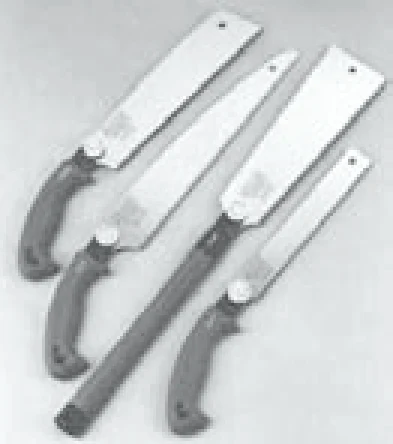
Bear Saws can be used on anything from logs to fine finished wood. They have a super-thin blade with razor-sharp, specially ground, triple-edged teeth that leave a smooth finished edge. Cutting on the pull stroke prevents blade buckling and binding, which allows the blade to be made thinner. According to the company, the saw removes less material on the pull stroke than conventional saws, allowing swifter, more precise cutting. Comes in four blade styles to match any job, from a 13-in. coarse/medium for rough cuts to an 8-in. extra-fine blade for finish woodworking. In between are a 10 1/2-in., medium-fine blade and a 10-in., double edge style. All four blades are easily interchangeable on any of the handles and are firmly secured with a locking knob.

The saw can be quickly disassembled for toolbox storage. A blade guard is available to protect the super-sharp teeth.

The saws sell for less than $10 apiece depending on the model. Contact the company for your nearest dealer.

Contact: FARM SHOW Followup, Vaughan & Bushnell Mfg. Co., Box 390, Hebron, Ill. 60034 (ph 800 435-6000; Website: www.vaughanmfg.com).

From the archive · Full text
Feature story

Engine-Powered Welder “Designed Just For Farmers”

Featured source:

This new high frequency DC welder attaches to any engine-driven vehicle, giving you a powerful mobile welder that you can take with you wherever you go.

The ZENA welder installs on any engine capable of producing at least 7 hp so you can put it on pickups, tractors, garden tractors and even ATV’s. The company says it will perform as well as expensive portable engine-driven industrial welders.

Several different models are available, ranging from 150 to 600 amps. All models are 100 percent duty and come with 20-ft. long welding cables as standard equipment. Overall cable length can be extended to 200 ft. A belt-driven power unit installs permanently on the engine.

Whenever you want to weld, you just attach the mobile welding system’s cables to the power unit and plug in control wires. A solid-state control system allows the operator to regulate welding power using controls built into the electrode holder. There’s no need to vary engine speed to control welding power, and the operator doesn’t have to go back and forth between the vehicle and the work site to make adjustments to the equipment.

The welding system produces a very high frequency DC output in both standard and reverse polarity modes, according to the company. The high frequency DC power generator produces an “extraordinarily fine bead” and is said to produce “a welding joint with better appearance and fewer impurities than any standard AC/DC stick welder.”

For operator safety, power is not supplied to the electrode holder unless the operator depresses and holds a push-button safety control. Welder output is also electrically isolated from the vehicle and earth ground. No modification to the vehicle’s electrical system is required. Suggested retail prices start at $750.

Contact: FARM SHOW Followup, ZENA, Inc., 330 Club Springs Road, Elmwood, Tenn. 38650 (ph 615 897-2011; fax 2023; E-mail: [email protected]).

From the archive · Full text
Feature story

Welding Helmets Stand Out From The Crowd

Featured source:

These new welding helmets do double duty. You can use them to weld, and they’ll also come in handy for costume parties.

Made from lightweight plastic that meets all industry standards, a wide variety of “faces” are available, including a gorilla, a hog, several different skulls, a panther, tiger, a football helmet, and more.

“They make a great gift for anyone who likes to weld,” says a company spokesman.

“All models come equipped with a standard clear see-through, flip-front lens. A quick-change electronic lens is also available. It stays clear until you strike the arc, then turns dark.”

The helmets sell for $60 apiece plus a UPS charge of $5 anywhere in the U.S. Models equipped with an electronic lens sell for about $150 more.

Contact: FARM SHOW Followup, Weiler Welding, 324 East 2nd St., Dayton, Ohio 45402 (ph 800 526-9353 or 937 222-8312; fax 2729).

From the archive · Full text
Feature story

Sub-Zero Metal Treatment Catching On Fast

By By Mick Lane
Featured source:

From cultivator points to racing engines, gun barrels to hitch pins, subjecting metal parts to extreme sub-zero temperatures is catching on fast as a way to increase useful life.

Cyrogenic processing of steel involves using liquid nitrogen to lower the temperature of parts to -320° F.

But don’t try this at home, experts warn. For the treatment to be effective, it must be done as part of a controlled process.

“You can’t just immerse a piece of steel in a tank of liquid nitrogen,” says Rick Diekman, Controlled Thermal Processing, Inc., Streamwood, Illinois. He says that although cryogenic processing is starting to catch on for agricultural equipment, the majority of the company’s customers are motor sport enthusiasts. A cryogenically treated race car transmission, for example, will last two to three times as long as an untreated one.

“That’s typical,” says Diekman, noting that cryogenic processing normally doubles product life.

Les Baych, Dave Snyder and Bruce Melick opened Cryogenic Engineering, Inc., in Cedar Rapids, Iowa, last year. The three formerly worked for Midland Forge. Baych says they got into the business after sending out parts for cryogenic processing. A die that was normally good for 7,000 pieces lasted through 193,000 pieces after treatment.

Seeing the potential, the three contacted “300 Below”, a Decatur, Illinois, company that sells cryogenic equipment. They bought what they needed and set up shop.

Diekman says a New England knife manufacturer pioneered the idea of cryogenic processing nearly 60 years ago. It was later refined by Applied Cryogenics, a Waltham, Mass., company which developed equipment that it now sells to other companies.

Diekman says the process is just beginning to be used for agricultural equipment like cultivator chisel points.

In cryogenic processing, the temperature of the item to be treated is lowered to at least -300 degrees F.

“It is very important that the temperature of an object be brought down at a controlled rate that is compatible with the temperature is dropped to -320 degrees F over a period of 8 hours or so. The temperature is dropped by allowing liquid nitrogen to enter a heat exchanger that cools the air in the chamber,” he says. Liquid nitrogen is never allowed to actually touch the parts being treated.

Once the temperature in the treatment chamber has reached -320 degrees F, it is held there for at least 6 hours. Some items, however, may be held at the low temperature for as long as 36 hours.

“It depends on the materials being processed,” Diekman says.

After the part has been at -320 degrees F for the proper length of time, the machine then brings it back to ambient temperature, again very slowly to avoid damaging it. Most materials require an additional tempering process. The cryogenic processing machines Diekman uses can continue warming the parts inside up to +300 degrees F. and then cool them again at a controlled rate.

“In some cases, this tempering cycle is repeated a second or even a third time. Again, the rate of change of temperature is rigidly controlled during each cycle,” he says.

“This is much more effective than the rapid heat and quench process alone that some use to temper steel.”

The cryogenic process works on all types of steel and most other commonly used metals. Some sources say steel needs to have doesn’t benefit from treatment, while Diekman has conducted studies that suggest otherwise. Harder type 400 stainless steel does respond, as do most other metals, such as brass (musical instruments), copper, aluminum alloys and some, but not all, cast iron. In addition, some plastics also benefit from cryogenic processing.

Baych says they’ve approached manufacturers about cryogenic treatment of wear parts on farm equipment, but with few successes.

“Manufacturers have an interest in selling parts, so anything that would make them last longer might not be in their best interests,” Baych theorizes.

Cryogenics Engineering says they’ve found that the process adds life to non-steel items too. They’ve even tried it on panty hose.

“If you have something you’d like to process, call us,” Baych says.

“If we’ve had experience with it, we’ll tell you what you can expect from the process. If we haven’t had experience with it, we might try it anyway, particularly if we can then run tests to compare the results with identical untreated items.”

Cost of cryogenic processing is usually based on the weight of the material being processed. Prices start at $6 and $10 per pound and may go down with increased volumes.

Where To Get Cryogenic Processing do cryogenic processing of parts: Applied Cryogenics, Inc. Contact: Jeff Levine 15 Wall Street Waltham, Mass. 02153 ph 781 642-7860 www.huron.org/cryogenic [email protected] 300 Below 2101 E. Olive St. Decatur, Ill. 62526 ph 217 423-3070 Fax 217 423-3075 www.300below.com American Cryogenics,Inc. 305 Travis Lane Waukesha, Wis. 53186 USA ph 414 513-0486 fax 414 513-0485 e-mail: [email protected] http://www.americancryogenics.com Controlled Thermal Processing, Inc. Contact: Rick Diekman 1521 Bourbon Parkway Streamwood, Ill. 60107 ph 630 540-1510 www.metal-wear.com Cryogenic Engineering, Inc. Contact: Les Baych 1131 Wenig Road NE Cedar Rapids, Iowa 52402 ph 319 861-3343 www.cryoeng.com Motion Improvements Contact: Leo Fortey 276 Ayr Road Paris, Ont. N3L 3E2 ph 519 861-6611 www.motion.fortey.net/