Practical ideas from FARM SHOW MagazineSubscribe · Free issue · Send us your shop tip
Subscribe to FARM SHOW
Issues / Vol. 34, No. 5 (2010)

Vol. 34, No. 5 (2010)

Money-Saving Repairs & Maintenance Shortcuts · Printed section pp. 36–39

32 selected entries · Complete text of selected entries

This issue’s section includes reader tips and feature-length shop stories. Held items and editorial notices are not reproduced.

Archive text: prices, coupons, availability and contact details reflect the original publication, not current offers. Reader methods are not universal instructions; follow manufacturer guidance and proper safety practices.

Reader shop tips

From the archive · Full text
Reader shop tip

Don Blake

Don Blake, Cherokee, Iowa

“I used an old chair and some scrap steel to make a handy roll-around shop chair that holds tools and parts. It really makes it easier for an old man to work on machinery.

“The chair welds to a frame made of 1 1/2-in. angle iron and 1 by 2-in. sq. tubing. The platform under the chair holds parts as does a tray attached to the side of the chair. There are 3-in. casters under the frame that make it easy to maneuver around.”

From the archive · Full text
Reader shop tip

Andrew Sewell

Andrew Sewell, Yorkshire, England

“I recently spotted this idea on a local tractor. The farmer who owned this Deere 578 tractor put colored plastic ties on the hydraulic hoses and valves to make it easy to hook up the right hoses. It’s a cheap replacement for the colored plastic covers that come on the hoses but often get ripped off and lost. You can buy a whole box of ties for a couple dollars.”

From the archive · Full text
Reader shop tip

Tom Gaddel

Tom Gaddel, Oregon City, Ore.

“I read with interest the reports in your last issue about people having fuel problems with their Deere Gators. I talked to the dealer and he gave me what he called hotter spark plugs. I installed them and eliminated the smoking problem from unburned fuel.”

From the archive · Full text
Reader shop tip 1 of 2

Glenn Hatfield

Individual tip 1 of 2 from this reader’s published contribution.
Glenn Hatfield, Crossville, Tenn.

“In a recent issue someone said his rototiller would act up whenever the fuel tank got down to half full. I think the trouble was really with the gas cap vent, which gets stopped up.

From the archive · Full text
Reader shop tip 2 of 2

Glenn Hatfield

Individual tip 2 of 2 from this reader’s published contribution.
Glenn Hatfield, Crossville, Tenn.

“In another report, someone said his chainsaw was cutting sideways because the chain had two teeth on one side, but I don’t think that was the problem. The problem was that one side of the chain was sharper than the other.”

From the archive · Full text
Reader shop tip 1 of 2

Jerry Brandt

Individual tip 1 of 2 from this reader’s published contribution.
Jerry Brandt, La Grange, Mo.

“I’m 66 years old so my Ford 9N is one year older than me. My dad got it in the early 1950’s. As far as I know, this tractor has never been overhauled and has had the same rear tires for more than 30 years. I use it once a week to mow about four acres of grass and to clear snow during the winter.

“This tractor used to have a starting problem when it still had a 6-volt battery system. To solve the problem, I installed a 12-volt battery on positive ground, and to reduce voltage also added a second resister voltage reducer. That helped the tractor to start and run a lot better.

From the archive · Full text
Reader shop tip 2 of 2

Jerry Brandt

Individual tip 2 of 2 from this reader’s published contribution.
Jerry Brandt, La Grange, Mo.

“I also had trouble with the points and coils. One day I replaced them and accidentally hooked up the 12-volt battery to negative ground. It was a lucky mistake because for more than two years now I haven’t had any problem with the points, plugs or coils. The tractor starts immediately and runs great.”

From the archive · Full text
Reader shop tip

Jeff Lang

Jeff Lang, Newport News, Va.

“I was always finding golf balls lying around in the park whenever I walked my dogs. Since golf balls are quite expensive I would pick them up. One day I made a file handle out of one and found it’s about the best file handle you could ever have. The golf ball won’t come off, and I don’t get any blisters in the palm of my hand like I do with conventional file handles. I just drilled a hole and filled it with JB Weld.”

From the archive · Full text
Reader shop tip

Samuel Borkholder

Samuel Borkholder, Shipshewana, Ind.

“While adding a lean-to onto a farm shop, we had to remove some old metal that was nailed on through 2-in. thick insulation. The farmer we were working for suggested we try his specially-made nippers, which had a 1/2-in. dia. by 16-in. long rod welded to one handle. Once the nipper is hooked on under the nail head, a sliding weight on the rod is used to pull out the nails. It worked great without damaging the metal.”

From the archive · Full text
Reader shop tip

Larry Schulze

Larry Schulze, Clifton, Texas

“I relocated the 3-pt. lift lever on my Deere 3010 tractor, so I can raise or lower the 3-pt.

while looking back over my right shoulder. The lift lever was previously mounted on the dash and would often get stuck. I moved the lever to the back of the tractor.

“I installed an 18-in. length of 1/8-in. thick steel plate on the right side of the tractor and then bolted it to the 3-pt. lift linkage, as shown in the photo.”

From the archive · Full text
Reader shop tip

Blaine Cornell

Blaine Cornell, Malta, Mont.

“I have several small engines and vehicles with stripped oil drain plugs so I use a vacuum oil extractor to change oil. It’s made by Mytyvac (www.mytivac.com) and you can get one at any auto parts store. Uses an air compressor or manual pump. I use it both ways.”

From the archive · Full text
Reader shop tip

Dan Johnson

Dan Johnson, San Antonio, Texas

“If you’re like me you keep a number of PVC, CPVC, ABS, etc., fittings around for repairs. How many times have you reached for a can of glue or solvent and found it to be dried out? An easy fix is to store the cans upside down. Cans of plumbing solvent can be kept fresh for years by using this simple tip.

“Most people call PVC cement ‘glue’ but it’s actually a solvent that welds plastic pieces together. The solvent contains highly evaporative compounds. That’s why the cans are sealed so tight from the manufacturer. Storing them upside down forces volatile compounds into the closed space above the liquid. With no outlet, the pressure builds until an equilibrium is reached.”

From the archive · Full text
Reader shop tip

John Schroder

John Schroder, Brainerd, Minn. (ph 218 829-7170)

“My friend Barry Aldridge came up with an inexpensive solution to a problem I was having with my Deere Gator. The problem was with the gearbox. It turns continuously, so whenever I try to shift gears I hear a grinding noise. As a result it takes too long to shift, and when it finally does shift it slams. I’m sure it also causes premature wear in the gearbox. I’m told this is a common problem on Deere Gators.

“To solve the problem, Barry made a brake that stops the gearbox belt from turning while shifting gears. The brake consists of a metal bracket with a brake lever on it. The lever bolts on under the Gator’s front seat and is connected to a cable that goes back to a brake pedal off a bike. Pulling on the lever causes the brake pedal to push up against the belt drive and stop it as I shift into gear.

“When I’m done shifting gears I let up on the lever and away I go. Very simple.”

From the archive · Full text
Reader shop tip

Pete Captein

Pete Captein, Ontario, Ore.

“I was never able to justify the cost of a big shop press so I built my own. It’s about 14 ft. high, 10 ft. wide and is made from 10-in. H-beams.

It sets on a 6-ft. wide base. The 8-in. dia. cylinder is off an old Michigan payloader and is made so I can roll back and forth on the table, anywhere I want. It can handle very big jobs.

“The payloader’s other cylinder is mounted off to the side where I use it to pull things apart. It hangs from a steel beam near the shop’s ceiling. I’ve used it to pull a pto apart, to straighten out a silage truck’s door, and to straighten a bent T-ring on snap-on dual wheels.

“Both cylinders are powered by a 10 hp electric hydraulic power unit with two control valves, one for the main pressing cylinder and one for the pulling cylinder.

“A commercial shop press of comparable capacity sells for $20,000 or more. I spent less than $1,000.”

From the archive · Full text
Reader shop tip

Mike Marshall

Mike Marshall, Orchard Park, N.Y.

“I injured my shoulder while lifting a full-size battery overhead to install in a Thermo King reefer unit on a semi trailer. I made up this lift jack using piping and an old car bumper jack. It works well and is easy on my shoulder. I put it on wheels so I can roll it under a Thermo King Super II reefer unit.”

From the archive · Full text
Reader shop tip 1 of 2

Derrick Caisse

Individual tip 1 of 2 from this reader’s published contribution.
Derrick Caisse, Chaplin, Conn.

“I coat plow blades and discs with non-stick cooking spray for winter storage. It costs less than grease and is far less messy.

From the archive · Full text
Reader shop tip 2 of 2

Derrick Caisse

Individual tip 2 of 2 from this reader’s published contribution.
Derrick Caisse, Chaplin, Conn.

“I always seem to have problems with bent watering wands. I’ve found that by fitting a piece of 1/2-in. I.D. pvc pipe over the aluminum shaft the wand will no longer bend.”

From the archive · Full text
Reader shop tip

Myron Finch

Myron Finch, 315 S. High St., Baxter, Iowa 50028

“My 3-wheeled bicycle had been outside for too long, which caused the bike’s chrome wheel rims and fenders to become rusty. Steel wool worked to clean the rust but it was a slow process.

“To speed things up, I cut the point and head off a 3 1/2-in. deck screw and placed it into a 3/8-in. electric drill. Then I wound up some steel wool around the screw. Using the drill to clean the rust off this way works great, especially around the wheel spokes. When I got done I waxed the chrome with chrome sealer that I bought at a hardware store.”

From the archive · Full text
Reader shop tip

CrystaLenz

CrystaLenz, P.O. Box 159, Clarksburg, Tenn. 38324 (ph 731 431-5278; www.crystalenz.com)

The headlight cleaning kit produced by CrystaLenz is designed to restore faded, yellowed headlights. It doesn’t use power tools, therefore eliminating the risk of burning and scratching the headlights. Application is a 3-step process that removes deep-set dirt and grime, and polishes away scratches. Sells for $29.95 plus $5 S&H.

From the archive · Full text
Reader shop tip

Ken Hall

Ken Hall, Purdy, Mo.

“The hand crank to raise and lower the head on my milling machine was difficult to move and to reach, so I replaced it with a garage door opener which I bought at a surplus store for $10. I welded a 1-in., no. 40 chain sprocket to the opener and a 4-in. sprocket to the mill. The opener is reversible and is operated by a 2-way switch. Now the head moves easily both up and down.”

From the archive · Full text
Reader shop tip

C.F. Marley

C.F. Marley, Nokomis, Ill.

“Recently we had to dig a trench and install a new hydrant in our yard. We were concerned that freezing and thawing could lift the hydrant, causing the plastic pipe that connects to the base of the hydrant to break. So instead of connecting plastic pipe to the hydrant, we substituted a 3-ft. length of galvanized pipe, and then connected the plastic pipe to that. The galvanized pipe serves as an anchor to prevent the hydrant from lifting.”

Shop feature stories

From the archive · Full text
Feature story

Engine Block Repair Patch

Featured source:

Alan Easley felt responsible for a crack that developed in the block on his grandson Steven’s Farmall C after he stored the tractor in an open shed one winter without checking the antifreeze. He had heard about engine block repairs and figured he and his son, Greg, could fix one, too. Fortunately the crack was in an easy place to get to on the water jacket. The Easleys cut a 2 1/2 by 12-in. patch out of 1/8-in. flat plate and heated it with an acetylene torch. They repeatedly bent it on a vise until the curve was the same as the block. They drilled 11 1/4-in. holes on the patch, marked them on the block and drilled holes to match and tapped the threads. Easley used a standard 3/8 variable speed drill and advises taking your time and not forcing it.

“The metal on these old water jackets is pretty thin, so you don’t want to apply too much pressure,” he says. The Easleys ground a V in the block’s crack, filled it with J-B Weld, applied a generous coat of high-temperature gasket cement and bolted on the patch with 1/4- by 3/4-in. stove bolts.

“After about 100 tractor pulls and a lot of farm work the patch is still holding,” says Easley. So, what would have happened if it didn’t hold?

“We would have had a junk block, which is what we had before we started,” Easley laughs. Contact: FARM SHOW Followup, Alan Easley, 8300 E. Turner Farm Rd., Columbia, Mo. 65201 (ph 573 442-0678).

From the archive · Full text
Feature story

Air Filter “Blaster” Pays For Itself

Featured source:

This new air filter cleaner uses a blast of air to instantly clean dirty canister-type filters.

“The Air Filter Blaster is designed to clean dirt from any canister-type air filter,” says Dennis Grieve, Salmon River Innovations, Salmon, Idaho.

“It lets you use your air compressor to blow dust out of the filter. It’s not intended to permanently replace the purchase of new air filters. It’ll just make them last as much as 20 times longer.” The unit comes with a cone-shaped, centrifugal force air induction chamber that pressurizes the filter from the inside out. To clean a filter, you hook up a compressor to a fitting on the induction chamber. The pressurized air creates a vortex that causes a poly shaft with slots in it to rotate. As the shaft rotates inside the filter element, the pressurized air coming out of the slots dislodges dirt and dust from the filter.

“It has just one moving part and should last a lifetime,” says Grieve.

“The cone on top of the unit fits filters of various sizes and seals tight onto all of them. The air filter can be cleaned several times without applying more than 40 psi to the filter element. It works a lot better than damaging the filter by banging it on the ground, or holding an air nozzle 1/4 in. away from the filter, which can tear the filter element.” The Air Filter Blaster comes with a duffel bag to store the unit, as well as a 3-lb. portable air tank and additional attachments. It sells for $249 plus S&H. The company also sells a shop model for $499 plus S&H. Contact: FARM SHOW Followup, Salmon River Innovations, LLC, Industrial Park – Airport Plaza no. 2, Salmon, Idaho 83467 (ph 208 756-8085; [email protected]; www.airfilterblaster.com).

From the archive · Full text
Feature story

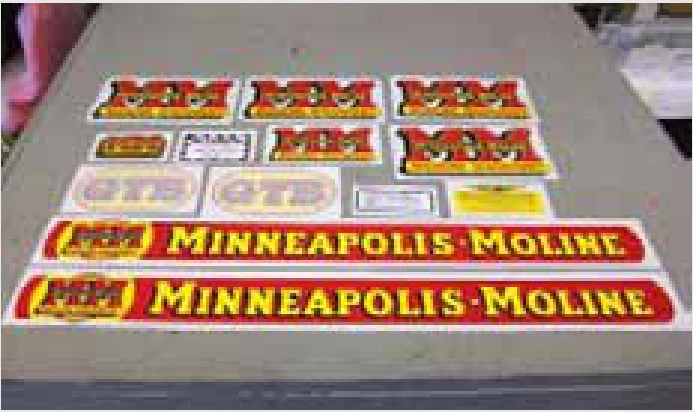
Where To Buy Authentic Tractor Decals

Featured source: The Decal Store

If you’re looking for a decal for a gearshift on an old “H” or the logo for a Rumely steam engine, check out the Decal Store. You can order on the internet or call the store and talk to the owner, Karen Kackmeister, who says there are more than 10,000 decals in stock.

“We carry individual decals and sets,” says Kackmeister.

“You can order a set or just the one you need. If we don’t have it in stock, our suppliers probably have it.”

Pricing for decals varies by the set. Kackmeister says having the model number, as well as the make and year, makes it easier to locate a specific decal. However, she is glad to help people find what they need, even if it means extra research.

In addition to the standard current and past tractor brands, Kackmeister also carries lawn and garden decal sets, including lesser-known brands like Shaw Du-All, Mustang and Speedex. She also carries decals for a range of gas engines and implements.

Contact: FARM SHOW Followup, The Decal Store, 121 East 2nd St., Ainsworth, Neb. 69210 (ph 402 382-3290; toll free 800 286-2171; [email protected]; www.tractordecal.com).

From the archive · Full text
Feature story

He Overhauls Hydraulics On Antique Deere Tractors

Featured source:

If your antique John Deere needs its hydraulics repaired or overhauled, Gary McLaughlin can probably do it. Growing up on a farm, he learned welding and hydraulics repair from his dad. Today the director of maintenance at an aircraft company uses some of his dad’s vintage metal lathes to repair and rebuild vintage hydraulic systems on evenings and weekends.

“I work on anything Deere built between 1934 and 1960,” says McLaughlin.

“I specialize in hydraulics, but also do custom machining.”

He does repair and overhaul for Deere Power-Trol, Custom Power-Trol, Power Lift valves, Rockshaft control valves and Touch-O-Matic systems. He also consults with others who are restoring or repairing hydraulics and gives seminars at antique shows and gatherings.

McLaughlin got interested in the Deere Power-Trol when he restored a 1951 B that had been sitting in the weeds. Soon he was working on hydraulics systems for others. In 2006 he decided to get serious about the hobby and started MACfabrications.

“It took me about a year to build the tooling, develop the documentation and get the training I needed,” says McLaughlin.

“Now you can send me what you have, and I’ll rebuild it back into what Deere installed originally. I test every part with a hydraulic mule and have just finished a test stand that will drive remote pumps.”

Knowing what to do sometimes means knowing when and when not to follow the repair manual. McLaughlin says that Touch-O-Matics are challenging and require following the manual word for word. However, in one case the manual says to install a seal backwards.

“In that case, if you follow the manual the seal will leak like a sieve,” he says.

When faced with an unavailable or extremely expensive part, McLaughlin finds an alternative or makes his own.

“A customer asked me to make some selector valves,” he recalls.

“Deere wanted $289 for each of the 20 left in private stock. I bought the tooling, reverse engineered the part, and started making them. I pretty much break even on the $150 I charge for a selector valve assembly.”

When a customer sent McLaughlin a worn (and no longer available) pto shaft for an R, he figured out how to remachine it. First he under cut it, and then he shipped it to a company that put a hard chrome layer on the entire shaft. Hard chroming, he says, is an industrial process that’s like applying a weld without heat.

“When I got it back, I ground it back into tolerance,” says McLaughlin.

In addition to his hourly rate for custom jobs, McLaughlin has set rates for cleaning, disassembly, inspection, reassembly, leak checking and setting pressure on common systems. He charges $250 for Power-Trols and Power Lifts and $175 for Rockshaft control valves. Overhauls of Dashpot relief valves are $50 and pressure settings of them are $25.

Contact: FARM SHOW Followup, MAC-fabrications, 241 North Lane, Granville, Mass. 01034 (ph 413 357-9098; [email protected]; www.macfabrications.com).

From the archive · Full text
Feature story

Polaris Repowered With Yamaha Motorcycle Engine

Featured source:

When Ed Pacha bought a used Polaris Magnum 425 ATV with a bad engine, he planned to repower it with a V-twin 750. However, when he tore into the Polaris, he realized he couldn’t make the Polaris belt drive work with the 750’s shaft drive.

“I found a 1981 Yamaha Virago 920 cc motorcycle engine that had a chain drive,” says Pacha.

“To use it, I figured I just had to substitute sprockets for the variable speed belt drive ahead of the Polaris gearbox.”

Pacha kept both the high/low gearbox and the transmission and clutch from the 920. That gave him 10 speeds forward and retained a reverse gear. Drive chains to the front and rear axles from the back of the gearbox didn’t have to be changed. In fact, the only major change was to split the Polaris frame ahead of the gearbox and add 7 1/2 in.

“Spreading the frame made room for the engine and, once I made mounts, I just dropped it in,” says Pacha.

Other minor changes included eliminating the foot brake from the Polaris, replacing it with a master brake cylinder from the motorcycle, and adapting the brake lines. He also mounted the Virago brake lever on the right handle bar. Pacha mounted the Virago clutch lever on the left handlebar. The high/low control also had to be remounted.

Pacha says his repower is a work in prog-ress. He has a temporary fuel tank mounted to the front rack and has yet to make a cowling to cover the engine. His biggest challenge will be reworking the gearbox. While everything works great and he has tremendous torque, top speed is only 12 mph.

“The variable speed belt drive is what gave the Polaris its higher road speeds,” says Pacha.

“I may try to put a planetary gear on the drive end of the gearbox or simply rebuild the gearbox altogether. I’ve reworked the sprocket ratios all I can.”

Pacha asks FARM SHOW readers with ideas to give him a call.

Contact: FARM SHOW Followup, Ed Pa-cha, 3263 Highway 78, Brighton, Iowa 52540 (ph 319 694-4108; [email protected]).

From the archive · Full text
Feature story

Barbeque Grill Converted Into Portable Table Saw

Featured source:

“When my gas barbeque grill wore out, I discarded the grill and turned the rolling stand into a portable radial arm saw,” says Elroy Lindaas, Mayville, N. Dak.

“First I removed the grill from the stand, leaving the side shelves on. The saw came with a metal framework, which I bolted to the grill’s frame. Then I used heavy plywood to build a cutting surface like the ones that usually come with radial arm saws from the factory. The cutting surface was then bolted to the saw frame.

“I can easily move the saw wherever I need it, and roll it out of the way whenever I’m not using it. It works great,” says Lindaas.

“To be safe, be sure to mount the saw as close to the center of gravity as possible.” Contact: FARM SHOW Followup, Elroy N. Lindaas, 735 153rd Ave. N.E., Mayville, N. Dak. 58257 (ph 701 786-3064; [email protected]).

From the archive · Full text
Feature story

Torque Multiplier Loosens Stuck Bolts

Featured source:

Get rid of that cheater pipe, says Graham Keeney, and make your own torque multiplier to break loose rusted bolts.

“This is a lot safer; it doesn’t slip off,” says the retired International Falls, Minn., trucker.

“You can really pull with it.” Keeney needed something to break loose rusted trailer spring U-bolts. So he purchased a 24-in. long 1/2-in. socket drive breaker and removed the drive at the end. Then he cut off two 1/4-in. hardened steel chain links and cut out 5/8-in. gaps in one side of each of the links. He used 7018 rod and welded one chain on the end of the breaker and the other one 4-in. back. The gap is just enough to slip in the handle of open and box end wrenches and twist them in securely, Keeney explains. He’s used his homemade tool with 3/4 to 1 1/8-in. wrenches. He hasn’t come across any bolt that he couldn’t break open with his torque multiplier, although he sometimes uses a little heat on badly rusted nuts and bolts.

“It was very simple to make, and it does the job,” Keeney says.

Contact: FARM SHOW Followup, Graham Keeney, 3913 Highway 11, International Falls, Minn. 56649 (ph 218 283-2360).

From the archive · Full text
Feature story

Lawn & Garden Tractor Salvage Yards

Featured source:

If you’re restoring or repairing an older lawn or garden tractor, parts can be hard to find. Here are a few salvage yards and dealers who buy and sell parts as well as entire tractors. FARM SHOW recently spoke with them for an update on their businesses.

Patton Acres, run by Rich Patton, con-centrates mainly on Cub Cadet and Deere tractors, but he also carries a lot of Massey Ferguson parts. Patton says he has hundreds of tractors, including Cub Cadets varying from original models to late 3000 series. Pat-ton does business only on the internet. Parts listings can be found on eBay or requested by e-mail. Almost all orders receive next day service.

Contact: FARM SHOW Followup, Rich Patton, Patton Acres ([email protected]; stores.ebay.com/patton-acres-tractor-salvage).

Ray’s Lawn Mower Shop maintains 5 to 6 acres of lawn and garden tractors. Early 1950’s and 1960’s Bohlens and Wheel Horse partial units are still available. A wide variety of other tractors and parts are in stock.

Contact: FARM SHOW Followup, Ray’s Lawn Mower Shop, 1436 West Philadelphia Ave., Boyertown, Penn. 19512 (ph 610 367-2078; [email protected]).

Sandy Lake Implement carries thousands of used parts as well as new parts. They specialize in older Simplicity/Allis Chalmers tractors going back to the 1960’s.

Contact: FARM SHOW Followup, Sandy Lake Implement, 3675 Sandy Lake Rd., Sandy Lake, Penn. 16145 (ph 724 376-2489; toll free 888 252-0656; www.sandylakeimp.com).

Harald’s Small Engine, Inc. built its inventory by buying out lawn mower shops that went out of business. They have 3 1/2 acres of tractors and tractor parts, as well as new and used chainsaw parts, tillers, push mowers and other used equipment and small engines. Harald’s specializes in Deere, Cub Cadet, Wheel Horse and Allis Chalmers tractors, but also carries Snappers, Murray, MTD, Sears and others.

Contact: FARM SHOW Followup, Harald’s Small Engine, Inc., 5214 Jasmine Road, Billings, Mo. 65610 (ph 417 743-2491; [email protected]; www.haraldonline.com).

Weaver’s Equipment has more than 600 lawn and garden tractors in stock for parts or resale. Weaver’s specializes in Morris, Simplicity, Deere, Cub Cadet and Wheel Horse. Parts can be shipped out the same day as ordered.

Contact: FARM SHOW Followup, Weaver’s Equipment, 4809 State Route 61, Shelby, Ohio 44875 (ph 419 342-7033).

Joseph J. Nemes & Sons offers a full line of new lawn and garden equipment, but also carries a wide variety of used parts and equipment. The company specializes in Allis Chalmers and Simplicity machines, as well as pre-1980 Cub Cadets and miscellaneous pre-1976 parts.

Contact: FARM SHOW Followup, Joseph J Nemes & Sons, 1233 Rt 206 (Hwy 206 North), Princeton, N. J. 08540 (ph 609 924-4177; [email protected]; www.jnemes.com).

J & D Lawn Tractor specializes in Deere equipment, but also carries some Wheel Horse and other brands. Typically they carry around 100 tractors for parts and another 100 for resale or trade. Delivery averages three days after orders are received.

Contact: FARM SHOW Followup, J & D Lawn Tractor, 1254 N. 2150th Ave., Mendon, Ill. 62351 (ph 217 440-8365; [email protected]; www.jdlawntractor.com).

Jamestown Lawn & Garden specializes in new and used parts and attachments for lawn and garden tractors. Brands include Cub Cadet, Deere, Bolens, Wheel Horse, Ford, Jacobsen, and Sears and Craftsman lawn mowers. Jamestown also carries a variety of small engines, such as Kohler, Briggs & Stratton, Tecumseh, Honda and LCT. The “graveyard” has more than 200 tractors for salvage as well as countless shelved parts. The company tries to get parts out within 24 hours and promises no more than 48 hours from order receipt.

Contact: FARM SHOW Followup, Jamestown Lawn & Garden, 240 Ray RD, Jamestown, Penn. 16134 (ph 724 932-2195; [email protected]; www.mowergraveyard.com).

West Kentucky Tractor Parts specializes in used and rebuilt parts for Japanese brand garden and compact tractors. Many units are diesel and include Kubota and Mitsubishi tractors going back to the late 1970’s. Other Asian brands include Hinomoto, Iseki, Kioti, Satoh, Shibaura, Suze and Yanmar. North American brands include Allis Chalmers, Bolens, Case, Ford, Deere, Massey Ferguson, New Holland and White. The company has several hundred partially dismantled and several hundred more intact. They offer same day shipping on most orders, as well as truck freight discounts.

Contact: FARM SHOW Followup, West Kentucky Tractor Parts, 6375 Joppa Landing Road, Kevil, Ky. 42053 (ph 270 462-2191; toll free 800 564-0567; www.wkytp.com).

From the archive · Full text
Feature story

Tractor Lift Makes Service Work Easy

Featured source:

James Coffey, Sr., keeps his lawn tractor in great working condition, thanks to his home-built service lift.

“It lets me access the blades and change the belts or motor oil without having to remove the deck,” says the North Hampton, N.H. man. Being a big fan of Harbor Freight tools, he ordered one of the company’s manually operated motorcycle lift tables. A foot pedal is used to pump a small hydraulic jack that raises the platform. An electric/hydraulic version of the same table is available, but costs more. The platform had to be widened to accommodate the tractor, so he used 1 by 2-in. channel iron to build a frame and bolted it to the platform, then bolted 1 by 6 pressure-treated planks to the frame. Welding angle iron to both ends of the ramp, and then bolting more planks to the angle iron widened the lift table’s ramp. He bought a small electric winch and bolted it to a homemade mast. The mast consists of a length of 2 1/2-in. sq. steel tubing welded to a sq. metal plate with gussets, and is bolted to the lift’s deck. A cross-arm on top of the mast supports the winch. A friend in the sheet metal business made a metal box to keep rain and snow off the winch. The tractor had been modified years before with a front drawbar that’s now used to lift the tractor.

“The pedals that operate the lift had to be lengthened, because the modified platform is now over 50 in. wide and the pedals would have been covered and inaccessible with the mower deck in the down position,” says Coffey.

“The only problem we have is when we put a tractor on the lift table with an under seat-mounted, rear fill fuel tank. If the tank is full and we raise the front end of the tractor, fuel pours out the fill neck. So we try to do any service work after we’re done mowing, or before we fill the tractor with fuel.” Contact: FARM SHOW Followup, James Coffey, Sr., 221 Post Rd., North Hampton, N.H. 03862 (ph 603 964-8902).

From the archive · Full text
Feature story

“Made-In-Secret” Tool Holder

Featured source:

“I made sure to clean up the kitchen so my wife won’t know what I did until we get the next issue of FARM SHOW,” says David Novotny, West Fargo, N. Dak., who made a pvc pliers holder in the kitchen when his wife wasn’t home. Like a lot of people, Novotny carries a pair of pliers in his back pocket when working around the farm. But he has to take the pliers out when he sits on the metal seat on his old tractor. So he made a pliers holder that bolts onto the tractor fender. Here’s how he did it: “I cut an 8-in. length of 2-in. dia. pvc pipe and wrapped the pliers in several layers of aluminum foil. I heated the oven to about 350 degrees and put the pvc pipe inside to make it more flexible. Then I put on gloves and filled the kitchen sink with cold water.

“I took the pvc pipe out of the oven and put the pliers in it, squeezing the pipe around them. That caused the pliers to form fit nicely inside. Then I dunked both the pipe and the pliers in the cold water. I drilled a 1/4-in. dia. hole in my new pliers holder, and after a little whittling with a knife I bolted the holder to the tractor fender.

“Now whenever I sit down on the tractor seat I just drop the pliers in the holder, and grab it when I hop off.” Contact: FARM SHOW Followup, David Novotny, 407 Ramona Ave., West Fargo, N. Dak. 58078 (ph 701 730-8627).