Practical ideas from FARM SHOW MagazineSubscribe · Free issue · Send us your shop tip
Subscribe to FARM SHOW
Issues / Vol. 25, No. 6 (2001)

Vol. 25, No. 6 (2001)

Money-Saving Repairs & Maintenance Shortcuts · Printed section pp. 38–41

28 selected entries · Complete text of selected entries

This issue’s section includes reader tips and feature-length shop stories. Held items and editorial notices are not reproduced.

Archive text: prices, coupons, availability and contact details reflect the original publication, not current offers. Reader methods are not universal instructions; follow manufacturer guidance and proper safety practices.

Reader shop tips

From the archive · Full text
Reader shop tip

Bill Reeks

Bill Reeks, Cromwell, Ky.

“To break the bead of stubborn tires from the wheel rim, I lay a 3 by 4-in. board on the tire with the end close to the wheel rim and drive one wheel of a vehicle up on the board. The weight of my Suburban pops the bead loose easily. It’s simple, cheap and effective.”

From the archive · Full text
Reader shop tip

William Winter

William Winter, Tower Hill, Ill.

“I bought a scissors table at a factory dispersal sale and put wheels on it so I can move it around the shop. I use it to move supplies and materials around. I can load them from the back of my Jeep and wheel them to shelves or storage areas and then unload them. The table can be raised up to 4 1/2 ft. high, so it saves a lot of lifting. I’ve even used it to support a tractor transmission while working on it.” Winter says the scissors lift is raised by an air pressure cylinder so it’s easily adjusted. He wishes he’d bought more, but adds that a similar table would be relatively easy to build.

From the archive · Full text
Reader shop tip 1 of 3

Pete Peters

Individual tip 1 of 3 from this reader’s published contribution.
Pete Peters, Osler, Sask.

“Here are a couple of back-saving ideas I use. First, I made a heavy-duty cart from the front axle and wheels off an old riding mower. It works great for moving auger engines and other heavy items without lifting them.

From the archive · Full text
Reader shop tip 2 of 3

Pete Peters

Individual tip 2 of 3 from this reader’s published contribution.
Pete Peters, Osler, Sask.

Second is a convenient stand to hold an empty water tank that I use in the back of my pickup truck. The stand, made of treated posts and lumber, is the same height as my pickup bed. All I have to do is slide the tank into the truck bed. When I’m through with the tank, I just slide it onto the stand.”

From the archive · Full text
Reader shop tip 3 of 3

Pete Peters

Individual tip 3 of 3 from this reader’s published contribution.
Pete Peters, Osler, Sask.

Peters also passed along an electrical idea.“If you need to replace the alternator on an older tractor, combine, or other vehicle, its simple to make the changeover from the old external regulator style to the newer internal regulator style by just installing a one-wire Delco self-exciting regulator. All you need to do is hook the existing live wire to the main terminal on the alternator. If you want a volt or amp meter, run a wire from the #1 terminal on the alternator to the meter and then to the positive side of the battery. If the regulator’s bad on your old Delco external alternator, you can change it to a one-wire system by replacing the regulator with a self-exciting regulator.”

From the archive · Full text
Reader shop tip

Allan S. Maclean

Allan S. Maclean, Kingston, Ont.

“Waste oil can be stored in horizontally mounted 45 gal. drums by installing a piece of 2-in. pipe formed into a 90° elbow. Screw one end into the 2-in. hole, swinging it up to fill and down for a rain-proof vent. A 3/4-in. ball valve installed in the lower 3/4-in. tapped hole is used to draw off the oil.”

From the archive · Full text
Reader shop tip

Richard Cox

Richard Cox, Jacksonville, Ill.

“I bought a pair of vises at an auction, which I turned into a large jig to hold items that I want to weld. For example, I can weld two rods together end to end. Having a firm base is essential for this kind of job. A steel plate welding table serves as a base.”

From the archive · Full text
Reader shop tip 1 of 2

Robert Dunton

Individual tip 1 of 2 from this reader’s published contribution.
Robert Dunton, Topeka, Ill.

“The first thing I did when I bought my new 3-pt.

mounted King Kutter mower was to mount a pair of 12-in. high gauge wheels on the front side. I use the mower along roadsides and right-of-ways. The gauge wheels keep the rig mowing evenly and prevent the deck from gouging the ground, which my landlord greatly appreciates. Each wheel is attached to the mower’s 3-pt. bracket by a 1 by 3-in. flat metal bar. Deck height is controlled by adjusting a threaded rod with jamb nuts at each end. I set up my 8-ft. Bush Hog mower the same way, adding four gauge wheels on front of it.

From the archive · Full text
Reader shop tip 2 of 2

Robert Dunton

Individual tip 2 of 2 from this reader’s published contribution.
Robert Dunton, Topeka, Ill.

“I also replaced the metal guards on both sides of the back part of the deck with lengths of flexible 1/2-in. thick rubber. The original metal guards would at times drag in the ground and tear it up, whereas the flexible rear shield can yield to obstacles without getting twisted out of shape. I simply bolted the rubber onto the deck.”

From the archive · Full text
Reader shop tip

Lloyd Meffert

Lloyd Meffert, Hettick, Ill.

“I don’t have as many broken blade bolts since I bolted a pair of metal skids onto both sides of my 5-ft. wide New Idea mower. I use the mower to clear pasture land on which I’ve already cut down all the trees. I measured the highest stumps in the pasture and then made brackets for the skids accordingly, so the mower blades are always at least 1 in. above those stumps. Now I can use the mower anywhere without worrying about hitting the stumps. I used 2-in. angle iron to make the skids.”

From the archive · Full text
Reader shop tip

Steve Spiering

Steve Spiering, Milbank, S. Dak.

“I converted an old step-in electric fence post into a low-cost, drill-operated paint mixer which I use to stir up 1-gal. pails of paint. I used a chop saw to cut the post off flush with the top of the step and then cut a series of notches into the step. To stir paint, I insert the bottom end of the post into the drill chuck and drag the notched step along the bottom of the pail. The same idea would work for mixing 5-gal. pails of paint if you extended the length of the handle.”

From the archive · Full text
Reader shop tip

Richard B. Allen

Richard B. Allen, Queens Leo, Nova Scotia

“During the past three years I’ve had difficulty being able to see the twine when baling with my New Holland 630 baler. I couldn’t tell if the twine was moving or not so I often dumped out bales that weren’t tied. I also had bales with twine wrapped all through them because the twine didn’t cut off and I didn’t realize that it was still going out. I solved the problem by mounting a pulley on front of the baler. The twine travels under this pulley so I can see at a glance whether it’s moving or not. It didn’t cost anything more than a little time and material I had on hand.”

From the archive · Full text
Reader shop tip

Stan McDonald

Stan McDonald, 402 Rosedale Ave., Foxboro, Ontario, Canada K0K 2B0 (ph 613 968-9516; E-mail: [email protected])

“I came up with an attachment for small lathes that’s designed to cut round shapes or curves into brass, aluminum, steel, or plastic. The tool cuts convex curves up to 3/4 in. in diameter. Works great for making round ball joints, governor weights, railing knobs, round contact points for tools, nose cones, and many other useful and decorative objects.

“Commercial turning tools like this sell for more than $900. My tool is made to fit most small lathes with a 4 1/2 to 11-in. swing. Sells for $75 plus shipping.”

From the archive · Full text
Reader shop tip

Richard Cox

Richard Cox, Jacksonville, Ill.

“Grinding jobs are a lot cleaner ever since I installed a vacuum system to carry dust and small grindings out through my shop wall. I used a small fan and furnace pipe with elbows to do the job. I had dust collectors built to mount right up behind the grinding and buffing wheels.”

From the archive · Full text
Reader shop tip

Marvin Kellen

Marvin Kellen, Rt. 2, Box 155, Madison, Minn. 56256 (ph 320 598-3279)

“When the return hydraulic line under the platform on my Deere 520 tractor rusted out, I discovered that Deere no longer makes the part and no one else does, either. So I had a local machine shop fabricate the part for me and make six others at the same time. It’s designed to fit either Deere 520 or 530 tractors. I know it works because I installed it on my own tractor. I’m willing to sell to others for $69 apiece including S&H.”

From the archive · Full text
Reader shop tip

Michael Vanhorn

Michael Vanhorn, Sentinel Butte, N. Dak.

“When the U-joints on our 1983 Ford F-250 4-WD pickup went out, we made a tool that lets us remove the U-joints without having to take the driveshaft out. We just slide the tool in there, take the U-joints off, and push the new ones in. The tool consists of two flat metal plates that are 2 1/2 in. wide by 5 in. long, with a nut welded into the center of it. We simply tighten up a bolt inside the nut in order to push the U-joint out. Then we turn the tool around and push the new one back in.”

From the archive · Full text
Reader shop tip 1 of 2

Robert T. Valentine

Individual tip 1 of 2 from this reader’s published contribution.
Robert T. Valentine, 417 Commercial Ave. S., Wolsey, S. Dak.

“I read about the problems Norman Fiddler has had with front spindles breaking on his Deere 4020 tractor (Vol. 25, No. 5). I had the same problems with my Deere 4010 but I solved it in a different way. I bought a used Case 1370 front axle assembly from Paul Meyers Tractor and Combine Salvage in Aberdeen, S. Dak., and modified it to fit the 4010. I used the 4010’s regular saddle without any modification. We cut the Case cylinder brackets off the back of the Case front end. Then we cut loose the rear bracket that’s welded to the Case wishbone near the back, using the proper size shaft as an alignment guide. We then placed the shaft through the Case front end and through the Deere saddle. Next, we moved the cutout Case mounting ahead so that it’s against the Deere saddle and rewelded it in place.

“The Case tie rod ends are heavier and thicker than the ones Deere uses so we had a local machine shop enlarge the holes in the Deere steering arm in order to accept the Case tie rod ends.

“The machine work was done by folks at the Grasslands Hutterite Colony (11865 - 307 Ave., Wetonka, S. Dak. ph 605 439-3273). Ask for Alvin Wollman or George Waldner, Jr.).

From the archive · Full text
Reader shop tip 2 of 2

Robert T. Valentine

Individual tip 2 of 2 from this reader’s published contribution.
Robert T. Valentine, 417 Commercial Ave. S., Wolsey, S. Dak.

“I solved another problem with a broken spindle on our Oliver 1650 tractor. The 1650 uses the same spindle found on an Oliver 88 tractor. I removed the spindles complete with the outside housing and also the wheel hubs and traded them to a salvage yard for complete assemblies from an Oliver 1955 model. The 1955 has much heavier spindle assemblies and hubs but uses the same center section so the change was simple to make.”

From the archive · Full text
Reader shop tip

Gene Snellings

Gene Snellings, Montreal, Mo.

“I made my own shop on wheels, starting with the frame of an old pickup to which I added a tongue made of steel box tubing. I used two sheets of 9-gauge steel to make a 7 by 9-ft. bed, which has toolboxes on both sides - three under the bed and one on top. On front are expanded metal racks.

“The trailer carries a Miller welder, cutting torch, and air compressor which are all bolted onto the bed. It also carries a chop saw, air tools, welding clamps, and other metal working tools such as a vise and grinders. I welded used car wheels onto the trailer that serve as racks to hold hoses and welder cables. I also added a rack that’s specially-designed to hold acetylene bottles.

“I use the back side of the trailer as a work bench in the field. The trailer is legal to pull on the highway and has all required lights and license.”

From the archive · Full text
Reader shop tip

Steve Spiering

Steve Spiering, Milbank, S. Dak.

“I used a length of 2-in. dia. PVC tubing to make a vacuum nozzle that hooks up to my shop vac. It works great for cleaning out leftover seed in my drill fill auger. I used an electric heat gun to heat one end of a 1-ft. length of tubing until it started to get soft, and then squeezed it between two boards to flatten it out, leaving a narrow opening. Then I heated the other end of the pipe and inserted the vacuum hose. When the pipe cooled off, I had a tight fit. I also use it to clean out grain from under the aeration floor in my grain bin. You could make the pipe as long as you need.”

From the archive · Full text
Reader shop tip

Denis Seewald

Denis Seewald, Mustang, Okla.

“The bearings were worn out in my late ’40s or early ’50s vintage John Deere 8 ft. tandem disk. When I took it apart, I found there was dirt in the bearings and that had worn out the cages that hold the ball bearings. The races and the balls were still good. I priced parts for it and found those bearings cost $42 apiece -there are eight of them. New seals for each bearing were $10. Replacing all the bearings would have cost more than $400. Since I only use it a few hours a year, I decided to try to remake the cages with lead.

“To do this, I laid the bearing flat with one old seal in place on the bottom side. I spaced the balls equidistant around the race and covered everything well with grease. Then I poured melted lead into the bearing, making sure the lead was bridged across every ball. Since the lead won’t stick to grease, when it hardened, the balls rolled freely in the new lead cage.

“I’ve used the disk about 15 hours since I did this and it’s still running fine. I don’t think I’d try it on a newer, more expensive piece of machinery, but if it’s an older machine that gets only a little use, it doesn’t take much longer than replacing the bearings and it’s a lot less expensive.”

Shop feature stories

From the archive · Full text
Feature story

Easy Way To Boost Heat From Wood Stove

Featured source:

Robert Dunton, Topeka, Ill., found an easy way to boost heat output of the wood stove he uses to heat his shop.

He simply slipped a large T-shaped section of pipe over the flue pipe on his stove. The “T” is fitted with a grain aeration fan of the type that’s normally used to screw down into piles of grain. Here’s it simply fits the top of the “T” and pulls heated air off the flue pipe and circulates it around the shop.

Contact: FARM SHOW Followup, Robert Dunton, 26494 E. Co. Rd. 1900 N., Topeka, Ill. 61567 (ph 309 256-2811).

From the archive · Full text
Feature story

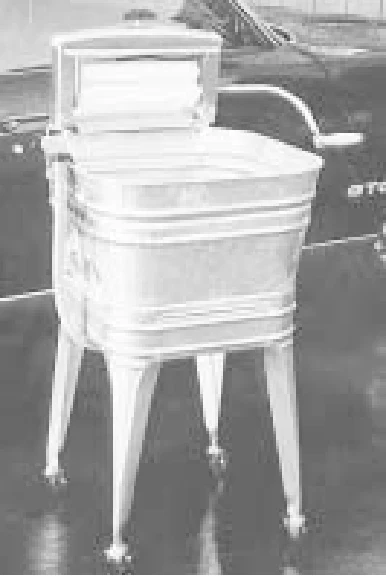
Wringer-Washer For Cleaning Shop Towels

Featured source:

Shop towels and chamois will last longer if you use this hand-operated wringer to wash them, says Fast Lane Products, Palos Verdes Peninsula, Calif.

The “Wring-A-Way” wringer consists of a rustproof, zinc-plated, all-steel frame housing two 15-in. long rubber rollers. A single knob at the top makes it easy to adjust closeness of the rollers (up to 90 percent of the water in a wet towel can be squeezed out).

The wringer comes with two adjustable clamps at the bottom that allow the unit to be attached to laundry tubs, barrels, sawhorses, or the company’s “Water-Wheels”, a 15 1/2-gal. portable galvanized steel drain tub and stand. A 30-in. hose connected to the tub’s drain outlet allows easy removal of water. The tub comes with a set of casters which can be left off for stationary use.

“The wringer’s gentle action greatly extends chamois life,” says Fay Flanzer.

“We’ve been using the same chamois to clean our cars for more than 10 years.”

The Wring-A-Way wringer sells for $139 plus $10 S&H. The Water-Wheels tub sells for $99 plus $19 S&H. Both units together sell for a a special price of $219 plus $22 S&H.

Contact: FARM SHOW Followup, Fast Lane Products, Box 7000-50, Palos Verdes Peninsula, Calif. 90274 (ph 800 327-8669; E-mail: [email protected]; Website: www.fastlaneproducts.com).

From the archive · Full text
Feature story

Paint-On Rust “Remover”

Featured source:

There are a number of rustproofing products on the market, but the one that most do-it-yourselfers seem to be using is POR-15, a “paint-over” product that stops rust in its tracks.

When POR-15 is painted onto rusty surfaces, it chemically reacts with the rust to create a rock-hard finish that won’t crack, chip or peel. It creates a hard finish that stops further corrosion and is not affected by road salt, gas or oil.

POR-15 can be painted directly onto rusted metal and used as a primer on frames, floor boards, fenders, bumpers, inside door panels and trunk areas.

POR-15 is available in black, silver, grey, clear; or semi-gloss black. One quart of black, silvery, grey, or clear sells for $29. One quart of semi-gloss black sells for $31.

Contact: FARM SHOW Followup, Imperial Restoration, Inc., 308 Lockport St., Lemont, Ill. 60439 (ph 800 576-5822) or Resto Motive Laboratories, Inc., Box 1235, Morristown, N.J. 07962 (ph 973 887-1999; fax 973 887-8007).

From the archive · Full text
Feature story

Tire Sealant Stops “2 x 4 Leak”

Featured source:

While covering the Farm Science Review near Columbus, Ohio, we came across an unusual exhibit set up by a local tire company.

They had a tractor tire on display with a 2 by 4 stuck right through the sidewall. What was amazing about the tire was that after the 18-in. long chunk of wood punched it’s way through the tire, the farmer was able to keep right on mowing. The tire did not go flat thanks to a new flat-stop product called Multi-Seal which he had mixed with the liquid calcium inside the tire.

We talked to national sales manager Craig Russell and he told us Multi-Seal has been around for years for use in military and commercial vehicles but has only been made available to farmers in the last couple years.

“There’s no other leak-stop product on the market that mixes with fluid in a tire. It will instantly seal a hole up to 1/2-in. dia. with the heavy-duty version of the product,” says Russell, noting that the liquid has tiny fibers that work like a tire plug to seal a hole. The tiny fiber was developed by NASA scientists for space suits. The plug is stronger than the tire itself.

“The fibers are so light and fluid that they go instantly to the hole, plugging it almost instantaneously,” notes Russell.

Multi-Seal has been used by the military for years – a special formula will plug holes up to 1 1/4-in. dia. — and has recently caught on rapidly with rental equipment companies. One national firm recently put Multi-Seal in 180,000 pieces of equipment that it rents nationwide.

“Once you put it in a tire, you’ve solved 95 percent of your puncture problems. Best of all, it’ll last the life of the tire yet the cost of treating a tire is less than the cost of fixing a flat,” Russell notes. The average cost of putting Multi-Seal into a 16-in. truck tire is $6 (takes about 18 oz. at 34 cents an ounce).

Russell says one big testimony to the effectiveness of Multi-Seal is that tire companies are selling it.

“There’s never been a sealant that tire companies would sell on a widespread basis. A number of tire companies are now putting Multi-Seal into every tire they sell and guaranteeing no repair costs for the life of the tire, including slow rim leaks and valve stem leaks. This product is also the first ever that will effectively stop leaks on high-speed over the road vehicles.”

Multi-Seal is designed for 3/4-ton vehicles and up so it’s not designed for use in cars and light duty pickups (it would affect tire balance on a lighter vehicle).

“Big savings can be realized by truck fleets, for example, by preventing under inflation which reduces gas mileage and increases the life of tires.”

Multi-Seal is the only tireseal product ever introduced that mixes with water and water calcium mixes in tires, according to Russell.

Contact: FARM SHOW Followup, Multi-Seal Corp., 16750 Hedgecroft, Suite 512, Houston, Texas 77060 (ph 281 591-0111; Website: www.multi-seal.com).

From the archive · Full text
Feature story

Air Hose Nozzle Works As Vacuum Or Blower

Featured source:

The switch from blowing off combines to sucking chaff out of engine components is easy with this new nozzle that acts as both a blower and a vacuum.

The Super Gun hooks up to a standard compressor. The unit has an on-off switch next to the handle, as well as two valves - one for blowing and one for vacuuming.

To use the tool as a blower you open the blow valve and close the suction valve. To vacuum, you close the valve and open the suction valve. To both blow and vacuum at the same time, you open both valves. The strength of the suction or blowing action is determined by how far you open the valves. Liquids or solids are sucked up a poly tube and into a bag or other container.

A Super Gun equipped with a short suction nozzle and bag filter sells for $77.30 plus S&H. The same model equipped with a flexible hose for vacuuming into your own container sells for $72.70 plus S&H. The company is looking for a North American distributor but you can order direct from Korea.

Contact: FARM SHOW Followup, Nambu Co., Ltd., Baik, Chang Hoon, 5-2 3’rd Standard Factory no. 23-1, Sahwa Dong, Chang Won City, Kyong Nam, Korea (ph 82 55 237-8620; fax 82 55 237-8619; E-mail: [email protected]; Website: www.supergunnambu.co.kr).

From the archive · Full text
Feature story

CamLock Washers

Featured source:

Arco Rosenow of Chillicothe, Ill., recently contacted FARM SHOW about a unique product that he discovered and liked so much he started selling it.

CamLoc Washers are heavy-duty lock washers that come in two pieces. They’re designed to maintain adequate tension on bolts and nuts to prevent any loosening due to vibration or shock.

“The washers aren’t impacted by heat, are reusable many times, and seem to incur no fatigue factor due to use,” says Rosenow.

“The face of the cam is at a different angle than the threads on the bolt. By placing the cam faces together, the lead angle or ramp of the cams is greater than the pitch of the threads on the bolt. When a bolt is at proper torque, the bolt is slightly elongated which keeps the bolt in a tension that will not let it override the cam angle. As a result, it actually requires more torque to loosen the bolt than to tighten it. This is a big benefit when tightening a screw in soft metals like brass or aluminum.

“I recently installed these lock washers on my chain saw. The muffler screws were set in an aluminum housing and kept coming loose due to vibration. I kept trying to tighten the screws but eventually stripped the threads. After I installed the washers the screws haven’t vibrated loose once. Three years ago I installed the washers on the pitman of my sickle mower, and since then the nuts have never loosened on their own. These washers are a little expensive, but they can save a lot of money if they keep a bolt from working loose and going through a combine.

“There are 18 different sizes available. Prices range from 32 cents to $6.18 apiece. However, the ones that fit most of my needs are 1/4, 5/16, 3/8, 1/2, and 5/8.

“I sell a sample pack of these five sizes, with one pair per size, for $3.75 including S&H.”

Rosenow also sells locking cotter pins designed to keep tractor drawbar pins in place. The pins install without the need for any tools. A sample pack is available for $3.00 including S&H.

Contact: FARM SHOW Followup, Arco Rosenow, 1223 Hallock Hollow, Chillicothe, Ill. 61523 (ph and fax 309 274-2107).

From the archive · Full text
Feature story

Whole Tractor Restorations

By By Mick Lane, Contributing Editor
Featured source:

If you’ve stashed an antique or collectible tractor or two in the shed for years and still haven’t gotten around to starting the planned restoration, you might want to consider turning the job over to a professional.

There are only a couple handfuls of truly professional tractor restoration experts. We’ve compiled a list of all we could find (see sidebar). If you know of others, tell us and we’ll add them to our list.

Before you turn a professional loose on your pet tractor project, though, there are a few things you should know. First, most charge an hourly rate of at least $25, plus all parts and materials. Rates of $35 an hour are common, and some charge different rates for different processes. For example, one full-time farm equipment restoration concern charges $25 an hour for general labor, but gets about three times that for specialized work like sandblasting parts to remove rust and old paint.

Second, if you have a John Deere tractor, you’ll likely pay less for the same degree of restoration. There are a couple of reasons for this. One is that there are a lot more aftermarket and restoration parts available for Deere tractors, and there also appears to be more full-time restorers specializing in Deere.

And it follows, too, that if you’re looking for a professional job on an extremely rare machine, restoration is likely to be considerably more costly.

Dan Peterman, Rusty Acres Restorations, Webster City, Iowa, says parts availability for many older Deere tractors is so good he can usually get what he needs overnight.

“I might look for weeks to find a useable part for less popular makes,” he says. Peterman says 80 percent of the tractors he restores are Deere, but he collects and restores Masseys himself.

Lou Spiegelberg, Spiegelberg Restoration and Service, Birmingham, Ohio, figures 85 percent of the tractors he’s restored are Deere, but says he’ll work on any make or color. He suggests that people who want to try a professional restoration should shop around and ask for references. And, too, he says they need to be prepared to pay part of the cost up front, like a retainer.

“I put together a rough estimate of what it will cost and if the customer agrees to that, I ask for a payment of around a third to get started. Then I bill again as I work through the amount already paid,” he says.

“If you’re good at this kind of work and are thinking of starting a business, you need to do something like this in order to have the money to keep going.” Plus, he says it keeps you from getting burned by a customer who doesn’t pay.

While you might think there would be fewer and fewer tractors around to be restored, most professional restorers disagree. Most say they already have tractors lined up that will keep them busy for the next 18 to 30 months. Ron Jungmeyer, Russellville, Missouri, says he’s collected and restored his own tractors for 31 years and has been restoring full time for others for going on 10 years. He believes that not only are there plenty of tractors and other machines out there to be restored, but that the demand for high quality restoration is growing.

“When I started, most people were just doing paint and major repairs. Now, there are more people collecting who want and can afford a complete professional restoration,” he says.

Most of the restorers on our list say there’s room for more people who do what they do.

“You just have to know where to find parts or who to call who can help locate them, and then be willing to do the job right,” says Peterman.

Because no two tractors need the same parts, it’s hard to say what a restoration might total. Peterman says that it’s always twice as much as you thought. While that may sound like he’s joking, it’s not meant to be funny. He says if the tractor comes in in reasonable shape, the price may be under $2,000, but most, he adds, are in the $2,000 to $3,000 range at his shop.

“One I did not long ago cost the owner $12,000,” he adds.

Where To Get A Tractor Restored Lou Spiegelberg Spiegelberg Restoration and Service P.O. Box 63 52771 State Route 113 Birmingham, Ohio 44816 ph 440 965-7679 E-mail: [email protected] Specializes in Deere, but does Farmalls and will tackle anything.

Dan Peterman Rusty Acres Restorations 1057 180th St. Webster City, IA 50595 ph 515 543-8641 E-mail: [email protected] Ron Jungmeyer Jungmeyer Tractor Restoration Service 55835 Hwy C Russellville, Mo. 65074 ph 573 782-4602 Richard Bockwoldt 27404 60th Ave. Dixon, Iowa 52745 ph 319 843-2270 Rob Detwiler Detwilers Tractor Parts S3266 Hwy. 13 S. Spencer, Wis. 54479 ph 715 659-4252 Foster’s Farm Repair 14167 Keeley Rd. Red Creek, N.Y. 13143 ph 315 754-6612 Corwin Groth 24880-145th Ave. Eldridge, IA 52748 ph 319 285-7009 Specializes in Deere GP tractors Carl Beyer Beyer’s Restoration and Shop 26144 Spring Valley Road Shannon, Ill. 61078 ph 815 864-2153 Kenny Carey 4889 Plateau Road Crossville, Tenn. 38555 ph 931 277-5227 King’s Tractor 1426 Noble Rd. Kirkwood, PA 17536 Mark Ketron R.R. 1, Box 424-A Lebanon, Va. 24266 ph 540 880-1298 Tim Talbot Tm’s Original Restorations 3619 Johnson St. Rd. Keokuk, IA 52632 ph 319 524-8383 Neal or Gary Potts Big Boys Toys Hwy. 13 S. Marshfield, WI 54449 ph 715 389- 2800 Gary Schmitt 2-Cylinder Repairs and Sales 22040 190th St. Rockwell, IA 50469 ph 641 822-4662 Gary Uken 1909 330th St. Titonka, IA 50480 ph 515 928-2010 (shop) 515 928-2177 (home) Lyle Schultz Schultz Gas Engines R.R. 1, Box 31-A Chatfield, MN 55923 ph 507 867-3442 Mark Wood Mark’s Tractors 2636 Couonty Rd. 2300 E. Gifford, IL 61847 ph 217 694-4735 Restores only Farmalls Mercer Implement Ramon and Dallas Mercer “Y” Highway Excelsior Springs, Mo ph 816 630-8300 Ron Berlage Pilot Knob Restorations 390 S. Pilot Knob Rd. Galena, Ill. 61036 ph 815 777-0826 fax 815 777-0912 Stanley Voorhees P.O. Box 14 Livingston, NY 12541 ph 518 851-9165 (shop) 518 851-3612 (home)