Practical ideas from FARM SHOW MagazineSubscribe · Free issue · Send us your shop tip
Subscribe to FARM SHOW
Issues / Vol. 23, No. 2 (1999)

Vol. 23, No. 2 (1999)

Money-Saving Repairs & Maintenance Shortcuts · Printed section pp. 38–40

32 selected entries · Complete text of selected entries

This issue’s section includes reader tips and feature-length shop stories. Held items and editorial notices are not reproduced.

Archive text: prices, coupons, availability and contact details reflect the original publication, not current offers. Reader methods are not universal instructions; follow manufacturer guidance and proper safety practices.

Reader shop tips

From the archive · Full text
Reader shop tip

Tom Trenary

Tom Trenary, Corinth, Kent.

“Here’s a way to speed up any funnel. Just attach a small piece of plastic tubing along one side of it that extends down below the bottom of the funnel and above the top edge. It increases the flow of liquid by letting the air escape much faster.”

From the archive · Full text
Reader shop tip

Gerhard Treviranus

Gerhard Treviranus, Georgetown, Ont.

“To tighten the belt on my table saw, I use an old pulley which is bigger than the pulley on the motor. It has no support, and is simply slipped between the two sides of the belt. Under load, the pulley moves toward the drive-pulley. When it’s not under load, it moves back to the middle. Now the pulley is always tight.”

From the archive · Full text
Reader shop tip

Scott Pfeiffer

Scott Pfeiffer, Albany, Ohio

“It’s hard to find air leaks on air bags on New Holland 855 balers. The dealer just wants to sell you a new pair of air bags at about $300 per pair. My solution was to remove all the air lines and spend $4 on some air fittings at the hardware store. I just screwed the fittings on to each air bag and inflate to 100 psi. When you come back in the morning you can see at a glance which bag has the leak.”

From the archive · Full text
Reader shop tip

Tom Kutruff

Tom Kutruff, Altoona, Penn.

“The hard rubber coating on my Deere 620 tractor was cracked and worn. I repaired it by removing the old hard rubber. Then I split a washing machine hose lengthwise and slipped it over the wheel and covered that with a mesh-type automative steering wheel cover. Worked well and was a lot cheaper than going to one of the companies that recover steering wheels.”

From the archive · Full text
Reader shop tip

Jimmy Holloway

Jimmy Holloway, Des Arc, Ark.

“We lost several fuel tank caps to our combine by forgetting to replace them after fueling. We solved the problem by removing the round magnet from an old radio speaker and sticking it to the combine next to the fuel spout. When we take the cap off, we just stick it to the magnet. We still might forget to replace the fuel cap but we don’t lose it.”

From the archive · Full text
Reader shop tip

James Collins

James Collins, Richfield Springs, N.Y.

“One of the handiest ideas I’ve had in my shop are my nut and washer holders made from wire coat hangers. What I do is reshape a hanger so it looks like a big safety pin, with a hook at one end. Each hangar holds a different size nut or washer. I just slip them on a hook and hang it on a rod. You can put a lot of hangars in a small space and yet they’re very visible. And when you’ve got a repair, you can quickly grab several different sizes as needed.”

From the archive · Full text
Reader shop tip

Donald Albright

Donald Albright, Perkins, Okla.

“Re-cently, one of your readers wrote in about problems he was having with the string cutter on his older New Holland round baler. I had the same problem and wanted to pass along the way I solved the problem.

“I made a new twine cutter using two sickle blade sections. One welds to the existing string guide. The other bolts to the lower corner of the welded blade and swings freely back and forth. A small piece of metal plate welds to the bottom of the welded blade. A spring runs from this plate to the hinging blade. A rope runs from the tractor through a series of eyebolts to the hinging blade. To cut the twine, I just pull on the rope and the sections scissor together to cut. The spring pulls the hinged blade back into cutting position. Would likely work on any baler.

“Like the other FARM SHOW reader, I have also started running two strings together in this baler. It really helps hold the bale better. I’ve tied over 100 bales this way and it has worked out well.”

From the archive · Full text
Reader shop tip

Robert J. Paugh

Robert J. Paugh, Bozeman, Mt.

“I’ve subscribed to FARM SHOW ever since you started and have always enjoyed it, but I was disappointed in the article on your last issue (Vol. 23, No. 1) about the Compact Bender that sells for $398. I’m enclosing a page from a recent Northern Hydraulics catalog showing what looks like the identical product for $150. I bought a bench model for even less - $100. The headquarters for Northern Hydraulics is not more than 10 miles from your office. Maybe you should get to know your neighbors and see what they have to offer. The one you featured looks like a rip-off. (Northern Hydraulics, Burnsville, MN 1-800-533-5545).”

From the archive · Full text
Reader shop tip

Matt Graham

Matt Graham, Rt. 1, Box 25, Patterson, Mo. 63956 (ph 573-856-4240)

“This gauge wheel adjustment tool saves me several minutes every time I have to change the depth setting on my 15-ft. Deere 750 no-till drill, which has 24 press units on it. It can also be used on air drills with the drill-type press units.

“The tool is a 2.5-in. long forked wedge with a 9 1/2-in. handle. There’s a 5/8-in. gap between the two prongs on the U-shaped fork. It tapers from the point to 1-in. thick and fits around the adjustment pin between the head of the pin and the main frame of the press wheel unit. You just slip the wedge in and move the handle back and forth to pry the pin out more easily to adjust the wheel.

“I cast the tool by pouring molten metal into a mold. Then I turned it in a lathe and sanded it to remove the rough edges.”

From the archive · Full text
Reader shop tip

Dennis Whitsitt

Dennis Whitsitt, Huntingburg, Ind.

“My shop floor anchors are used to straighten equipment too large to fit into our shop press. When we built our shop, I installed eight of them in the floor. We put four on the pad outside the shop at 2, 3 and 6-ft. intervals. We put four more inside with three of them in a row and a fourth at a right angle to them. The inside ones are next to our in-floor hoist so we can use the hoist as a jack to straighten large implement frames. These anchors are the least expensive feature in our new shop but my employees say they’re the best feature in it.

“One thing we use the anchors on is straightening our big bale carrier. We chain both ends down and use a bottle jack to bend the crooked area back into place. We have also used the anchors to adjust the camber on large truck steering axles by bending the axle beam. It’s a job that’s almost impossible any other way. We just drive the truck over the anchors, chain the axle ends to the anchors, and used two bottle jacks and a floor jack to jack the middle up to the correct position.

“Each anchor is made from 6-in. dia. heavy-gauge pipe cut 18-in. long. One inch from the top of the pipe we drilled two 1-in. dia. holes across from each other. A 9-in. long rod inserts through the holes and is welded in place. A 10-in. sq. flat steel plate is welded to the bottom of the pipe with a hole in the center for drainage. We bury the pipe in the ground so the top of the pipe is flush with the concrete to be poured. We put caps over the anchors when not in use.

“Each anchor cost just $25 in materials and took about 30 min. apiece to set up.”

From the archive · Full text
Reader shop tip

Arvin De Cook

Arvin De Cook, Sully, Iowa

Arvin mounted a powerful 300-watt floodlight on rolling frame made from bike parts into order to have good light anywhere in his shop or farmyard.

He used a junk bike frame and three bike wheels, joined together with scrap steel. The light mast mounts at the center. A hand-cranked screw jack is used to raise and lower the light, which also pivots back and forth as needed. A hinged handle on front makes it easy to pull around. Two 40-ft. extension cords hang from the side of the frame.

From the archive · Full text
Reader shop tip

Rick Mabeus

Rick Mabeus, Winfield, Iowa

“I got tired of always untangling my extension cords so I came up with the idea of putting them in empty plastic buckets. I now have five different cords in buckets. They’re easy to carry around and it’s easy to coil the cord back into the bucket. I use 5 and 1-gal. buckets, depending on the cord. The male end of the cord sticks out a 1 1/2-in. hole cut in the side of the bucket. It’s a very handy idea that saves a lot of hassle.”

From the archive · Full text
Reader shop tip

Don Moss

Don Moss, Tallula, Ill.

He built a hydraulic-powered press to use to straighten out longer items like wagon tongues, planter markers, fence posts, pipe, and so on. The press has a 5-ft. long bed made of a heavy piece of plate steel supported by a V-shaped base. A 20-ton cylinder applies down pressure to a 4-ft. long section of 4 by 4 heavy-walled pipe. He attached a ring to the top of the press so he can pick it up with a tractor loader to move it. He says there’s nothing on the market like it that’s priced reasonable and he built it mostly out of scrap parts. (C.F. Marley)

From the archive · Full text
Reader shop tip 1 of 2

Bill Reeks

Individual tip 1 of 2 from this reader’s published contribution.
Bill Reeks, Cromwell, Ky.

“You can make a large sorting tray for bolts, nuts and other small parts using a large plastic laundry detergent bottle. Just remove one side and lay it flat. After you’ve found what you want, you can screw off the top and pour the parts back into a storage jar. Handy and quick.

From the archive · Full text
Reader shop tip 2 of 2

Bill Reeks

Individual tip 2 of 2 from this reader’s published contribution.
Bill Reeks, Cromwell, Ky.

“I also use detergent bottles to carry oil and mixed gasoline for my chainsaw. I put a 50:1 mix of gas and oil into a larger red bottle and chain oil in a smaller blue bottle. Then I tie the handles together with a length of cord to make them easy to carry out to the woods. These types of bottles now have built-in pouring spouts so no funnel is needed. Very handy.”

From the archive · Full text
Reader shop tip

Gary Max Busler

Gary Max Busler, Blaine, Tenn.

Gary had problems from the get-go with an early 1980’s Deere 510 baler he bought used three years ago.

“The belts would cross and lock up in the front of the baler when I started to make a core in light hay. I had to stop, pull out the hay and uncross the belts whenever I started to make a core in light hay, which got extremely aggravating in short order.

“To solve the problem, I made a guide for the belts to run in. I cut a 10-ft. long highway stop sign post. I used the round bushings out of a GM car’s brake calipers as spacers between the two sections of sign posts, which keeps them 2 or 3 in. apart. To install the guide, I placed one section of pipe on one side of the belts, then bolted the other section of pipe to it. I bolted the assembly horizontally into the baler just above the roller.

“I haven’t had a problem with belts crossing since. The biggest expense was $25 for the bolts I used, with all other components coming from scrap I had on hand.”

From the archive · Full text
Reader shop tip 1 of 2

J.R. Tucker

Individual tip 1 of 2 from this reader’s published contribution.
J.R. Tucker, Tucker Tire, Dyersburg, Tenn.

“Here’s a recipe for ‘flatless’ tractor tires several of my customers at Tucker Tire swear by.

“The recipe is simply a mixture of anti-freeze and shredded newspapers. You mix up the two ingredients in a bucket so that a thick paste forms. Then you pour a half-gallon or so inside a tubeless tire so it coats the entire inside. Let it dry thoroughly and put the tire back on the rim. When the mixture has hardened, the newspaper fibers will automatically seal small holes, up to 1/8-in. in dia., made by brush or thorns.

From the archive · Full text
Reader shop tip 2 of 2

J.R. Tucker

Individual tip 2 of 2 from this reader’s published contribution.
J.R. Tucker, Tucker Tire, Dyersburg, Tenn.

“I also sell a variety of 8-ply tractor tires that last longer than 2 or 4-ply tires. Prices start at about $45 for 15-in. tires, the equivalent of what Firestone and Goodyear ask for 4-ply tires of the same size. As we like to say, ‘We sell twice the ply at half the price.’” Contact: FARM SHOW Followup, Tucker Tire, 844 S. Main, Dyersburg, Tenn. 38024 (ph 800 443-0802; E-mail: [email protected]; Website: www.tuckertire.com).

From the archive · Full text
Reader shop tip

Bob Gamble

Bob Gamble, Sundre, Alberta

Bob built a multi-purpose tool that he uses to straighten bent loader teeth, among other things.

“What’s different about it from other presses or benders is that it’s portable enough to move around easily by hand and doesn’t take up a lot of room in your shop or garage. It stands 2-ft. high by 10-in. wide and is made out of channel iron and pipe. The top and bottom are 12-in. lengths of 8-in. wide channel iron. The top piece has the flat part facing down; the bottom piece, which is filled in on the ends, has the flat side facing up. Four 16-in. uprights made from 2-in. dia. pipe mount in each corner. A hydraulic bottle jack stands at the center. Bent loader teeth hang below the top plate for straightening. A U-shaped piece of steel plate can be used to bend strap iron.

“I also set my shop-built mini anvil on top of the tool.”

From the archive · Full text
Reader shop tip

Dennis Shaffer

Dennis Shaffer, Thermo-Tec, Green- wich, Ohio

Dennis’s company, Thermo-Tec, sells new “Quick-Wrap” exhaust jackets that reportedly increase horsepower and torque on any engine by reducing heat loss and re-duce under-hood temperatures by up to 70 percent.

The system consists of high-temperature silica wraps, or tubes, that can withstand temperatures of up to 2000 degrees F. To install, you simply measure the primary exhaust tubes, cut to length and attach with squeeze clamps (included).

Kit includes enough material to cover 22 in. of exhaust pipe.

Available for 6 and 8-cyl. engines, they sell for $75 and $98, respectively. Can be used on cars, pickups, trucks and RV’s.

Contact Thermo-Tec for the distributor nearest you.

Contact: FARM SHOW Followup, Thermo-Tec, P.O. Box 96, Greenwich, Ohio 44837 (ph 800 274-8437 or 419 962-4556; Website: www.thermotec.com).

From the archive · Full text
Reader shop tip

Michael Sulwer

Michael Sulwer, Speed Bleeder Prod- ucts, LeMont, Ill.

Bleeding brakes is a one-man job when you install the bleeder screws from Speed Bleeder Products.

The bleeder screws are fitted with a built-in check valve that regulates pressure in the lines automatically so you don’t need a second person to repeatedly depress the vehicle’s brake pedal. Instead, the valve resets pressure by itself.

They’re available for any vehicle with hydraulic brakes, from a motorcycle up to the largest industrial construction equipment.

They sell for $6.50 apiece plus $2 S&H. Contact: FARM SHOW Followup, Speed Bleeder Products, 12 South 751 Carpenter St., P.O. Box 306, LeMont, Ill. 60439 (ph 630 739-4620; fax 9626; E-mail: [email protected]; Website: www.speedbleeder.com).

From the archive · Full text
Reader shop tip

John P. Webb

John P. Webb, Sickle Service Inc., Grand Island, Neb.

“You can easily double the life of your sicklebar and increase cutting capacity of your combine, swather or mower with our new wear blocks that save wear and tear to the knifeback.

“They consist of a 1/2-in. thick by 1 1/4-in. wide, 5-in. long, piece of hardened steel that bolts on the two guard bolts between hold-downs on the cutterbar.

“Typically, there’s up to 1/4 in. of forward and backward play between the knifeback and the guard itself even on new parts,” says John.

“As parts wear, play increases to 1/2 in. or more, causing wear and tear on the knifeback. The machine loses capacity as the knife moves further back in the guards. The wear block, which bolts on top of the cutterbar, makes contact with the sickle section. Then you slide the wear block forward so there’s a minimum of forward and backward play at the front of the guard. You bolt the block down with bolts that are 1/2 in. longer than the original guard bolts.

“You install one wear block per foot. It takes about two minutes.”

Fits virtually any combine, swather or mower.

They sell for $3.44 apiece plus S&H. Contact: FARM SHOW Followup, Sickle Service Inc., 3090 W. 2nd St., Grand Island, Neb. 68803 (ph/fax 308 381-7090; E-mail: [email protected]; Website: www.sickleservice.com).

From the archive · Full text
Reader shop tip

Bill Reeks

Bill Reeks, Cromwell, Ky.

“Small floor jacks like you buy at Wal-Mart or Sears are cheap ($19.95) and really well-built. But you always have to remove the handle to activate the valve that raises and lowers the jacks, and that’s a real pain.

“To make them easier to use, I slipped a metal washer with 1/2-in. dia. center hole into the slot where the handle goes. I used J-B Weld to hold the washer in place. The washer acts like a key in a door to close and open the valve. Once the washer is installed, you can bolt or tape the handle permanently in place so you can pull the jack all over your shop without having the handle come off.”

From the archive · Full text
Reader shop tip

Ron Casper

Ron Casper, I-Con, Chagrin Falls, Ohio

Ron has been selling a “flameless welding” product to big grain companies for years. Abraso-Weld, or “metal in a can”, has been used by Cargill and others to make industrial-size repair jobs without requiring con-ventional welding.

The company recently began offering its product in a “mini kit” that’s ideal for farmers with smaller metal repair jobs. The product consists of three components - a special liquid epoxy, a clear activator, and an aggregate, silicon sand.

To use, you first cover the hole to be filled with masking tape to hold the patch in place until it cures, which takes four hours at 80 degrees F (slightly longer at lower temperatures). You mix up enough product as needed for the repair, then apply liberally with a putty knife. Wet the tools with mineral spirits if a smooth surface is desired.

The product is impact and abrasion resistant, non-toxic and unaffected by solvents, mild acids and alkalis. It can be machine turned, drilled, tapped, and used to plug heavy cast iron castings, and repaired areas are stronger than surrounding metal, according to the company.

The “mini kit” contains enough material to cover 20 sq. ft. and sells for $60.15 plus S&H. Also available in two larger sizes.

Contact: FARM SHOW Followup, Inter-continental Coatings Corp., 16744 West Park Circle Drive, Chagrin Falls, Ohio 44023 (ph 888 881-4266 or 440 543-3114).

From the archive · Full text
Reader shop tip

Goertzen Mfg.

Goertzen Mfg., 1508 W. 7 Rd., Aurora, Neb. 68818 (ph 402 694-3089)

“Many of our customers say the Cobalarc electrodes we sell are the best rod they’ve ever used. They’re made in Australia where they’ve grown steadily in popularity and are now widely used. What we like is that they can be applied with very low heat and yet still maintain excellent flow. For example, a 3/16-in. rod can be run as low as 60 amps with exccellent flow; 1/4-in. rod can run as low as 70 amps. We use them in our operation to hard surface cultivator shears. Low heat also allows the hardsurfacing of small rippers, cultivator shovels, augers, chopper blades, shredders, etc.”

From the archive · Full text
Reader shop tip

Jim House

Jim House, Aberdeen, Wash.

“A big problem with chain saws is that vibration often causes the screws to shake out of the cover. There are 15 or 20 screws on most saws so it can be a real problem. Over the years I’ve tried using lock washers but they didn’t hold. You can use Locktite, but then you can’t remove the screw if you need to.

“I finally discovered an easy solution. Re-move the screws and wrap 1/2 in. wide nylon tape (the type used for plumbing) around them, then screw them back on. The tape holds the screw tight. You can still remove the screws if you ever have to repair the saw.”

From the archive · Full text
Reader shop tip

Boyt Young

Boyt Young, Dallas, S. Dak.

Boyt uses a grease gun tip equipped with a long needle to grease wheel bearings to get more grease in and around bearings.

“The needle tips are available from most implement shops or auto parts stores. Needles come in various diameters, similar to hypo-dermic vaccinating needles. They let you fill the bearing completely with grease and are a lot faster than packing bearings by hand. They can also be used on greaseless bearings. You simply stick the needle through the seal to inject grease.”

From the archive · Full text
Reader shop tip

Rodney Remley

Rodney Remley, Eaton, Ohio

“I had trouble with the fuel tank on my 1981 Ford F-250 rusting from condensation and then plugging the fuel filter. I’m sure it’s a problem on any pickup with a steel fuel tank. To solve the problem, I installed a 3/4-in. dia. spin-on fuel filter in the fuel line. It’s the type used on portable fuel tanks. I’ve had no trouble since. The spin-on filters are available for about $15 at any tractor or supply store.”

Shop feature stories

From the archive · Full text
Feature story

Free Welding Guide

Featured source:

If you do your own welding, you might want to call Lincoln Electric to get a copy of their free guide, “Stick Electrode Welding Guide: Procedures and Techniques”. Even if you’re experienced, you might learn something new from this detailed booklet.

The guide walks you through the specifics of creating high quality welds on all types of materials. Drawings and photos walk you through specific welding situations and there’s also information about various factors that affect welding speed and cost, such as selection of electrode, joint position, buildup, overwelding, and other miscellaneous factors. Other, more advanced welding procedures are discussed complete with illustrations of procedures and there are charts listing plate size, electrode name and size, amperage and feet of weld and weight of electrode used per hour.

For a free copy, call or write for a copy of book number “C2.410”. Contact: FARM SHOW Followup, Lincoln Electric, 22801 St. Clair Ave., Cleveland, Ohio 44117 (ph 800-408-1188 or 216-481-8100, ext. WELD); web site: www.lincolnelectric.com.

From the archive · Full text
Feature story

New “J-Wrench” Reaches Into Tight Spots

Featured source:

This might be the handiest tool since the crescent wrench.

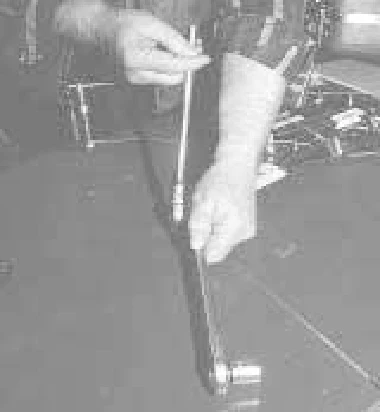
“Response has been tremendous. The demand for a tool like this is unbelievable,” says David Lund, inventor of the new “J-Wrench” which is essentially an extension for ratchets or power drills. It makes it possible to reach into tight spots that wouldn’t be accessible any other way.

It simply fits over the ratchet or drill on one end and you fit a socket or screw drive to the other end. There’s a gear-drive system enclosed inside the wrench that drives it.

Two models are available. One has a socket drive and the other has a 1/4-in. hex-style drive for screw tips.

Sells for about $55 plus S&H. Contact: FARM SHOW Followup, Dakota Tools, Inc., Box 261, Orford, New Hampshire 03777 (ph 888 597-3624; fax 603 353-4836).

From the archive · Full text
Feature story

Heavy-Duty Shop-Built Metal Roller

Featured source:

“Commercial units are real hard to come by and you have to pay through the nose if you ever find one,” says Bruce Barnes about a heavy-duty metal roller he and his employee Chad Burnett built out of components Barnes collected over a period of five or six years. It handles sheet metal up to 8 ft. wide and 1/4-in. thick and will roll any diameter necessary.

The Girard, Ill., welder has used the machine to roll snow plow blades, grain bin hopper bottoms, auger troughs, replacement buckets for backhoes, and barrels.

It features three solid steel rolls weighing 1,000 lbs. apiece. They’re made out of a salvaged industrial size machine bolt cut into three 8-ft. long sections. Originally 6 1/2 in. in dia., the giant threaded bolt sections were turned down flat to exactly 6 in. on Barnes’ lathe, which took a month. The rollers mount together in a triangular configuration, held in place by side panels made out of 2 in. solid plate. Four cross-braces made out of 1/2-in. thick pipe hold the unit together.

A 5 hp electric gear reduction motor drives the bottom roller mounted using a double #80 roller chain and sprocket. A 1 hp electric motor at each side of the machine moves the rear roller up and down to vary the finished diameter of the material being rolled. The two motors are wired to run independently or together.

The machine is fitted on the left side with a cam latch made out of pipe to open the side to remove large dia. pieces.

A control panel, also mounted on the left side, swivels to permit operating the machine from the center or off to the side.

Altogether, the roller weighs 5,200 lbs. and stands about 30 in. tall.

“The trickiest part was getting the rollers wired to run independently or together. It took an electrician quite a while to figure that out,” Barnes says.

“We’ve used it for several jobs since completing it in January and it works beautifully.”

Out-of-pocket expense was $1,500, including $500 in new parts, compared with commercial units that cost $20,000 or more.

Contact: FARM SHOW Followup, Bruce’s Welding, 302 S Third, Girard, Ill. 62640 (ph 217 627-2241).

From the archive · Full text
Feature story

Replacement Parts For Older Tractors

Featured source:

These replacement parts for older tractors are big sellers for Abilene Machine because they sell for a lot less than parts from the factory and meet or exceed original specs.

• Fuel tanks for Deere 4000, 4010 and 4020 tractors. The one-piece 25-gal. tanks are made out of poly so they won’t rust or corrode as metal. They sell for $400.

• Door frames for Deere Soundguard cabs where the bottom has rusted off or the hinges are cracked. Fit 30 and 40 series cabs (prior to 1981). They sell for $275 apiece, without glass and molding.

• Replacement poly fuel tanks for Case 770, 870, 970, 1070, 1090, 1170 and 1175 tractors. They sell for $650.

Abilene Machine also offers replacement rims for loader tractors with heavy-duty 3/ 8-in. press plate centers instead of stamped steel. Available in either 6 or 8 hole bolt pattern in 8 by 15-in. through 10 by 16-in. sizes. They sell for $64 to $85 apiece.

Contact: FARM SHOW Followup, Abilene Machine, P.O. Box 129, Abilene, Kan. 67410 (ph 800 332-0239, 800 255-0337 or 785 655-9455; fax 3838).