Practical ideas from FARM SHOW MagazineSubscribe · Free issue · Send us your shop tip
Subscribe to FARM SHOW
Issues / Vol. 41, No. 1 (2017)

Vol. 41, No. 1 (2017)

Money-Saving Repairs & Maintenance Shortcuts · Printed section pp. 32–35

37 selected entries · Complete text of selected entries

This issue’s section includes reader tips and feature-length shop stories. Held items and editorial notices are not reproduced.

Archive text: prices, coupons, availability and contact details reflect the original publication, not current offers. Reader methods are not universal instructions; follow manufacturer guidance and proper safety practices.

Reader shop tips

From the archive · Full text
Reader shop tip

Samuel C Jones

Samuel C Jones, Valdosta, Ga.

“I connected a trailer light connector plug to my 12-volt chainsaw sharpener. That makes it easy to plug it into the connector on my truck. I place the chainsaw on the tailgate of my truck to sharpen the blade in the field.”

From the archive · Full text
Reader shop tip

Tim Stegman

Tim Stegman, Neche, N. Dak.

“We use a lot of chainsaws in tree service and they have fuel-related stoppages at times. We remedied the issues with Sea Foam and 91 octane with no ethanol. I should be a Sea Foam dealer because I tell everyone about it. It works!”

From the archive · Full text
Reader shop tip

John C. Campbell

John C. Campbell, Marysville, Wash.

“I own a 15-acre vegetable farm and we use a lot of wheelbarrows. Picking a lot of sweet corn, your hands get wet so they slip off the ends. The original handles are very poor – too short and my hands slip off the ends. I replace the handles with new ones made out of 2 by 3’s that are 3 in. longer than the original handles. I also cut a notch out near the end so your hands can’t slip. Also, when pulling the empty wheelbarrow behind you, your heels don’t hit the frame.”

From the archive · Full text
Reader shop tip 1 of 2

Donald Rostad

Individual tip 1 of 2 from this reader’s published contribution.
Donald Rostad, New Philadelphia, Ohio

“I use black pepper to stop radiator leaks. Add pepper when the motor is hot.

From the archive · Full text
Reader shop tip 2 of 2

Donald Rostad

Individual tip 2 of 2 from this reader’s published contribution.
Donald Rostad, New Philadelphia, Ohio

“I never use starting fluid. Instead, I use WD40 because it works just as well and there’s lubricant in it.”

From the archive · Full text
Reader shop tip 1 of 2

Mark Coulter

Individual tip 1 of 2 from this reader’s published contribution.
Mark Coulter, Franklin, Penn.

“I have a hard time throwing away plastic bottles because there are so many uses for them. Empty 2-liter soda bottles can serve two purposes. Cut off the top for a funnel and nail the screw cap to the bottom of a shelf to hold the funnel so it stays clean. The bottom half can be used as a nut and bolt container.

From the archive · Full text
Reader shop tip 2 of 2

Mark Coulter

Individual tip 2 of 2 from this reader’s published contribution.
Mark Coulter, Franklin, Penn.

“An empty dish soap bottle with a pull-up top makes an excellent battery filler. Just invert over the hole, pull the top open, and when the cell is full, push down to shut off the flow. No spills.”

From the archive · Full text
Reader shop tip

Jack Fulton

Jack Fulton, Sioux City, Iowa

“I have a 1974 Chevy pickup that we only use on the farm. The metal gas tank rusted out so I took a 2-gal. plastic tank off a riding mower and mounted it in the engine compartment and ran a rubber line out of the tank with a fuel filter. Works great and I won’t be having any more rust issues.”

From the archive · Full text
Reader shop tip

Charles Matthews

Charles Matthews, Petersburg, Tenn.

“When using small files, like the ones jewelers use, they can have very sharp, pointed tangs. To protect the palm of my hand while using, I screw a wire nut onto the end. I usually keep 2 or 3 of various sizes in my toolbox file drawer so they’re always handy.”

From the archive · Full text
Reader shop tip

Wayne Chamberlain

Wayne Chamberlain, Lowell, Mich.

“If you have an older battery in a seldom used piece of equipment that has no terminal voltage, sometimes you can restore the battery by removing it from the vehicle and tilting it 45° sideways, and then bumping it on the ground. The problem is that material flakes off the battery and piles up between the plates, often causing the plates to be shorted out. When you tilt the battery, it levels off the crud in the battery. Many times it will allow the battery to take a charge and be good for several more years if you keep it charged.

“I have done this successfully with several old batteries over the years. It doesn’t always work but is worth a try.”

From the archive · Full text
Reader shop tip 1 of 3

Luke Heinle

Individual tip 1 of 3 from this reader’s published contribution.
Luke Heinle, Buchanan, N. Dak.

“The throttle position sensor on my pickup was failing, causing the accelerator to cut out occasionally. I removed the unit and applied dielectric grease to the connections. It has been working well ever since.

From the archive · Full text
Reader shop tip 2 of 3

Luke Heinle

Individual tip 2 of 3 from this reader’s published contribution.
Luke Heinle, Buchanan, N. Dak.

“I keep magnetic paper towel holders in multiple locations around my farm and shop so shop towels are always easy to find.

From the archive · Full text
Reader shop tip 3 of 3

Luke Heinle

Individual tip 3 of 3 from this reader’s published contribution.
Luke Heinle, Buchanan, N. Dak.

Another tip: I use oversized hiking clips, called carabiners, to hold commonly used wrenches in tractor cabs or on other equipment.”

From the archive · Full text
Reader shop tip

Mike Laduron

Mike Laduron, Pelican Lake, Wis.

“Rather than crank the battery down on any older gas tractor when it’s 20 below zero or colder, I point a small torpedo-style heater at the carburetor and intake manifold for 5 min. until warm. Works all the time.”

From the archive · Full text
Reader shop tip

Jim Ruen

Jim Ruen, La Crescent, Minn.

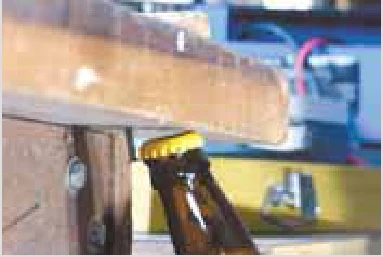
“I’ll never have to search for a church key (bottle opener) again. All I need is a spot to hammer in a small nail.

“I saw the idea in a list of shop tips, and it doesn’t get much easier. I used a 1-in. shingle nail with a large head. However, almost any nail with a full head would work. It doesn’t take much to catch the edge of a bottle cap.

“I put the nail under the edge of my workbench, but I may add some elsewhere, just in case I have a bottle that needs to be opened.”

From the archive · Full text
Reader shop tip

Gary Swensen

Gary Swensen, Yankton, S. Dak.

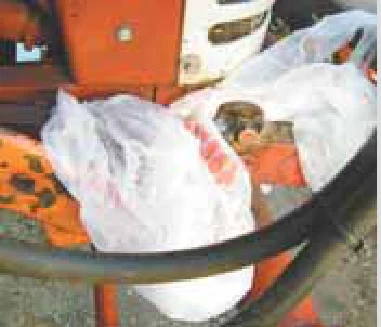
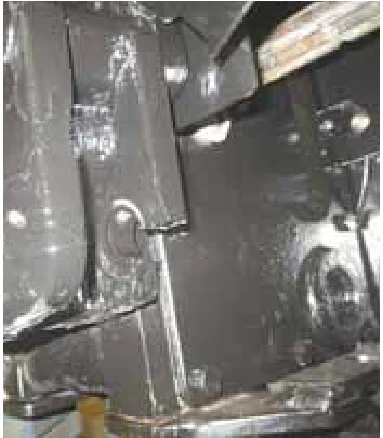
“Whenever I have to do spot painting on equipment, instead of using masking tape I just use old plastic grocery bags. It’s easy to tuck the bags into tight places, and they can be left on indefinitely without leaving any sticky residue like with tape. And after the bags dry out they can be reused. The photo shows how we recently used plastic bags while painting the mounting brackets on our front-end loader.”

From the archive · Full text
Reader shop tip

KLR Inc.

KLR Inc., Lebanon, Tenn. www.speedyflo.com; ph 615 449-8244

Anyone who has ever poured heavy oil into a standard funnel knows that you have to pause periodically to allow air to escape. If you pour too fast, the oil backs up and can splash out of the funnel.

The new Speedy Flow Funnel comes with an air vent located inside the funnel. It allows air to escape so you can pour continuously. Also, the funnel’s long neck fits tight against the engine opening, keeping debris from entering. The funnel is available in 10 and 12-in. dia. sizes that sell for $6.95 and $7.95, respectively.

From the archive · Full text
Reader shop tip

Milford Scharlau

Milford Scharlau, Lyndonville, N.Y.

“Two years ago I bought a Cub Cadet riding mower equipped with a 50-in. deck. Right away I found it hard to push down on the reverse foot pedal. To solve the problem, I drilled a hole through the pedal and fastened a 2-ft. length of thin pipe to it. Now whenever I want to back up I just grab the pipe. I seldom even have to remove my foot from the forward foot pedal.”

From the archive · Full text
Reader shop tip

Alan Linda

Alan Linda, New York Mills, Minn.

“I own a 1997 Chevrolet 1/2-ton pickup equipped with a 305 cu. in. V-8 engine, which was using a lot of oil - about a quart every 600 miles. The photo shows what the no. 7 spark plug looked like every 600 miles or so. I wasn’t driving the pickup much at the time, so replacing the plug that often wasn’t a big problem.

“But last year I started driving the pickup a lot more and replacing the plug became more of a job. One day when the engine was a quart low I decided to dump in an entire quart of Marvel Mystery Oil. I soon noticed the engine started to run better and better. After about 600 miles I removed the plug and it looked clean as a whistle. However, no one could explain why. Not only did the plug quit fouling, but the engine stopped using oil.

“I told my local Chevy dealer what had happened and he asked if the plug I was removing happened to be from the number 7 cylinder. I was flabbergasted, because yes, it was. Then he led me into his shop and showed me the intake manifold gasket for a small block Chevy V-8. He pointed out an imprint in the gasket between the no. 7 and 8 cylinders and said that was where the EGR valve had been mounted, and that it was a weak spot where a lot of small block V-8’s leaked oil. He said built-up oil deposits cause oil to well up over that spot, and then the no. 7 cylinder inhales it.”

From the archive · Full text
Reader shop tip

Gary Oberg

Gary Oberg, Arlington, Wash

“Most forklifts have a hole burned into the end of one or both forks for lifting with a chain. That works okay, but if the lifted item needs to be rotated it can be a problem.

“To allow heavy loads to be rotated, carefully cut apart a chain binder, keeping the ball and socket-hook assembly. Weld one end of a short length of chain onto it and weld a 1/2 grade 5 or grade 8 bolt to the chain’s other end. Then run the top end of the assembly up through the hole in the fork and insert the bolt, which will allow the entire assembly to swivel.”

From the archive · Full text
Reader shop tip

Joe Roberts

Joe Roberts, Malta, Ohio

“Here’s an easy way to avoid accidentally cross threading when installing a new spark plug. I tried this idea when I replaced the plugs on my 1990 Chevrolet S10 4-WD pickup equipped with a 4.3-liter gas engine.

“Start with a 12-in. long gas line hose - the kind with embedded reinforcing string in the rubber to stiffen the hose. Make a cut in one end of the hose the same length as the porcelain on the plug. Then insert the plug into the hose and wrap a rubber band around it. I use the kind of blue rubber band used by grocery stores to secure farm-raised vegetables such as broccoli.

“Insert the plug and hose into the hole and then rotate the hose until the plug is threaded all the way in. If the plug starts to cross thread, the hose will turn but the spark plug won’t so you won’t cause any major damage. Then back off and start over until the plug is threaded properly.”

From the archive · Full text
Reader shop tip

Bayard E. Young

Bayard E. Young, Elkwood, Va.

“After several years of use the coulters and double disc openers on my Tye 3-pt. mounted, 10-ft. no-till grain drill became wobbly due to worn-out sealed bearings, a problem that was caused by a lack of grease. Replacing the bearings was a big job, and I decided that I was only going to do it once.

“So instead of installing new bearings, I decided to drill and tap in new grease zerk fittings. That way I can grease the bearings any time I want. It was a lot of work, because with the disc openers I had to first remove the rivets from the caps. However, now the sealed bearings on this drill will stay greased forever.”

From the archive · Full text
Reader shop tip

David Marihart

David Marihart, Dumont, Minn.

“Recently I needed to read the part numbers on a truck’s carburetor, but the numbers were so small that I couldn’t make them out, even with a magnifying glass and flashlight. So I used a digital camera to take a photo of the carburetor and downloaded it to my computer. By using the zoom feature on the computer, the numbers became as clear as day. Not only did the computer magnify the photo, but somehow it enhances everything which makes the numbers easier to read. I’ve also used this method on tractors and other machines to read serial numbers that are painted over or all scratched up.”

From the archive · Full text
Reader shop tip

Rick Plunkett

Rick Plunkett, Albany, Ky.

“When the air filter on my 2-year-old Toro 5060 zero-turn riding mower got dirty, I replaced it with a much bigger filter designed for a 20-gal. shop vac that I already had. The original filter was only about 4 in. long and a new one would have cost $37, which I thought was ridiculous. A shop vac filter has much more capacity, and costs only about $10. I think the same idea would work on any mower brand or model.

“I cut a piece of Lexan into a large circle to make a base for the filter, and cut a smaller hole in the middle to fit the air intake. To protect the filter I wrapped a section of metal gutter guard around it and secured it with plastic zip strips. I then installed a fine mesh metal screen over the carburetor intake and screwed the filter down on top of it.

“I used the lid off an aluminum cooking pan as a cover for the filter. I removed the handle and ran a long screw up through the filter’s base and out through the pan lid, then put a plastic nut on it.

“I installed the big filter about a year ago and really like how it turned out. Whenever it gets dirty I just use a garden hose to clean it. I kept the original filter in case I ever decide to sell the mower.”

Shop feature stories

From the archive · Full text
Feature story

Heavy-Duty “Buster” Clears Out Clogged Grease Zerks

Featured source: Ron Post

Ohio farmer Ron Post says that on most equipment there’s always a stubborn zerk or two that won’t take grease, especially in the winter, and he’s gotten really tired of dealing with them.

“I had one of those grease busters that you hammer onto a zerk, but that didn’t seem to work well when it was cold, so I built my own tool.” Post attached a grease hose to a 4-ton portable jack. First he replaced one end with a 1/4-in. male hydraulic quick hose connector.

“I hooked up my porta power, then took a 10-ft. long hose and put a female hose connector onto the hydraulic hose. I put it on the zerk and it took oil, so I thought it sure should take grease, too,” he says. Post often uses the device on a manure spreader and a dump wagon with good results during the winter.

“If you’ve got a stubborn zerk, it’s gonna bust it loose or you’re gonna have to replace the zerk. With this tool you have constant pressure on it and something has to give.” Contact: FARM SHOW Followup, Ron Post, 726 Skeels Rd., Celina, Ohio 45822 (ph 419 942-1897).

From the archive · Full text
Feature story

Broken Rear Axle Repair

Featured source: Weaver’s Compact Tractor

Weaver’s Compact Tractor in Shippensburg, Penn., specializes in parts for Ford, New Holland, and Deere compact diesel tractors. The company recently introduced its latest idea - a bolt-on kit to repair a broken rear axle housing on Deere 4000 series tractors. The problem happens when the pin hole for the tractor’s 3-pt. lift arm breaks out of the rear axle housing.

“You just bolt the kit onto the housing using existing holes and go,” says Jim Weaver.

“There’s no need to replace the expensive rear axle housing and have the tractor spend hours of downtime in a shop for repairs. Just install the kit and hook up the existing 3-pt. lift arm and your tractor is ready to go back to work.” The kit is available for Deere 4200, 4300, 4400, 4210, 4310, and 4410 Deere models. It sells for $299 plus S&H. Contact: FARM SHOW Followup, Weaver’s Compact Tractor, 22 Fish Hatchery Rd., Shippensburg, Penn. 17257 (ph 866 950-1050; fax 717 530-9705).

From the archive · Full text
Feature story

Small Adjustment Brings Big Improvement To Deere Combines

Featured source: Randy West

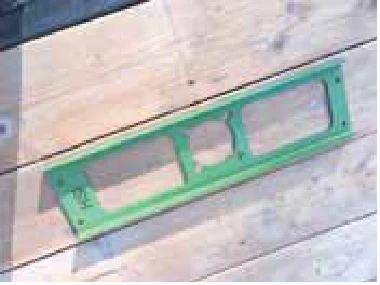
Randy West found that just moving the fan a tiny amount on Deere S Series combines had a huge impact on how well it cleaned grain. After developing a replacement fan bracket for the 8 S series combines he manages, he started selling them through his other business, Harvest Solutions.

“I make improvements to combines out of necessity,” says West, who did custom harvesting for 30 years.

“I found that others had the same problems I was having.” The fan brackets are only the latest in a series of his improvements. They move the fan down and to the rear, reducing the cut-off point from 1 in. to 1/4 in. That’s all that is needed to make the fan more efficient and eliminate dead spots.

“The cleaning fan is the same for the S Series Deere combines as for the 70 Series with its smaller shoe area,” explains West.

“The way it comes from the factory, it is not efficient for the 24 percent larger chaffer and a sieve that is only 15 percent larger on the S Series.” West advises checking the chaffer and sieve for dead spots at the end of the season by looking at wear patterns. Replacing the factory-installed brackets is fairly simple.

“The same belt is used, and fan speed isn’t affected. However, it can be more difficult on the drive side.” He warns that the drive sheave and bearing have to be pulled off. The bearing can be a problem, and he advises simply cutting it off.

“If you use heat, you may ruin it, and it’s not a bad idea to replace the bearing anyway,” says West.

“After you replace the bracket, you pull the bearing off the other side and replace that bracket, too.” The brackets are priced at $145 for a pair. Another of his simple solutions is a $40 clean grain gearbox seal that protects a $2,000 gearbox by covering an exposed seal. For a full list, check out the Harvest Solutions website.

West credits his combine mentors like Ray Stuckle of Idaho, Bill Schwerin and Edie Maughn, and later Dan Hurt and Mike Ellison with Precision Ag Parts, for his decision to make improvements on his own combines.

“I was talking to Mike about problems and options to fix them, and he said, why don’t you figure it out and test it,” says West.

“Don’t just accept what Deere offers us.” West says sharing the solutions with others has been fun.

“I get to talk to people all over the country and have even shipped some parts to Australia.” Contact: FARM SHOW Followup, Harvest Solutions, Inc., 32812 W. Spearman Rd., Hermiston, Ore. 97838 (ph 541 786-2358; [email protected]; www.harvestsolutionsinc.com).

From the archive · Full text
Feature story

He Replaced Wooden Disk Bearings With PVC Pipe

Featured source: Willard Wickey

“My friend had an old 10-ft. disk equipped with wooden bearings that were worn out. He asked me for help but I didn’t have the right tools to make new round wooden bearings, so I used pvc pipe instead,” says Willard Wickey, Hersey, Mich. The disk’s axle housing is built in 5-in. long sections that bolt together around the axle. Wickey unbolted the sections and replaced the wooden bearings inside them with ones that he made from 2 different sizes of electrical conduit pvc pipe. One pipe (white) was 2 in. in dia. and the other (grey) was 3 1/2 in. He used a chop saw to cut the 2-in. pipe lengthwise and then cut the halves into 4-in. long sections that fit together in pairs around the axle. The sections are spaced 1/2 in. apart inside the axle housing, in order to make room for a series of metal ribs built into the axle that held the original bearings in place. He also drilled a hole in each section to make room for a grease zerk. He cut up the 3 1/2-in. dia. pipe to make a layer of shims that are glued together and fill the gap between the 3-in. pipe and the axle housing.

“I made the pvc pipe bearings last fall. My friend uses the disk on his 1-acre property so it doesn’t get a lot of use. But electrical conduit pvc is as hard as wood, and as long as the bearings are kept greased they work as good as new,” says Wickey. Contact: FARM SHOW Followup, Willard Wickey, 913 170th Ave., Hersey, Mich. 49639 (ph 231 832-1123).

From the archive · Full text
Feature story

Motorcycle Lift Adapted For Lawn Mower Work

Featured source: Leonard Downing

Leonard Downing made working on his collection of antique riding lawn mowers easier by widening a motorcycle lift that lifts them up to a comfortable height.

“It’s a lot easier than crawling on my hands and knees,” says the Warren, Ohio, collector who recently turned 80. He got the idea when he saw a 1,000-lb. capacity motorcycle lift at Harbor Freight, and told his family it would be a good Christmas gift, especially when it went on sale for $300. He spent part of last winter modifying it. Downing purchased two 6-ft. long pieces of 8-in. wide cold rolled metal (1/8-in.) for $50 to add to each side of the lift. He attached the sheets to the lift by welding one end of 1-in. square tubing to the metal and running 5/16-in. bolts through the other end of the tubing and the motorcycle lift bed. The 10 bolts can be taken out to remove the side wings and quickly restore it back to a motorcycle lift, Downing says. He used a 4 1/2-in. grinder to cut slots for the tubing to lie flat on the lift platform.

“For the foot pump that raises it up I added key stock to the handle,” Downing adds, because the extended width of the table covered the original handle. He also lengthened the release with a piece of an old Deere lawn mower blade. In the down position, the lift is about 4-in. off the floor. Downing uses ramps to roll his riding mowers on the lift. He sets the brake, and the tubing keeps the mower in place. The lift pumps up about 3 ft. off the ground. A round steel bar, which runs through holes between the lift’s front arm and the frame, acts as a safety to keep the lift up. The clamp on the end of the lift also comes in handy for holding pieces when using a grinder. Topping it with a sheet of plywood also made the lift a handy serving table when Downing celebrated his 80th birthday on Christmas Eve. Contact: FARM SHOW Followup, Leonard Downing, 3056 Palmyra Rd., Warren, Ohio 44481 ([email protected]).

From the archive · Full text
Feature story

55-Gal. Plastic Garbage Barrels

Featured source: Gary Swensen

“Ordinary metal garbage cans rust and can get bent by garbage haulers. Instead, I convert old plastic 55-gal. barrels into garbage cans that are lightweight and won’t rust. I drill holes into the bottom of the barrels so they don’t collect rain water,” says Gary Swensen of Yankton, S. Dak. The barrels originally contained windshield washer fluid. Swenson’s son got them for him.

“I use a reciprocating saw to cut the top of the barrel out, leaving a small lip that serves as a handle,” says Swensen.

“I also add some reflective tape. I put a metal handle at the bottom of the barrel to make it easier for the garbage man to dump. Another advantage is these barrels won’t get bent if they’re banged against the garbage truck like metal ones will.

“A few weeks ago our local garbage collector came by and thanked me for my plastic containers because of the handles and drain holes. They said that without drain holes, an open-topped garbage can really gets heavy after a big rain.” Contact: FARM SHOW Followup, Gary Swensen, 1408 Sunrise Drive, Yankton, S. Dak. 57078 (ph 605 660-3489; [email protected]).

From the archive · Full text
Feature story

Portable “Fuel Station” Made From 55-Gal Barrel

Featured source: Tom Chaney

“I have a small acreage and use older machinery that runs on gas. I wanted a portable, self-contained fuel transfer tank that I could easily load into my pickup. Most of the ones I found on the market are rated only for diesel and they aren’t portable. Also, they cost hundreds of dollars. So I made my own out of a 55-gal. barrel and other materials I already had,” says Tom Chaney, Sr., Chrisman, Ill. The barrel stands on a wooden pallet cut in half and is held in place by a homemade wood cage made from 3/4-in. thick plywood and 2 by 4’s. The base is extended 1 ft. on 2 sides to provide stability. Metal hooks are embedded in each corner of the sleeve, making it easy to lift the entire setup into a pickup bed with an overhead chain hoist. The barrel came with 2 bung holes - a large one that serve as a fill port and a smaller one fitted with a spigot. Chaney mounted a 12-volt fuel pump in the large bung, which is operated by the battery off a garden tractor. The battery is stored in a small box on the side. Chaney now needed a fill and vent cap, so he removed the spigot from the small bung and used a sawzall to widen the hole. He cut a large bung out of another barrel that he already had and welded it into the hole, then installed the vent fill cap from a junked 50-gal. portable fuel tank.

“It works fast,” says Chaney.

“I can quickly lift it into my pickup, then haul it out to the field where I’m working and drive my tractor up to it every time I need to refuel. And if I need to use the pickup for something else I can quickly set the barrel and pump down on the ground. If the barrel ever rusts up I can always replace it.

“I came up with the idea because I operate a sideline business making hay for area farmers. I got tired of carrying 5-gal. gas cans, and it wasn’t always safe to carry one on a tractor or combine. I needed something to speed my operation up, without tieing up my pickup. My dad and grandpa always said to use whatever you have on hand and make it work if you can. Then if you can’t make it work but still really need it, go buy it.” Chaney says he came up with the wood cage idea because the barrel is top heavy and would have been hard to strap down on its own.

“It makes the barrel more stable and provides a safe, convenient way to haul the barrel in my pickup. It also provides anchor points for tie-down straps in the pickup bed,” says Chaney. He says he already had almost everything he used to build the unit.

“A friend gave me the fuel pump a few years ago because it didn’t work, and I fixed it up. I added a fuel filter onto it in order to catch any debris.” Contact: FARM SHOW Followup, Tom Chaney, Sr., 14732 E. 1800th Rd., Chrisman, Ill. 61924 ([email protected]).

From the archive · Full text
Feature story

Automatic Greaser For Snapper Riding Mower

Featured source: Arlon Glander

Arlon Glander likes his 2002 Snapper 18 hp. lawn tractor equipped with a 48-in. mower deck. However, he didn’t like the poor access to the zerk fittings for the blade bearing housing. So he made his own deck-mounted automatic greasing system.

“One of the zerk fittings was out in the open where it was easy to reach. But to reach the other two zerks I had to remove a metal housing, which required removing 4 bolts on each housing. So I decided to build a manifold block that distributes grease through individual lines to each grease point.” The manifold block is made out of 1-in. sq. aluminum. Glander drilled 3 holes in it, then tapped the holes on both sides with 1/8 NPT tapered threads. He bought some poly tubing and pushlok fittings, and ran the tubing from the block to the original zerk taps inside the bearing housings.

“It’s really handy to use,” says Glander.

“I just give each bearing three pumps of grease every time before I go out to cut our lawn. I made my automatic greaser 14 years ago and haven’t had a single bearing failure since.” Contact: FARM SHOW Followup, Arlon Glander, 28664 Northfield Blvd., Randolph, Minn. 55065 (ph 952 250-7494; arlondiesel@northfieldwifi .com).

From the archive · Full text
Feature story

Rubber Track Expert Sells Parts For All Makes, Models

Featured source: Daniel Troyer

If you’ve got a rubber tracked tractor, dozer or other equipment, DJ’s General Repair is likely to have whatever parts you need. Owner Daniel Troyer claims he carries track and undercarriage parts for more than 4,000 rubber tracked machines.

“If I don’t have the parts in stock, I have easy access to them,” says Troyer.

“Call in your order before 3 p.m., and it will be shipped that day. Ninety percent of orders arrive within 2 to 3 days. Most are at the customer within 2 days.” Troyer advises customers to have the make, model and year of the equipment that needs the part. If they don’t know where to look for the serial number, he can often help over the phone.

Troyer is proud of his ability to find parts when others fail. That holds true even for “gray area” equipment that technically shouldn’t be in the U.S. If parts numbers can’t be matched up, Troyer has suggested customers send the part that needs to be replaced, and he will try to match it.

“Gray area machines are the most difficult to find parts for,” he says.

“I’ve found rollers that weren’t exactly like the original, but they could be made to work. You may need to go to a machine shop to get some parts modified.” All parts are sold under warranty (except for the ones that need machine shop work). He notes that warranties vary from one company to another, as does reliability.

“The previous owner started out selling a lot of different brands, but he ended up with so much warranty work that he weeded out suppliers that didn’t hold up,” says Troyer.

“I’ve stayed with the best ones, including CAT, ASV, Camoplast and Warrior Tracks.” Warrior Tracks is a major supplier for him. They offer a 13-month or 1,100-hr. warranty, and they back it up, he says.

“I can’t tell you how many of their tracks I’ve sold, but I’ve only had a problem with one set,” says Troyer.

“It was a year old when one side broke, and after seeing an emailed photo, they replaced it.” Contact: FARM SHOW Followup, DJ’s General Repair, 2407 Pearson’s Corner Rd., Dover, Delaware 19904 (ph 302 423-5690).

From the archive · Full text
Feature story

Old Generators Made Like New Again

Featured source: Ken Warner

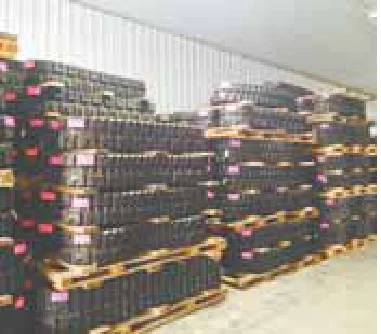
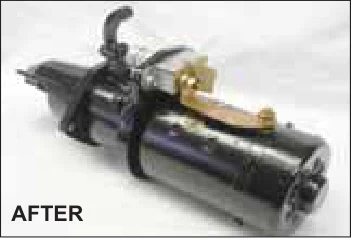
When Ken Warner restores an old generator, it is effectively like new. He doesn’t simply replace brushes. He tears the generators apart, strips them down to bare metal, and replaces every nut, bolt and screw. If the parts were originally plated, he will replate. His reputation for total restoration has produced some interesting challenges.

“I don’t do a lot of motorcycles, but I once redid a 1919 or 1920 Harley,” says Warner.

“Nobody else could figure out how to restore it. The oldest car I’ve done was a 1922 Essex.” In several decades of working with antiques, he has made accuracy a key feature of the business. He may even suggest replacing a generator rather than restoring it. This is especially the case if the customer is restoring a vehicle to showroom status.

“I’ll often get a request to restore a generator for a tractor and discover it isn’t the original make or model generator the tractor had when it left the factory,” says Warner.

“A starter is married to the motor, but early generators often got changed out by farmers. I’ve seen Cadillac generators on tractors. What’s on it now doesn’t mean much with a 70-year old tractor.” The tendency to swap out units is why Warner suggests sending in a picture of the generator when requesting a restoration. Include the make, model and year if possible, and he will verify if it was original. When a difference occurs, Warner gives the customer a choice. He’ll restore what is there or get the right one for the tractor. Even if the generator is the right one, there can be a question over color. Warner explains that up until the introduction of the 520 or 530, Deere generators were painted green.

“Many people assume that all Delco generators on Deere tractors were Delco’s classic semi-gloss black paint,” says Warner.

“Green was usually the original color. If a generator was added to a B John Deere after purchase, or if it was later replaced, it may have been black.” That said, if the customer wants his B generator painted black, Warner is happy to oblige, saying, “Ultimately, it is up to the customer.” When it comes to old cores, Warner is a likely customer.

“I’m always in the market for old cores,” he says.

“A lot of John Deere and Oliver generators are hard to come by. A John Deere H starter is like finding gold.” Contact: FARM SHOW Followup, Classic Generator, 4316 Dollar St., Midlothian, Texas 76065 (ph 817 473-1448; www.classicgenerator.com).

From the archive · Full text
Feature story

Container Fitted With 8 Gpm Pump Transfers Fluid Fast

Featured source: FLO-FAST

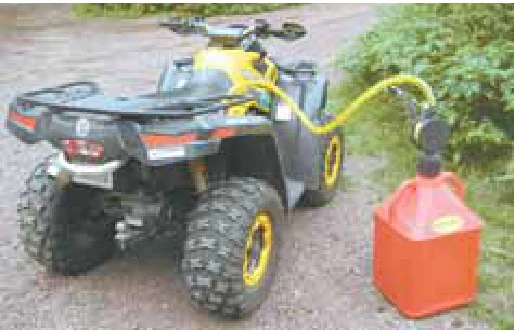
Whether you need to fill a tank with chemicals or fuel up a tractor or ATV, FLO-FAST “fluid transfer containers” get the job done fast thanks to the 8 gpm pump that fits on top. Mike Franks, owner of the Eden Prairie, Minn., company, says the pump is operated with a simple hand crank. It can be reversed for extraction, which is useful for multiple applications including fuel, chemicals and diesel exhaust fluid. The cap on the pump system fits on all standard containers as well as FLO-FAST’s own containers, which come in 2 sizes - 7 1/2 and 10 1/2-gal. The rotationally molded containers are 3 to 4 times thicker than traditional containers and are suitable for fuel, lubricants, oils, chemicals, anti-freeze, bio-diesel, etc. They have built-in air valves to release pressure and vent the container, and come in various colors for fuels and HAZMAT liquids. FLO-FAST also offers carts to wheel the containers and pumps to boat ramps, across farm yards and off-road areas. Though the containers are too small to fuel large tractors, they’re ideal for filling diesel exhaust fluid, small tractors and chemical tanks, Franks notes.

“If people need more capacity they can buy multiple cans. The pump transfers from can to can very quickly,” he says, adding that customers appreciate the portability of the system. FLO-FAST offers a variety of sizes and packages including basic 5-gpm pumps and pumps that can be attached to 55-gal. barrels and/or containers. Prices run from $209 for a barrel pump to $269 for a pump and 10 1/2-gal. container to $569 for a complete system with a cart. FLO-FAST products are available in some farm supply chain stores and through about 70 dealers. Franks welcomes inquiries from interested dealers for all applications, from ag to marine to commercial. Contact: FARM SHOW Followup, FLO-FAST, 7887 Fuller Rd., Suite 116, Eden Prairie, Minn. 55344 (ph 952 934-4505; www.flofast.com; [email protected]).