From the archive · Full text
Reader shop tip
David Obrecht
To protect the electric motor on his bin auger from the weather, David cut a 55-gal. drum in half and mounted it over the top of the motor.
Money-Saving Repairs & Maintenance Shortcuts · Printed section pp. 36–39
34 selected entries · Complete text of selected entries
This issue’s section includes reader tips and feature-length shop stories. Held items and editorial notices are not reproduced.
To protect the electric motor on his bin auger from the weather, David cut a 55-gal. drum in half and mounted it over the top of the motor.
“This happened a number of years ago. Saved me a lot of aggravation.
“The rear bearing on my New Holland side-slinger barrel-type manure spreader would go out repeatedly, lasting only 6 mos. to a year, even with new seals. I finally replaced it with a 2 by 8-in. block of oak with a hole bored through it and an oil hole at the top. I used the old bearing housing to reinforce it. I thought this fix would maybe last a few months but it held up for 6 years, spreading manure from 150 head of dairy cattle. When it finally wore out, I rotated it 180° and used it for another 3 years.”
“I like your publication “More Great Shop Ideas”, and noticed on page 45 that a reader had problems with the inside part of the tires on his gravity wagon wearing out faster than the rest of the tires.
“I think the problem could be due to 3 things: the center part of the axle was bent downward; the spindle wasn’t square with the axle; or the toe was wrong with the tires.
“The camber, or tilt of the wheel, must be way out of line so the tires aren’t running straight down the road. Replacing the tires won’t solve that problem. Maybe the wagon was overloaded. I think the bushings in the kingpin may be worn, due to a lack of lubrication. If he corrects any of these problems he won’t wear out his tires.”
Abilene Machine recently began offering remanufactured transmissions for Deere 6000, 7000 and 8000 series tractors. The transmissions come with a standard one-year warranty. A company spokesman says Deere rebuilds some of the same transmissions but not all of them, and that Abilene offers substantial cost savings. The company says the components used to rebuild the transmissions surpass industry standards.
“When rebuilding a transmission I needed a special compressor but it was way out of my price range. So I looked at a photo and built my own.
“To avoid spending money on sandblasting sand, go to your local river and bring a bucket or two of river sand home. Dry the sand out and filter it through a screen. Works great. There’s a little work involved, but the sand is free.”
Their Deere 318D skid loader has a small toolbox located under the seat in the cab. However, the toolbox is too small and hard to reach. So Dan decided to attach a toolbox to the upper part of both loader arms.
“It puts my tools outside the skid loader where they’re easier to reach,” says Dan. He bought two 15-in. toolboxes, as well as a 1/4-in. thick rubber mat, 2 snap pins, and four 1/4 by 3/8-in. hard steel bolts. He welded 2 bolts to the upper part of each arm, using the toolbox to measure where they should go. He cut two 3 by 4-in. rubber mats for each arm and bolted them on.
“The mat makes a good surface to set the toolboxes on,” says Dan. He measured and drilled 1/4-in. holes in the toolboxes to match the bolts, then set the toolboxes over the bolts and onto the mats.
Next, he cut two 6 by 15-in. mats and set one mat inside each toolbox. The mats keep the tools from sliding around. He also attached a snap pin to each toolbox latch to keep the toolboxes from accidentally opening up while operating the skid loader.
“I had lots of smaller items and parts to put on shelves in my shop but not enough storage space. I hit on a simple solution that cost very little and works as well or better than anything I could have bought.
“I stacked old plastic milk baskets, which measure 12 in. sq., on their sides against one wall right up to the ceiling. I zip-tied them all together and screwed the whole bunch to the wall. Works great.”
“My trailing lawn vac cart had a tendency to turn over when on sidehills. To fix the problem, I designed a hitch system that supports the motor and fastens to the vac with two 1/2-in. bolts and a 3/4-in. dia. hitch pin. The hitch pivots up and down and twists back and forth. All the metal came from an old hay rake, including the curved brace that connects with the hitch pin.”
“If you ever lose the gas cap for a small metal gas tank, you can often use the cap from glue containers for pvc pipe. Just remove the glue dauber and drill a small hole in the middle of the cap for a vent so you won’t collapse the tank. Put a baffle under the cap to prevent gas from spilling out of the vent.”
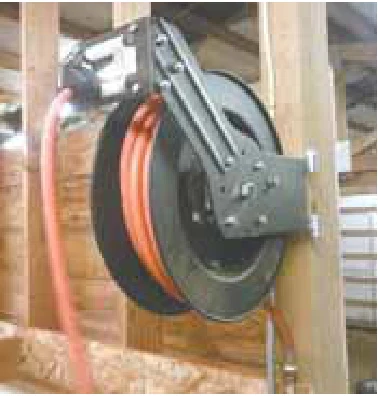
“I used 1/2-in. gate pins and hinges to mount a 50-ft. by 3/8-in. retractable air hose reel on a post in my shop. I can grab the hose and walk in any direction, and the reel will swivel 180 degrees. I mounted the reel in a central location so the hose will easily reach all areas of my shop.”
“I read an article in FARM SHOW about Shane Myrick of Pleasonton, Kan., who uses an old refrigerator to store all his welding rods (Vol. 36, No. 3). I keep 5 old refrigerators in my back shed and use one to store welding rods, one for paint, two for canned tomatoes, and one for canned asparagus, new potatoes and fruit jelly.
“I installed a night light inside each refrigerator, and run short extension cords from a power strip to all the refrigerators to provide a little extra heat. The power strip is hooked up to a thermostat so the night lights come on at 35 degrees. Last winter none of the contents froze inside any of the refrigerators, even in temperatures down to 14 degrees below zero.”
Husky’s battery-operated 55-gal. drum gauge is designed to monitor the liquid level in standard 55-gal. drums. The plastic unit fits into the barrel’s 3/4-in. vent opening. It can be used to measure oil, transmission fluid, anti-freeze and other non-explosive liquids. The unit is in sleep mode until activated when you touch either side of the device. An LED illuminates for 20 seconds to display the current liquid level inside the drum, from 5 to 90 percent. An alarm goes off when the fluid level drops below 5 percent of capacity, while 3 LED’s and an additional light at the top of the console illuminate to remind you that action is required.
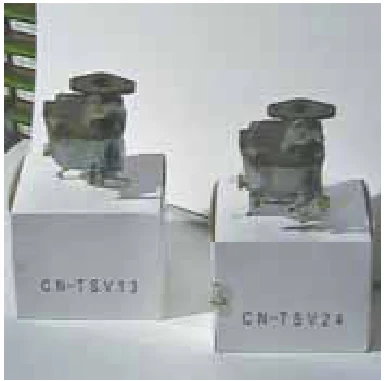
“In your last issue a reader complained about loose steering on his Chevy Tahoe. I used to be a GM tech and I’ve fixed lots of steering problems on earlier GM trucks. The problem often is in the EVO (electronic variable orifice) system that uses a solenoid valve (located on the power steering pump) to provide maximum assist at low speeds, such as parking, and gradually lessens the assist as speed rises to give the driver road feel. The culprit is the sensor at the base of the steering column that gets corrupted and sends a bogus signal to the solenoid. You’ll notice it most on a long curve where there is moderate pressure on the steering wheel and suddenly it ‘lets go’. It can be very disconcerting for the driver who suddenly finds himself swerving across the yellow line. It almost always happens in one direction or the other. Replacing the sensor (which is nothing more than a position sensor) fixes the problem and makes for worry-free steering. The steering column does not need to be removed from the vehicle to replace it.”
“To remove Deere axle wedges, it works really well to tighten the two pusher bolts as tight as possible with a 3/4-in. drive breakover bar and a 4-ft. piece of pipe. Then have one person put continuous pressure on one of the 2 bolts while the other one smacks the end of the axle with a 5 or 10-lb. sledgehammer. Amazingly, they usually break loose. Our dealer’s shop foreman told me about this trick.”
“My 2001 F-250 Ford pickup with a 5.4 engine, has 144,000 miles and still has the original U-joints, starter and battery. Once a month I lube the U-joints with a motorcycle chain lube, working it into the joint with a small paint brush.
Every other summer I unbolt the starter, and use motorcycle chain lube to lubricate the bushing and starter gear.”
“I’m a real estate agent so I’ve seen a lot of clever and not-so-clever ideas in the homes I sell. I liked this one. The top rail of a chain link fence is a piece of galvanized pipe that’s plumbed into a water line at the house and 3 water spigots spaced every 20 ft. around the yard for watering plants and grass. That way you don’t have to drag a hose all over the yard.”
“I save money by mixing Rustoleum thinning oil with non-Rustoleum oil-base paint to make rust-covering paint on the cheap.
“
“The plastic fingers on combine reels bend back and break when you hit something hard. There’s a plastic knob on the back end of each finger that fits into a hole for mounting. When a finger gets sheared off, I drill a small hole near where the knob was and insert a metal screw to hold the finger in place. Works just as good as a new finger and saves $3 apiece.”
“I’ve seen lots of methods for getting 4020 Deere wheel centers loose from axles. If you can plan ahead, I’ve found that ‘time’ is the best way to do it. Just squirt used oil in the cracks between the wedges, take the cork out opposite the pinion gear pin, and put lots of oil in there. Let it go weeks or even months if you can. Then it’ll all come loose.
“If you’re in a hurry, loosen all big bolts and turn the ‘jam bolts’ up. Strike the end of the axle as hard as you can with a 12-lb. sledge. I’ve never seen it take more than 6 licks to break the center loose.”
“The clutch froze recently on my Deere 4010 tractor. When I stepped on the clutch the transmission would grind. The clutch plate was stuck to the splined shaft and I could not free it.
“I tried pulling the tractor while it was in gear to break the plate free but it didn’t work. I then sprayed Penetrol 90 (a Schaeffers oil product) all around the splined shaft and surrounding areas. Over the next 24 hrs. I sprayed almost 3/4 of a can through the bottom cover that you take off to grease the throw-out bearing. It’s important when doing this to have the clutch pedal pushed in. I wedged a block of wood against the pedal to hold it down.
“Anyway, the next day I put the tractor in 3 gear and drove it out of the shop, jerking on the brakes while the clutch pedal was pushed in. It came free.
“My Deere service man said it happens sometimes to tractors that are stored for a while. He said most times the tractor has to be split to fix the problem, which can be a $5,000 repair. My total cost was a $7 can of penetrating fluid.
“A mechanic friend told me that when you store a tractor for a long time you should have the pedal pushed in. So I’m going to make up some wood blocks and use them on my 4010, 4020 and 4440 for winter storage.”
“I pull my 2007 Agri-Fab 2-wheeled, hard top Mow-N-Vac lawn vacuum behind my riding mower. It does a beautiful job and really cleans up my yard nice (ph 800 448-9282; www.agri-fab.com). My yard looks like a golf course when I’m done. The only problem was that if I turned too short around trees, one of the wheels would catch on the tree causing the box to tip over. I solved the problem by bolting 3-ft. long, aluminum ‘handicap bars’ diagonally onto both sides of the box. Now if the box hits a tree it just slides by it.
“The vacuum is powered by an 8 hp engine and it always starts right up, even when using old gas. I’ve never had an easier starting engine.”
“The front axle broke down on my Massey Ferguson 205-4 MFWD tractor and I couldn’t find the parts to repair it. Instead, I made a mounting system to attach a 1975 Ford 1/2-ton 4-WD axle to the tractor. I had to turn the axle upside down to use on front of the tractor. I fitted the axle with a 9-in. drive pulley that’s belt-driven by a small pulley on the driveshaft. It worked out very well.”
“I made this 2-wheeled cart out of scrap metal for my Honda generator,” says Kerry Kligora, Mineral Point, Wis.
“The only things I purchased were the tires, which cost $14 at Harbor Freight.
“Most carts for this type of generator cost $150 to $200 online, and many require drilling into the generator’s frame and limit access to the motor for maintenance. My design allows access to all panels and, to remove the generator, I just undo a ratchet strap. The design also allows me to set the cart directly on the ground, eliminating the need for posts that tend to sink into soft ground.”
The cart rides on 10-in. pneumatic tires that allow the cart to roll easily on uneven ground. The handle can be adjusted to different angles with a simple pin, allowing for people of different heights and also allowing different weight load distribution while moving it.
“The position of the handle shown in the photo is best for moving the cart while it’s running, as it keeps the oil level correct in the generator’s motor,” notes Kligora. Contact: FARM SHOW Followup, Kerry Kligora, 2138 Co. Rd. E., Mineral Point, Wis. 53565 (ph 608 553-2062; Kerry. [email protected]).
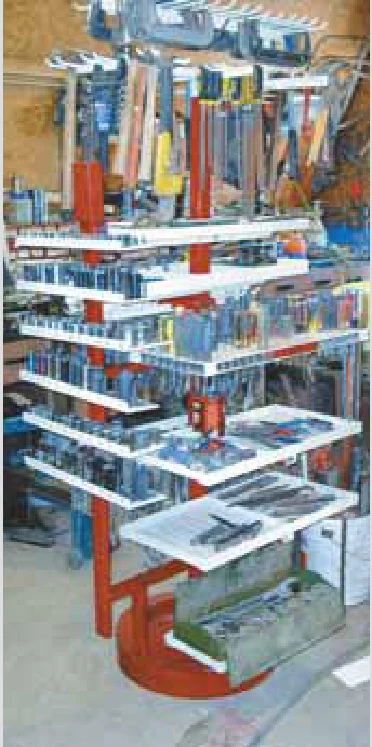
There’s no digging through cabinet drawers or toolboxes when Brian Haubrich needs a 3/4-in. wrench or socket. Every tool he needs is out in plain sight.
“I got tired of looking for tools in cabinets, on hooks or on my workbench,” says Haubrich.
“I built a tool tree with long hooks and shelves to hold practically every tool I have. The best part is I can reach most of my tools without moving far from my vise.” The list of what the tree holds includes hundreds of sockets, and dozens each of wrenches, punches, chisels, cutters, calipers, pliers, screwdrivers and more. There is even room for a welding helmet as well as hacksaws, hammers and clamps. Amazingly, the entire tree takes up only a few square feet of shop space. Yet each item has its own spot with duplicate wrenches lined up on the same hook.
“I can hang a dozen 3/4-in. combination wrenches on a single rod,” says Haubrich.
“I keep lots of duplicates around. Even so, when you outfit a couple of air seeders or combines in season, the rack gets emptied out pretty quickly.” Haubrich used a baler flywheel for the base. He welded 1 5/8-in. pipe stubs in opposing holes of the flywheel. The actual rack, which is made from 2 by 2-in. square, 1/4-in. thick steel tubing, slips over the pipe. Shelving is fabricated from 1/4-in. flat steel and hooks are 1/4-in. steel rod. Heavier wrenches are hung on 5/16-in. rod. Each socket sits on an upright peg on the shelf so they won’t get knocked out of position.
“Each hook is marked for the size wrench that’s on it,” says Haubrich.
“Shelves for sockets have the socket size marked as well. It makes it easy for my son or our hired men to grab the tools they need for the machine they are running.” Haubrich likes his shop tool rack so much that he made smaller versions for each piece of farm equipment. Racks with needed wrenches, sockets and other tools hang on the doors in the cabs or stand upright so they’re easy to see and grab as needed.
“We all love these racks,” says Haubrich.
“When you get back in the cab, you see the tool rack and can immediately tell if any tools are missing. When you get back to the shop to put away the machine, it’s easy to hang the tools back on the tree.” While it may be easy, Haubrich admits that it doesn’t always happen, and the in-cab tool racks don’t prevent tools from getting lost.
“I watch for sales at the stores and will pick up a couple sets,” he says.
“We always need more tools.” Contact: FARM SHOW Followup, Brian Haubrich, Box 21, Glenbain, Sask., Canada S0N 0X0 (ph 306 264-3809).
The truck Steve Bellaw bought used had a bad automatic transmission that needed to be rebuilt. To rebuild it, he needed a clutch spring compressor.
“It’s used to keep things from flying apart,” says Bellaw.
“The auto parts store wanted $200 for the tool, but I couldn’t justify the money.” After looking closely at the commercial version, Bellaw decided to try making it. He describes it as looking a bit like a backwards gear puller, pushing instead of pulling. It presses on the retaining washer in the clutch drum to compress the clutch piston return springs. This allows him to remove and later re-install the snap ring.
“I used 3/8-in. steel that was 3/4 in. wide for all the pieces,” says Bellaw.
“I drilled out a hole in a 4 1/2-in. long piece to make a T-handle for the carriage bolt that does the pushing. I welded the bolt in place.” He cut 2 slots in a 6-in. long piece of the steel and threaded a hole in the center for the carriage bolt. The spring retaining arms are 3 in. long with holes drilled and threaded in one end of each for bolts. Once properly spaced to match the size of the spring, wing nuts secure them in place. For a “pusher” plate, Bellaw machined a circle of 3/8-in. steel and threaded it for the carriage bolt. He installed a lock nut at the end of the bolt.
“It took a little lathe work and some machining, but it works great,” says Bellaw.
“I’ve used it for other applications and loaned it out to friends. Bottom line is don’t let them tell you that you need a special tool or part. You can always come up with something.” Contact: FARM SHOW Followup, Steve Bellaw, 408 Valley View Dr., Piketon, Ohio 45661 (ph 740 443-5030; [email protected]).
You can sandblast an old tractor, pickup or car without making a mess using a “Bad Dust®” containment bag that completely encloses the workspace inside a bag.
“It’s a very mobile unit can be set up outdoors or inside buildings,” says Roxanne Winslow, owner of the company. Instead of framework, the bags hold their shape with a low-pressure positive airflow - just a 1/3 hp blower is enough to maintain a 10 by 25-ft. automotive bag, for example. Exterior loops accommodate ground anchors or ceiling suspension to keep bags securely in place.
“The product has been in use and gone through research and development for over 15 years. It’s very professionally made in the U.S. by a company that manufactures for the military,” Winslow says. Made of durable ballistic nylon fabric, Positive Containment Systems, LLC, can customize the bags to whatever dimensions are needed to fit a job, and zippers make the units modular to add on sections if more work space is needed at a later date.
“For one customer in the marine industry, we made two separate 65-ft. long bags that were able to zip together to make a 130-ft. long bag for a much larger project,” Winslow says. Bags are easy to store in a stuff sack to be reused over and over. Clients appreciate that they can order a bag customized for their project and that zippers and buckles are interchangeable for future expansion, Winslow notes. Prices vary according to size. For example, a 10 by 10 by 25-ft. automotive bag sells for $3,500. Winslow points out that in addition to being convenient, the bags help customers meet regulations for controlling air-borne pollutants from various media blasting and other restoration activities. She adds that while painting can be done in them, they are not designed to be spray paint booths and the fabric shouldn’t be coated with paint. Bags and curtains of all sizes can be purchased through the Positive Containment System website. Contact: FARM SHOW Followup, Positive Containment Systems, LLC, 338 Westchester Rd., Colchester, Conn. 06415 (ph 860 267-1733 ; [email protected]; www.baddust.com).
Treadwell Carburetor Co. in New York has a long history of rebuilding car, truck, industrial engine and farm tractor carburetors.
“My father started this business in 1957,” says shop owner Jim Leitenberger, who figures he’s worked on several thousand carburetors in the past 50 years.
“We still work on many of the same carburetors we worked on 30, 40 or 50 years ago,” John says, “but now many of them are from older equipment that’s being restored, so they’re difficult to dismantle because of seized parts.” A large portion of Treadwell’s business is rebuilding older farm tractor carburetors, including those for Deere, Farmall, International, Ford, Ferguson, Minneapolis Moline, Massey Harris, Allis, Cletrac, BF Avery and Oliver. Leitenberger says they’ve dealt with all types of carburetor problems, ranging from worn out parts to carburetors that have sat for years on old equipment and are rusted tight.
“We dismantle every carburetor that comes into the shop, clean all the parts and see what needs to be replaced,” says Leitenberger. Gaskets and O-rings are often cracked and defective, causing fuel and air leaks and poor engine performance. Treadwell will replace parts with new ones and they’re also able to machine worn and warped castings back within tolerance.
“We do whatever it takes for a good and lasting job,” Leitenberger says. For quality assurance, Treadwell runs every carb that it rebuilds on a test engine before it’s shipped back to the customer. Rebuilt units are checked for idle, acceleration, flooding and leaks.
“Quality is more important to us than anything,” Leitenberger says.
“We want our customers happy with our work.” Contact: FARM SHOW Followup, Treadwell Carburetor Co., 4870 County Hwy. 14, Treadwell, New York 13846 (ph 607 829-8321; www.carbsandkits.com).
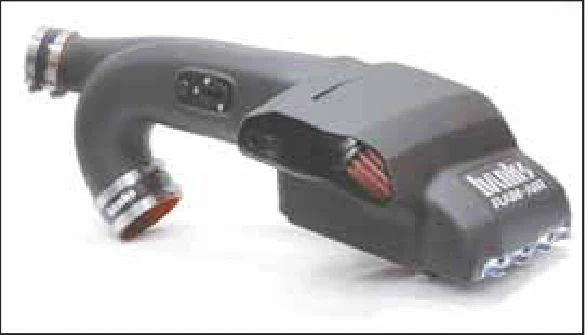
The Ram-Air intake system from Banks Power promises to boost mileage and power, thanks to the filtered, denser and cooler air it feeds into the engine. The high-performance system has been available for gas and diesel-fueled truck and motor home engines for more than 30 years. It’s now available for the Ford F-150, 3.5L EcoBoost engine. The large filter housing and the large filter itself are designed to be less restricting to airflow. The housing replaces the OEM air filter housing to pull in cool outside air. Gale Banks, Banks Power, notes that most competitive, replacement air intake systems draw air from directly above the engine.
“We’ve tested our competitors’ systems in hot engine compartments surrounded by a reservoir of blistering air, and the men were separated from the boys,” says Banks.
“In terms of temperature reductions, 7 out of 9 aftermarket intakes we tested actually performed worse than stock.” The Ram-Air pulls in cooler outside air. Cool air is denser with more oxygen for a better burn, better fuel economy and better performance. A flexible bellows between the air intake and the engine accommodates engine movement.
The dome-shaped filter not only facilitates that flow, it also never has to be replaced. The cotton gauze lets air flow through more easily than stock paper filters do. The design eliminates sharp bends and choke points. It’s easy to install and easy to maintain. The filter should be serviced every 30,000 to 50,000 street miles or more often in heavy dust conditions. An air filter restriction gauge is available for even more accurate maintenance. A special Banks Ram Air Filter cleaning system must be used for cleaning and to re-oil. Standard detergents, solvents or high-pressure water can damage the filter.
“Cleaning the filter is easy,” says Gil Cormaci, Banks Power.
“Simply spray the cleaner on, let it soak in, and spray it off with water. Re-oil, let it sit a while and then reinstall.” The Ford EcoBoost model is available direct from Banks for $348.30, as well as from auto parts suppliers. The service kit, including cleaner and oil for re-oiling, retails for $17.50. Contact: FARM SHOW Followup, Banks Power, 546 Duggan Ave., Azusa, Calif. 91702 (ph 800 601-8072; www.bankspower.com).
I got a call recently from regular contributor Roger Gutschmidt in Gackle, N. Dak. It’s always fun to hear from him because he’s usually up to something interesting. This time he told me he was planning to move a 5-in. thick concrete slab that measures 25 by 6 ft. in size that served as an apron outside one of his farm buildings that he planned to enlarge. The plan was to tow it to a new location with one of his tractors.
“Rather than having to break it up and haul it away, I figured I didn’t have anything to lose by trying to move it to a new location alongside another shed,” Roger told me. A couple weeks later I heard back from Roger with a detailed report.
“I made a hole in the slab by drilling several 3/8-in. dia. holes in a circle and then knocking out the center with an air chisel. In order to slip a heavy log chain through the hole, I tunneled under the slab with a long air nozzle to blast out dirt.
“I hooked up to my 7530 Deere MFWD 150 hp tractor and pulled the slab away from the wall. It was going pretty good until I headed uphill over some uneven ground and the slab broke into two big pieces. I pulled them one at a time to the new location and set them in place. I filled the big crack between them with concrete. It works great to hold chemical totes and other stuff.” Contact: FARM SHOW Followup, Roger Gutschmidt, Gutschmidt Mfg., LLC, 6651 Hwy. 56, Gackle, N. Dak. 58442 (ph 701 698-2310; [email protected]).
“My 1971 Deere 4020 with its original engine was losing power and using oil, so instead of overhauling it, I replaced the engine with one from a 6620 Deere combine,” says semi-retired Iowa farmer Arlis White.
“The engine from the 6620 turns 115 hp on the dyno. It sounds great and has a lot more torque than the original engine.” White says he looked into overhauling the original tractor engine, but the cost was fairly steep. He was able to acquire the used 6620 engine at a price that was considerably less. He replaced the engine himself with help from his sons over a 2-week period.
“It wasn’t very difficult to make the switch at all,” Arlis says.
“We disconnected the radiator, the fuel line, removed the starter and just started taking bolts loose, supporting the frame before removing the engine. The new engine slid right in place and we connected everything back up and it started right up.” White says he’s put close to 1,000 hrs. on the 6620 engine in summer and winter work over the past 3 years. In the summer he uses it for haying and some occasional field work, but during the winter the tractor has a loader, a bucket and snowblower.
“It starts just fine in all kinds of weather, runs well and just sounds better than the original tractor engine. It’s fuel efficient and doesn’t use a drop of oil,” Arlis says.
“I’d recommend this engine for anyone wanting to repower a 4020.” White says he enjoys keeping older equipment running well and working around his farm. He has completely restored a Deere 60 tractor that he still uses regularly. Contact: FARM SHOW Followup, Arlis White, 18214 Dalmation Ave., St. Olaf, Iowa 52072 (ph 563 783-2463).
Don’t burn or throw out dirty oil when you can clean it and use it to safely run diesel motors. You can clean a gallon of old oil at a time or clean old oil continuously 24/7 with centrifuges from US Filtermaxx.
“We’ve powered our shops for 18 months straight burning used oil in our diesel generator,” says Steve Chastain, US Filtermaxx.
“We have 4,000 hrs. run time without a problem.” Chastain first got involved with waste oil about 10 years ago when his house was without power for a week.
“To save money we started blending used motor oil with diesel, but realized it needed to be clean.” The answer was a centrifuge. He tried different commercial products before deciding to build his own.
“I feel we have them perfected now with a very high gravity force and cleaning to submicron particles,” says Chastain.
“We build them like a tank, heavy and nearly indestructible. The motors are designed to run at only 1,800 rpm’s for longer life.” His centrifuge can clean from 10 to 40 gal. per hour, depending on the weight of the fluid and how dirty it is. It can be filled a batch at a time with a stop to clean the sludge out every hour and a half. Set one up with pumps, preheaters and automation, and it will clean oil continuously and dump the sludge by itself. While the basic centrifuge bowl is the same in all the standard models, with a capacity of slightly less than a gallon, the drive units vary. The speeds and resulting G-force changes from one model to another. The company offers 2,400G, 3,000G and variable speed 6,000G models. Chastian is offering the 3,000G centrifuge with a 1 1/2 hp motor for $1,500. Prices go up with the complexity and G rating of the system. A 6,000G with variable speed programmable controller and in-line oil heater is priced at $3,339. Options include pumps, heaters and more. Automatic controllers allow the units to cycle and drain sludge, cleaning up to 1,000 gal. per day.
“We will be introducing a 10,000G unit by the end of the year,” says Chastain.
“It will have a variable frequency drive with a new heater system that can take up to 4,000 watts.”
The centrifuges are designed to fit over a 55-gal. drum or can be placed inline between dirty oil tanks and clean storage tanks in an automated system. Systems vary depending on the need.
“We have shipped centrifuges around the world,” says Chastain.
“They are being used on-board oceangoing ships to clean bunker oil before it fuels the engines. They are also in use at airports around the country with oil being blended into the fuel for taxicabs. In many lesser developed countries, oil is going through our centrifuges instead of being dumped on the ground.” Chastain suggests blending cleaned oil and gas 80:20. Diesel fuel can be blended at 80:20 to 50:50 rates.
“FARM SHOW readers can receive a $200 discount on the basic and programmable 3,000G centrifuges,” says Chastain.
“Just use the code ‘FARM SHOW’ when you order.” Contact: FARM SHOW Followup, US Filtermaxx, 2925 Mandarin Meadows Dr., Jacksonville, Fla. 32223 (ph 904 334-2838; [email protected]; www.usfiltermaxx.com).
“I designed sliding door supports for my new machinery storage building. Each door is 20 ft. wide and 20 ft. high. I had a lot of trouble opening them on windy days. Once the door got past the edge of the building it would catch wind like a big sail. These supports keep that from happening,” says Roger Gutschmidt, Gackle, N. Dak.
“As the door opens, it goes behind two uprights, which are set in concrete. The tallest one is braced by a horizontal bar that runs over to the sliding door upright.” Contact: FARM SHOW Followup, Roger Gutschmidt, Gutschmidt Mfg., LLC, 6651 Hwy. 56, Gackle, N. Dak. 58442 (ph 701 698-2310; [email protected]).