From the archive · Full text
Reader shop tip
Jack Kaiser
“If you have a radiator with small leaks, just add black pepper to the coolant and it will seal them right up without plugging the cores like stop-leak solutions sometimes do. Works great.”
Money-Saving Repairs & Maintenance Shortcuts · Printed section pp. 36–39
32 selected entries · Complete text of selected entries
This issue’s section includes reader tips and feature-length shop stories. Held items and editorial notices are not reproduced.
“If you have a radiator with small leaks, just add black pepper to the coolant and it will seal them right up without plugging the cores like stop-leak solutions sometimes do. Works great.”
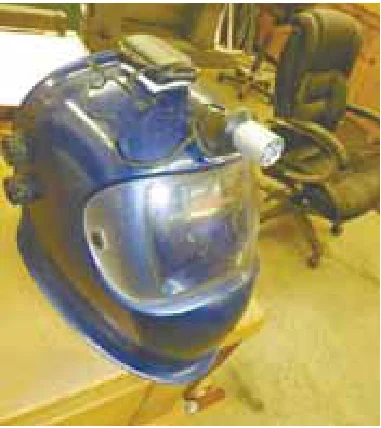
“I have a lot of trouble seeing while welding. So I took a head-band LED headlamp and removed the band. Then I used Velcro to stick the headlamp and battery pack to the top of my welding helmet. It solved my problem.”
“I used to have a lot of problems with banging water pipes in my house and it got worse after we installed a water-to-air heat pump. I tried different things to no avail. I finally hooked up a garden hose with a cap on the end to a water line in my basement. I leave the water valve to the hose open all the time. After two years, I haven’t had any more banging pipes. It works like a commercial ‘hammer arrester’ because the hose contracts when water is turned on elsewhere and then absorbs the shock when pressure goes back up.”
“One problem with ramps used to work on vehicles is that once the wheels are up on top, the slanted part of the ramps are still in the way of your creeper. I solved the problem by building ramps that pivot out to the side once the vehicle is up. The hinge simply attaches to the side of the ramp. Once you’re done working, you can simply swing the ramp back into place and back the vehicle down.”
“My Makita 7 1/4-in. dia. metal cutting saw blade (#A-93815) will cut steel up to 1 in. thick and slices through 2 3/8-in. dia. steel tubing in 15 sec. The 36-tooth ceramic metal-tipped blade does a great job, even though the Makita 4131 saw I have it mounted on is not the greatest.”
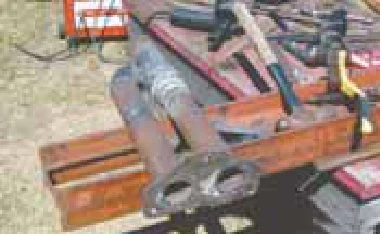
“When the casting failed on my 930 Case tractor’s exhaust, I decide to replace the exhaust and make it a dual header. I cut a piece of heavy flat iron from a piece of I-beam. I used heavy pipe, one with a flange and a welded elbow. I cut a gasket from gasket material bought at NAPA auto. I used the old casting for a pattern to drill the holes. Make sure you clamp the new flat iron to something solid when welding the pipe to the flat iron to prevent warping. Bolt it on and you’re good to go!”
“I keep a row of old refrigerators in my shop and use them as storage cabinets. They’re lined up against one wall.”
“We bought a router table equipped with a cast iron top. However, when we went to use it the grease on top that it was shipped with had dried fast. We tried to scrape the dried grease off, but it didn’t come off very well until I got a can of carburetor cleaner and sprayed it lightly over the surface. The grease wiped right off.”
“A friend of mine needed help repairing a hay rake over the summer, and we used a common repair technique with a new twist. If you break the head off a bolt or stud, the common repair method is to weld a nut onto the remaining stem. But if you’re using a wire welder it’s hard to get a solid weld, stud to nut. A better way is to weld a cut washer to the stud and then weld a nut to the washer.
“To use this technique, both the washer and nut must have no plating. Be sure to clean the area around the stud thoroughly, as oil and other substances may contaminate the weld.”
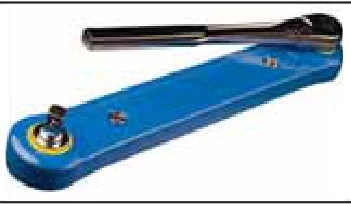
It’s a common problem to run into tight spots with your ratchet where a full swing is impossible. The Tite-Reach extension wrench lets you reach nuts and bolts in tight areas and eliminates the problem of using your socket driver one click at a time. It works with existing 3/8-in. or 1/4-in. socket sets and brings the ratchet point out 10 in., where you can exert full rotation on your driver. It results in better leverage and less chance of busting your knuckles. The tool comes in 3 different models.
“I recently had to rewind a recoil spring for the pull-start on my Polaris ATV. I had trouble winding it tightly enough to fit back into its housing. Here’s how to solve the problem. Pound a nail into the center of a small piece of plywood and attach the outer edge of the recoil spring to the nail, then attach a drill to the inside edge of the spring. As you begin to slowly advance the drill, the spring will wind and tighten. You may have to hold your hand flat over the spring while winding to prevent it from flying apart.
“Once the spring is wound to the proper size, attach a zip tie tightly around the outer diameter of the spring. You should now be able to remove the nail and lift the spring without it coming unwound. Once you place the spring in its housing, remove the zip tie. The recoil is now ready for reassembly. This method has saved me a lot of time and money.”
“I own a Farmall 706 tractor equipped with a D-310 engine. I have a problem with one of the cylinders leaking water or anti-freeze around the bottom of the cylinder where the O-ring goes. As a result I’ve had to replace the O-ring twice. It doesn’t leak at first, but after a few months it starts leaking and replacing the sleeve doesn’t help. I’ve thought about adding some kind of sealant on the O-ring. Otherwise the tractor is in good shape. I’d like to hear from anyone who can help.”
“I stick an ordinary cow magnet into the end of a short length of garden hose to pick up metal off a shop floor.”
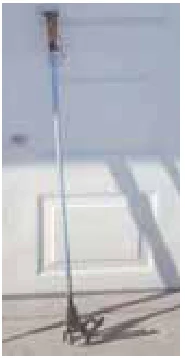
“I made a ‘pickup’ tool that really comes in handy around my place. It has a magnet at the top for picking up nails, bolts, and other small parts. It’s 4 1/2 ft. long and made from a length of 5/8-in. conduit. There are 4 tools welded onto it at the bottom – a J hook, a pliers, a screwdriver ‘poker’, and an open-end wrench.
“I used a 3-in. long cow magnet mounted inside a short length of light channel iron on top, then screwed the channel iron onto the conduit. I added a short wooden handle that slips down over the conduit and is riveted to it, making the tool more comfortable to carry around.
“The spring-loaded pliers at the bottom are attached to a cable that runs up through the conduit to a metal ring at the top. The pliers stay open until I pull on the ring. When I let go of the ring, the pliers automatically open back up. I also welded on an open-end wrench and a bent screwdriver. I use the pliers to pick up trash, the open-end wrench to dig out dandelions, and the screwdriver to pick up trash and also to dig out dandelions.”
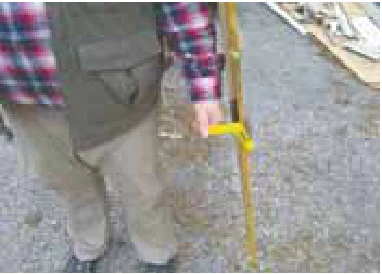
Carrying plywood, doors, sheetrock and other large panels is easy with JHandles, 3-pronged, powder-coated metal grippers that are designed to give you a tight hold on large panels (ph 765 673-4005; www.jhandles.net). Just grab onto one of the grips and place the other two grips on the end of the drywall or other material and lift. The weight of the material being lifted will squeeze the grips tight.
It makes carrying large flat loads much easier and reduces the possibility of back injury and muscle strain. The grips hug both sides which helps distribute the weight evenly. As a result you can lift a load and steady it with the same hand, freeing up a hand to open doors or gates. You also can carry multiple sheets with little or no damage. JHandles come in a set of two and retail for $24.95 plus S&H. You can use the website’s store locater to find a reseller in your area.
“I built a simple blacksmith forge for less than $50, using an old cast iron brake drum as the forge pot and mounting it on a tripod stand. I was helped by local welder David Dotson.
“The brake drum bolts to a 1/8-in. thick steel plate that has holes drilled into the center. We welded the plate on top of the tripod stand, which he made from lengths of sq. tubing. A short 2-in. dia. pipe is welded to the bottom of the plate and fits into a T-connector. Another pipe is attached at a 90 degree angle to the T-connector and serves as the forge’s air flow tube. A third pipe with a metal cap on the bottom extends down from the T-connector and is used to collect ashes.
“To operate the forge, we clamped a blower to the air flow tube and it heats the lit coal in the forge pot until the coal bed is hot. Once it’s hot, reduce the blower’s speed until the coal bed reaches the ‘coke’ stage.”
“The air filter on my 029 Stihl chainsaw would plug up in about 30 min. I cut a square piece of pantyhose and put it over the filter. Now it’s easy to flip the piece of nylon over to clean it and I use a lot less fuel.
“I needed a lightweight stool to sit on around the shop. I screwed a square piece of plywood to the bottom of a milk crate. Works great. It’s light and has built-in handles.”
“I bought a big steel plate at an auction for use as a work table and bolted a large vise onto it. The plate measures 3 ft. wide, 5 ft. long, and 4 in. thick and weighs about 2,800 lbs. Now whenever I’m bending steel or pounding something with a sledge hammer, I don’t have to worry about anything sliding around.”
“With every tough mechanical issue that I come across, I always take photos of every step to make sure I don’t forget anything during reassembly. I usually use the camera on my cell phone because the phone is always right with me.”
“We were excited that Battery Equalizer was featured in your 2014 Best of FARM SHOW issue. Unfortunately, the phone number for anyone who lives East of the Mississippi should have been 717-656-0067 (readers in other parts of the U.S. should call 888-851-4431; in Canada, call 800-563-5947). Our websbsite is www.batteryequaliser.com.
“This product can double the life of any lead-acid battery by reversing the built-up sulphation that kills batteries as they get older. Treated batteries will charge faster and hold a charge longer. Thousands of FARM SHOW readers are already regular users. A 12-oz. bottle sells for $19.95 plus S&H (will treat 4 car batteries).”
You can boost throttle response, horsepower, torque and fuel economy in 1998 to 2007 Cummins 5.9L engines with the Heater Grid Delete Kit from Toxic Diesel. The kit is a non-restrictive replacement for factory-installed heater grids designed for cold weather starts.
“Our customers are guys who are more into performance and want to get more air into their motors,” says Fabian Ortiz, Toxic Diesel.
“It’s for guys who don’t want to spend thousands of dollars for more airflow with air ram kits. It works phenomenally for the price.” Toxic Diesel’s kit installs in 30 min. or less. Just remove the OEM heater grid below the intake elbow. The kit is a direct bolt-up part. No cutting or modifications are needed.
“The kit is designed for easy removal and, if needed, replacement of the OEM heater grid,” says Ortiz.
“Any time the temperature drops below 20°, we recommend putting the heater grid back on." The Heater Grid Delete Kit is pre-drilled and tapped with two 1/8-in. ports for installing injection or monitoring systems, including water, nitrous, propane or boost gauges. The kit is available from local distributors or can be ordered from the company website. Distributor list price is $96.33, but the internet price is $83.49. Ortiz says FARM SHOW readers ordering from the website can get 10 percent off the list price by mentioning this article. Contact: FARM SHOW Followup, Toxic Diesel, 1478 South 270 East #1A, Saint George, Utah 84790 (ph 435 628-5544; [email protected]; www.toxicdiesel.com).
Steve Mattias built a sandblasting cabinet for his engine repair business because he couldn’t justify the cost of a commercial unit. The retiree says his sideline business keeps him busy nearly full-time. The sandblaster also comes in handy to maintain his small engine collection.
“I use it for cleaning up small parts,” says Mattias.
“If I get an old engine with a pie plate muffler and want to clean it up, it goes in the cabinet. That high-quality old steel comes out like new.” Mattias estimates his cost to build the unit was less than $50. He used mostly parts and pieces left over from other jobs.
“The paint and primer cost as much as anything,” says Mattias.
“About the only other thing I bought was the siphon-type blasting gun.” The plywood cabinet is 36-in. wide, 24-in. deep and 24-in. high at the rear. Total height is 63-in. A 3-sided wooden box at the top of the cabinet holds a 2-ft. fluorescent light protected by a plexiglass bottom. A 10 by 30-in. Lexan window mounted in a 15 by 36-in. door provides good visibility of the part being cleaned and also provides access. A 16 by 16-in. door on one end provides additional access.
“My son Brian owns a pipe organ repair company, and he gave me two 3-in. long, 6-in. dia. aluminum flanges that I inserted through the wall below the window,” says Mattias.
“On the inside of the cabinet, I slid elbow length rubber gloves over the flanges and fastened them in place with radiator hose clamps.” The base to the blasting cabinet is a piece of expanded metal. A 26-in. deep hopper beneath it holds the sand. The angled hopper has a pvc pipe with threaded cap at its bottom for changing blasting medium. Mattias used angle iron from bed frames for the framework and casting for shopping carts beneath it. Sandblasting is powered by a large pressurized tank.
“I have a squirrel cage fan mounted on the frame with a pvc pipe up to the cabinet to pull out dust and 4 half dollar size vents on back of the cabinet so I don’t draw a vacuum in the cabinet,” says Mattias. He has a larger, pressurized, sandblasting tank outside. However, his rolling cabinet has proven well worth the time it took to build, especially in the winter.
“I roll it over near the door and attach a flexible hose from an old backpack sprayer to the exhaust fan,” says Mattias.
“I stick the hose out the door and blast the part clean. It works great.” Contact: FARM SHOW Followup, Steve Mattias, 9 Kulas Rd., West Warwick, R.I. 02893 (ph 401 822-4596).
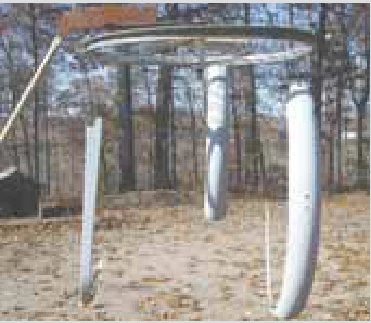
Small parts can often be a challenge to paint on a flat surface – they roll, they don’t dry easily, and they’re hard to handle. Scott Bruce of Ozark, Mo., made a bicycle wheel parts rack that solves the problem. The parts hang from the wheel, which is positioned horizontally off the ground at a comfortable working level so Bruce can stand in one spot and rotate the wheel. There’s plenty of space between the parts, allowing maximum air flow so the paint dries faster. He used a wheel off an old 10-speed bike with the tire removed. It hangs from an angled frame that can be set up anywhere. The parts hang from wire hooks that attach to the wheel spokes.
Contact: FARM SHOW Followup, Scott Bruce, 2108 Logan Ridge Rd., Ozark, Mo. 65721 (ph 573 350-4955; [email protected]).
Ross “Wilky” Wilkinson of Thompson Falls, Mont., says he’s rebuilt and sold close to a dozen 1950’s and 1960’s Deere crawler tractors, and every one of them has a special story.
“I started out fixing the first one out of necessity,” Wilky says, “and after awhile I just grew to like the work, so I kept at it.
“One of the changes I make on most of the crawlers is to improve the winch or add one if it isn’t there,” Wilky says.
“Most of those winches came with steel pivot rollers and pistons in the winch controls. When the brake fluid gets some air and moisture in it, the steel inserts rust and they won’t work.” Wilky removed the original steel control parts and replaced them with parts he made out of brass.
“I polished them real well, put them back in along with new O-rings and the system holds pressure. I could leave the machine sit for any length of time and the winch controls always worked,” Wilky says. He bought his first model 440 because it was fairly inexpensive and it just needed TLC and not much repair. Wilky says he didn’t want to invest much into a rig just to move logs, and he figured it would be fairly easy to repair the drive clutches and build a canopy so he could work in the woods. He builds canopies out of tube steel and expanded sheet metal. He also repairs the hood metal and fixes other parts to put the refurbished 420, 440, 1010 and 2010 crawlers in good working condition. Some need engine work and others need transmission and final drive work. After working on several 440’s and 1010’s, Wilky located a 2010 Deere that had been sitting on blocks for 15 years.
“The guy who owned it always had good intentions to fix it, but never made it happen. My son and I bought it from him, mainly because it had a 6-way blade, which we thought would be real handy around our place.” Wilky and his son started the tractor and it ran real well, but wouldn’t move.
“We split the body apart and found a small wood chip in the entrance orifice of the expander clutch,” says Wilky, “and everything else looked good.” They felt fortunate because if the transmission had needed replacing, the cost would’ve been more than the machine was worth. After they put it back together it ran and moved just fine. They added a canopy, fixed the winch and had themselves a real “find” for skidding logs. Wilky has also re-built winch systems using parts borrowed from other equipment. He makes a cable swivel fairlead out of 6-in. dia. turbine governor bearings. The arch is made from salvaged bridge steel. Together, Wilky says, the setup works like it was made in a factory.
“A good winch in the woods is worth a million bucks,” Wilky says, “and a bad one can ruin your back, your day and your pocketbook all at once. The ones I’ve fixed have paid for themselves many times.” Wilky says old equipment is getting harder to find, but he still keeps his eye out for possible renovation projects. He’s broadened his search from model 420’s, 440’s, 1010’s and 2010’s to include newer models like his 5200 MFWD tractor and even a Kubota U45 Excavator/Mulcher.
“Most Deere dealers still have parts for the old Deere crawlers,” Wilky says. Contact: FARM SHOW Followup, Ross Wilkinson, P.O. Box 1226, Thompson Falls, Mont. 59873 (ph 406 827-4916).
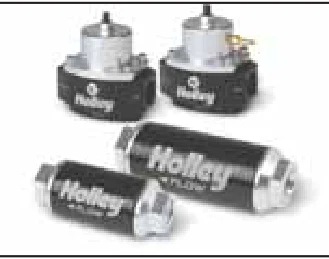
If you’re looking for a massive boost in power for cars or pickups, Holley Performance Products have what you need. The Dominator in-line billet fuel pumps can provide up to 1,800 hp EFI or 2,100 hp carbureted. The aftermarket system uses the latest OEM gerotor technology for a quiet, smooth, no whine pump. The Dominator is a twin pump design that offers lots of options for street and performance use.
“The Dominator is primarily designed for performance vehicles like trophy trucks, drag racers and street performance,” says Blane Burnett, Holley Performance Products.
“However, you can wire it up the way you want to use it, whether one at a time as progressive pumps or both at once for hard core, full-time duty. If you have a problem with one pump, you can still get home or to the finish line with the second.” The lightweight (5 1/10 lbs.) compact design makes it easy to install on frame rails or in other tight areas. It measures only 7 1/2 in. long, 5 in. wide and 2 1/2 in. high. Use one pump for street cruising and both pumps when needed. Staging pump use eliminates unnecessary recirculating and heating of extra fuel, avoiding performance and hot fuel issues. The Dominator is fully submersible for in-tank installation. Holley also offers Dominator fuel pressure regulators and filters. Like the pumps, they are precision machined from billet aluminum for strength and durability and bright dip anodized for corrosion resistance and looks. Regulators are available for both fuel-injected or carbureted applications. The fuel filters come with NPT or AN inlets, outlets, three filtering levels and three flow rates up to 260 gph.
“The Dominator is approved for use with gasoline, diesel and E85,” says Burnett.
“The fuel pressure regulators use a diaphragm material compatible with gasoline, diesel, alcohol and E85. The O-rings in the filters are Viton and are safe for use with all these fuels as well.” The Dominator 12-1400 for up to 1,400 hp EMI and 1,850 carb is priced at $326.37. The 12-1800 for up to 1,800 hp EFI and 2,100 hp carb is priced at $407.95. Units are available direct from Holley Performance Products or from approved dealers. Contact: FARM SHOW Followup, Holley Performance Products, 1801 Russellville Rd., Bowling Green, Ky. 42101 (ph 270 782-2900; www.holley.com).
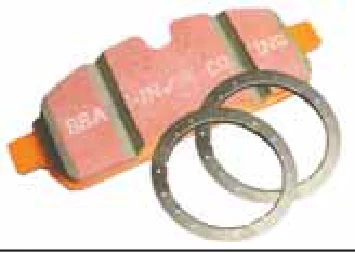
Owners of light trucks, Jeeps and SUV’s should take a look at EBC Brake pads, made from a new material designed to self-clean, stay cooler, grip better and last longer.
“These are ideal pads for use in heavy braking, towing or downhill descents under load,” says Brendan Cashman, automotive manager, EBC Brakes USA. The pad design includes high volume grooves that vent heat better and remove dust and debris, allowing the pads to cool faster after use. The carbon granule-based material was originally developed for use in race cars and has a wide range of operating temperatures. It has earned the highest rating in friction tests, stopping at temperatures exceeding 1,400°F. Winter testing shows it provides cold braking in even the worst wet and cold conditions. Even the best pad material fails if not properly bonded to the backing plate. The new Extra Duty EBC pads feature the NRS Hook system made by NUCAP of Canada. Small hooks about 1 mm tall are pressed into the surface of the backing plates. The EBC pad material is then laid into it, creating a stronger, more secure bond than possible with adhesive bonding alone. This better bond prevents edge lift, when the pad begins to peel away from the backing plate. It is that separation that creates vibration/noise when braking even though pads have plenty of wear left. Edge lift also speeds disintegration of the pads and needed replacement. "The replacement pads cost less than original parts and are guaranteed against pad corrosion or pad separation," says Cashman. "They provide more stopping power and longer life." Contact: FARM SHOW Followup, EBC Brakes USA, 6180 S. Pearl St., Las Vegas, Nevada 89120 (ph 702 826-2400; www.ebcbrakes.com).
You can extend the life of worn asphalt shingles with Shingle Sealer™, a new product made in the U.S. by Nationwide Chemical Coating in Florida. The 100 percent acrylic product seals the loose granules on the roof, waterproofs, stops mildew, and gives roofs a fresher look, says Steve Ellis, marketing manager for the company. Many customers are contractors who buy it in 55-gal. drums. But Nationwide also sells the sealer in 1 and 5-gal. ($199) sizes for homeowners. Coverage ranges from 250 to 350-sq. ft./gal depending on the roof’s absorbency. Shingle Sealer is the consistency of water and can be brushed or rolled on, but spraying and back rolling is recommended. Two coats are required for the 5-year limited material warranty. More coats can be applied for an even shinier appearance. Shingle Sealer can be reapplied every three to five years for continued maintenance. While manufactured mostly for asphalt roofing, the sealer works on most sloped roofs including concrete, wood, adobe and various types of metal roofing. All need to be properly washed and prepared according to instructions, and the temperature must be 45 degrees F or higher. Shingle Sealer has been sold to customers in all climates, Ellis adds, from Canada to the Middle East. Contact: FARM SHOW Followup, Nationwide Chemical Coating MFRS, Inc., 7106 24th Court E., Sarasota, Fla. 34243 (ph 800 423-7264; www.nationwidecoatings.com).
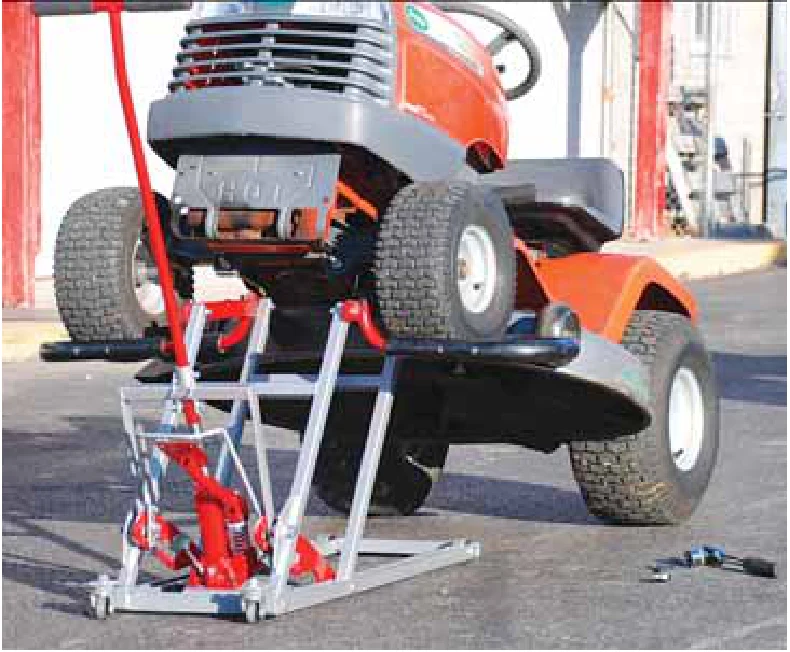
If you’ve ever thought about getting a mower lift, check out the Pro-Lift. It uses a foot-operated bottle jack to provide up to 20 in. of clear working space. The unit can safely lift up to 350 lbs. of front axle weight to full working height, making blade sharpening, belt replacement and debris removal safer and easier. The lift rides on 4 small steel caster wheels. It’s equipped with a pair of rubber-coated saddles that support the mower’s front wheels, and a foot pedal-operated 2-ton bottle jack. You drive the mower wheels up onto the saddles, then pump the foot pedal until the mower is at the desired height. Push button adjustable baskets allow you to move the saddles out to 48 in. or inside to 15 in., allowing the lift to be used with any size mower. Dual mechanical auto-locks prevent the mower from slipping or becoming unstable.
“It has no pins to pull or any adjustments to make,” says Seth Derstine, SFA Companies, Kansas City, Mo.
“There are locking mechanisms on either side of the bottle jack, so as the mower is being lifted they lock in place with every couple of pumps you make.” The T-5350B model retails for $199.99. The company also offers 2 commercial grade models, the T-5500 and T-5501. Both are equipped with the wheel saddles as well as a rubberized steel saddle center that can be used to lift the mower’s frame from the front deck or rear chassis. They have 750 lbs. of axle capacity on the center platform and 500 lbs. on the saddles. The T-5501 is available with an air-powered option that uses compressed air to operate the bottle jack.
“It lets you use your air compressor or the compressed air lines in your shop to pick up the mower, without doing any pumping,” says Derstine. The T-5500 retails for $449.99 plus S&H, and the model T-5501 for $549.99 plus S&H. Contact: FARM SHOW Followup, SFA Companies, 10939 N. Pomona Ave., Kansas City, Mo. 64153 (ph 816 891-6390; [email protected]; www.proliftproducts.com).
A bench vise is a necessary tool in any farm workshop, but it does have one limitation: It can’t clamp round or tapered objects in its jaws. I recently came across a new tool that attaches to an ordinary bench vise to hold odd-shaped parts. It opens up a whole new way to approach clamping. It was invented by Ron Iacobelli and his brother Michael. The Gyrojaw is a pyramid-shaped attachment made from a gripping-type elastomer that fits against the jaw of a standard bench vise. It’s designed to clamp things that don’t have parallel faces. A carriage bolt is embedded into one end, and the bolt’s curved head allows the Gyrojaw to be pivoted to many different angles and then clamped tightly against the work piece. Friction and pressure between the Gyrojaw and the vise surface is what holds it in place. The Gyrojaw sells for $12 plus S&H. It can also be used on C-clamps. Contact: FARM SHOW Followup, Gyrojaw, 16280 Softwater Lake Drive, Linden, Mich. 48451 (ph 800 937-5755; www.gyrojaw.com).
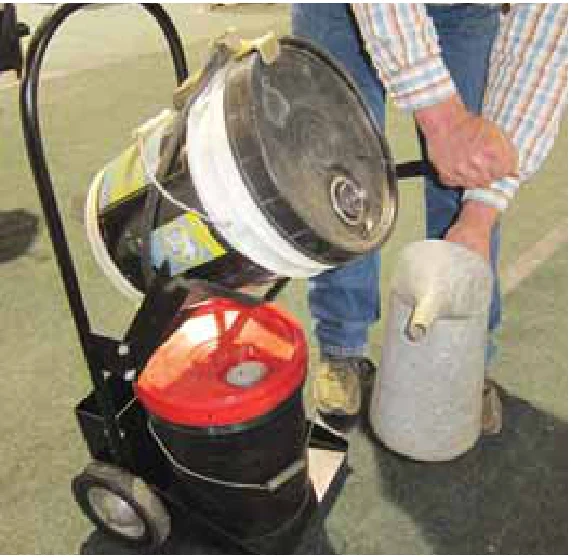
“Pouring out of 5-gal. pails of liquid is easy with my portable Pail Tender,” says Wayne Tjeerdsma, Selectro Co., Avon, S. Dak. The Pail Tender is a 2-wheeled cart with a dispensing cradle at the top and a storage platform at the bottom. The pail sets inside a removable cradle that drops into a pair of yokes attached to a bungee cord.
“It lets you easily control the pail with one hand and hold the container you’re pouring into with the other,” says Tjeerdsma.
“It’s much more stable than trying to use both hands to do the job and results in fewer spills. It works great for any kind of petroleum products, paint, etc.” Tjeerdsma says he’s working with a distributor to put the product on the market. He expects the Pail Tender to sell for less than $200. He also expects to sell wall-mount and bench stand models. Contact: FARM SHOW Followup, Selectro Co., P.O. Box 226, Avon, S. Dak. 57315 (ph 605 286-3221; [email protected]; www.slectro.com).
PA Performance has been building, customizing and modifying vehicles for more than 20 years. In the process they’ve learned how to upgrade electrical components to provide greater performance.
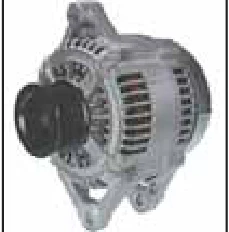
“We recently introduced a new alternator that will directly replace any 10DN, 10SI or 12SI series alternator,” says Kevin Bealer, a company representative. These alternators are commonly found on most early GM vehicles along with some agricultural and excavating equipment. Bealer says the company’s new alternator is capable of producing a maximum of 120 amps at 6,000 rpm’s and up to 60 amps at idle. The original alternator produced 60 amps at 6,000 rpm’s and 10 to 20 amps at idle.
“Our high-output alternator produces more than 3 times the electrical capacity compared to the original unit,” Bealer says.
“It allows vehicles to run a high wattage sound system with powerful speakers or to power extra lighting on emergency vehicles. It’s also excellent for trucks that are running snowplows and other auxiliary equipment.” PA Performance builds its new alternators with 2 internal cooling fans to efficiently dissipate heat from the heavy-gauge wiring. This extends the service life of the alternators and maintains maximum output in all weather and performance conditions. Prices start at $139 and can be ordered through the company website or by phone. Orders placed by 1 p.m. Eastern time generally ship the same day. Bealer says the new alternators join a growing line of products from a business that’s known for producing new components with exceptional quality.
“We’re not just taking existing products and ‘hopping them up’ for more performance,” Bealer says.
“We build new products with excellent components and in most cases offer a limited lifetime warranty.” High Output units have a one year warranty. Most of the alternators PA Performance sells are available in different powder coat, chrome or polished finishes. The company also markets starters, voltage regulators, battery cables, solenoids, wire kits and many other electronic parts. Special order “HO” units are available for performance and diesel vehicles. Contact: FARM SHOW Followup, PA Performance, 704 East 4th St., Boyertown, Penn. 19512 (ph 877 471-8010; [email protected]; www.paperformance.com).