Practical ideas from FARM SHOW MagazineSubscribe · Free issue · Send us your shop tip
Subscribe to FARM SHOW
Issues / Vol. 25, No. 3 (2001)

Vol. 25, No. 3 (2001)

Money-Saving Repairs & Maintenance Shortcuts · Printed section pp. 38–41

36 selected entries · Complete text of selected entries

This issue’s section includes reader tips and feature-length shop stories. Held items and editorial notices are not reproduced.

Archive text: prices, coupons, availability and contact details reflect the original publication, not current offers. Reader methods are not universal instructions; follow manufacturer guidance and proper safety practices.

Reader shop tips

From the archive · Full text
Reader shop tip

Alspach Farms

Alspach Farms, Mt. Pulaski, Ill.

When the engine in a Versatile tractor needed overhauling, Allspach Farms pulled it into the shop. However, it was cold outside and they wanted to shut the shop door. The tractor wouldn’t fit all the way so they had to improvise by closing the door onto the articulation point, leaving the rear end hanging outside.

From the archive · Full text
Reader shop tip

Bruce & Roger Elliott

Bruce & Roger Elliott, Montrose, Ill.

One key to farm safety is having plenty of light when working at night but it’s hard to get light exactly where you need it. Bruce and Roger Elliott came up with a simple “go a n y w h e r e ” floodlight that’s made up of a 2-wheeler fitted with a light pole.

The floodlight mounts at the top of a piece of conduit. A switch mounts halfway up the pole. Stability is provided by two feet at the front of the 2-wheeler. A concrete block, strapped to the platform on the 2-wheeler, anchors the light firmly to the ground. It’s easy to roll the light around to wherever needed on the back two wheels.

From the archive · Full text
Reader shop tip 1 of 3

R.D. Elder

Individual tip 1 of 3 from this reader’s published contribution.
R.D. Elder, Blue Mound, Ill.

Since Elder broke his back 18 years ago, he’s developed a lot of equipment to help cope with the difficulties of farming from a wheelchair.

He farms with his father and brothers and has responsibility for many of the shop repairs. He designed a special welding table that’s lower to the ground for easy access.

From the archive · Full text
Reader shop tip 2 of 3

R.D. Elder

Individual tip 2 of 3 from this reader’s published contribution.
R.D. Elder, Blue Mound, Ill.

He also built a low level workbench which lets him get close to detail work, such as grinding and knife sharpening. He’s an expert with knives.

From the archive · Full text
Reader shop tip 3 of 3

R.D. Elder

Individual tip 3 of 3 from this reader’s published contribution.
R.D. Elder, Blue Mound, Ill.

To get around in the field, Elder modified a Polaris ATV. It has all hand controls and a special high back support, which he “padded” with camouflaged tape. He can get on and off the ATV by himself.

From the archive · Full text
Reader shop tip

Tom Hoffman

Tom Hoffman, Nokomis, Ill.

Here’s an easy way to seal the bottom of large doors. Tom Hoffman makes a cut through a bicycle inner tube on the side opposite from the air valve. Then he fashions two metal clamps to go over either end of the long tube and clamps them in place in a vise. Then he fills the tube with air. Once cold weather comes, he simply slips the air-filled tubes in under the gap between the door and the floor. You could also fasten the tubes to the bottom of the door.

He notes that even a small crack can let in a lot of cold air and he figures the few seconds it takes him to the seal the door is well worth the time.

From the archive · Full text
Reader shop tip

Thomas Empfield

Thomas Empfield, Indiana, Penn.

“You can use 1-quart oil bottles to make handy parts and hardware bins. Lets you recycle the bottles and the bins as good or better than anything you can buy.

“You can use different color bottles to indicate at a glance what’s in them. For example, all yellow bottles might have bolts, green bottles screws, white bottles nails, etc.

“I built a shelf to hold the bottles, sizing it so they fit in tightly because the bottles have thin sides and they’ll stand up better. The drawing shows the best way to cut the bottles. It keeps them as sturdy as possible.”

From the archive · Full text
Reader shop tip 1 of 2

Leroy Klesel

Individual tip 1 of 2 from this reader’s published contribution.
Leroy Klesel, Halletsville, Tex.

“Older Farmall tractors with 6-volt systems are hard to crank. We changed our electrical system over to 12 volts by installing a 12-volt battery, a 12-volt Delco alternator, and put a resistor between the switch and the coil. The tractor works great now.

From the archive · Full text
Reader shop tip 2 of 2

Leroy Klesel

Individual tip 2 of 2 from this reader’s published contribution.
Leroy Klesel, Halletsville, Tex.

“To put a bearing cone on a shaft, heat the bearing up in a container of hydraulic oil. It will slide right onto the shaft. To remove an old bearing race, just weld a bead inside the race to shrink it. It’ll come off easily.”

From the archive · Full text
Reader shop tip

Bob Hudspeth

Bob Hudspeth, Era, Tex.

“I do a lot of woodwork, especially with my radial arm saw. I didn’t like having to let go of the machine or the wood I’m cutting to turn the machine on or off. I wanted hands-free operation and found a simple way to do it that also lets me turn any other power tool into a “hands free” machine without modifying it at all.

“I mounted an electrical outlet on the wall and removed the little connector tab between the terminals on one side of the plug-in assembly. This let me wire the top outlet to be ‘hot’ at all times for use as a normal plug-in. Then I wired a foot control switch to the bottom outlet so it’s ‘hot’ only when the foot control is pressed. Now, with the radial saw plugged in and its switch turned ‘on’, it will only work when I press the foot control, leaving my hands free at all times. I put a 10-ft. cord on the foot control so I can move it around and use it for any other power tool.”

From the archive · Full text
Reader shop tip

Fred Biddle

Fred Biddle, Waupun, Wis.

“If you twist off a bolt, weld a nut on the broken stud. As soon as it cools enough so the red is gone, turn the bolt out. The heat from welding will loosen the bolt. This method will test how good a welder you are.”

From the archive · Full text
Reader shop tip

Kenneth L. Nielsen

Kenneth L. Nielsen, Marshall, Minn.

“The pto shaft on my big tractor-mounted V-type snowblower operated at a steep angle and broke the yokes frequently. To solve the problem, I converted it to a chain-driven system with a jackshaft.

“I built a platform on the blower out of 7-in. channel iron. I bolted two pillow block bearings and a short shaft fitted with a spocket to the platform. Then I put a sprocket on the input shaft, installed an idler sprocket for the tightener, and fitted it with a #80 roller chain.

“Now the pto shaft runs level and the snowblower pulls much easier. It seems to blow more snow with the same amount of power. I know this setup takes a lot of stress off the driveline of the tractor.”

From the archive · Full text
Reader shop tip

John Meyers

John Meyers, S&H Industries, Inc., 5200 Richmond Road, Cleveland, Ohio 44146 (ph 800 253-9726; fax 216 831-9573; E- mail: [email protected]; Website: www.shindustries.com)

“Our mechanical ‘friction jack’ provides up to 3,000 lbs. of mechanical muscle to push or pull things into place. It was originally developed for auto body repairmen to push or pull body components back into line. However, it has also become popular with plant maintenance technicians, builders, pipe fitters, welders, remodeling contractors and others who find it to be a simpler, easier to use and less expensive alternative to heavier and more complicated hydraulic positioning devices.

“It consists of a 55-in. long, 3/4-in. dia. steel rod available with five hardened friction plates. The plates provide secure locking in an infinite number of positions to either push or pull. To use the unit, you simply depress the locking tabs to slide the rod into position and then use the jack handle to apply exactly the pressure needed to accomplish the job. It can exert up to 3,000 lbs. of push/pull power.

“We also offer a full range of chains, hooks, clamps and other accessories for further versatility.”

From the archive · Full text
Reader shop tip

Cary Dan Roach

Cary Dan Roach, Aransas Pass, Texas

“Last fall I accidentally rolled my Scotts garden tractor while mowing. I was left with a broken rib and a 6-month-old garden tractor with numerous cracks in it and pieces broken off the hood and grill. I couldn’t find anyone who would sell me only the exact parts that I needed.

“I tried using different kinds of glue but none of them worked. Then I decided to try welding the plastic pieces back together. I got out my little hand-held propane torch and a spoon. I heated the spoon until it was red hot and then simply rubbed it back and forth across the cracked areas where I wanted to weld. Even the parts that were completely broken welded back together extremely strong, and the welds were hardly noticeable. I was glad to find that the spoon handle didn’t even get warm, much less hot. However, the cupped part of the spoon got red hot very fast. I simply let the spoon cool off and then heated it back up and started over again.

“Since making the repairs I’ve used the mower on my 5-acre yard several times, and not one weld out of 12 has recracked or broken.”

From the archive · Full text
Reader shop tip

John C. Morton

John C. Morton, Janesville, Wis.

“A wheel bearing on the steering axle of my combine went bad, which caused the wheel to fall off in the field and left the bare spindle suddenly buried in dirt 16 in. deep. To get it out, I dug dirt out from under the axle and slid a scissors hoist under it. I attached a hydraulic hose to the hoist and raised the combine out of the dirt. Since then I’ve also used this idea for other jobs. My total cost was about $30 for a new hydraulic hose and quick coupler. The hoist came off an old ear corn wagon.”

From the archive · Full text
Reader shop tip

Ezra C. Gilliam

Ezra C. Gilliam, Salisbury, N.C.

“When sharpening my chain saw I often find it difficult to determine where I started sharpening and where I should stop. To solve the problem I tie a piece of thread around the chain at the point where I start sharpening and then proceed to sharpen each tooth until I reach the thread again.”

From the archive · Full text
Reader shop tip

David M. Welling

David M. Welling, Ridgeway, Ohio

“Whenever I have to use a cutting torch near hoses, wires, cables, or air lines, I protect them with a heat shield, such as a piece of 16-ga. metal. I also keep a spray bottle of water handy. It saves a lot of grief.”

From the archive · Full text
Reader shop tip

Ross McGehee

Ross McGehee, Natchez, Miss.

“To extend the life of Bush Hog blades, we cut the cutting edge off completely and replace it with a section of grader blade, which holds an edge much longer. It costs about $15 per blade.”

From the archive · Full text
Reader shop tip

Mark Himes

Mark Himes, Beecher City, Ill.

If your shop is located inside a big machine shed, here’s an idea you might want to consider. Mark Himes built a shop-within-a-shop inside his 40 by 60-ft. machine shed.

The inner room measures 12 by 24 ft. with a 7-ft. tall ceiling. One reason for building it was for safety when welding. He wanted to blade.”

isolate the work from the rest of the building. The photo doesn’t show the drop curtain that encloses the open side of the shop room.

The room also provides handy storage space over the ceiling of the room for supplies as well as efficient space to hang tools, lights, shelves and other equipment.

From the archive · Full text
Reader shop tip

Larry Zenz

Larry Zenz, Parks, Ark.

“I’ve used the welding bench shown in the photo for 40 years as an anvil for straightening, clamping, and welding work. The vise is bolted to a base that swivels on a pair of telescoping pipes, allowing vertical or horizontal clamping. It can also be removed for full flat surface welding. The biggest advantage of this welding bench design is that I can’t put a lot of junk on it that would obstruct my welding work.”

From the archive · Full text
Reader shop tip 1 of 2

Max R. Fitzpatrick

Individual tip 1 of 2 from this reader’s published contribution.
Max R. Fitzpatrick, Whiteland, Tenn.

“I have an outside ramp built out over an incline alongside our driveway. Works well as a pit to service and change oil and is comfortable for the operator because he lays on an incline.

From the archive · Full text
Reader shop tip 2 of 2

Max R. Fitzpatrick

Individual tip 2 of 2 from this reader’s published contribution.
Max R. Fitzpatrick, Whiteland, Tenn.

“When working inside, I drive onto a rectangular frame made from two pieces of channel iron about 10 ft. long and 12 in. wide, with cross bars welded at either end. I drive onto the C-channel, then hook my engine lift onto the front and raise the vehicle enough so I can work on it. As a safety precaution I block up the front end with heavy wooden blocks.”

From the archive · Full text
Reader shop tip

John Haldemann

John Haldemann, Chinook, Montana

“My Hesston stack mover was great for hauling hay, except when the terrain was a little rugged or rocky, as it is on much of my ranch. The stack mover tended to bounce and shake when there was no load on it, and when it was loaded, it had very little flex, so we had to go slow with it. To help it handle our terrain better and enable us to pull it faster, we removed the original walking beam axles and replaced them with the axles and suspension from a new 10-ton trailer. The springs really made a difference. Now it handles loads better at higher speeds.

“Replacing the original axles with the trailer axles was simple. It did raise the bed of the stack mover and the feeder about two inches, but that really hasn’t made a difference in loading or unloading stacks.”

From the archive · Full text
Reader shop tip

PFW Systems Corp.

PFW Systems Corp., 850 Medway Park Crt., London, Ontario, Canada N6G 5C6 (ph 519 474-3300)

Next time you have trouble finding a repair part, you might want to check out a new Website that lists more than a million parts from North American farm equipment dealers and manufacturers .

“Go to www.partfinder.pfw.com to search for the part you need. You can search the entire database or search by your own state or geographic area.

The “PartFinder” database got its start just a year ago but has already signed up hundreds of dealers and vendors, who list their complete parts inventories. However, most of the parts in the database are parts that have been sitting on dealer’s shelves for a year or more. They normally don’t list everyday parts because they know they’ll sell those anyway. There’s no charge for using the service. Dealers pay a fee for posting parts to the Website.

Shop feature stories

From the archive · Full text
Feature story

Pickup Transmission Powers Nut And Bolt “Rethreader”

Featured source:

Putting new threads on old nuts and bolts by hand can be a slow, tiresome job. To make the job easier, Stan Knafelc, Watson, Sask., uses an old 3-speed pickup transmission that’s belt-driven by a 1/4 hp electric motor.

The entire setup bolts to the top of a welding table in Knafelc’s shop. He attached a big pulley to the transmission’s clutch shaft and fitted an adjustable chuck to the output shaft, which holds taps and dies for cutting threads.

He puts the transmission in gear, then uses a pliers to force a nut over the thread cutter. To withdraw the nut he simply puts the transmission in reverse.

“It’s fast and a lot easier than rethreading nuts and bolts by hand. It doesn’t take long to rethread a whole bunch of nuts or bolts,” says Knafelc.

“I can rethread nuts ranging from 1/4 to 3/4 in. diameter. The big pulley gears the transmission way down so that it runs slow. I keep the transmission in second gear so the thread cutter rotates at about 60 revolutions per minute. I used a synchromesh transmission so that I can shift the thread cutter into reverse without having to stop the motor.”

Contact: FARM SHOW Followup, Stan Knafelc, Box 67, Watson, Sask., Canada S0K 4V0 (ph 306 287-3789).

From the archive · Full text
Feature story

“Power Box” Said To Boost Deere Engine Horsepower

Featured source:

If you have late model Deere equipment, you may have heard rumors about “magic electronic boxes” that boost horsepower from diesel engines. Reportedly, some of these have turned out to be duds but, farmers who’ve used a new “Power Box” from Canada say this one really works.

The electronic device was developed by farmer Dave VanSegbrook, engineer Brian Fox and Fox’s son Jason, an electronics technician. All three men farm and continue to be involved in producing the Power Box.

VanSegbrook says the Power Box works only on Deere 7.6 L and 8.1 L electronically controlled diesel engines, found on 8000, 8010 and 9100 tractors, 9000, 9010 and 9050 Series combines with Bosch fuel injection systems. The engines are also found in cotton pickers and other self-propelled machinery.

The Power Box plugs into the existing wiring harness at the fuel pump and modifies the electronic control unit (ECU) signal, allowing the engine to put out more horsepower. The effect is similar to turning up the pump on older model engines.

“Our Power Box has been used on three continents now, and has proven itself in some pretty harsh conditions, from winter in Canada and Northern Europe to the hot, dry Australian Outback and the American Southwest,” he says.

“We get a consistent 20 percent boost in horsepower at maximum RPM and 23 to 25 percent boost on the power bulge. Our customers tell us they use no more fuel per acre.”

The Power Box can be installed quickly and easily.

“All you do is plug it into the existing wiring and attach it to an existing fastener,” VanSegbrook says.

“You’ll need only one wrench to loosen and retighten the bolt in that fastener. Most people can install it in less than 15 minutes.”

Complete instructions are provided with the Power Box. The box itself contains all solid-state circuitry and is made out of “military-spec components,” VanSegbrook continues.

“We sell it with a 2 year warranty.”

Current price for a Power Box is $800 U.S., which includes next day delivery.

“We give discounts for multiple purchases,” he says. Power Boxes are sold direct and through some farm machinery dealers and diesel fuel injection shops.

They’re often asked about Power Boxes for other engines, but VanSegbrook says the current model works only with these two engines.

“We continue to work on other new applications, but we have none on the market yet.” It should be pointed out that using a Power Box will void the warranty on engines still covered.

Contact: FARM SHOW Followup, ATO, 9186 Oldfield Line, RR 3, Tupperville, Ontario N0P 2M0 Canada (ph 519 628-5816; fax: 519 628-5816), or toll free from anywhere in North America 877 773-8100; E-mail: [email protected]; Website: www.ag-tech.com).

From the archive · Full text
Feature story

Rotating “Bolt Boxes” Eliminate Need To Dig

Featured source:

William Hettler doesn’t have to dig for nuts and bolts since he built these handy boxes that rotate 360°.

“I keep all my nuts and bolts in big bins. I was always digging to the bottom for small bolts. That’s why I came up with these rotating bolt boxes which eliminate the problem,” says Hettler, Monmouth Jct., New Jersey.

The boxes have removable sliding lids on top and bottom so he can turn them upside down when looking for a nut or bolt, and remove the lids to look inside.

There’s a centered pin at each end of the bolt boxes. The pins are held by a sturdy metal frame. There’s one large box at bottom and two smaller bins on top that contain nuts, washers and other small parts. The entire assembly mounts on the frame of a shopping cart so it’s easy to roll around the shop.

Contact: FARM SHOW Followup, William Hettler, 650 Georges Rd., Monmouth Jct., N.J. 08852 (ph 732-329-6440).

From the archive · Full text
Feature story

I-Beam Workbench Built Like An “Anvil”

Featured source:

Russ Gilbertson is pretty sure no one is going to carry off the workbench he and his father Ron built for their repair shop in Glasgow, Montana.

Gilbertson does a little farming, and has a small beef herd. He also sells and repairs trailers.

“We needed a substantial workbench for the shop,” he says.

“I looked around the farm and came across some steel I-beams that had been around for awhile. We got them for nearly nothing when our old high school was torn down. The flat sides of the beams are 15 in. across, so we welded two 20-ft. sections together to make a 20-ft. long, 30-in. wide workbench.”

Gilbertson says the steel in the beams at their thinnest point is 1/2 in. thick.

“We put four legs made of 3-in. square tubing on front and mounted the back side of it to the wall. The worktop is about 30 in. off the floor,” Gilbertson adds.

To mount tools, they welded trailer hitch receiver tubes at various locations along the front edge of the table. Then they attached hitch insert tubes to their shop tools, including a vise, bench grinder and hydraulic hose maker.

“This method holds the tools solidly, but makes it easy to move them where we need them, or just take them off if we have to put something big on the bench,” he says.

“There are some old rivet holes, about an inch in size, in the top that come in handy for bending things, too. As heavy as it is, you can use it just like you would an anvil. And because it’s steel, it makes a good welding table too.”

He figures the entire bench cost less than $200.

“These old I-beams are really good quality steel. Welding them together took some time, but wasn’t all that difficult,” he adds.

“I don’t know how much the bench weighs, but we had a heck of a time getting it up into place, even using the tractor to lift it.”

Contact: FARM SHOW Followup, Russ and Ron Gilbertson, RR1, Box 4855, Glasgow, Mont. 59230 (fax/ph 406 228-8900).

From the archive · Full text
Feature story

“Can’t Fail” Product Stops Battery Corrosion

Featured source:

After listening to his father complain for years about always having to clean corrosion off battery cables on his tractors, Avre Papst, who was teaching school in Omaha, Nebraska, mixed some common household products into a paste and applied it to the cable ends and battery posts.

Six years later, there was still no corrosion on the cables or the battery posts. At that point, Papst figured there just might be a market for his concoction, so he began investigating a way to produce and package the stuff.

To see if it really would sell, he got it into the hands of friends, neighbors and relatives. When it performed just as well for them as it did on his father’s old John Deeres, he went into business.

He loaded up a van with Goo-It and headed out on the road. Living out of the van, he drove thousands of miles calling on retailers who sold automotive parts and on farm equipment service shops.

That was about two decades ago. Since that time, he’s sold enough product to treat the battery posts and cables on 1.5 million cars, trucks, tractors, combines, etc.

While he won’t say what’s in it, Papst does acknowledge that it’s non-toxic and the ingredients can be commonly found in most homes.

“It’s a sealant, neutralizer and an emulsifier. It also enhances electrical conductivity,” he says.

“It won’t burn, has no odor and is totally non-corrosive. And it doesn’t contain any petroleum products. Petroleum is an insulator and once it gets between the posts and the cable ends, it drops voltage, which can damage some electrical components.”

“I knew from the beginning that you could increase battery life if you could keep current flowing and cables and posts from corroding,” he says. In some cases, customers say they can double lead acid battery life.

He calculates that for every $1 spent on his product, users save as much as $50 in increased battery life, labor, materials, and decreased downtime.

“You need to use this only once during the life of a battery. I sell most of the product in 2-oz. tubes, which contain enough product to last the lifetime of a battery,” he says.

“He also sells Goo-It in 1-lb. tubs for use with commercial fleets, and in automotive and farm shops.

“I give a money-back guarantee with the product and my name, address and phone number is on every package. In all the years it’s been on the market, I’ve never had one complaint about it not working. The only way this product will fail is if you fail to use it,” says Papst.

In addition to protecting lead acid batteries and cable ends, it will also keep moisture and dirt out of other electrical connections. It is exceptional for protecting electrical connections for monitors and controls on planters, fertilizer and herbicide application equipment, even where highly corrosive fertilizers are used. He says a study on using it to protect dry cell batteries and their connections looks promising.

Suggested retail price for a 2 oz.

“toolbox-sized” tube of Goo-It is $9.95. His commercial sized 1-lb. package lists for $39.95. If you order from him direct, shipping is included.

Contact: FARM SHOW Followup, Avre Papst, Fullerton, Neb. 68638 (ph 308 536-2618; fax 308 536-2571).

From the archive · Full text
Feature story

Tool Removes Lawn Mower Blades

Featured source:

Have you ever mowed the yard with a dull blade because you didn’t want to go through the hassle of taking it off to sharpen it?

If so, you’ll be interested in this new tool that makes it easy to remove and install blades.

It simply fits over the blade. Tabs on either side hold it in place. You put your socket wrench through the center to reach the bolt and hang onto the tool’s rubber-gripped handle.

“It eliminates the need to grab the blade with your hands or use something to block the blade,” says Larry Holstein, who along with Kevin Sterling invented the tool.

“For mowers equipped with a large brake or mandrel, an adapter can be bolted onto the bottom of the tool. The adapter extends beyond the brake or mandrel and allows the tool to catch either side of the blade.”

Sells for $49.95 plus $10 S&H ($18 S&H in Canada).

Contact: FARM SHOW Followup, Larry Holstein, 4606 S. Gid Hall Pt., Inverness, Fla. 34452 (ph 352 726-4931) or Kevin Sterling, 16315 S.E. 92 Ave., Summerfield, Fla. 34491 (ph 352 307-5700; Website: [email protected]).

From the archive · Full text
Feature story

They Specialize In Used Parts For Skid Steer Loaders

Featured source:

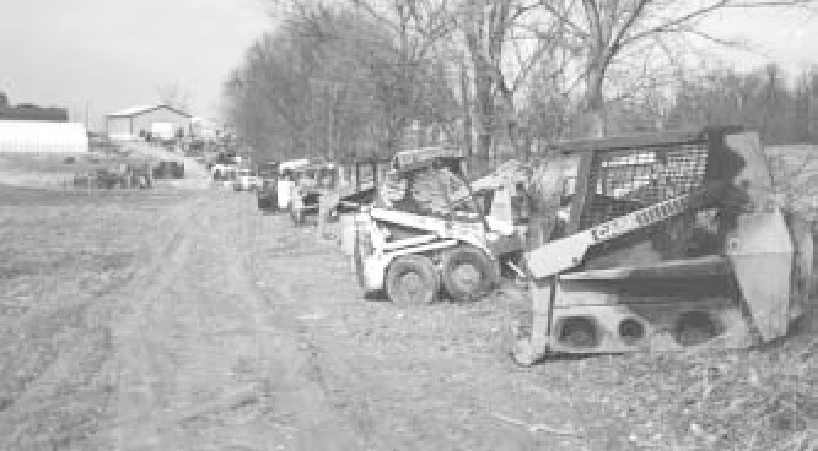
If you need parts for a skid steer loader, there’s a good chance GD Equipment, Shippensburg, Pennsylvania, has what you need.

Owner Aaron Shirk has been buying and selling used skid steers for 10 years.

“When we get one in that we can’t repair, we part it out. We also have new and reconditioned parts and we’ve become specialists at rebuilding hydrostatic transmissions for all types of skid steer loaders and even other equipment — everything from lawn mowers to bulldozers.”

GD Equipment sells skid steer hydrostatic parts at prices up to 50 percent less than you’ll find anywhere else. And if you need a rebuild, Shirk says his prices can save you up to 70 percent over what a local repair shop or dealership might charge.

“We have some unique rebuilding procedures for hydrostats that make them as good as new and in some cases, better than new. And we do it more economically than just about anyone else can,” he says.

While they don’t stock parts for every make and model of skid steer ever produced, Shirk says it would have to be an extremely rare part if they didn’t have it.

“We have most of the hard-to-find parts, either used, new or after market,” he says.

While the parts business is what got them involved in hydrostatic transmissions, rebuilding hydrostats is now their most requested service.

“We get hydrostats in from all over the East, as far south as the Carolinas. We even get them in from as far west as Kentucky and Wisconsin,” he says.

Contact: FARM SHOW Followup, Aaron Shirk, GD Equipment, 414 Rowe Road, Shippensburg, Pennsylvania 17257 (ph 717 530-0170).

From the archive · Full text
Feature story

“Quick And Cheap” Portable Shop Benches

Featured source:

When Mike Douglas, Harmony, Minnesota, needs an extra work table in his shop, he whips out his conduit bender.

“I’ve made several conduit work benches,” says the body shop owner.

“I borrowed the idea from an old mechanics magazine and have modified it several ways.

“They work on the principle of the old TV trays,” he says.

“You bend the conduit at right angles to make legs and a top of the right width. You need two pieces - one for each side. Then you drill holes through the legs and put a bolt through them to allow them to ‘scissor’ together. A chain fastened to each leg either below or above the bolt keeps them from separating. Then all you need is a board or piece of plywood for a top. It only takes about 15 minutes to make a bench this way.”

Douglas says he keeps several 10-ft. lengths of 1-in. conduit around the shop just to make benches from.

“You could use any size conduit,” he notes, “depending on how much weight you want to put on the bench. I’ve actually set a car engine on top of one, so I know they’ll hold just about anything.”

If you make several pairs the same size, you can set them up to make benches of any length, he says, noting that they make great portable tables for flea markets. When you no longer need the bench, you take off the top and fold the legs together. Then they can be stored along the shop wall or hung out of the way.

Contact: FARM SHOW Followup, Mike Douglas, Route 3, Box 55, Harmony, Minn. 55939 (ph 507 886-3456; E-mail: [email protected]).

From the archive · Full text
Feature story

“Rust Buster” Spray Welder Fills Big Holes In Sheet Metal

Featured source:

Do you have an old pickup that runs great but has a body full of big rusty holes?

Rodney and Garry Rose think they can help. It took 20 years to perfect their wire-feed “rustbuster” Spray Welder, which fills big gaps in sheet metal by spraying molten zinc into the rusted-out holes.

“You can repair auto bodies, augers, metal siding, or any other metal that’s rusted or corroded,” says Rodney, who operates a sandblasting business in Portland, Oregon in addition to staying busy manufacturing and promoting his spray welder. Garry has a similar business in Salt Lake City, Utah.

“We started with this idea in 1978 and finally had a machine that worked the way we wanted in 1998,” Rodney says.

To fill a hole, you first sandblast the area to be repaired.

“All the rust or corrosion must be removed for best results,” he says. Then you use the spray welder to rebuild the piece, filling in any holes and smoothing over pits. The spray welder actually melts zinc wire and sprays it over the surface.

Once the surface has been restored by this process, it has about the same feel as 30-grit sandpaper. Once he’s rebuilt a piece, Rose applies a primer on the surface and then smoothes it with a block sander.

“Once that’s done, it’s ready to finish,” he says.

Besides being useful for auto body work and siding repair, Rose says it can be used to rebuild steel handrails, rusted pipe gates, or in restoring antique tractors and farm machinery.

To demonstrate the machine locally, Rose completely refinished a 1975 MG Midget sports car. Both rear quarter panels were nearly gone because of rust before Rose used his spray welder on it. Now it looks like new.

“I sanded it down and put a clear coat on the surface, so it looks like a galvanized car now,” he says.

The Rose brothers call their company Rustbusters. They sell the Spray Welder as part of a package that includes the Rustbuster name, the machine, training needed to operate it, and, importantly, rights to a protected territory in which to use it. They will bring the spray welder to you and give you on-site training in its use, all for a total of $25,000. If you go to Portland, Oregon, for training at the Rustbuster factory, you can get set up for $20,000. So far, they have assigned nearly 20 protected territories, mostly in the West and Midwest.

Contact: FARM SHOW Followup, Rustbusters, P.O. Box 341, Clackamas, Ore. 97015 (ph 800 600-3203; Email: [email protected]; Website: rustbusters.com).

From the archive · Full text
Feature story

Farmer-Designed Belt Lacer Speeds Repairs

Featured source:

Seventy-year-old Melvin Garner bales about 1,800 acres of hay each year on his Durant, Okla., cattle farm, but thanks to a do-it-yourself belt lacer he came up with, broken belts are not the headache they once were. Garner says it’s the fastest and easiest to use on the market and he now makes three different models: one specifically for JD balers, one for Heston/International balers, and one he calls his “American Style Lacer,” that will work on any baler.

“They’re all simple and easy to operate. They’ve got the squaring and trimming on them so there’s no guess work about it,” Garner says.

“I’m a farmer and I don’t like buying anything that’s not any good. I designed these and got a company to make them for me. I did it because I got tired of the time spent having to leave the field when I broke a belt before.”

With Garner’s belt lacer, repairs are complete in as little as 15 minutes and the portability of the device allows farmers to make the repair right on the baler if they wish.

The Deere model and the Heston/International model are both patented, heat treated, and will lace 4-in. and 7-in. belts.

The American Style lacer is made of steel and comes in two different models. One fixes 4-in., 7-in. and 10-in. belts and costs $210 U.S., while the other model fixes 4 to 18-in. belts and costs $250 U.S.

“People can special order lacers to fix up to 20-in. belts like the conveyor belts used by f e r t i l i z e r c o m p a n i e s , ” Garner says.

Garner charges $500 for the Deere and H e s t o n /International belt lacers. He ships all lacers by UPS collect. They weigh about 45 lbs.

C o n t a c t : FARM SHOW F o l l o w u p , Melvin Garner, G a r n e r Manufacturing, 204 Sunny Meadow Drive, Durant, Okla., 74701 (ph 580 924-2975).