From the archive · Full text
Reader shop tip
Dale Fisher
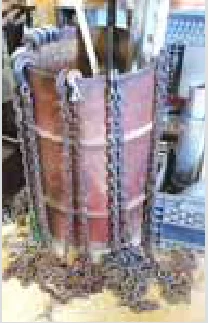
“I store chains in my shop by hanging the hooks from the edge of a 55-gal. drum. Works much better than just putting them in a pile. When I need a chain, I just grab one and go.”
Money-Saving Repairs & Maintenance Shortcuts · Printed section pp. 32–35
30 selected entries · Complete text of selected entries
This issue’s section includes reader tips and feature-length shop stories. Held items and editorial notices are not reproduced.
“I store chains in my shop by hanging the hooks from the edge of a 55-gal. drum. Works much better than just putting them in a pile. When I need a chain, I just grab one and go.”
“If you use old shirts and other clothing for rags, borrow your wife’s rolling fabric cutting tool. It’s unbelievable how fast you can get the job done with one of these.
“However, be advised to treat the tool with kid gloves and return it after you’re done, or you can expect burnt toast, cold coffee and a cold shoulder for an extended period of time.”
Tony’s happy with his King Kutter 33-in. pull-behind offset disk for his ATV.
“Despite its small size, this disk does an excellent job chopping up crop residue and makes an excellent seedbed. The disk is the perfect size for small gardens or wildlife food plots, and it tows great behind an ATV for getting into more remote areas of woods and marshes.”
“Lots of shops have old refrigerators in them to hold welding rods. But if you’re short on space and don’t have a lot of welding rods, use an old microwave with a light on inside to keep them dry. Works good.”
“I weld a 1/2-in. box-end wrench on one handle of a set of pliers and a 9/16-in. wrench on the other handle. It makes my pliers about the handiest tool I own. I’ve used this idea for many years and whenever the pliers wear out, I just go to the shop and cut off the ends of a couple of wrenches and weld them to the pliers. They’re quite a conversation piece.”
“I recently had to reassemble an old wood swing set for a customer. There was a 4 by 4 timber that was a very tight fit between three other pieces. The solution? Slathering all surfaces with Dawn liquid dish soap and a little tapping with a hammer. There was no staining, and the excess will wash off.
“I needed a lid with a cleanout hatch for my septic tank. I cast a rectangle of concrete around a water-filled plastic bucket and then cut out the pail after the concrete set. It was much easier than trying to hack out wood forms. The pail worked great because of no sharp corners prone to cracking.”
“I was tired of chimney sweep rods taking too long to screw together and take apart while making multiple passes sweeping a chimney. So, I used some old air hose couplers to speed up the process. Air couplers and chimney sweep rods have the same threading so it’s as simple as just screwing on the couplers once and then hooking up is as quick as connecting an air hose.”
“Whenever I wanted to use my bottle jack I would have to search for the handles. I solved the problem by clamping two pieces of conduit to the jack. Now the handles are always with the jack and the conduit does not interfere with operating the jack.”
“I use plastic flowerpots to hold extension cords. I drill two holes, one near the bottom and the second on the opposite side and higher up. I put the extension cord inside and pull a few feet out of the bottom hole and coil the rest inside. You can just pull out what you need and they’re stackable for storage.”
“I had a broken bolt that holds the fuel filter bracket on my 3010 diesel. My mechanic said I should convert to the modern square filter anyway. The bolt was about 1/4-in. deep into the block. After trying to weld a nut on it with no luck, I drilled a hole and tried an Easy Out. It wouldn’t budge. My mechanic suggested candle wax. I heated the bolt and block and pushed a candle against it. Then the bolt turned right out.”
“When mounting wheels on a tractor or other equipment with lug bolts, the easy way to do it is to find a bolt that is 5 to 6-in. long with the same threads as the lug bolts. Cut the head off and screw the headless bolt into the hub. Hang the wheel on the bolt and then slide it onto the hub.”
“My DR trimmer was always troublesome to start. It came with an oddball cordless battery that powers the starter and had no charging circuit. I have a lot of Ryobi 18-volt tools and some extra chargers. So, I rewired a charger and made a plate to adapt it to the housing. It works great and spins the engine so fast that the primer bulb is not needed. I used for most of two seasons before I even had to charge the battery.”
“Punching Holes in shim stock for bearing halves without tearing or wrinkles can be done by drilling a hole in a piece of flat bar the size desired. Turn up a short piece of round stock to fit the hole. Grip the round stock in the drill press chuck and lay flat bar on the drill press table. Pull the spindle handle down to engage the two pieces. Clamp the flat bar securely for a ‘hurry-up’ punch press.
“If you want something more permanent for many holes, use case-hardened material. A concave grind on the punch will help. I have easily punched brass stock up to 1/32-in. thick.”
“I added a 12 kW pto generator to my tractor so I can do welding repairs anywhere. I also use a cracker box welder and plasma arc welder.”
“My truck was leaking oil out of a small crack in the oil pan. I would’ve had to drop the axle or pull the engine except for a stick of Blue Magic QuikSteel epoxy. I got the pan as clean as I could (with oil dripping) and mashed a glob of epoxy on the crack. It hasn’t leaked now in over two years.”
“I put a used oil filter on my tractor front hub as a dust cap.”
“A trick I discovered to get tiny ports clean is to use a small fish aquarium pump. The pump creates a very fast vibration and if you put the carb in a small dish of gas and then set it on the pump, it vibrates the carb and liquid to better clean the inside. This basically replicates a more expensive ultrasonic cleaner.”
Dale McLaen has three ideas that make shop work easier.
“The open-top, 30-gal. drums we use for garbage cans get pretty heavy when full,” says McLaen.
“It was always difficult to keep them on the hand truck and maneuver around obstacles or over rough ground.”
McLaen resolved the problem by adding a simple double-finger swinging hook to his hand truck. Attached at a height to grab the lip of the drum, it hangs out of the way when not in use.
“The hook is made from a 9-in. piece of 5/16-in. rod and a 1-in. piece of pipe with a matching center hole,” explains McLaen.
“It took about 30 min. to build and paint. It makes moving the heavy garbage containers a breeze.”
The height support device is another neat shop helper. It lets McLaen fine-tune the height of material he is working on with a sliding pipe leg and a top-mounted automotive scissors jack. The overall height can be adjusted a total of 28 in.
The 2-part vertical leg is a 2 3/8-in. O.D. pipe butt welded to a steel plate that is in turn welded to a 15-in. car rim base. A slightly smaller upper leg pipe slides inside the larger pipe. The scissors jack base is welded to the top of the inner pipe.
“I welded a 14-in. long, 1 1/2-in. pipe to the top of the jack to support the material,” says McLaen.
“A bolt through the pipe secures tabs at either end of the pipe to help hold material in place.”
McLaen drilled 2 holes in the lower pipe and welded nuts to the whole surface. D-handle set screws fabricated from scrap bolts lock the inner pipe in place after it’s adjusted.
“The inside pipe gives me about 14-in. additional height,” says McLaen.
“The scissors jack provides another 14 in. of adjustable height. I get close to the desired height with the pipe and then fine-tune the setting with the jack.”
Marking the insides of tight spaces with a carpenter’s pencil can be frustrating. McLaen’s angled pencils make it easier.
“I took 2 ordinary carpenter’s pencils and cut the ends off with my miter saw,” says McLaen.
“Then I glued them back together at various 90 and 60-degree angles to the original pencils. They cost me less than a buck each and make marking a lot easier.”
Contact: FARM SHOW Followup, Dale McLaen, 13756 Hwy 11, Rutland, N. Dak. 58067 (ph 701-678-5232; [email protected]).
Wayne and Charlene Eash got the idea for a self-propelled ladder when a friend showed them one he had made.
“Wayne asked the fellow to make one for him,” Charlene says.
“Instead, he said to go ahead and make your own and, if you want to, go ahead and make them for other people, too.”
Wayne is a foreman at Shed Time, a mini-barn builder in Ligonier, Ind., and they’re always looking for ways to save steps.
“He began by purchasing a 6-ft. ladder,” Charlene says.
“The first step was to try and find a base with wheels on which he could attach the ladder.
“He found a guy that buys old Jazzy Scooters from senior centers, hospitals and home medical supply stores, fixes them up, and then resells them,” she recalled.
“Wayne bought one, removed the seat, and was left with the base and wheels.”
After that, Wayne and a fellow church member welded the ladder to the base and had their first working prototype.
“The scooter’s motor is controlled by a joystick that’s attached to one of the steps on the ladder,” says Eash.
“The scooter makes it easy to move the ladder from place to place while walking alongside.”
The ladders come in two sizes. The 6-ft. ladder retails for $1,400 and the 8-ft. sells for $1,480.
Contact: FARM SHOW Followup, Wayne and Charlene Eash, Shed Time, 6550 W 900 N, Ligonier, Ind. 46767 (ph 260-894-3806).
FARM SHOW contributor Tony Bunniss built a lift table from a 5,000 lb. truck lift modified with extra scrap steel from his shop.
Bunniss has long enjoyed restoring and retrofitting garden tractors and other lawn equipment to sell. Sometimes he has over a dozen tractors in the works and needs to transition quickly from one machine to the next.
“I looked at several commercial lift tables, none of which met my criteria,” says Bunniss.
“This included lifting a tractor, but the table also had to lift it to a height that I wanted to work at. I could have revamped any of the commercially available ones, but why should I spend my time correcting someone else’s mistakes, especially since I knew what I wanted and had the facilities to make it happen?”
“I bought a truck lift at an auction and only paid $10.00 for it because it had been sitting in water and the air cylinder was rusted,” says Bunniss.
“I had no idea if the air cylinder could be used, but I was able to hone it smooth and then had a local O-Ring manufacturer make me custom O-Rings.”
The table measures 40 in. by 6 ft. and lifts from 17 to 54 in. with a stop/lock every 6 in. Bunniss torched off the original wheels on the lift and installed casters on the rear. For the front, he used two heavy-duty bearings to serve as wheels.
All the sliding points of the scissors and lift arm utilize a bearing (six total), and the pivot points are bronze bushings. The scissors brackets work to keep the table level, as all lifting is completed through the original lifting arm, which initially had U-shaped brackets designed to fit under a truck’s rear axle.
As Bunniss explains, “The attached hydraulic hoist is capable of lifting the front of any of the garden tractors so that I can remove the mower or work underneath if need be. I use an adjustable jack stand if working under the tractors. It also comes in handy if I need to remove an engine which I can then place a removable, small engine test bracket, which is on the side of the table.”
He used 6-ft. straight ramps on the table, which are long enough to allow for winching any of his garden tractors onto it while clearing the edge of the table with the tractor’s deck.
While Bunniss isn’t sure how much his table can lift, he has his air compressor set at the factory setting of 175 psi. As the cylinder has a 12-in. bore, he estimates it amounts to 19,000+ lbs. of push.
“This lift will move my Deere 420 garden tractor with the thatcher, vacuum, and mower or the rotary broom mounted on it,” says Bunniss.
Overall costs for the project were minimal. Bunniss estimates he spent under $500 for the lift, O-rings, boom jack, winch and ramps.
Contact: FARM SHOW Followup, Tony Bunniss, Webster, Minn. ([email protected]).
Michael and Connie Kenner got tired of getting stuck in soft ground with their hand truck. They turned the 2-wheeler into a 6-wheeler, and now it goes just about anywhere.
“It was great except on soft dirt or sand.
“We added four wheels to the axle, and that solved the problem,” says Michael.
The Kenners have a couple of acres in the city. At 76, Michael appreciates how handy the hand truck is for moving potted plants and a few 55-gal. barrels he has put to use.
“I have a lot of stuff, and some of it’s getting hard to move by hand,” says Kenner.
Adding the wheels was fast and easy on this particular hand truck.
“Others might be more challenging, but all I had to do was pull one cotter pin,” he says.
“The axle slipped straight out, and I added the wheels with some pvc spacers to keep them from rubbing into each other.”
Kenner says he appreciates all the great ideas in FARM SHOW and hopes the go-anywhere hand truck idea will help someone else.
Contact: FARM SHOW Followup, Michael and Connie Kenner, 2618 Lomita St., Oceanside, Calif. 92054 (ph 818-424-4747).
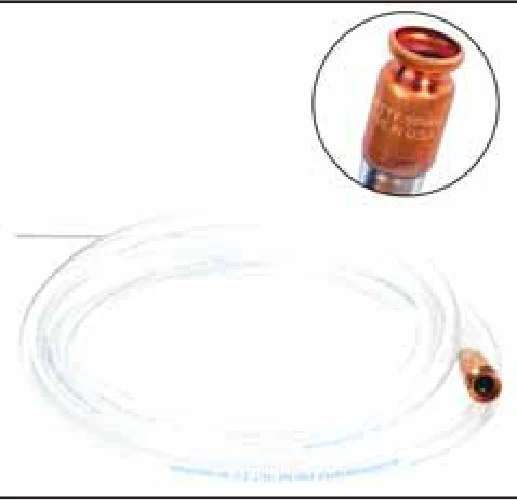
The Original Safety Siphon has 40 years of experience and satisfied customers that the company says prove it’s the best siphon in the world.
Owner Mike Ryan started as a sales rep before buying the whole operation.
“We began with a 1/2-in. sized siphon. We’re up to four sizes: 3/8 in., 1/2 in., 3/4 in. and 1 in. The siphons come in 6-ft. and 10-ft. lengths,” says Ryan.
Farmers and boaters are the largest siphon buyers. Siphons can be used to transfer liquids like gas, oil, diesel, kerosene and water.
“You’ll need gravity to work with when you use the siphon,” Ryan said.
“You shake it to prime it, and once you fill the hose with liquid, the siphon will automatically transfer it for you. This is very easy to use.”
Inside the copper check valve is a ball and spring that creates the vacuum to bring the fuel into the siphon. It’s much safer than someone sucking on the other end to get the fuel moving from the tank.
“If you’re filling up a tractor, you’ll have to sit the gas can above the tank,” he said.
“The check valve end goes into the fuel can, shake it and once it’s full of fuel you don’t have to shake it anymore. Then, it will suck that fuel into the tractor without spilling any of it.
“Farmers have asked about transferring diesel because it’s a thicker and heavier fluid,” Ryan said.
“Using the 1/2-in. size can slow down the transfer, but it can still transfer up to 3.5 gals. a min. and up to 6 gals. a min. on the 3/4-in. size.”
The check valves on the end are pure copper, one way to know for sure that you’re getting the Original Safety Siphon. Ryan said many of the knock-off versions are copper-plated.
“We also do a lifetime warranty on our check valves, something you’ll never get with the knock-offs,” he said.
“Plus, the hose is made of recycled pvc material, and it won’t break down as quickly as other hoses because there are no fillers in there.”
The siphons are all 100 percent made in America, and they’re not just a handy way to transfer fuel. Livestock farmers can use a siphon to help water their animals. Take a 1/2-in. or 3/4-in. siphon and put the intake end into the water source. The company offers garden hose connectors.
Transferring 3 gals. or less makes the 3/8-in. siphon the right choice. If a farmer needs to transfer between 4 and 10 gals. of fluid, they will use the 1/2-in. model. 15-20 gal. transfers will require the 3/4-in. siphon, and above that, the 1-in. model moves 10 gals. a minute for the big jobs.
3/8-in. and 1/2-in. siphons are $12.99 for 6-ft. and $24.99 for 10-ft. lengths. A 3/4-in. siphon is $23.50 for the 6-ft. and $34.99 for the 10-ft. length. The 1-in. siphon is $30.99 for the 6-ft. model and $39.99 for the 10-ft. size.
Contact: FARM SHOW Followup, Mike Riley, The Original Safety Siphon, 1012 S Center Ave., Somerset, Penn. 15501 (ph 724-344-4864; www.safetysiphon.net).
Boyd Brue hangs extra light exactly where he needs it in his pole shed. A 10-ft. long, 1 by 3-in. board with a wooden hook at one end and a trouble light fixture on the other is easy to place when lighting up the shadows.
“I park two trailers in my pole shed with very little room to spare,” says Brue.
“I can hang the light so I can see the trailer wheels in the left-hand rear mirror. I can park them within an inch of where they are supposed to be.”
The beauty of the idea is a combination of simplicity and versatility. The long board can hook on virtually any cross member of the shed’s rafters. Not only does it hold the trouble light on the end, but the extension cord to it is also held up and off the shed floor.
“I replaced the original light with a high-power LED,” says Brue.
“It gives out a lot of light. The end of the cord is wired into the overhead light circuit, but with its own switch at the light. If the overhead lights are on, I can turn this on for a little extra light.”
Contact: FARM SHOW Followup, Boyd Brue, Rochester, Minn. (ph 507-269-4087; [email protected]).
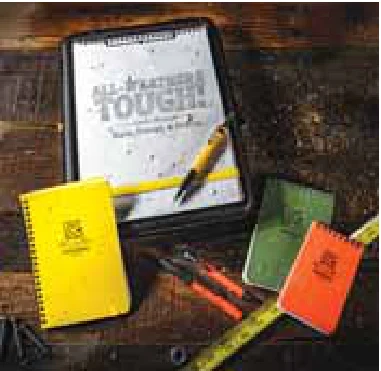
In 1916, while searching for a more efficient way to tally lumber in the Pacific Northwest, Jerry L. Darling came up with a paper coating formula. Dipping one sheet at a time, he and his wife, Mary, created weatherproof paper which came to be known as Rite in the Rain. Over a century later, the patented coated paper is now used to make a variety of paper and notebook products at the Tacoma, Wash., business.
“We know rain and have the only pulp-based, waterproof paper,” says Emily Evans, who works in marketing for Rite in the Rain.
While the notebooks and paper are still useful in the logging industry, the biggest customer is the U.S. military, followed by researchers and all types of industries.
“Our biggest agriculture product is the beef calving notebook and also notebooks for researchers,” Evans says, noting the notebooks are ideal for anyone working outside where it can be wet or dirty.
“If coffee is spilled on it, the paper repels the liquid and you can wipe it up. If it gets dropped in the water, it may get warped, but your notes won’t wash away,” she says. Some customers work in drier environments but deal with dirt, grime and other undesirable materials that can be easily wiped off, thanks to the coating.
Ordinary pens, permanent markers and mechanical and regular pencils can be used. The only exceptions are gel pens or water-based ink pens which won’t write on the coating.
Rite in the Rain’s most popular product is the $3.95 3 by 5-in. top spiral pocket notebook, which comes in a variety of colors and special editions.
Contact: FARM SHOW Followup, JL Darling LLC, 2614 Pacific Highway E., Tacoma, Wash. 98424 (ph 253-922-5000; [email protected]; www.riteintherain.com).
Preventing leaks may be the main reason that farmers and truckers fill their tires with LiQuiTube, but the tire sealant does much more, says Dennis Belanger, sales manager for the Carterville, Ill., company. Made with antifreeze and a proprietary blend of fibers and ground plastic particles, and pumped into a tire after removing the valve stem core, LiQuiTube thoroughly coats the inside of the tire. Then, if the tire is punctured, it quickly seals holes up to 3/4-in. in diameter (in heavy ply industrial tires).
“It stays liquid, with the consistency of a Dairy Queen Blizzard® treat. It takes about a half to one second to seal the hole,” Belanger says.
“Other products dry out, then leak. With us it’s a permanent fix.” U.S-made LiQuiTube has been on the market since 1990 and is commonly used at semi dealerships and in mining equipment. It’s private labeled for companies such as Kubota, Polaris and Toro. The sealant is effective for tires on slower traveling vehicles such as ATVs. For higher speeds on the highway, tires need to have at least a 19-in. rim or be 10 ply (E-rated). For about $10/tire, LiQuiTube premium seals 1/2-in. holes in 10-ply pickup truck tires. The sealant ensures about 90 percent less flats and offers other benefits as well. Tires are better balanced and are never underinflated. And LiQuiTube adds 30 percent longer tire life, partly because tires run 35 degrees cooler in the summer. Because it contains antifreeze, LiQuiTube also works in cold weather.
“What people appreciate most is time savings,” Belanger says.
“Saving down time is huge, above the cost of repair.” Farmers in the midst of harvest don’t have time to waste fixing tires. And truckers hauling livestock through desert areas can’t risk a flat tire, for example. LiQuiTube is non-corrosive and washes off the rim easily with water. It can be found in all the major semi-truck dealerships and at a variety of big box, farm and ranch, and auto stores. It is also available in bulk in 55-gal. drums and 275-gal. totes. In addition to LiQuiTube premium, the company sells Ballast Sealant, a less concentrated version meant to mix 1/10 with calcium chloride, beet juice or other ballast media used in tractor wheels. Contact: FARM SHOW Followup, LiQuiTube, 11521 Kevin Lane, Carterville, Ill. 62918 (ph 303-483-5750; [email protected]; www.liquitube.com).
“The Jerry Clip is designed to eliminate the frustration of not having a writing instrument, which we’re all familiar with,” says Jerry Clip inventor Gerald Mullen.
The idea came about for a simple reason: “I have very narrow ears on the top, and I can’t put a pencil or pen up there without it falling out,” he says.
“Plus, I wear hearing aids.
“I was building a shed behind the house a couple of years ago, and every time I turned around, the pencil slipped out from under the brim of my hat,” he says.
“I wasn’t getting a lot done because I kept looking for my pencil.”
At the end of the long day, Mullen was sitting on his porch and looking at a metal ball marker that golfers use on the course. He thought if the marker could be turned into a U-shape and attached to a hat or glasses with a magnet, a pen or pencil would always be secure.
“We could add it to a hard hat, soft cap, or even the frame of someone’s glasses,” Mullen says.
“That was the genesis of the idea in 2017, and I’ve been working on it ever since.” Jerry Clips can be purchased on the company website.
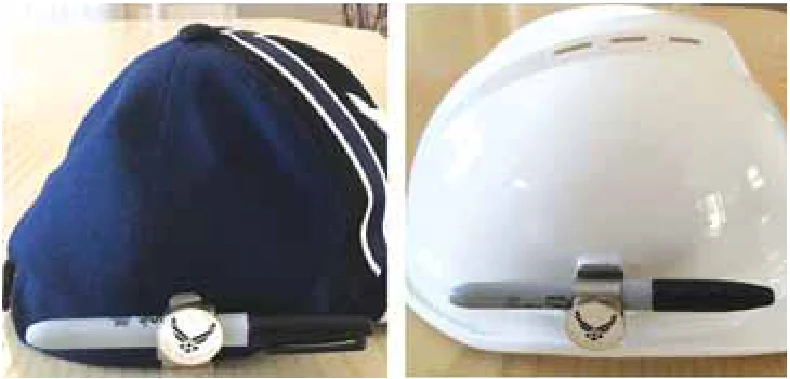
“If you’re wearing a soft hat such as a cap, it attaches right on the sweatband,” he says.
“There’s a magnet inside the sweatband secured by double-sided Velcro tape. The clip attaches to that, and the pen or pencil attaches to the clip.
“If it’s a hard hat, it’s more of a permanent addition to the hat,” Mullen says.
“Double-sided industrial Velcro tape is affixed to The Jerry Clip and the magnet.
The Jerry Clip for eyeglasses is a little different design, but it still attaches at the temple by a magnet.
Mullen, a retired Air Force veteran, can be creative with The Jerry Clip and add a special logo or design on it.
“I have the Air Force logo on mine,” he says.
“If you’re a union member, you could put your union logo on there. If you’re a patriotic person, we could put the U.S. flag on your Jerry Clip.”
The Jerry Clip for a soft or hard hat is $13.91. The eyeglasses clip is $14.79. Sleeves sell at $1.79. S&H is additional.
Contact FARM SHOW Followup, Gerald Mullen, 256 Heather Drive S., Mantua, N.J., 08051 (ph 609-670-5334; [email protected]; www.thejerryclip.com).
When Craig Nelson’s dealer installed a snowplow on his F150 Ford, the control switches were installed on the floor. Using mostly salvaged parts, he soon had them within easy reach.
“I didn’t want to have to bend over every time I adjusted the plow, so I raised them up on a permanent mount at seat level,” says Nelson.
“I used the arm from an old satellite dish and screwed it to the floor of the truck. I picked up a 3-gang electric box at Home Depot and screwed it to small flanges on the arm.”
Before screwing it down tight, Nelson added JB Weld to the union to reinforce the joint.
“The snowplow switches fit the 3-gang box perfectly,” he says.
“Once in place, it is easier to reach the controls than it is to turn on the radio.”
Contact: FARM SHOW Followup, Craig Nelson, 8760 River Rd., Clark Fork, Idaho 83811 (ph 208-266-1526; [email protected]).
Merle Miller builds cabinets, tables and moldings for shops, barns, lake homes, and pool houses. What sets him apart is the Marine-grade polymer building material he uses that makes it ideal for moist environments where wood molds and rots.
“It’s not flimsy plastic,” Miller notes.
“My cabinet face frames are 3/4-in. polymer and the side panels are 1/2-in. thick. I strive to make cabinets that last a lifetime.”
Besides handling moisture, they are easy to clean. Many customers use a pressure washer, for example, to clean shop cabinets. Brake cleaner takes care of grease or stains.
At the same time, the cabinets are attractive enough to put in a home. He also makes sewing cabinets and an 8-ft. pull-out table that stores in a cupboard with leaf storage.
Gray has been a popular color, but Miller has a dozen colors to choose from including wood grain patterns. Using one color for the frame and another for the faces is also a decorative option.
Millers Custom Plastics in Nappanee, Ind., has grown steadily since Miller started his home-based business in 2019. Miller had experience building wooden cabinets as a teen before working at an RV factory. He recognized that plastic was an opportunity to offer something new and would allow more time at home with his family.
He’s already more than doubled his shop size and added a full-time employee. He has many repeat customers and is open to trying new ideas for custom orders.
“I’ve built for milk houses, horse barns and dog kennels. I’ve also built for children’s play areas, where they can clean off crayon and marker with brake cleaner,” he says.
His prices are similar to cabinets made with high-quality wood, Miller says. He ships to other states and works with homeowners and contractors for custom orders. He is in the process of selling wholesale and working with dealers. Besides cabinets and trim, he makes signs, clocks, mirrors and other items out of plastic.
Contact: FARM SHOW Followup, Millers Custom Plastics, 27012 Co. Rd. 50, Nappanee, Ind., 46550 (ph 574-773-0569; www.millercustomplastics.com; Facebook: Miller Custom Plastics).
When Mark Yax needed to replace some rotten wood on his barn this past autumn, he decided to modify his 1,000-lb. rated Harbor Freight motorcycle lift into a man lift scaffold to complete the work.
“I’m getting older, so I didn’t want to work off a ladder,” says Yax.
“I thought if I could put a cage on the lift, I’d be able to safely reach what I needed to.” Yax used an old 2 by 2-in. bed frame for the 6 railings and cage supports and added swing-out gates on either end of the platform for entry and exit. A bracket on one end supports a ladder for him to climb into the raised scaffold. The pump-up hydraulic cylinder to raise and lower the lift is normally controlled by foot pedals, but Yax extended the handles with black pipe so he could operate them by hand from inside the elevated platform. To raise the scaffold higher, he welded 3 by 3-in. square tubing to the underside of the lift for his tractor’s 3-pt. hitch forklift attachment forks to slide into. For extra safety, he drilled holes through the forks and inserted bolts to secure the scaffold. Yax also covered the deck surface with gritty Rustoleum truck bed coating for a non-slip surface.
“I can adjust the front/back tilt and level the platform with the adjuster on the lift arm when the tractor is on a small slope,” he says.
“It raises about 4-ft. in the air and the tractor lifts it another 3 ft. so I can work comfortably at a height of 10 ft. It’s great for painting, cleaning gutters or working on windows.” He says the total cost of the project was about $100 as he already had the motorcycle lift and most of the metal lying around. Contact: FARM SHOW Followup, Mark Yax, Valmark Tool and Machine LLC, 36755 Pettibone Rd., Solon, Ohio 44139 ([email protected]).