From the archive · Full text
Reader shop tip 1 of 3
Keith Fisher
“Instead of using penetrating oil or a breaker bar to remove rusted bolts, nowadays I just use a portable grinder to cut them off. Quick and easy.
Money-Saving Repairs & Maintenance Shortcuts · Printed section pp. 32–35
38 selected entries · Complete text of selected entries
This issue’s section includes reader tips and feature-length shop stories. Held items and editorial notices are not reproduced.
“Instead of using penetrating oil or a breaker bar to remove rusted bolts, nowadays I just use a portable grinder to cut them off. Quick and easy.
“Whenever I can I use stainless steel fasteners and Never-Seez. Avoids the rusted bolt problem.
“After sharpening mower blades, I put vinyl tape on the sharp edges until I’m ready to put them back on the mower. It prevents a lot of small cuts.”
“I used to have a lot of problems with gummed-up carburetors on equipment that gets used infrequently. I eliminated the problem by using Star Tron fuel enzyme before storage. It works much better than Seafoam or Stabil and if you have an engine that’s already gummed up, just remove the old fuel and double dose the new fuel with StarTron. This has saved many a carb rebuild for me.”
“One of the handiest ideas I’ve added to my farm shop is putting in motion detector lights right by where I come in. Not only is it safer and easier when entering the shop, especially when my hands are full, but I can tell after dark if a cat or dog got locked in there because the light will keep going on.”
“Here’s a quick tip that I use all the time around my shop and farm equipment. I buy shrink-wrap plastic in 4-in. wide rolls
and use it to protect all kinds of tools and parts. For example, I wrap up ratchet straps that store under the seat and in the toolbox. If you roll them up nicely, then shoot the ratchet with a little WD40 and wrap them completely with shrink-wrap the straps will stay clean and working like new. Before I started doing this, it seemed like I had to replace straps every year or so.
Source context: This independent tip uses shrink-wrap for storage.
“I also use it to wrap hydraulic lines, covering the end fittings so they stay clean.
If I pull bolts out while working on a piece of equipment but won’t get back to the repair for a while, I just shrink-wrap the bolts to the equipment.
Source context: This independent tip uses shrink-wrap for storage.
When storing garden hose or electrical cords, a couple wraps hold them together. There are thousands of uses and I keep finding them all the time.”
“I set up a battery charging station using an old Dewalt tool case. Using a rotary tool, I cut out the dividers in the case to make room for the chargers, which are held in place by a zip tie. The lid can be closed with the batteries hooked up to the 3 chargers. The chargers plug into a 3-way splitter. This idea solved my problem of daily mess of tangled cords when going to jobsites and then charging batteries at night back at the shop. There’s also room in the case to store extra batteries. The case is fairly weatherproof and most days it’s in the bed of my truck. This is just an easy way to get all my batteries charged for the next day.”
“Here’s a tip I learned a long time ago for an easy way to check points to see if you’re getting a good spark without turning the engine over with a key. Just pull the distributor cap and rotor, pull the coil wire out of the distributor, take a popsicle stick to break the points, and hold the coil wire 1/4 in. away from the engine block. You should see a good spark. If not, replace points and condenser.”
“When the factory spring broke on my garden tractor’s shift lever, the lever wouldn’t stay in place. I came up with a quick fix by attaching a door spring to the housing in a way that keeps the shift lever engaged.”
“I clean out used equine wormer tubes and fill them up with Anti-Sieze lubricant from NAPA auto parts and keep them in my tool bag. I use them to lube any bolt, shaft, or gearbox where rust or moisture is a problem. Works great and is less messy to use.”
“I use old refrigerator produce drawers to store bolts, home clamps, springs, etc. They fit into shelves I made between studs in my shop.”
“Here’s a way to check to see if your radiator is plugged up. Bring your engine temperature up, then get a spray bottle of water. Spray water onto the cores. The tubes that have flowing hot anti-freeze will dry right off.
The ones that are plugged up will stay wet longer. If they’re plugged, drain the fluid and add water, vinegar and a pinch of salt. Run the engine until the plugged cores are all open and then flush and refill with anti-freeze.”
“Replacing a bad fuel line in a small plastic gas tank, such as on a weedeater, can be a difficult job. Over time the fuel line hardens and doesn’t seal properly against the hole where it enters the tank, which allows fuel to leak out. It’s best to pull the fuel line out and replace it with a new one, but the tank’s fill hole is often too small to reach in with a needle-nose pliers. Some older tanks come with a molded-in fuel barb that clamps on, but newer tanks don’t have that.
“My solution is to wrap fishing line several times around the top part of the fuel line and then knot it to keep it from unraveling, which compresses it. I also cut off the end of the line at an angle, which makes it easier to pull and push the line through. I make sure to attach the in-tank filter and weight on the line at the proper length, and then I pull the line out and install a new line. It’s resilient and forms a tight seal. I make sure that the new fuel line is the correct diameter.
“I use an old drop-down lawn fertilizer spreader to apply asphalt sealer on my driveway. I cover all the holes in the spreader with duct tape, except for the metering holes at the bottom. I fill the spreader about 2/3 full and open the shut-off lever. Then I start walking backward so I don’t leave tracks as I go back and forth down the driveway. The sealer drips out of the metering holes in a series of thin strips, and after I’ve covered the entire driveway I go back and squeege the material at an angle to smoothen it out.
“This method is much easier and cleaner than pouring sealer out of a 5-gal. bucket and having it splash all over me. If I’m careful, I don’t even get my feet dirty.
“To avoid leaving footprints, I trace around an old pair of shoes on a piece of plywood and then attach the shoes to the plywood with 1 5/8-in. sheetrock screws. They protrude about 1/4 in. out the bottom of the shoe, so I’m walking only on the tips of the screws.
“When you’re drilling or milling metal, shavings which can fly everywhere and make a big mess. To catch the shavings that come off my drill press, I place a small magnet from an old car speaker on the table around the drill bit. The magnet catches 99 percent of the shavings.
“The photo shows a compound vise that I mounted on the table, which allows me to use the drill press as a milling machine.”
“The sweeps on my field cultivator use 3/8-in. dia. bolts, but I wanted to use a sweep that takes larger bolts. As a result, the square under the head of a 3/8-in. plow bolt wouldn’t take hold. Bolts with oversize heads are available, but I didn’t have any. So I took a couple of larger bolts I already had and drilled and tapped them to 3/8-16. I then cut off the heads and used hex head bolts to mount the sweep.”
“We couldn’t remove the rear wheels on our 1996 Honda Civic no matter what we tried. Then our local mechanic suggested that we carefully and firmly hit the tire – not the wheel – with a sledge hammer. The wheel came right off while I was holding my cell phone with one hand and the sledge hammer with the other.”
“I use GE Silicone Household Glue instead of gaskets because the glue isn’t affected by gas or oil. It’s available on Amazon and at Home Depot, Walmart, and other stores.”
“The engine on my Swisher Trail Mower kept dying while I was mowing. I thought the problem might be that I was going up and down hills with a gravity-flow fuel system, so I made a bracket that’s designed to raise the fuel tank. Problem solved.”
“To keep equipment in top condition, I always grease bearings after I’m done working. It keeps moisture and dirt out while the equipment is sitting around.”
“A large roller bearing failed on my combine. It would have been unsafe to use a torch to remove it. Instead, I used a Dremel tool to cut it off. That fixed the problem.
“I recommend using Never-Seez wherever you can to keep bolts, nuts and other parts from locking up.”
“I bought a Harbor Freight battery-powered polesaw and spotted a small hole near the nose of the bar that was not mentioned in the owner’s manual. I called the company and they said it’s a ‘micro grease port’ for the rotary nose of the bar. Everytime I use the saw, I put grease in the hole until it comes out the other side using a small micro grease gun with a needle nose. I’ve noticed my chainsaw has the same kind of hole on the bar. It makes a big difference in performance of my saws.”
“I needed a swivel hook to use on my engine hoist so I made one out of a piece of heavy-wall steel tubing. I used a 2 1/8-in. long piece of 2-in. sq. tubing. I cut a slot in the top of the tubing for a chain link to slip through. The link is held in place by a 1/2-in. grade 8 bolt with a lock nut. A hook with a threaded shank fits into the bottom of the tubing, held in place with a castle nut and cotter pin so it can’t come unscrewed.
“This swivel is especially handy when removing my quick hitch, which is too heavy for me to lift by hand. Space is very limited in my shop so I was always fighting to keep the hitch from twisting while it hung from the chain. The swivel makes handling much easier whenever I need to turn a load.
“Here’s a tip for whenever you have to wash up outside at a hydrant in the yard after working in the shop. Any cheap soap will work. Just pick up a pinch of dirt to use as an abrasive along with the soap. It’ll all wash off clean when you’re done.”
The article in our last issue on the Zoha grinder disc fitted with chainsaw teeth prompted 87-year-old Niles Schulz of Loweville, N.Y., to send FARM SHOW a photo of a similar grinder disc he made himself about 20 years ago. The Zoha is a 4-in. disc for a hand-held grinder that’s fitted with 22 chainsaw teeth so you can cut in any direction. The cutting disc Schulz made is 5-in. dia. and fitted with 8 chainsaw teeth. He uses it on his hand-held grinder.
“I came up with the idea because a local feed mill needed a wooden handle for a specialized tool they use to move railroad cars into position for loading grain,” says Schulz.
“Over the years I’ve also used it to make several long wooden peavey handles for friends, and to make the handle for a cant hook.” He used a protractor to make a template for the disc, then cut out 2 circular steel plates and bolted them together. A local chainsaw shop made the chain.
“We started with 4 teeth on each side of the chain, but I soon realized the teeth on one side weren’t cutting anything. So we took the chain apart and remounted all the teeth on one side,” says Schulz.
“It’s amazing how well it cuts. The first time I used it in my shop wood chips went flying all over, and since then I’ve only used it outdoors.” Schulz mentioned the FARM SHOW article to a local Amish man, who said that many years ago he used to sell similar grinder discs at a small chainsaw store in Pennsylvania.
“He thought those grinder discs were made for hand-held weed trimmers. He didn’t remember the name of the manufacturer, but said they had to quit production because their insurance company wouldn’t provide coverage,” says Schulz. Contact: FARM SHOW Followup, Niles Schulz, 6714 Buckingham Road, Lowville, N.Y. 13367 (ph 315 376-3460).
Dale McLaen can quickly mount shop tools at a convenient working height, thanks to the receiver hitch-style tool mount he bolted to his shop floor. The 34-in. tall, 2 by 2-in. steel tube is welded and braced to a square piece of steel plate.
“I have several metal working tools that I have mounted on 2-in. hitch tubes with set screws that fit into the receiver tube,” says McLaen.
“The tool holder is mounted solidly to the floor so I can pull or push as hard as I need to. Plus, I can quickly remove one tool and install another.” The base is 1/4-in. thick, 16-in. sq. steel plate. It is mounted to the floor with four 1/2-in. anchor bolts. The upright tool holder is braced with four 1 1/4 by 1/8-in. angle irons. The tool holder mast is 3 by 3-in. square tubing that McLaen “bushed” down to accept the 2-in. square tubing. Set screws are 1/2-in. screw-type bolts with T-handles welded to them. McLaen installed mounting tubes on small and large benders, a rotary sheet metal shear, a 90-degree welding fixture, a 2-in. pipe saw, a paint shaker and a flat iron bender.
“It also works great for a vice when you need to do some serious pulling or pushing and don’t want things moving around,” says McLaen.
“I’ve got other tools too, but anyone who makes one will have their own stuff to mount.” McLaen notes that for some tools he likes to work at a lower height so he can take off a 16-in. upper extension.
“A lower height is just right to shear metal, and the taller height works great with other tools. It lets me work standing straight. I hate stooping over to work on things only slightly more than I hate working on the floor.” Contact: FARM SHOW Followup, Dale McLaen, McLaen’s Service, 13756 Hwy. 11, Rutland, N. Dak. 58067 (ph 701 724-6232; [email protected]).
“I built these heavy-duty, infinitely adjustable roller stands out of angle iron and square tubing. I use them with my drill press and table saw when handling long material. When spaced 4 ft. apart, they provide a sliding surface for moving objects along,” says Dave Sand, Avon, Minn.
“Using one or more of the roller stands, I can make straight cuts on material of virtually any length. A pair of 1/2-in. bolts makes it easy to adjust the height. The bolts squeeze 2 vertical angle irons together to form a clamp.” The stand’s base is made from more angle iron and tubing. To keep the stands from moving, Sand lined them up in a straight line every 4 ft. and then drilled holes in his shop floor. He inserts pins through each side of the base and into the holes to keep the stands straight in line. Sand used the same idea to install adjustable wheeled stands on his chop saw and drill press, allowing him to roll the tool in line with the rollers stands.
“It saves time because I can cut or drill a piece of metal, and then roll it back onto a rack for storage without having to drag it across a sawhorse,” says Sand.
“I recently broke my foot so I set the stands only about 2 ft. high, which allows me to work from a wheeled chair and scoot myself along.” Contact: FARM SHOW Followup, Dave Sand, 11080 Lynn Rd., Avon, Minn. 56310 (ph 320 237-6189; [email protected]).
Old oil filters don’t last long in Dale McLaen’s on-farm auto repair shop. His shop-built, hydraulic crusher can handle even large truck and tractor filters and do it faster than $1,600 commercial alternatives.
“I couldn’t find a commercial filter crusher that was fast enough, tough enough, or big enough for my needs so I built my own,” says McLaen.
“In about 20 seconds, it will crush most automotive filters down to about 1 1/2 in. and most truck filters down to 4 in.” McLaen fabricated the crushing chamber out of 7 by 7-in., 1/4-in. steel tubing. A 6 by 6-in., 3/8-in. square tube piston and a 4 by 9-in. hydraulic cylinder fit inside the chamber. The piston is shimmed with 2 strips of 1/8-in. thick steel on each of its four sides to keep it from binding in the slightly larger chamber. The cylinder pins to clevis-like ears on a plate that fits in the top of the chamber. Two pieces of channel iron are welded to the top of the plate.
“I drilled 2 sets of holes at the top of the chamber for pins that slide through the chamber walls and the channel iron,” says McLaen.
“The pins let me take the plate out or raise it for taller filters by slipping them in the top pair of holes.” An access hole in the side near the bottom of the piston lets McLaen pin the cylinder ram to ears welded to a steel plate welded to the bottom of the piston.
“Pinning the different components together makes it easy to service the crusher if needed,” says McLaen. Most of the steel came from McLaen’s scrap pile or that of a neighbor. The hydraulic cylinder came from an online surplus center, and a local NAPA dealer made the hoses.
“I power it with the auxiliary valve on my skid steer, but any hydraulic pump or set of remotes would do,” says McLaen.
“Oil from the crushed filters drains out of a 1-in. hole in the bottom of the chamber and into a catch pail.” The entire crushing unit is mounted on wheels, with the chamber mounted high enough that McLaen doesn’t have to bend over to slip filters through the access door.
“I can move it out into the open when there are a bunch of filters to crush and out of the way, when it isn’t needed,” says McLaen.
“I can crush 3 small filters or 2 large ones at a time.” He fabricated it in his spare time over a couple of weeks. Oil from the crushed filters is burned in the shop’s waste oil furnace, and the metal is recycled.
“It was fun to build and is even more fun to operate,” says McLaen.
“The total cost was about $900, and most of that was hydraulics.” Contact: FARM SHOW Followup, Dale McLaen, McLaen’s Service, 13756 Hwy. 11, Rutland, N. Dak. 58067 (ph 701 724-6232; [email protected]).
As an owner of businesses that use big trucks and heavy equipment, Kenny McCulley has accumulated an impressive collection of unique and expensive wrenches. But a couple of his “sideways” wrenches caught our attention.
“I bought cheap wrenches (12 and 6-in. from Harbor Freight) and cut off the heads with a chop saw, turned them 90 degrees and arc welded them back on,” says McCulley.
“They work in hard-to-get places, like taking a hydraulic line off.” The low-cost wrenches cut easily, he says, and he’s had no problem with the welded heads breaking off.
“The weld may be stronger than the wrench,” he notes. Contact: FARM SHOW Followup, Kenny McCulley, P.O. Box 133, Happy Camp, Calif. 96039 (ph 707 951-4943).
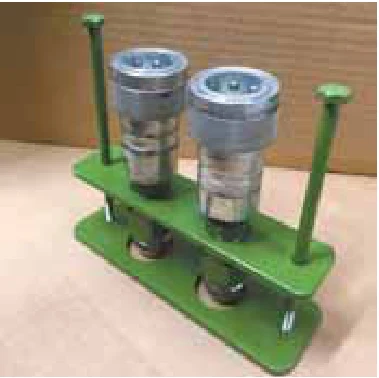
Galen Snoeberger can clean up the hydraulic valve mess often found on older Deere tractors. His kit costs about $100 less than Deere’s fix and takes less than 5 min. to install.
“The little balls in female coupler tips can get worn down, loosening the connections,” says Snoeberger.
“A kit from Deere to redo a valve is around $250. My bolt-on kit is only $150 plus shipping.” Snoeberger has been making the kits for about a year. They consist of male couplers with female extension tips and 2 retention plates with bolts to lock the replacement coupler tips in place. Installation is simple. Insert the male coupler tips and place one retention plate on the back side of the housing and the other over the male tips. Bolt the plates in place with the 1/4-in., 6-in. bolts provided and screw on the female tips.
“Some valve castings have a burr on the back side,” notes Snoeberger.
“They may require longer bolts, or they can easily be ground off.” He explains that his kit can update couplings on older 20, 30 and 40 series Deere’s. When ordering, select the more universal Pioneer-style female coupler tips found on newer Deere tractors. The original Deere-style female tips are also available. Contact: FARM SHOW Followup, Galen Snoeberger, 4413N 275W, Delphi, Ind. 46923 (ph 574 339-7462; [email protected]).
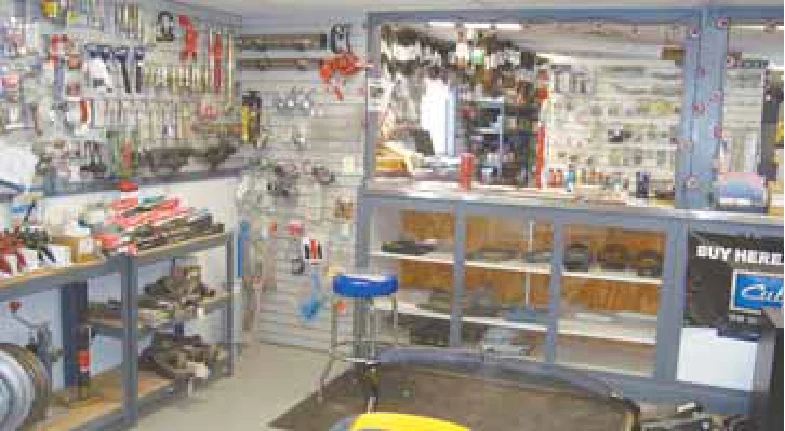
When you need a tractor part, it’s nice to know that the salesman has hands-on experience with tractors and tractor repair. That’s the kind of help Madson’s Service Inc., in St. Nazianz, Wis., prides itself in offering. What started as a tractor repair shop operated by Ervin Madson in 1971, evolved into a service and parts shop that specializes in IH and Farmall but also carries parts for tractors of all colors from John Deere to Ford. In the 1980s Madson’s added new Cub Cadets and parts to its inventory.
“We’re small enough so that everyone wears a lot of hats and knows all parts of the business,” says Scott Madson, who bought into the family business with his wife in 1995. With 10 to 15 outside parts vendors, and a large stock of inventory, Madson’s can get parts for models from 1939 to the present, though they have older model parts as well.
“We really specialize in old restoration parts for collectors - from tune-up parts to sheet metal to clutches and hydraulic pumps,” Madson says.
“We surprise a lot of people with the parts we are able to find. We recently did some mechanical repairs on a Case IH 7140 tractor that was the first production 7140 to be sold to the public. It’s always exciting to work on models or serial numbered tractors that are rare.” Cub Cadets are also popular and make up about half of the business, he adds. While many sales are local, employees who answer the phones are often mechanics who can knowledgeably answer questions and find the correct parts.
“We sell parts all over the world,” Madson says. Contact: FARM SHOW Followup, Madson’s Service Inc., 114 S. 2nd Ave., St. Nazianz, Wis. 54232 (ph 920 773-2661; www.madsonservice.com; [email protected]).
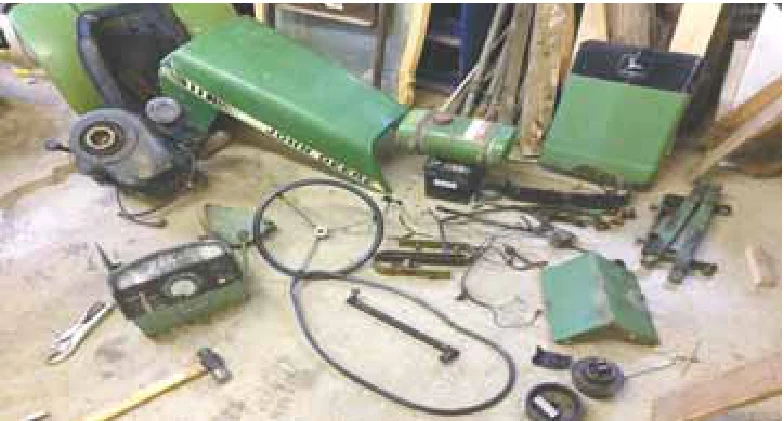
If you need parts for an older lawn or garden tractor, check with HAPCO or Deaven Tractor Parts. If one doesn’t have what you need, the other likely does. Brandon Pfeiffer started restoring a 1966 Deere 110 he bought while in college. He quickly discovered a lot of parts were not available, so he made extras of some parts and sold them. HAPCO grew from there.
“We specialize in parts for Deere lawn and garden tractors that are no longer available,” says Pfeiffer.
“Our mission is to provide our customers with the most authentic reproduction parts available.” Collecting and restoring led to doing a newsletter. Then in 2002 he and his wife Charlotte started a magazine. They were soon joined by now managing editor Kate Goelzhauser. For the first 5 years, they covered just Deere tractors, but in 2007 Lawn and Garden Tractor Magazine expanded to cover all brands (www.lagtmag.com). In a similar way, the parts business has expanded to include used parts and other brands. In the past 3 years Pfeiffer and Goelzhauser acquired Dandy Sales and its Panzer parts and Baird Beaver parts. A redo of the company website will soon list parts from all 3 brands. Inventory includes around 300 different Deere parts, around 700 Panzer parts, and about 100 Baird Beaver parts. It was also a restoration project that got Josh Deaven into the business. His father Bill bought a Ford LGT 100 in 1975 and Deaven grew up driving it. When they started restoring it, one thing led to another. As they worked on the restoration, they found it needed to have a wiring harness made, as well as knobs, the steering wheel cap, and even vibration dampers for fenders to sit on.
“As we found parts that were broken or not available, we tried to reproduce them,” says Deaven. By the time they finished, they had parts to sell. This led to custom restoration work for Deaven and his dad. Deaven, a tool and die maker by trade, and his dad, a small engine mechanic for 30 years, are well-suited for the work. They also continue to make and sell parts.
“We make reproduction parts for Jacobsen-built garden tractors from 1964 to 1976 model years,” says Deaven.
“These models include Minneapolis Moline, Oliver and Ford garden tractors. I try to make what I can or find a source that can. If not, we’ll try to clean up or repair the original.” Deaven tries to have all the small parts that really make a good restoration, noting that a restoration is more than just paint.
“You want to have nice stainless steel bolts, new tires, new tie rod ends and hardware that matches,” he says. In addition to fiberglass molds, Deaven carries about 40 parts.
“A lot of my parts are short-run reproductions. Perhaps 10 to 15 were made, and I’ll have 5 or 6 sitting on the shelf,” says Deaven. Loving to restore a tractor can make finding parts for customers a challenge.
“It’s hard to part out a tractor that may be in better shape than the one you are restoring,” says Deaven. While Pfeiffer keeps around 100 tractors on hand for parting out, he would rather be restoring.
“If I could, I would be restoring tractors all day long,” he says. Both companies are active on Facebook. Contact: FARM SHOW Followup, HAPCO, Inc., 8977 Framewood Dr., Newburgh, Ind. 47630 (ph 812 455-5870; [email protected]; www.hapcoparts.com) or Josh Deaven, 326 Hillside Rd., Elizabethtown, Penn. (ph 717 367-0756; [email protected]).
If you have a wiring harness that’s burned or otherwise damaged, Porch Electric can rebuild or replicate it. The company specializes in not just harnesses, but also in everything electric for tractors – mostly of the IH variety, but they also do custom work. On the gas-powered Farmall M with regulator and battery ignition, for example, there are 10 product listings covering everything from the harness to the fuse housing and fuse, battery cables, rear light cable, and starting switches.
“We ship to every state in the U.S., including Alaska and Hawaii,” says Eric Porch, Porch Electric.
“We’ve even shipped to Canada and New Zealand. We like talking to people doing restorations and helping them out.” If you have the part number, very little conversation is necessary. If you don’t, just go online to the catalog and select the tractor and the series, whether numbered, lettered or in the Super Series, like the Super A, C or M. If lacking key information or just not sure, give the company a call, and they’ll help.
“We need to have the tractor serial number and know whether it’s generator or alternator equipped and gas or diesel,” says Porch. If they don’t have the needed harness on hand, they’ll make it up.
“If a sample can be provided, we can reverse-engineer the assembly,” says Porch.
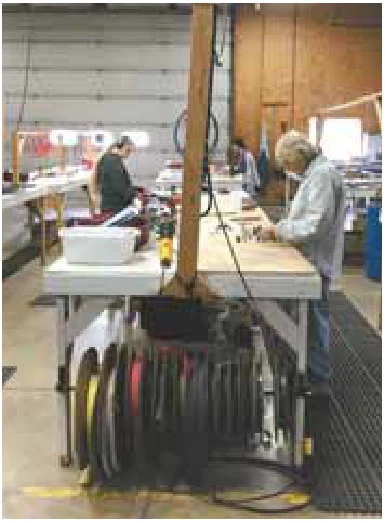
“We can manufacture a custom-made harness that looks like the original OEM specifications. That includes battery cables. We braid 95 percent of them like an OEM harness. We don’t do just a plain Jane cable.” The Porch braiding machine can braid cotton braid over cloth lacquered, covered wire or use a nylon braid. Custom harnesses consist of types and sizes of wire, solder and crimp-type terminals and pins, along with electrical components specified by the customer. Every termination is checked for pull test and crimp height.
“Our most unusual requests come from people wanting to create a homemade tractor,” says Porch.
“Orders can range from a couple of dollars to $1,000, depending on what you need.”
Contact: FARM SHOW Followup, Porch Electric, 205 N Main, Lostant, Ill. 61334 (ph 815 368-3230; [email protected]; www.porchelectric.com).
Retired engineer and pilot Ron Heidebrink has invented a double alternator for use on farm tractors, combines and other vehicles such as trucks, construction equipment and even military vehicles.
“A failed alternator diode that costs just a few dollars can put a big engine out of service quickly, but the redundancy of my double alternator provides electrical backup to keep your equipment running.” The device can be used in single and dual battery vehicle systems using the same space and existing mounting hardware. Heidebrink says his double alternator is actually two complete alternators in a single housing, using a few common parts. It produces multi-voltage output and works with systems from 60 to 440 amps. It’s a patented design with advanced cooling technology, dual remote status indicators, and anti-vibration control. Made with lightweight aircraft quality material, the double alternator doesn’t add extra weight to the mounting bracket. The device produces high idle amperage, can be controlled by internal or external voltage regulators, and has built-in anti-vibration control for reliability. His most popular Double Alternator is the 2J with a J180 mounting, used on retired Military MTV and LMTV Vehicles. It’s a 12/24-volt model producing 160 amps at 14.2 volts, and 70 amps at 27.4 volts. It replaces many of the Niehoff, Delco, Prestolite, Ford, Leese Neville, Chrysler and other brand alternators. Several of Heidebrink’s models in different voltages for the farm and construction industry include an air filter kit that cleans 97 to 100 percent of the air before it enters the alternator. This extends the life of the alternator and allows it to run up to 100 degrees cooler.
“Some people are adding dual alternator kits because their vehicle has options such as heating and cooling systems that drain battery power when the vehicle isn’t running and receiving a charge,” Heidebrink says.
“Those kits require extra brackets along with a new belt and take up more room than my product, which fits on a regular alternator mounting and provides the same benefits in a simpler and more cost effective way.” Over-the-road truckers are also using the double alternator because it allows them to simultaneously charge a 48-volt DC battery and the normal 12 or 24-volt electrical system while the engine is running, then use just the 48-volt system while the rig is parked. Contact: FARM SHOW Followup, Ron Heidebrink (ph 843 756-7007; www.double-alt.com).