From the archive · Full text
Reader shop tip
Robert E. Spencer
“When trying to install a nut in a difficult spot without having it fall off your fingertip, you can hold it in place with a bit of chewing gum on the end of your finger.”
Money-Saving Repairs & Maintenance Shortcuts · Printed section pp. 32–35
38 selected entries · Complete text of selected entries
This issue’s section includes reader tips and feature-length shop stories. Held items and editorial notices are not reproduced.
“When trying to install a nut in a difficult spot without having it fall off your fingertip, you can hold it in place with a bit of chewing gum on the end of your finger.”
“I have a box of cheap wrenches, sockets and other tools from flea markets and pawn shops that I can bend, grind, file, cut, or weld to fit fasteners that would otherwise be impossible to hold or turn. This has saved me a lot of trouble over the years and kept me from needing to ruin one of my good wrenches.”
“I had a problem on a 1980’s Caterpillar V40D forklift that had a leaking “inching” valve (which lets you disengage the transmission without taking it out of gear) that caused intermittent failure when going into forward or reverse. Once my mechanic finally figured out the problem, he bypassed the valve entirely instead of replacing the valve, saving me about $500 or more. I rarely used the inching valve pedal anyway. The forklift has a Hercules engine and has been a good machine with just one engine rebuild in more than 11,000 hrs. of use.”
“You can save time and prevent messes by freezing wet paint brushes instead of cleaning them off each time you use them. Just thaw them out next time you want to get back to work.
“To save time, I write the oil type, filter model, and wrench size needed on the wall near my tractors in our machine shed.”
“When I’m trying to solve problems on my older Ford and Farmall tractors, I get a lot of help from people at Yesterday’s Tractors, which is a website forum with lots of good folks (www.yesterdaystractors.com). One of the things I got help with was putting electronic ignition on all my old tractors and REO trucks.”
“I have found that sometimes I can repair an item or tool by wrapping with string or nylon cord and then saturating the cord with super glue. Makes a long lasting, solid repair.”
“When pushing new brake lines through the frame on cars or trucks, I put a spent shell casing on the end of the line to keep out dirt. There’s a shell casing that will fit any size line.”
“When loosening the fan belt on my Farmall, I spray soapy water on the belt with an old spray bottle. This slips the belt against the pulleys so it’s easier to work with. You can rinse it off when you’re finished.
“I use WD-40 to clean gas, diesel and grease off my hands, then wash with soap and water. WD-40 is water soluble so it comes off easy, yet mixes with petroleum.
“I welded short pieces of pipe to a piece of angle iron that I mounted crosswise on the post holding up my vise. This makes it easy to keep a variety of hammers close by.”
“I was talking to a farmer friend recently about how to limit fires on combines. Many farmers use a leaf blower to clean off any debris that might catch fire.
“He told me he takes a different approach, especially because he runs an older machine. He bought a hand-held infrared thermometer and when he stops at the end of the day, he walks around the machine pointing it at bearings and other parts to see if anything is running hot. When he finds a hot spot, it usually means a part needs to be replaced.”
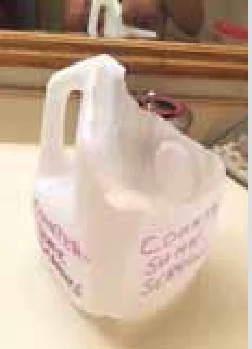
“This is not a new idea but maybe some folks haven’t heard of it. Large 1-gal. milk jugs work great to store small parts. Cut a large opening in the container, leaving the handle intact. I label the contents with a permanent marker. I separate all the bolts in the containers by thread size - coarse or fine, metric or SAE, etc., and store the containers on 8-in. deep shelves.”
“A machinist friend and I built this overhead crane that pivots 180 degrees from side to side. I’m disabled and can’t lift anything so it’s one of the handiest tools in my shop. A trolley and chain hoist run on a track made from a 6-ft. long, 4-in. I-beam. The track is free to swivel on a bushing mounted high on a 10-ft. steel post.
“The crane is located near one wall of my shop where I keep most of my tools. To move the crane around I just pull on the chain hoist. It’s more convenient to use than a portable floor hoist because there aren’t any legs in the way. It’s a life saver for lifting objects weighing up to 800 lbs. or more. The photo shows the crane lifting a 150-lb. ‘power pack’ that mounts on my tractor’s 3-pt. hitch.”
“For 25 years I did maintenance work on rental homes at a local college, so I’ve seen a lot of clogged drains in sinks and bathtubs. Usually I was able to use a shop vac with a 1 1/4-in. dia. hose to handle the problem. I removed the stopper and plugged the vent hole with my finger, then placed the vac over the drain to suck out the material. Rarely did I have to use a chemical drain cleaner or a ‘snake’. Besides, if you accidentally drop a wedding ring down the drain a chemical drain cleaner won’t help get it out.”
“I was using my riding mower recently and turned off the engine so I could pick up some sticks in the yard. When I got back on I couldn’t get the mower started.
“I opened the hood and found that an eyelet on the end of a cable from the battery to the starter was broken. I didn’t have a new eyelet that large so I made one using a 2-in. long, 3/8-in. dia. soft copper pipe. I hammered one end of the pipe flat and drilled a 5/6-in. dia. hole through it, then soldered it to the battery cable. I was back mowing in just 20 min., and it saved me a trip to town.”
“I use my table saw a lot for projects using mostly 5/8 and 3/4-in. thick oak and other hardwoods.
I have to make a lot of 90-degree cuts but was having trouble keeping my saw guide at precisely 90 degrees on repeat cuts.
“To solve the problem I bought a 3-ft. length of 3/4-in. wide, 3/8-in. thick hot rolled steel and a length of 2-in. channel iron. It serves as a cross piece. I carefully squared up the 2 pieces and then arc welded them together. I’ve made 3 different saw guides this way - one for 90-degree cuts and the others for 45-degree cuts.
“My homemade saw guides are a real time saver because they eliminate the need to ever check the angle degree. I bolted a long 3/4-in. thick board onto the channel iron that extends over the edge of the table saw and serves as a handhold. As I’m working I hold onto the board with both hands to make sure I get a nice, square cut. The board can easily be replaced if I happen to nick it with the saw.”
“Ever lost the filler spout cap on a 5-gal. fuel can? A 1/2-in. pvc cap makes a great substitute.”
“To weld cast iron I use Weldcote Nickel 99 cast iron electrode repair rods (weldcotemetals.com). I cool off the cast iron in dry sawdust.”
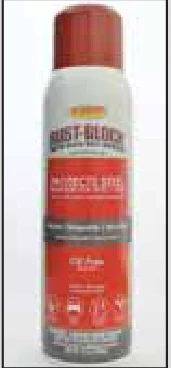
Evapo-Rust water-based rust inhibitor is now available in an aerosol can. The aerosol makes it easy to evenly coat the surface of any object by just spraying it at any angle. It’s sold only at O’ Reilly Auto Parts (www.oreillyauto.com).
“Mud was plugging the gauge wheels on my no-till planter, so I drilled four 2-in. dia. holes in the wheels so the mud can escape.”
“I made a tool that fits into the receiver hitch on my pickup and lets me raise the deck on my 54-in. riding mower up off the ground so I can service the blades safely while standing up. It uses a hand-cranked boat anchor winch equipped with a 4-ft. nylon strap, with the winch bolted onto a vertical 4-ft. length of 2-in. sq. tubing. The tubing is welded at a 30-degree angle to a shorter length of tubing that fits into the receiver hitch. The joint where the 2 tubes are welded together is reinforced with scrap metal. I welded a small hook on front of the mower frame.”
“The drive pulley on my Ford flail mower worked loose and stripped the splines, so I had it replaced with a Browning clamp-on spline hub (www.applied.com/c-browningshq1hub/p/100790189). Bergman Electric in Auburn, N.Y., performed the work. The pulley was held in place by a snap ring, and once it worked loose I couldn’t find a way to secure the pulley. A factory replacement pulley would have cost about $300. The Browning clamp-on spline hub was still a fairly expensive solution but it solved the problem.”
“Trying to hold any kind of round stock, such as small pipes and bolts, in place in my vice is much easier since I cut shallow matching grooves into both vice jaws. I used a grinder to make one horizontal groove, 2 vertical grooves, and another groove at the end of each jaw face at about a 45-degree angle. Problem solved.”
“I am a retired welder who needed a hobby. My wife and I started doing a variety of crafts which need spirals, springs, rings, and other twisted metal. I decided to make a machine to produce them.
“I needed a gearbox that would be powerful, but slow. I used a gearbox out of an old lift chair and drive it with a 1/2-in. drill.
“I can twist or wrap steel rods and make all kinds of springs or rings for many types of projects. I’ve made a variety of jigs out of conduit or pipe. I can turn anything from 1/8 to 1/4-in. dia. rod on jigs up to 1 1/2-in. dia.
“The stock to be twisted is stuck through a hole in one end of the jig, which is then turned slowly by the gearbox. Tightness of the spiral is controlled by the operator. To make rings, I simply make one complete turn, cut off the stock, and flatten it out. Tightness of the spiral is controlled by the operator.
“Word has spread among friends and neighbors about what this setup will produce so I now make things for other people. It works great and saves a bunch of money as well as trips to town.”
“I spotted a discarded fire hose reel at our local transfer station and figured I could put it to good use as a big air hose reel.
“I like to do work all over my yard – not just in the shop. My portable air compressor is not big enough to run tools or blow up big tires. So I decided to use the fire hose reel to load up a long air hose.
“I figured that if the fittings on the reel could contain water, they would probably also hold air. And they can, with only a little bit of leakage. I had to rework the fittings to fit the air hose and loaded up about 125 ft. of 1/2-in. hose. The reel could hold a lot more so I’m planning to increase the total length to about 300 ft.
“When I’m done, I roll up the hose by hand – mostly because I need the exercise. It would be easy to add an electric motor and chain to drive the gear that’s still in place on one side. The entire reel mounts on a hand cart so it’s easy to move around.”
A tool invented by Michael Sharpe of Greenfield, Tenn., makes releasing pressurized hydraulic couplers as easy as turning a bolt. The tool makes use of the following parts: a female ISO hydraulic coupler, a 3/8-in. flange nut, a 3/8 by 2 1/2-in. bolt, a 1/8-in. pipe elbow, and a 2-in. long, 3/8-in. dia. round bar. To build the tool, Sharpe uses a needle nose pliers to unscrew and remove the internal components from the coupler, leaving an open barrel that will couple onto the hose under pressure. The next step is to weld the flange nut upside down into the coupler’s threaded opening. Sharpe welds the 2-in. long round bar horizontally to the top of the bolt to make a “T”. He inserts the bolt into the nut so it extends down far enough to reach into a coupler. He also drills and taps a hole in the side of the coupler to insert a small pipe elbow. To use the tool, he connects the coupler to the hose and then gently screws the bolt in until it contacts the ball in the center of the coupler tip to relieve the pressure. The fluid comes out of the pipe elbow and can be collected in a Dixie cup.
“Make sure you don’t screw the bolt down far enough to damage the coupler. You can prevent that by trimming the bolt length,” says Sharpe.
Contact: FARM SHOW Followup, Michael Sharpe, 688 Puckett Rd., Greenfield, Tenn. 38230 (ph 731 431-7354; [email protected]).
“I got tired of wearing out my arm stirring paint cans. So I came up with an automatic paint can shaker that saves a lot of time and hassle,” says William Hettler, Federalsburg, Md. A 1/3 hp electric motor belt-drives a right angle gearbox to reduce the speed. Hettler cut a groove next to the hub of a small pulley on the gearbox and welded in a vertical bolt, on which he installed an idler pulley with ball bearings. He bolted a metal plate on top of the idler pulley and then bolted a pitman arm to the plate. The pitman arm pushes and pulls a home-built metal basket that’s sized to hold a 1-gal.
paint can. The basket is welded to a pair of heavy duty hinges that pin onto the end of the pitman arm.
“It works great. I made it last spring and have already used it a lot,” says Hettler.
“The pitman arm pivots back and forth on the idler pulley, which causes the basket to rock back and forth about 2 in. I used light duty angle iron to make the basket and use a bungie cord to hold the paint can in place. The whole assembly mounts on a board that’s easy to move around.” Contact: FARM SHOW Followup, William Hettler, 5816 Davis Mill Pond Rd., Federalsburg, Md. 21632 (ph 410 754-0005).
Herman Vander Vos doubles the life of his chopsaw blades with a shop-built saw. The 14-in. dia., carborundum metal cutting blades on his heavy-duty chopsaw have to be replaced when they wear down to 8 in. Now he puts them back to work.
“I used a mandrel on an old belt-drive emery wheel as a mount for a worn down blade,” says Vander Vos.
“After removing the emery wheel from the mandrel, I mounted the motor and pulley on a 2 by 12-in. board.” The worn down blade has a 1-in. center hole that has to be reduced to 1/2 in. to fit the mandrel. Vander Vos uses a 1/2 in. bit to enlarge the center of a pair of 1-in. dia. washers. He slips the washers into the center hole of the blade and mounts it to the mandrel.
“The washers fit snugly and keep the blade perfectly balanced on the mandrel,” says Vander Vos. He uses a couple of short 2 by 4’s as a rest for the metal being cut. They have a channel cut part way through them just large enough to admit the free-turning blade.
Vander Vos notes that the mandrel speed should be over 3,500 rpm’s.
“It makes an excellent cutting tool,” says Vander Vos.
“It gets more mileage out of a blade and sure beats using a hacksaw on small jobs.” Contact: FARM SHOW Followup, Herman Vander Vos, 7034 Nash Rd., Bozeman, Mont. 59715 (ph 406 587-0271).
Longtime FARM SHOW reader Edwin Jordan says he has an easy way to prevent oil and liquid spills if you don’t have a funnel handy. Don’t remove the aluminum seal on the bottle of chainsaw bar oil, antifreeze, motor oil, or other products, he says.
“I use my pocket knife to make a hole big enough to get a good stream going, and make another small vent hole for air,” he says.
If the container doesn’t have a seal, you can just make holes in the cap, and cover them with tape for storage if you don’t use the entire bottle, Jordan suggests.
“It works especially well when you’re shooting at a small target, like a chainsaw or lawn mower.” At 87, Jordan says he has been a jack-of-all-trades and doesn’t like to waste anything. Not spilling oils and liquids also saves time as there is no mess to clean up.
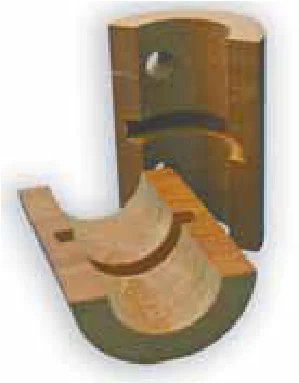
“Wood bearings have been used since wheels were invented and they’re still used today in equipment ranging from combines to water turbines and even nuclear submarines,” says Starkey Steuernagle, general manager of Woodex Bearing Company in Maine.
“Even though there are all kinds of metal, composite and plastic bearings, we still supply standard-size roller, hanger, spherical and custom wood bearings.” Steuernagle says Woodex bearings provide the least abrasive surface for metal shafts and they don’t usually need oiling. They’re made from rock maple, which woodworkers know as hard maple and maple syrup lovers know as sugar maple. Rock maple has the perfect composition for bearings because its cell structure is like tiny “straws” that store oil for lubrication. Before Woodex bearings are cut, the raw wood is infused with lubricant using a heating and cooling process. Its bearings are made using antique lathes more than 125 years old, modern CNC equipment, and several hand tools. Hand-drawn plans and 3D software configure the company’s standard and custom designs. Steuernagle says, “After wood bearings are installed and put to work, they warm up from friction, which allows capillary action to move the lubricant to the shaft. When the machine is turned off and the bearing isn’t in use, the oil cools and flows back into the wood, ready to lubricate the next time.” Woodex began producing bearings for farm equipment many years ago because of an unusual request. One morning employees arrived at work to find a rusted old disc harrow parked in front of their shop. A note attached asked the company to fit the machine with new bearings, which they did. Later the company began making replacement bearings for a Ferguson tractor club. Today they make bearings for antique disc harrows, cultivators and cultipackers. Steuernagle says modern farm equipment, including the straw walkers on combines, still use wood bearings, although many of those are mass produced in China.
“Woodex has a rich history and a long-standing tradition of customer satisfaction,” says Steuernagle. The company began in 1905 as a trademark of the Neveroil Bearing Company, which produced bearings for New England’s textile industry. As those businesses moved south, or overseas, Woodex moved north to Maine, where today the employee-owned company thrives.
“Our 30 Woodex employees create affordable and precise wooden bearings,” Steuernagle says. Contact: FARM SHOW Followup, Woodex Bearing Company, 216 Bay Point Road, Georgetown, Maine 04548 (ph 207 371-2210; www.woodexbearing.com).
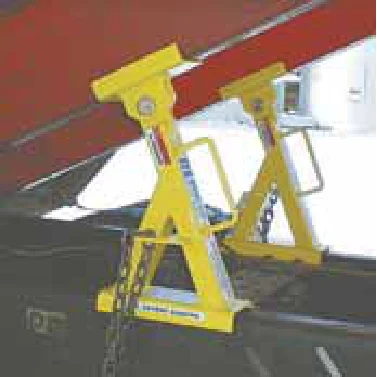
“I built the Gate-Lok safety bar after a customer told me one of his employees was killed when the endgate on a gravel truck slammed shut on him,” says Mike Krall of Work Safe USA, Inc.
“It’s a simple idea that I’m amazed wasn’t out there before.” Krall’s patent-pending device secures a truck endgate in the open position for unloading or during maintenance. The standard size is a 40-in. metal bar made for full-size dump trucks and trailers. The “shorty” is 38 in. long and works for one ton and ton-and-a-half contractor dumps. Both are priced at $160. Krall started his business in 2007 with a safety lock to hold up truck boxes. At the time he was a city maintenance supervisor who observed an employee using a 4 by 6-in. wood beam rather than a metal prop rod to hold up a truck box. The beam slipped on the oily truck frame and instantly Krall knew there had to be a better way to support the box. He searched the internet and found a dump bed lock invented by a truck driver in Wisconsin.
“I wanted to buy a set, but he said he couldn’t get them built so I made a deal to produce them, even though I didn’t know anything about doing that. Several months later I found a manufacturer and the rest is history. In 10 years we’re up to 300 dealers who’ve sold 10,000 Dump-Loks in the U.S., South America, New Zealand and Europe.” Krall’s success story doesn’t stop there. While touring a fire department he noticed a mechanic working on a truck engine with a flimsy rod holding up the cab.
“I chewed the guy out for not being more safety conscious, and he told me that’s the way it’s always done,” says Krall. The next day we started working on our Cab-Lok, and that’s been a great product too.” The company also produces the No-Jack, a device that mounts on a self-loading wheel lift so wreckers can safely lift a disabled vehicle without a jack.
“All our stuff is common sense safety equipment that protects workers and helps employers meet OSHA guidelines,” says Krall.
“This year we’re starting a re-certification program for older model Dump-Loks. We’ll check the welds, bolts, chains and holding plates, then repair and re-certify the product at no cost. If our products save one injury or one life, then I’ve done my job,” says Krall. Contact: FARM SHOW Followup, Mike Krall, Blue Ribbon Safety, P.O. Box 138, New Berlin, Ill. 62670 (ph 217 891-1674; www.dump-lok.com).
Norm Bennett got tired of constantly having to deal with dead batteries so he designed a system that uses a single trickle charger to maintain up to ten 12-volt batteries at the same time. The system consists of a Stanley FatMax 8-amp battery trickle charger; two 10-ft. lengths of 12-ga. wire – one red and one black; and 10 positive and 10 negative 3-in. clamps. He lines the batteries up in a row with all the polarities on the same side. The largest battery is first in line and the smallest battery is last. The batteries are spaced about 1 ft. apart and sit on a 2 by 8 board. He soldered the negative clamps about 1 ft. apart on the negative wire, and the positive clamps 1 ft. apart on the positive wire. One clamp attaches to each battery.
“The trickle charger maintains each battery’s charge all the time instead of letting it go dead, which is hard on a battery and reduces its efficiency and its life span because sulphation builds up inside,” says Bennett.
“I came up with the idea because I had been storing a lot of batteries from various vehicles during the winter, and I needed 10 different trickle chargers just to keep them charged. Now all I need is one 8-amp charger.
“I’ve used this idea for the last 3 years on batteries off everything from pickups to boats, 4-wheelers, Jet Skis, riding mowers, tractors, and so forth, and have never failed to keep a battery charged.” Bennett says the trickle charger senses each battery’s voltage and reduces the amperage as needed according to the battery’s voltage and charging capacity. He paid $28 for the trickle charger and about 50 cents apiece for the clamps. Bennett also uses the system to charge batteries on accessories that are designed to plug into a vehicle’s cigarette lighter.
“For example, I use a 12-volt portable DC cooler to keep drinks cool when I travel. The day before I go on a trip I put the cooler in line with the other batteries and charge it up. The next day it’s ready to go.” Contact: FARM SHOW Followup, Norm Bennett, 188 Drown Mill Rd., Newport, Vt. 05855 (ph 802 624-0720; [email protected]).
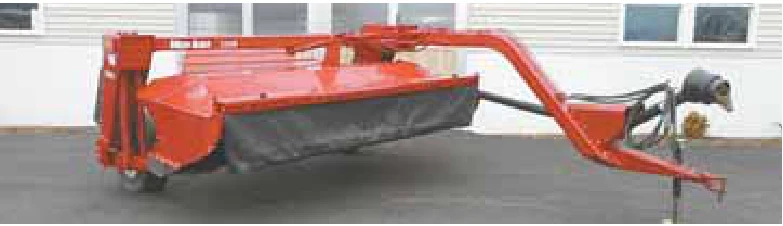
“The name Discbine Doctor is easy for people to remember when they need good used parts or a used machine,” says “Doctor” Mark Beiler, Ronks, Penn.
“Since I started the business in 2010 we’ve sold parts in most U.S. hay-producing states as well as in Canada and Australia.” Beiler says his used parts inventory comes from old machines that he buys at auctions or acquires from dealers as salvage.
“We stock new and used parts such as wear plates, wear shoes, cutter bar parts and blades for most major makes and models,” Beiler says.
“We have several different roll replacement options, including aftermarket steel rolls and rubber roll recovering. We also sell drivelines, pto shafts and constant velocity shafts.” In addition to its parts business, Discbine Doctor reconditions and sells about 20 to 25 used discbines annually. Says Beiler, “We thoroughly clean and lubricate every machine and replace parts that may be a problem for the new owner. Our goal is to sell used machines in the best condition possible.” Beiler had no intention of starting a repair or parts business when he bought a 10-year-old Deere 1460 for his own farm in 2003. He repaired it, realized the machine was too large for his operation, then sold it and did the same with 2 other machines.
“Feed prices were high and milk prices were low, so the work became a good source of extra income,” Beiler says.
“Early on I worked mostly on local machines, but word-of-mouth, and ads on TractorHouse.com have given us great exposure.” Now he has 2 fulltime mechanics and his 3 sons help pack and ship parts during the busy summer months. The shop also does welding and repairs on other farm equipment for local farmers. Contact: FARM SHOW Followup, Discbine Doctor, 68a S. Weavertown Rd., Ronks, Penn. 17572 (ph 717 768-7542; www.discbinedoctor.com; [email protected]).
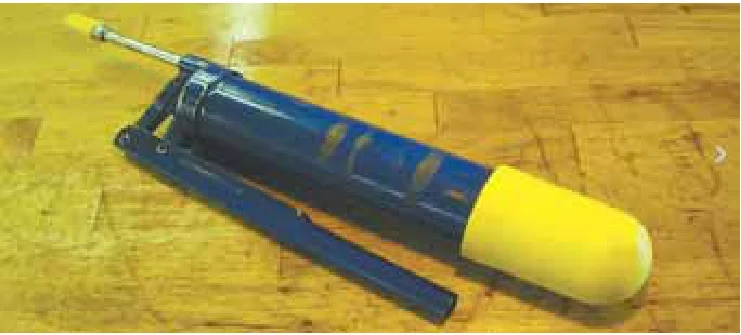
This new grease gun cap collects grease that drips from your grease gun and also acts as a priming bulb and dust cover. It’s designed to fit battery-powered grease guns as well as manually pumped guns. It’s custom molded from heavy-duty, mold-resistant nytro rubber and slides over the barrel of the grease gun. You can use the cap to prime the grease gun by pressing against the bottom of it to move the grease up into the cone. When you want to change the cartridge, just remove the Gundom and wipe it out and then put it back. One advantage is that it fits snugly to collect drips when you’re working with the grease gun or when it’s being stored. It also protects contaminants from getting into the grease if you accidentally drop the gun in dirt. Available in 2 sizes. The magnum fits grease guns with a 14-oz. cartridge and the mini fits guns with a 3-oz. cartridge. Both models sell on the company website for $9.95 including S&H. It’s also available on eBay and at www.locknlube.com. It comes in 5 different colors - red, blue, yellow, green and orange. The different colors can be used to identify the grade of grease in the grease gun.
Contact: FARM SHOW Followup, Michael Koch, Deep Fork Machine, Inc., 18100 E. Coffee Creek Rd., Luther, Okla. 73054 (ph 405 613-6964; [email protected]; www.deepforkmachine.com).
Moving big shop tools in and out of his garage is an easy job for Gene Williams, since he mounted them on a 4-wheel cart fitted with caster wheels. The cart carries a vise, drill press, and grinder. He moves it with a metal pull handle attached to one end.
“I’m semi retired and we recently moved to a smaller place. As a result, I went from a big workshop to a 2-car attached garage,” says Williams.
“I didn’t want to give up all my tools and didn’t want the drill cuttings and grindings falling on the garage floor to track into our house. I roll the cart out to the edge of our driveway to do my work and use air to blow any debris toward the yard.”
He already had a metal framed cart with locking caster wheels. He mounted an oak pallet on top of the cart and added a 1/2-in. thick steel plate on top of the pallet, to which he lag-bolted the tools.
“I didn’t need to use such a heavy steel plate, but it was what I already had and it makes a heavy, solid base,” says Williams.
“I drilled holes in the plate and lag- bolted through them to the pallet. I mounted the drill press on a 2-in. thick wooden block so that it sets up higher and I can drill longer pieces.” Contact: FARM SHOW Followup, Gene Williams, Jr., 1903 College Ave, Vincennes, Ind. 47591 (ph 812 890-1530; [email protected]).
“We diagnose problems fast, give people a fair estimate, and get the work done quick, because truckers need to get back on the road as soon as possible,” says Norma Vaughn of Kankakee Spring and Alignment. The Illinois business that she, her brother, and 2 sisters have owned since 2002 has been meeting that goal for 75 years. Vaughn says, “We work on trucks big or small and have seen them all.” One of their busiest pieces of equipment is the Bee Line Laser Computerized Alignment System. It can handle any make of car and truck up to 16 tons per axle.
“Proper alignment can save 2 percent on fuel costs, add thousands of miles to the life of tires, and greatly improve handling on any vehicle.” The company also replaces coils, hangers, shackles, and broken springs. They align axles on big rigs, press drive shafts, make custom U-bolts, and do “all of the tough stuff that many others avoid,” Vaughn says. One of their employees has 45 years experience and can expertly custom-make leaf and coil springs. Kankakee can repair or rebuild the suspension for any vehicle, from a small car to commercial-grade trucks, tractor-trailers, and farm equipment. They sell a wide range of suspension parts, helper spring kits, and complete air suspension kits. Vaugh says they also have springs for obsolete vehicles that customers might be restoring. Contact: FARM SHOW Followup, Kankakee Spring & Alignment, 88 West Issert Drive, Kankakee, Ill. 60901 (ph 815 932-6718; www.kankakeespring.com).
“I had to pull 3 wires through 400 ft. of 1 1/4-in. dia. underground black plastic pipe. To get it done, I tried an unusual method,” says Roy Ringler, Goshen, Ind.
“I tied a knot in a plastic shopping bag so it would fit into the end of the pipe and tied 400 ft. of string to the bag. Then I went to the other end with a shop vac and sucked the bag and string through. Then I tied the 3 strands of wire to the string and pulled them through. The idea worked great.” Contact: FARM SHOW Followup, Roy Ringler, 25417 County Rd. 40, Goshen, Ind. 46526.