Practical ideas from FARM SHOW MagazineSubscribe · Free issue · Send us your shop tip
Subscribe to FARM SHOW
Issues / Vol. 37, No. 4 (2013)

Vol. 37, No. 4 (2013)

Money-Saving Repairs & Maintenance Shortcuts · Printed section pp. 36–39

37 selected entries · Complete text of selected entries

This issue’s section includes reader tips and feature-length shop stories. Held items and editorial notices are not reproduced.

Archive text: prices, coupons, availability and contact details reflect the original publication, not current offers. Reader methods are not universal instructions; follow manufacturer guidance and proper safety practices.

Reader shop tips

From the archive · Full text
Reader shop tip

Ronald Post

Ronald Post, Celina, Ohio

“To remove a stubborn bearing from a shaft, I come in sideways with an air hammer where the set screw is. The screw will pop out and split the collar. This is a far better way than using a torch. Wear safety goggles because the pieces can shoot out.”

From the archive · Full text
Reader shop tip

Robert Boddy

Robert Boddy, Bloomingfield, N.Y.

“I mounted an electric generator to the base of a push lawn mower. It makes moving the generator from place to place much easier. Real handy.”

From the archive · Full text
Reader shop tip

Paul Seward

Paul Seward, Wray, Colo.

“I often use a squirt of ether to get older engines started. I’ve found that warm ether ignites much better than cold. Makes a lot of difference. Engine just comes alive right away. Cold ether is more caustic to the metal surfaces. In the winter, just keep your cans somewhere warm rather than outside in a cold shop.”

From the archive · Full text
Reader shop tip

Anonymous

Anonymous, Richmond, Va.

“Bar chain oil for my chainsaw is about $25 a gallon. So I use old motor oil. After I change oil in a car or truck, I let the oil sit for a day or so in the sun and then pour off the top 3/4 of the jug to use in my chainsaw. The lubricating properties of the oil are still plenty good for a saw.”

From the archive · Full text
Reader shop tip

Chad Travis

Chad Travis, Drasco, Ark.

“I made a wheeled bucket stand for a local auto garage. It’s designed to support a 5-gal. bucket of fluid 3 1/2 ft. off the floor, which makes pumping fluid into gearcases a much easier job when the vehicle is up on a lift. One person can hold the hose in the gearcase fill hole and pump in fluid, without having to reach down to the floor.

“The stand’s center support is made from a 2-ft. length of pipe welded to an angle iron base. The bucket rests in a tray made from 1-in. angle iron and 10-ga. sheet metal. The back support is made from 1/4 by 1-in. flat strap bent in a half circle.

“You just roll it under the vehicle. The raised stand makes the bucket much easier to reach than if it was on the floor.”

From the archive · Full text
Reader shop tip

Myron Ashcraft

Myron Ashcraft, Gold Beach, Ore.

“Here’s a quick, simple way to air up tubeless tires. Jack the wheel up to clear the ground. Wrap a loop of steel cable on a come-along around the tire and through a heavy-duty washer. Hook both ends of the come-along in opposite directions and in line with the centerline of the tire. When it goes through the washer this way it’ll form an X.

“Then use the come-along to squeeze the tire until it seals to the rim. Fill the tire with 10 to 15 lbs. of air before releasing the come-along.”

From the archive · Full text
Reader shop tip

Reuben Miller

Reuben Miller, Nappanee, Ind.

When he bought a load of concrete forms, the old enclosed semi trailer that delivered them came with the deal. They removed one wall and created a shelf inside the remaining shell, mounted on an angle iron frame. The heavy- duty shelf works great for holding skidsteer attachments and bulky or heavy parts. They removed the wheels from the trailer.

From the archive · Full text
Reader shop tip

David Clark

David Clark, Rome, Penn.

“My septic tank is more than 30 years old, and I was worried the tank would soon rust out and fail. I didn’t want to spend thousands of dollars to replace it. Also, according to the law here I would have had to install a new sand mound at a cost of about $6,000, as well as a new pump. So to save money I had the tank pumped out. Then I lined the entire inside of the tank with mobile home vinyl skirting which I bought at a mobile home supply store.

“The skirting comes in 12-ft. long, 13-in. wide panels which slide together. I used a saw to cut the panels down to fit the 5-ft. deep tank. Then I drilled holes in the panels, slid them together, and screwed them to the tank, bypassing the tank’s metal baffles. My son handed the skirting down to me and I screwed it on. The job took about 2 1/2 hours.

“It turned out the tank was still in pretty good condition, but I’m glad I added the vinyl skirting. It won’t rust or rot and should greatly extend the tank’s life.

“It was a messy, smelly job, but then I’m 83 years old and my smeller isn’t as good as it used to be so it wasn’t so bad. I bought 5 sheets of mobile home skirting at $12 per sheet and paid $220 to have the tank pumped out.”

From the archive · Full text
Reader shop tip 1 of 2

Mike Kellett

Individual tip 1 of 2 from this reader’s published contribution.
Mike Kellett, Sublette, Kan.

“When the rechargeable batteries on a power tool go bad, I take the tool apart and solder a coiled cord to the contacts inside the handle. I have a one-way plug in my pickup bed that’s connected to the battery, and I also carry a garden tractor battery with the same plug to make it more portable. A fully charged battery will last for days of hard use. I’ve found that 12, 14, 16, and 18-volt tools all work well on automotive 12-volts.

From the archive · Full text
Reader shop tip 2 of 2

Mike Kellett

Individual tip 2 of 2 from this reader’s published contribution.
Mike Kellett, Sublette, Kan.

“I use my leaf blower constantly in the shop to dry spills, sweep in hard-to-reach places, clean out combines and tractor cabs, blow dirt off clothing, dry paint and even to discourage stray cats and other varmints that wander into the shop. I also use it to dry out wet boots, and to pull noxious fumes away from me when welding galvanized steel.”

From the archive · Full text
Reader shop tip 1 of 2

George Kronbach

Individual tip 1 of 2 from this reader’s published contribution.
George Kronbach, Yulee, Fla.

“My 1988 Chevrolet 3500 diesel pickup would start only if I sprayed ether in the air intake.

I got tired of having to remove the air filter cover and trying to re-install it on a running diesel engine. To solve the problem, I drilled a 1/2-in. dia. hole in the air filter and then installed a tire valve without the core. Now I simply take the cap off the tire valve, insert the straw supplied with the can of ether, and spray. I don’t have to take off the air filter cover at all.

From the archive · Full text
Reader shop tip 2 of 2

George Kronbach

Individual tip 2 of 2 from this reader’s published contribution.
George Kronbach, Yulee, Fla.

“I use Amsoil products in the same pickup and installed the company’s dual remote bypass oil filter system. It traps the extremely small, wear-causing contaminants that full-flow filters can’t remove. Now I can go about 25,000 miles between oil changes. Saves time and money and the oil stays clean.”

From the archive · Full text
Reader shop tip

Marvin Hammer

Marvin Hammer, Bartow, Fla.

“Over the years I’ve used JB Weld to repair many items, most recently a cellphone antenna that broke off from the case. I’ve also used JB Weld to repair a plastic wand that broke on a pump-up sprayer, and an aluminum condenser pipe on an air conditioner unit that was leaking.”

From the archive · Full text
Reader shop tip

Clinton Keeney

Clinton Keeney, Creighton, Mo.

“I couldn’t find wheel weights for my Ford 4000 tractor, and I didn’t want to fill the tires with fluid. Instead, I found some bar bell weights that were the right size and welded an 18-in. length of pipe to the wheel, slid the weights on and put three bolts through the pipe and wheel rim so they wouldn’t slide off.”

From the archive · Full text
Reader shop tip

Allen Dilg

Allen Dilg, Gurnee, Ill. (ardilg@yahoo)

“We do a lot of tractor restorations and came up with an easy way to get rid of crud in a vehicle’s fuel tank. Open the drain on the carburetor, and the fuel should run out in a full stream. If it doesn’t, find a 3/8-in. pipe plug, a coffee can, and a piece of fine brass screen measuring about 1 1/2 in. wide by 2 1/2 in. long. Place the coffee can under the fuel tank and remove the sediment bowl assembly which will let some fuel run out of the carburetor and flush out the crud. Then install the pipe plug.

“Clean out the sediment bowl and re-install the screen in the top part of the sediment bowl. Put Teflon pipe-thread sealant on the pipe threads and reinstall the sediment bowl assembly. Then after letting the gas set for a while you can pour it back into the tank.

“I’ve used this method many times with good results. It works a lot faster and easier than removing the fuel tank and then pressure washing it.”

From the archive · Full text
Reader shop tip

Ecobust

Ecobust, Las Vegas, Nevada (ph 888 509-2420, www.ecobust.com)

This company says it offers a quiet, safe way to remove concrete. Ecobust is a powder which, when mixed with water and poured into pre-drilled holes, expands to break up the concrete into clumps. There’s no noise, vibration or dust. Just drill several 1 1/2-in. dia. holes about 85 percent through the slab and fill them with the Ecobust-water mixture. The non-toxic powder can be washed away and is biodegradable. Comes in 11 and 44-lb. buckets.

From the archive · Full text
Reader shop tip

C.F. Marley

C.F. Marley, Nokomis, Ill.

“You can cut small squares of rubber out of a tire’s sidewall by using a wood chisel and a wood block. Just insert a 2 by 4 under the part you want to cut. You can also use a sabre saw by first drilling a hole through the rubber.”

From the archive · Full text
Reader shop tip

Richard Duane

Richard Duane, 311 Congressional Drive, Stevensville, Md. 21666 (ph 410 643-2899)

If you’ve been online looking for older Deere parts lately, you know that often the parts you need are no longer available. One such part is the water pump rear cover plate on Deere 420, 430 and 440 tractors. Many times the plate is rusted through. The Maryland Two Cylinder Club is making this part available. It’s laser cut and made in the U.S. for $36 plus $6 S&H.

From the archive · Full text
Reader shop tip

MDI Products

MDI Products, 36 Hovey Rd., Monson, Mass. 01057 (ph 866 213-0772; www. mo-deck.com)

Grass has a tougher time building up under mower decks treated with Mo-Deck aerosol undercoat, says the company. It keeps wet grass from sticking to the deck and greatly reduces the need to do any power washing or scraping to get the deck and blades clean. The product creates a slick, non-stick surface ideal for build-up areas, including the mower’s blower housing and chute. An 11-oz. aerosol can sells for $7.95 plus S&H.

From the archive · Full text
Reader shop tip

Mark Yax

Mark Yax, Valmark Tool and Machine, Solon, Ohio

“I made this welding cart for my Lincoln Mig welder. I bought a surplus 2-wheeled tank cart for $26 and added two rolled rings made from tubing to hold the gas cylinder. Then I made supports for the welder out of 1-in. sq. tubing and bolted the welder to them. I also wanted to store welding supplies on the cart so I bought a 16 by 24-in. electrical enclosure, made some metal shelves, and welded them to the cart’s frame. I use the shelves to store extra wire spools, tips, tools, helmet, gloves and so on.”

From the archive · Full text
Reader shop tip

David R. Matthews

David R. Matthews, Welland, Ont.

“To make a universal wheel wrench, simply weld a 1/2-in. socket drive to one end of the wrench. Comes in handy for working on all kinds of farm machinery and wagons. Of course, the idea works with any size socket.”

From the archive · Full text
Reader shop tip

Mark Vimont

Mark Vimont, Independence, Ore.

“I was doing a job where I needed both ends of my flarenut wrench at once. Buying another wrench would have cost $19. So I just cut the wrench in two and then slid pieces of steel tubing onto the stubs. Worked great.”

From the archive · Full text
Reader shop tip 1 of 3

Curtis Footh

Individual tip 1 of 3 from this reader’s published contribution.
Curtis Footh, Stanley, N. Dak.

“I used Deere baler belting to make a loader-mounted sling. Works great for maneuvering vehicles up onto my service rack. It’s similar to the slings found on old auto wreckers and is built strong – it’ll lift a 2 1/2-ton truck with no problem.

“A pipe across the bottom with steel hooks on it attaches to the vehicle’s frame. Vertical strips of 1-ft. wide, 3-ft. long baler belting form the sides, with more belting and chain hooks on top.

From the archive · Full text
Reader shop tip 2 of 3

Curtis Footh

Individual tip 2 of 3 from this reader’s published contribution.
Curtis Footh, Stanley, N. Dak.

“I mounted an old motorhome generator on a homemade wheeled cart to make a portable power unit. The generator is bolted to an angle iron frame with a metal loop on top, allowing me to lift it into the back of my pickup. The gas tank is off an old outboard motor and sets inside a cradle, making it easy to keep fresh gas in the tank. An electric fuel pump is clamped to the tank’s handle and wired to the battery. The generator is out of a Dodge motorhome and has a 3,000-watt output.

From the archive · Full text
Reader shop tip 3 of 3

Curtis Footh

Individual tip 3 of 3 from this reader’s published contribution.
Curtis Footh, Stanley, N. Dak.

“I made a dumpster out of an old fuel tank. It stands on wood blocks and I hinged the top 1/4 of the tank, putting a handle to lift it. Metal rails tack-welded to to top edge reinforce the tank and cover the sharp edges.”

Shop feature stories

From the archive · Full text
Feature story

“Tread Cutter” Boosts Tire Traction

Featured source: Ken Schulte

“We don’t recommend the Tread Doctor for tractors or other big equipment tires, but it works great on motorcycles, ATV’s, cars and light duty truck tires,” says Kevin Schulte, Hardline Products. Over time, aggressive tire treads round off, reducing traction. The Tread Doctor was developed to keep knobby tires on dirt bikes sharp. However, as Schulte suggested, the device works equally well on maintaining tread on any traction tire. Its heated, carbide cutting blade quickly slices away the rounded edge, returning the sharp edge needed to grab the soil.

“The Tread Doctor can extend the useful life of your tires,” says Schulte.

“With a little practice, you can cut off the minimal amount of rubber needed to regain traction.” The Tread Doctor comes with its own holding stand and runs on 110V AC. It’s priced at $59.99. It’s also available with a second brass head and 10 replacement blades for custom designing knobby patterns in the face of treads. It’s priced at $79.99. Contact: FARM SHOW Followup, Hardline Products, 677 Cochran St., Simi Valley, Calif. 93065 (ph 805 581-4700; [email protected]; www.hardlineproducts.com).

From the archive · Full text
Feature story

Farmall Filter Adapter

Featured source: Richard A. Rice

“Several years ago I acquired some old Purolator PER-3 spin-on oil filters from a service station that was closing. I had to make an adapter so I could use them on my Farmall A tractor,” says Richard Rice, Waverly, Tenn. The threads in the PER-3 filter were 3/4-in. fine thread, while the Farmall engine fitting was 1/2-in. coarse thread. The Farmall used a partially hollow bolt to hold an old element-style element in place, with oil flowing through the bolt and into the filter. To make an adapter, Rice cut 9/16 in. off the threaded end of a 1/2-in. coarse-threaded bolt and 3/4 in. from the threaded end of a 3/4-in. fine-threaded bolt. Then he brazed the cut ends together and bored a 3/16-in. hole through the entire assembly. The 3/16-in. hole is the same size as the one in the bolt that held the old element-style filter in place.

“You could use the same idea on other types of spin-on filters by making adapters to fit their threads,” says Rice.

“A potential problem is that the face area where the filter’s rubber gasket makes contact may be a little rough and not make a tight seal. To prevent that from happening, I smear some silicone on the filter gasket, which makes a good seal. I’ve used these filters for 10 years now with no problems,” notes Rice. Contact: FARM SHOW Followup, Richard A. Rice, 211 E. Railroad St., Waverly, Tenn. 37185 (ph 931 296-3491; cell 931 622-6285).

From the archive · Full text
Feature story

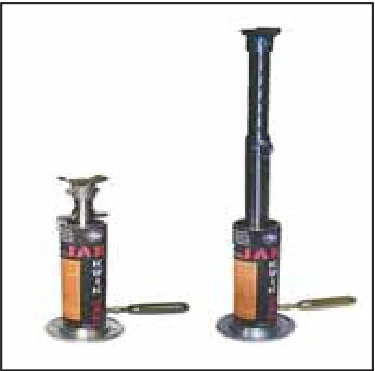
CO2 Cartridge Lifts This Handy Jack

Featured source: Baja Designs

The Kwik Jak comes in handy if you spend a lot of time in an off-road vehicle on your farm or ranch. Small and lightweight, it can be tucked in a small place, ready to use should you get a flat tire. It’s also simple to use, says Trent Kirby, project and marketing manager for Baja Designs, Inc., the California company that manufactures and sells Kwik Jak. While developed mostly for off-road racers, it’s handy for anyone with vehicles up to small 4-WD pickups. It works like a bottle jack. Align it on the axle, adjust the height, and thread a CO2 cartridge into the jack. That breaks the seal, releases the CO2 and lifts the jack. Slip in a pin to hold it in place. Baja Design sells Kwik Jak for $299.95 with two CO2 cartridges. Replacement cartridges come in a four-pack for $27.95, or they can be purchased from other vendors.

Contact: FARM SHOW Followup, Baja Designs, Inc., 185 Bosstick Blvd., San Marcos, Calif. 92069 (ph 800 422-5292; www.bajadesigns.com).

From the archive · Full text
Feature story

“Easy Roll” Toolbox For Pickups

Featured source: Orville Miller

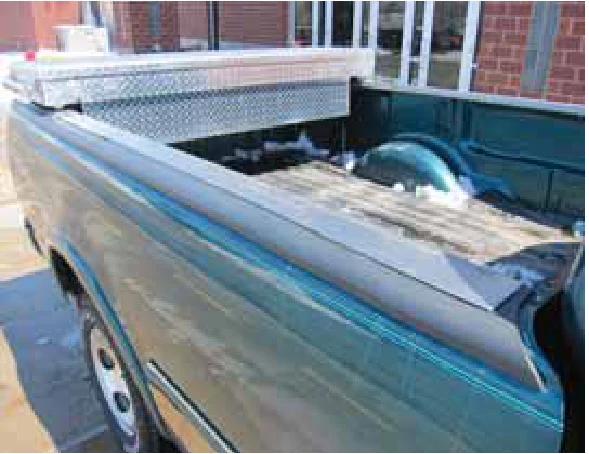
Tools are always at your fingertips with this new traveling toolbox that lets your toolbox roll to the back of the pickup for easy access.

“It brings your tools to you so you don’t have to climb up into the pickup to get to them,” says inventor Orville Miller. His Easy Roll toolbox kit consists of 2 aluminum rails that clamp on top of the pickup bed, 4 wheel bearing rollers that mount under the toolbox, and a pair of metal pins on brackets that hold the toolbox in place at the back of the bed. The toolbox locks into position by inserting the pins into slots on an over-center cam.

“Your toolbox moves easily on the rollers toward the back of the pickup bed. The rails are positioned so the toolbox clears the wheel wells,” says Miller.

“It’s still in the prototype stage and I don’t have anything for sale yet. I think my idea would work on any toolbox as long as it clears the wheel wells.” Contact: FARM SHOW Followup, Miller Equipment & Mfg., 1519 13th St., Clarkfield, Minn. 56223 (ph 320 669-4628; [email protected]).

From the archive · Full text
Feature story

He Set Up Shop Inside Old Slurrystore

Featured source: Marv Rubingh

Marv Rubingh converted his 23-ft. tall, 62-ft. dia. Slurrystore into a shop. Built in 1979, it was still structurally sound. Rubingh started thinking about converting it even before he stopped using it for manure storage.

“Two years ago I bought an outside wood boiler for the house, but with enough capacity to heat the shop as well. So I decided to get to work,” says Rubingh. The conversion was relatively simple. He used a circle saw with a metal cutting blade to cut out a 16-ft. high, 20-ft. wide doorway. Rubingh reinforced the cut edge with steel columns and the top with a steel I beam. He mounted a Schweiss bifold door with windows and a walk door in the opening. Rubingh had leftover steel trusses set aside. When he measured them, he discovered they would fit the shop perfectly. To prepare for the trusses, he cut 2 by 8’s and mounted them to the sidewalls where each of the 19 trusses would intersect the sidewalls.

“I read an article in FARM SHOW that gave me the idea,” says Rubingh.

“They serve as support columns under each truss. I also mounted 2 by 8’s around the circumference of the shop.” Hanging the trusses was the trickiest part of the process. Rubingh cut them to the right angle and then cut a 3-ft. long, 9-in. dia. steel pipe to use as a center collar. He used a man-lift and a telescoping forklift to set each truss in place. He welded them to the collar and secured them to the sidewall. Once they were all in place, he reinforced the center with a second steel ring welded to the underside of the trusses.

“We covered the trusses with barn roof steel, running a peak ridge cap down every track where they joined,” says Rubingh. To insulate the shop, Rubingh sprayed the walls and ceiling with insulated foam. He had already covered the existing floor with Styrofoam for a heat barrier. On top of that, he laid 4 in. of concrete with water lines for in-floor heat.

“We connected it to the boiler, but we haven’t needed heat yet,” says Rubingh.

“We’ve only done a few jobs in there this spring, but it will be a nice place to work this winter.” Contact: FARM SHOW Followup, Marv Rubingh, 8022 Rubingh Rd., Ellsworth, Mich. 49729 (ph 231 588-6084; [email protected]).

From the archive · Full text
Feature story

Blow-By Reservoir Keeps Engines Clean

Featured source: George Muth

George Muth keeps a clean engine, thanks in part to his Blow-by Reservoir. Without it, blow-by oil collects under engines, drips onto roadways and collects at intersections.

“I used to see the oil under my engine and look for a leak,” says Muth, a professional trucker.

“I would change out gaskets and seals, and the mess would come right back.” Realizing that it was the blow-by oil from the breather tube, Muth worked on a solution. What he came up with was two aluminum canisters with a hose from the breather tube outlet at the valve cover to the first and largest canister.

“We can retrofit them to any large engine from farm tractors and construction equipment to semi-tractors or anything else,” says Muth.

“People that have them really like them.” The pressurized oil and air enters the first canister and passes through a series of baffles with alternating size holes. As it cools, the oil condenses, and 85 to 90 percent of the oil falls to the bottom. The air still containing minute traces of oil passes into the second chamber and through a washable filter that traps most of the remaining oil.

“By the time the air exits the second chamber, the system has captured between 98 and 99 percent of the blow-by oil,” says Muth. Oil captured in the second and smaller chamber drains back to the first. A dash-mounted warning light notifies the driver when the larger canister needs to be emptied.

“I empty mine at every oil change,” says Muth, who runs a 400 Cummins diesel over the road.

“Normally you’ll collect less than 16 oz. of oil per oil change.” Muth designed the 6-in. diameter canisters for easy maintenance. A manual drain is installed at the bottom of the 32-oz. capacity, 16-in. long reservoir canister. The second canister containing the washable filter is 9 in. long. A smaller system with 4-in. dia. canisters is available for pickups. That reservoir is 9 in. long, and the filter canister is 6 in. long. Muth says the systems are very durable. He has one that has been on an older truck since 1998. He has only replaced the float in it once, and that was due to the wire on it corroding from exposure to road salt and weather.

“They are easy to install,” he says.

“Everything is included in the kit except a hose from the valve cover to the inlet on the canister and wire from the float to the warning light on the dash.” Muth custom fabricates systems to order. The price for the larger units runs from $400 to $500, depending on the cost of aluminum. A pressure gauge for crankcase pressure is available as an option.

The Blow-by Reservoir can also save money and time, acting as an early warning system. He cites several test trucks where the reservoir filled too quickly and problems from a blown piston to a cracked block were found. Contact: FARM SHOW Followup, George Muth, 36550 Bailey Rd., Pomeroy, Ohio 45769 (ph 740 591-4229; [email protected]).

From the archive · Full text
Feature story

Powerful Vac Mounts On Shop Wall

Featured source: David Stern

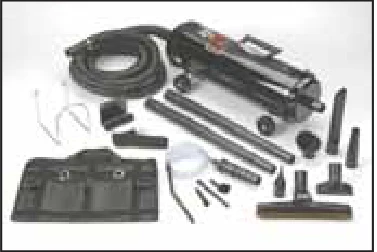
“It’s ridiculously powerful,” says David Stern, at Metropolitan Vacuum Cleaner Company, Inc., about the Vac ‘N’ Blo PRO system.

“Nobody has this much power in such a lightweight vacuum. And it’s made in the U.S.” The 4-hp unit is similar in power to carwash vacuums, but the PRO unit at $250 is portable and handy for everyone from car detailers and collectors to operators who want to keep trucks, tractors and equipment clean. One accessory kit (AGB-3) includes attachments to groom horses and other animals. The rugged, all-steel canister vacuum uses bags and can be mounted on a shop wall, rolled in place on wheels or carried with a shoulder strap. With a 12-ft. cord and 24 ft. of hose and extension wands, it has a long reach. Several attachments make it versatile enough to reach in all kinds of nooks and crannies on a variety of surfaces. Use the inflator adapter on the blower end to blow up inner tubes, blow debris out of a shed or blow-dry parts. Metropolitan is a family business that’s been selling vacuums since 1939, Stern says. The family takes pride in its tagline: Deliberately Made Better In The USA®. Check out the website for information on the Vac ‘N’ Blo PRO and other products and to locate a dealer in your area. Contact: FARM SHOW Followup, Metropolitan Vacuum Cleaner Company, Inc., 5 Raritan Rd., Oakland, N.J. 07436 (ph 201 405-2225 or 800 822-1602; www.metrovacworld.com; www.carvacexcellence.com).

From the archive · Full text
Feature story

Company’s Rebuilt Augers Work “Better Than New”

Featured source: Princeton Flighting Corp.

Minnesota farmer Dennis Skaro says, “When metal augers have excessive wear, they need to be repaired or replaced or they’ll damage grain and cost you a bunch of money.” That’s why Skaro likes Princeton Flighting, an Illinois company that repairs augers with conventional helicoid flighting or its patented Super Edge™ flighting that’s up to 50 percent thicker at the exact location where the greatest wear occurs. The added strength is achieved through a patented cold rolling process that doesn’t add extra weight. Super Edge flighting is a major advance over standard helicoid flighting and can be incorporated without modifying existing auger specifications. The raised edge formed by Super Edge flighting is formed integrally during the manufacturing operation and isn’t just a strip attached with a secondary weld. This edge process improves auger performance because of greater wear resistance and gentler grain handling. The process combines dimensional precision with a high quality surface finish rolled to CEMA standards and OEM specifications. Flighting is 30 to 50 percent thicker at the main point of wear and the precise thickness gain depends on the flighting dimensions. Super-Edge flighting can be applied on left or right hand, standard pitch, short pitch, long pitch, cupped or ribbon augers from 3 to 40 in. in dia. The maximum flight diameter for conventional helicoid flighting application is 42 in. and the maximum strip thickness is 0.5 in. in coil form and 0.75 in. in bar form. The maximum flight diameter for a stainless steel auger is 30 in. and the maximum strip thickness is 0.25 in. The cost for flighting repair depends on the length and diameter of the auger. A price quote is provided by the company after specifications are given over the phone or on the company’s website. Contact: FARM SHOW Followup, Princeton Flighting Corp., P.O. Box 599, Princeton, Ill. 61356 (ph 815 872-1431; www.princetonflighting.com).

From the archive · Full text
Feature story

Babbitting Expert Says His Services Still In Demand

Featured source: Rod Gaffrey

Rod Gaffrey keeps busy doing every kind of Babbitt replacement, from tiny bearings for rods weighing a few ounces to rods that are 3 ft. long and weigh 75 lbs. He has done work on rare one-of-a-kind antique car engines, airplane engines and old V-8’s.

“I have to be ultra careful with lots of the work I get,” says Gaffrey.

“You can’t just go to a hardware or auto store for a replacement. They’re all pretty challenging.” Gaffrey started out in an automotive and diesel machine shop in 1970 and taught himself Babbitting as a sideline niche. He describes it as “learning by trial and error.” He does rebabbitting of insert bearings, connecting rods, blocks and cylinder sleeving as well as antique engine repair.

“There are absolutely no shortcuts. If you try to rush it, you’ll have to do it over,” he says.

“If you want to get rich, find another occupation. If you want to get tested, then Babbitting may be your thing.” Babbitt metal is a matrix of hard and soft materials. Used in bearings, as the shaft turns, the friction melts the soft material (usually tin, but can include lead), lubricating the shaft as it’s supported on the still-hard materials. Gaffrey notes that Babbitt metal is still used commercially in large generators at hydroelectric dams and other heavy equipment. He uses several grades of the alloy of tin, copper, antimony and trace elements, but never uses lead. He buys and melts Babbitt for each job, heating it to 750° to 1,000°F depending on the alloy. Before doing it, he cleans and dries the parts to be filled. That includes heating any tool that will be used in the hot Babbitt.

"If you don't heat a ladle before putting it into molten Babbitt, the moisture in the pores will make the Babbitt come out of the pot like lava from Mt. Vesuvius," says Gaffrey. "It can blow the Babbitt right out of the pot. You have to get the ladle hot first to bake out any moisture." That is one reason Gaffrey urges anyone who tries working with Babbitt to wear protective clothing and face shields. "When I see people on YouTube with no face shield or gloves, I wonder how stupid can they be." Gaffrey says he has done work for people in 45 states, a number of Canadian provinces and a number of countries overseas. Because each job is unique, he says it’s hard to give prices for what he does. "If you need Babbitt work done, give me a call with all the measurements and whatever information you have on the part," says Gaffrey. "I have engine bearing books going back to 1913, so between us, we can sort through what is needed. " Contact: FARM SHOW Followup, Gaffrey Babbitting, 12023 Bearingsmith St., Deadwood, S. Dak. 57732 (ph 605 578-1057; [email protected]; www.gaffreybabbitting.com).

From the archive · Full text
Feature story

After-Market Fuel System Solves Powerstroke Problems

Featured source: Dennis Schroeder

Strictly Diesel has the answer to fuel line problems with older Ford Powerstroke engines. The company makes and markets the “Driven Diesel Regulated Return” fuel system kit that helps the engine run better and components last longer.

“Our kit improves fuel flow and pressure, reduces noise and improves throttle response and economy,” says Dennis Schroeder, co-owner, Strictly Diesel.

“We discovered over time that the more consistent flow and pressure also enhanced longevity of the injectors.” Schroeder says problems with the Powerstroke started when Ford switched to a dead-head fuel system in 1999. The only change Ford has made since to improve the fuel system is a change to a long lead injector.

“I was part of an internet community in 2000 and 2001 that tested solutions and exchanged ideas on solving the problem better than Ford had done,” says Schroeder.

“As a result, some of us started producing a quality kit for Powerstrokes. As the engines evolved to higher horsepower, we changed to match the bigger injectors and turbos.” The kit eliminates the dead-head stock fuel rails and provides adjustable fuel pressure. It ties the ends of the fuel rails through a bypass fuel pressure regulator. Larger, high-flow units that eliminate restrictive check valves replace stock fuel lines and banjo bolts.

Today the kit works as well on from-the-factory engines as on 600 hp modified engines. The standard kits include CNC bent stainless steel tubing and braided Teflon hoses, custom stainless steel banjo bolts, a billet-aluminum adapter and a Fuelab pressure regulator. They range in price from $569.95 to $674.95.

“Use of the kit eliminates the stock fuel pressure regulator assembly completely,” says Schroeder.

“It’s an especially good investment for older engines as the components have aged. Installing a kit now will give an even better return than it would have when the engine was new.” Schroeder says shade tree mechanics should have no problem installing the kit themselves. Driven Diesel provides detailed directions with pictures.

“It’s a detailed installation, and most plan to take a full day doing it,” says Schroeder.

“The more experienced you are, the faster it will go.” Strictly Diesel also offers kits and components to convert 1994 to 1997 Ford Powerstroke truck engines over to electric fuel pumps. Contact: FARM SHOW Followup, Strictly Diesel, Inc., 621 W. Lone Cactus Dr., Phoenix, Arizona 85027 (ph 623 582-4404; www.strictlydiesel.com).

From the archive · Full text
Feature story

“Lift Hangars” Make Mower Maintenance Easier

Featured source: Adrian Flath

“I wanted to lift my mower to clean the deck and do other maintenance,” says Adrian Flath of Evans Mills, N.Y.

“So I made hangars to fit my lift and pick the mower up by its wheels.” He welded up two different sizes out of 2-in. angle iron to fit under the front and back tires. The other end of the hangar slips over the pads on his 12,000-lb. vehicle lift.

“When I’m done, I pull the hangars off the lift so it doesn’t tie the lift up at all. They’re light and easy to store,” Flath says.

“I could make hangars to use it for other equipment, too.” Flath has used the lift for two years to keep his zero-turn Ferris mower (with a 35 hp, 3-cylinder CAT engine) in tiptop shape. Besides cleaning the deck, it makes it easy to change the blades and make adjustments.

“I’m taking good care of my mower so it will last a long time,” he says. Contact: FARM SHOW Followup, Adrian Flath, P.O. Box 125, Evans Mills, N.Y. 13637 (ph 315 629-4355).