Practical ideas from FARM SHOW MagazineSubscribe · Free issue · Send us your shop tip
Subscribe to FARM SHOW
Issues / Vol. 36, No. 2 (2012)

Vol. 36, No. 2 (2012)

Money-Saving Repairs & Maintenance Shortcuts · Printed section pp. 36–39

40 selected entries · Complete text of selected entries

This issue’s section includes reader tips and feature-length shop stories. Held items and editorial notices are not reproduced.

Archive text: prices, coupons, availability and contact details reflect the original publication, not current offers. Reader methods are not universal instructions; follow manufacturer guidance and proper safety practices.

Reader shop tips

From the archive · Full text
Reader shop tip

Ken Hlady

Ken Hlady, Eureka, Mont.

“If you have an old dental Water Pic, it can be used as an adjustable minipressure washer. I find it works super for cleaning items such as shaver heads, watch bracelets, and other small parts and tools. It can be used with hot water and detergent, if needed.”

From the archive · Full text
Reader shop tip

Terry Upton

Terry Upton, Rochester Hills, Mich.

“Old refrigerator doors make good shelving in the shop for bottles and cans or other parts. Just screw them to the wall and fill them up.”

From the archive · Full text
Reader shop tip

Anonymous

Anonymous, Michigan

“I suggest you always check gearboxes of used equipment before buying. There’s at least one dealer in my area that removes the gear lube and substitutes a small amount of grease so it won’t leak. The equipment leaves his shop looking clean with no drips. When the gearbox ‘blows up’ after purchase, he says, ‘It’s your baby.’ It’s always best to get your hands dirty when buying used.”

From the archive · Full text
Reader shop tip

David L. Brown

David L. Brown, Maple Grove, Minn.

“I’ve read in your magazine about people using pvc piping to pump compressed air around a shop. This can be very dangerous. I worked in a small shop where they installed this type of system, mostly to have an air nozzle to blow parts off after machining. One morning, after an employee turned on the compression, he heard an explosion in the back of the shop. The piping by the compressor had shattered under the pressure and there were pieces everywhere. We were lucky no one was near the area. After checking with a pipe supplier, we found out the piping was not rated for air pressure. I’d never use pvc in my own shop.”

From the archive · Full text
Reader shop tip 1 of 2

Gabe Davidson

Individual tip 1 of 2 from this reader’s published contribution.
Gabe Davidson, Annandale, Minn.

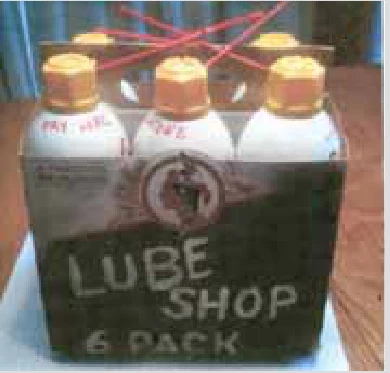
“Liquid Wrench makes a number of outstanding lubricants, including Chain Lube, Penetrating Oil, Dry Lube, and Silicone Spray. They work great – if you know where they are when you need them – and if you haven’t lost the ‘noodle’ tube that fits into the nozzle. I solved the problem by putting cans of lube in an old cardboard 6-pack carrier and writing on the tops of the cans so I know what each can is at a glance.

From the archive · Full text
Reader shop tip 2 of 2

Gabe Davidson

Individual tip 2 of 2 from this reader’s published contribution.
Gabe Davidson, Annandale, Minn.

To hold the tubes in place, when I buy a can, the first thing I do is take off the cap, lay the can on its side, and put a drop of glue on the nozzle to hold the noodle tube in place. Then I cut a slot in the side of the cap to fit back over the tube. Works great.”

From the archive · Full text
Reader shop tip 1 of 2

Wilson Rickenbaker

Individual tip 1 of 2 from this reader’s published contribution.
Wilson Rickenbaker, Lexington, S.C.

“I always use a scale when sharpening opposing rotary cutter blades to ensure smooth operation. It’s important to get the weights of the opposing blades even to prevent vibration.

From the archive · Full text
Reader shop tip 2 of 2

Wilson Rickenbaker

Individual tip 2 of 2 from this reader’s published contribution.
Wilson Rickenbaker, Lexington, S.C.

“To maintain good conductivity, I use brass or stainless steel fasteners on electrical connections, especially on old 6-volt equipment.”

From the archive · Full text
Reader shop tip 1 of 2

Steve Nichols

Individual tip 1 of 2 from this reader’s published contribution.
Steve Nichols, Galesburg, Ill.

“When mounting and dismounting smaller tires I generously spray the tire and wheel beads with Armorall protectant. It’s super slippery and is supposed to be good for the rubber. And it won’t make rims rust like dish soap solutions.

From the archive · Full text
Reader shop tip 2 of 2

Steve Nichols

Individual tip 2 of 2 from this reader’s published contribution.
Steve Nichols, Galesburg, Ill.

“I have a trick to repair mower deck hanging brackets with worn mounting holes that are oversized and egg-shaped. I clamp a piece of copper bar to one side of the metal piece, over the hole you are repairing. You can then weld the hole shut, grind the weld flat and redrill it to the original size. The copper bar is a conductor, but the weld won’t stick to it.”

From the archive · Full text
Reader shop tip

Joseph De Ruiter, Jr.

Joseph De Ruiter, Jr., Vesper, Wis.

“One of your readers recently reported how he uses an electric winch to power the lift arms on his Farmall. I have a better solution that I came up with on my Farmall B. I mounted an old power steering pump up by the fan, ran 2 copper lines back to the seat, and mounted a hydraulic cylinder and one control valve. I used it to replace the old vacuum-powered pickup system that Farmall used to use for the cultivators and plows. I did this years ago and the homemade hydraulic system still works great.”

From the archive · Full text
Reader shop tip

R.B. Hunter

R.B. Hunter, Lancaster, Texas

“To clean and shine old rusty chains or tools I simply drag them behind my tractor on a gravel road. Anything that’s rusty or corroded will clean up fast.”

From the archive · Full text
Reader shop tip

Jeff Bond

Jeff Bond, Anaconda, Mont.

“I use an old military truck for logging and sometimes have to leave it outside overnight. The ignition switch on military trucks has no key so it could be easily stolen. You can buy an in-line ignition lock for the battery cable, but it’s expensive and can be unreliable.

“To solve the problem, I welded together a small metal box made from 1/8-in. thick steel and used a 1-in. dia. steel pin off an old 3-pt. hitch. I insert the pin from the back of the dash through a hole already in the dash and through a hole that I cut into the box. The pin extends out from the box about a half inch. Then I attach a padlock to the pin to lock the box in place against the dash, which prevents access to the master battery switch and the ignition switch. When the box is removed, the dash looks just like it did before.

“I also use the box to store my registration and insurance papers. Installing the box took about one hour and I spent about $10 to weld it up and paint it.”

From the archive · Full text
Reader shop tip

Rex Gogerty

Rex Gogerty, Hubbard, Iowa

“We equipped our shop furnace with extra registers to get more heat into our main work space, which is about 40 ft. away. We cut and bend corrugated metal and anchored it above the furnace f a n ’s o u t l e t . Crude baffles can be adjusted to direct the air flow. The furnace m o u n t s o n concrete blocks to avoid possible water damage and to simplify cleanout and maintenance.”

From the archive · Full text
Reader shop tip

Allen Heling

Allen Heling, Clintonville, Wis.

“After the fuel injection pump on our Deere 4230 tractor was worked on, we noticed it started smoking more and wasting fuel. So last year my son and I installed a turbocharger, the same one found on Deere’s 4430 and 4630 models. It made a big difference. Now there’s virtually no smoke and therefore, no need to adjust the injection pump. We’re getting about 20 more horsepower and using 10 to 15 percent less fuel.”

From the archive · Full text
Reader shop tip

Art Olive

Art Olive, Stacy, Minn.

“I keep Dawn foam-type dishwashing soap handy whenever I come in from my garden or shed. It works great for cleaning up dirty, greasy hands. The soap comes in a 10-oz. pump bottle. Two pumps give me a handful of foamy suds that look almost like shaving cream.”

From the archive · Full text
Reader shop tip

BD Diesel Performance

BD Diesel Performance, Abbotsford, B.C., Canada, (ph 800 887-5030 or 604 853-6096; www.dieselperformance.com)

If you’re having trouble keeping your Ford pickup driving straight, this company’s new Cam Caster Adjuster kit might help. It’s designed for 2005 to 2010 Ford Super Duty models. The kit installs on the radius control arms to help correct the caster to a more positive angle and also helps prevent a number of potential steering problems. Sells for $213.75 plus S&H.

From the archive · Full text
Reader shop tip

Enterprise Plastics, Inc.

Enterprise Plastics, Inc., Kent, Ohio, (ph 330 346-0496; www.epstores.com)

This company sells a variety of replacement parts for Minneapolis Moline tractors. Examples include rubber moldings, headlight brackets, grilles, pivot pin spring clips, rubber gas tank mounts, battery supports and clamps, battery clamp ends, and tractor switch labels. The company continues to develop new parts.

From the archive · Full text
Reader shop tip

Floyd Miller

Floyd Miller, Miller Power Enterprises, Topeka, Ind. (ph 260 768-7002)

“I specialize in Honda engine sales and service and have thousands of engine parts in stock, both new and used, including parts no longer available from Honda. If you’re looking for a new or used part, there’s a good chance I’ll have it or can get it for you.

“I also have a large inventory of new, used and obsolete Briggs & Stratton engine parts as well as Tecumseh, Peerless transmission, Kohler, McCullogh, MTD and more. The photos show one of Honda’s oldest single cylinder models, and also their newest twin cylinder model. All Honda GX commercial series engines come with a 3-year warranty.”

From the archive · Full text
Reader shop tip

David Koenig

David Koenig, Quincy, Ill.

“When I can’t remove a broken bolt because it’s flush with the material, I lay a nut on top of the stud and then use my Mig welder to weld the nut through the center. Then I back it out with a wrench. Works every time.”

From the archive · Full text
Reader shop tip 1 of 2

David Millsap

Individual tip 1 of 2 from this reader’s published contribution.
David Millsap, Abingdon, Va.

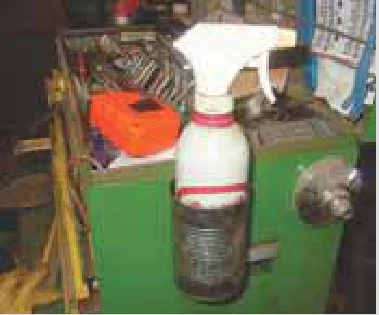
“I bolt soup cans to both sides of my roll-around toolbox. They make handy holders for cans of WD-40 or other spray bottles. I simply drilled small holes into the sides of the toolbox and then bolted the cans on.

From the archive · Full text
Reader shop tip 2 of 2

David Millsap

Individual tip 2 of 2 from this reader’s published contribution.
David Millsap, Abingdon, Va.

I also zip tie plastic coffee cans to my tractor’s rollbar. The cans provide a handy place to keep 2-liter bottles of water or pop as well as small hand tools.”

From the archive · Full text
Reader shop tip

Anonymous

Anonymous

“I recently tried to start a chainsaw and weed eater that had been stored for a long time. No go. I tried putting in new spark plugs but it didn’t help.

“Then I drained out the gas and put straight Gumout fuel system cleaner into the chainsaw’s tiny tanks and primed them. Varoom! Both tools started right up. Then I shut both machines off, drained the Gumout, and put fresh gas into the tanks. Again, both machines started right up. Unbelievable. Now both machines run great with no problems.”

From the archive · Full text
Reader shop tip 1 of 2

David Lindsey

Individual tip 1 of 2 from this reader’s published contribution.
David Lindsey, Mansfield, Tenn.

“In 1994 I bought a 1993 Dodge 1-ton dually pickup equipped with a 5.9-liter Cummins diesel engine and automatic transmission.

At about 48,000 miles the transmission overdrive started messing up. It would slip out of overdrive while I was driving along at a steady speed. It felt almost like I had shifted into neutral. I checked with three different transmission shops and all said the transmission needed a complete rebuild. So I had the transmission rebuilt at a cost of about $1,400.

“At about 98,000 miles the same thing happened again and I was told another transmission rebuild was needed. So, I started trying to figure out what was wrong.

“I removed the cover on the throttle position sensor and discovered there was a lot of dust in it. I used an air hose to blow the dust out and then took a screwdriver and jiggled the slot that operates the thing and blew it out again. Then I put the top back on. Now the transmission’s overdrive works just like new, and I didn’t have to spend $1,400 for another overhaul.

From the archive · Full text
Reader shop tip 2 of 2

David Lindsey

Individual tip 2 of 2 from this reader’s published contribution.
David Lindsey, Mansfield, Tenn.

“Here’s what I do when tubeless tires start leaking air around the rim. I remove the valve core and use an oil squirt can equipped with a thumb lever pump to deliver 25 to 40 squirts of oil into the tire. Then I replace the valve core, pump up the tire and drive the vehicle for at least a mile to sling oil all around the rim. I’ve used this idea successfully for years on all my tires.”

From the archive · Full text
Reader shop tip

Bryce Dunn

Bryce Dunn, Dunn, N.C.

“We had to repair a mast cylinder on our TCM forklift. The local shop said it would cost about $2,200 to remove the mast and stretch it out across the floor to remove the cylinder. Instead, we raised the forks and chained them to the top of our shop ceiling so we could take the cylinder out. We spent about $200 on repairs, saving us $2,000.”

From the archive · Full text
Reader shop tip

John Willenbrock

John Willenbrock, Hayden, Ala.

“I read with interest in your last issue how Jim Rankin of Paris, Ky., is able to grease wheels without removing the hub. He uses a simple tapered tip that screws onto the end of his grease gun. He drills a 1/4-in. hole in the center of the hub that’s the right size for the tip.

“In 1971 I was field supervisor for J&J Farms near Poplarville, Miss. We were running 5 IH disks 12 hrs. a day and losing one wheel hub per week due to fine dust getting inside the hubs.

“To solve the problem I drilled 1/8-in. dia. holes into the dust caps. Then I cut a 1/8-in. pipe coupling in half, brazed it onto the dust cap, and screwed in a grease fitting. I made sure that our drivers greased each wheel every day until new grease started to show up at the back of the hub. Problem solved.”

From the archive · Full text
Reader shop tip

Spring Creek Products

Spring Creek Products, San Angelo, Texas (ph 866 651-6702 or 325 651- 9558; springcreekproducts.com)

Spring Creek’s pipe-cutting guide makes precision cutting a simple job for welders. Four different precision cuts are possible: Saddle cut, 45 degrees, 22 1/2 degrees, and 90 degrees. You open the guide and place it on the pipe, then clamp the guide firmly in place with a heavy-duty spring, allowing you to draw in precise cutting guides. Available in 8 different sizes.

From the archive · Full text
Reader shop tip 1 of 2

Bill Smith

Individual tip 1 of 2 from this reader’s published contribution.
Bill Smith, Churubusco, Ind.

“I cut a 14-ft. field packer down to a 4-ft. model that I use behind my garden tractor to roll my lawn. I have a lot of moles in my yard and use the packer to smooth out the ground they dig up. First I roll one way and then a week later I roll at a perpendicular angle, which leaves a checkerboard pattern.

“The packer was originally designed to pull behind a disk or tractor and consisted of two gangs. I cut the gangs down and then added a single 4-ft. gang on top. I also shortened up the packer’s tongue.

From the archive · Full text
Reader shop tip 2 of 2

Bill Smith

Individual tip 2 of 2 from this reader’s published contribution.
Bill Smith, Churubusco, Ind.

“I used an old 2-wheeled trailer to build this portable deer hunting lodge, which was only partially built when I took this photo. I cut down four phone poles to a length of 9 ft. and bolted them to the trailer’s floor, then built the lodge on top of them. I used excess tin roofing off an old pole shed to build the sides and a solar panel to build the roof. I used 3-in. screws to attach the sides to the roof and made a window. The floor is made from plywood. I use a ladder to access the lodge. The lodge stays warm, although the solar panel doesn’t add much heat until the afternoon hours.”

Shop feature stories

From the archive · Full text
Feature story

“EGR Delete” Kit Solves Powerstroke Problems

Featured source:

If you have a Ford 6.0L Powerstroke and you’ve had EGR cooler problems, Performance Machine & Mfg. says it has the solution. And if you haven’t had EGR problems yet, you will, suggests Matt Henderson, Performance Machine & Mfg. Either way, the solution is the company’s EGR Delete Kit.

“With a few modifications, these can be great trucks,” says Henderson.

“They have coolers and valves that just go bad sporadically. There is nothing maintenance can do. The only fix is to remove it from the truck, which is legal in all states but Calif.” Henderson first ran into the problem working with the diesel trucks that carried his race cars to the track. Excessive heat passing through the EGR cooler can crack it, and the cylinders fill up with coolant, which has to go somewhere.

“It can end up breaching between head gaskets,” explains Henderson.

“In some trucks it can break rods and destroy the engine.” When he didn’t find any true fixes to the EGR cooler, he engineered around the problem. The EGR Delete Kit makes it possible to remove the cooler while rerouting the coolant.

“Pulling a cooler out is not a problem with our kit,” says Henderson.

“We have dealers who can do it, but anyone with experience working on a tractor or truck can do it with our instructions.” Since he came out with his EGR Delete Kit, he admits several others have also been introduced. However, he says, other kits don’t include oil filter housing gaskets and 8 injectors. Henderson says his kit does more than simply eliminate a problem.

“Trucks will still pass the smog test without the cooler, and you can usually expect a 1 1/2 mpg increase in efficiency,” says Henderson.

“If you add the tuner we sell on our website, you can get four to five more miles per gallon.” Henderson says the kit is designed for the Powerstrokes where the problem was most common - the 2003 to 2007 F250, 350, 450 and 550 models with 6.0L engines. He adds that a similar problem has shown up with Dodge 2500 and 3500 trucks in model years 2007 through 2011. He has introduced a kit for them as well as a kit for 2008 to 2012 Fords. The complete EGR Delete Kit starts at $259.95. The recommended tuner is priced at $379.99. The company makes and markets a variety of other performance enhancing kits and products. Contact: FARM SHOW Followup, Performance Machine & Mfg., 5890 Industrial Park Dr., Lenoir City, Tenn. 37771 (ph 877 408-3256; orders@performancemachinemfg.

From the archive · Full text
Feature story

Do-It-Yourself Power Hammer For Blacksmiths

Featured source:

materials and construction time, you can make your own power hammer with a unique drive mechanism.

“This Tire Hammer uses an emergency spare tire and rim mounted on a trailer axle and hub,” says Clay Spencer, who sells plans and leads workshops to build the tire hammers. The retired NASA mechanical engineer has a passion for power hammers because they’re so handy for any blacksmith – amateur or professional. He developed the design based on a sketch on a napkin by inventor Ray Clontz, who gave him permission to build and create plans. It’s driven by a 1 hp, 1,750 rpm, single phase, 60 cycle, 120/240 volt, frame 56, (TEFC preferred) electric motor. A flat pulley (3 7/8-in. dia.) is mounted on the motor. The motor is pivoted by the treadle action, so the pulley rubs against the tire to drive the hammer downstroke. This “clutch” provides outstanding control, says Spencer, because the harder you push on the pedal, the faster the tire spins. It delivers up to 270 blows a minute and will cut through 2-in. thick metal in about 20 strokes. Spencer’s design calls for a 50-lb. hammer and a 6 by 36-in. solid anvil. The 6 1/2-ft. column that supports the hammer and drive is made of 1/4-in. wall, 5-in. square tubing.

“We have made 371 hammers in workshops across the country,” Spencer says. Blacksmiths get together to plan a date and spend three weekends doing preassembly before Spencer arrives for the final weekend. His fee is a tire hammer and mileage from his home in Alabama.

“This is a difficult and demanding project to build correctly,” Spencer says.

“The welds must be done strong enough to hold everything together. The pins must all be parallel to prevent wearing out the bearings. The hammer head must be aligned to the anvil correctly so the dies will hit evenly, and the tire and crank must be properly positioned to line up with the toggle mechanism and guides.” Still, he notes, it’s a project many farmers and ranchers have the skills to complete, as well as parts on hand to reduce the cost. He has sold several hundred copies of his plans with 20 pages that include a materials list, drawings and complete directions. Spencer also offers workshops on making 450 tools to go with the tire hammers, and he has designed two styles of treadle hammers. Spencer teaches at the John C. Campbell Folk School in Brasstown, N.C., in a blacksmith shop named after him. To see his hammer in action, go to www.farmshow.com to view a video. Contact: FARM SHOW Followup, Clay Spencer, 73 Penniston Pvt. Dr., Somerville, Ala. 35670 (256 498-1498; [email protected]).

From the archive · Full text
Feature story

Where To Buy Uni Harvester Parts

Featured source: Jack Welti

Jack Welti likes New Idea Uni harvesters so much that he has 30 power units and 75 attachments in stock, as well as countless parts. He enjoys introducing the versatile, multi-use system to new users and helping other people around the country keeping their units running. He buys New Idea systems for resale and to salvage for reusable parts, as well as for use on his own farm.

“We got our first Uni’s in the mid 60’s with chopper, sheller and ear corn attachments,” says Welti.

“We mounted a spray tank with a 60-ft. boom on one, use a snowblower on another, and still do some harvesting with them.” Welti got into the used Uni parts business looking for parts and attachments for his own use. His business expanded when New Idea stopped making Uni harvesters in 1997.

“AGCO owns the rights to the Uni, and any AGCO dealer can get parts, but some dealers may not even have the parts books,” says Welti, who also carries a large number of operator manuals and parts manuals.

“The company was good about using a lot of universal fittings, so one part may be used in two or three applications with a different part number for each use. If you have the parts number, you can get most parts, but new ones can be costly.”

Some parts are no longer available, like the dampener pulley on the Perkins motor used on some models. He specializes in hard-to-get parts like the pulley. If he finds a Perkins engine with other problems, he knows the pulley may have some value. He also carries a number of after-market parts such as chopper knives and high wear parts. He also buys and sells Uni’s with a range of $6,000 to $12,000 depending on the model and the shape it’s in.

“Half or more of those I buy are for salvage,” says Welti.

“However, I recently picked up two nice 800C models with 5.9L Cummins engines with about 2,000 hrs. on them. I’m asking around $8,000 each.” Welti questions where else one could find a multi-use, 4-WD power unit with 150 hp or more at that price. He says the design makes them easy to adapt to other uses, something he enjoys helping with.

“One guy mounted a gravity box and auger on a Uni,” recalls Welti.

“ I know of two with rock pickers on them and one outfitted with a grain conveyer that can load a semi in 3 min. or less.” Welti says he is always glad to visit with farmers looking for a Uni or parts or those who simply want to talk about the unique line of equipment.

“We have people drive in just to see ours,” he says.

Contact: FARM SHOW Followup, Valley Farm, 28085 Hwy. 247, Plainview, Minn. 55964 (ph 507 269-0876; [email protected]).

From the archive · Full text
Feature story

They Burn Used Oil In Pickup Trucks

Featured source:

“Used motor oil works just fine to power my 1998 Chevy 3500 4-door pickup, which has a 6.5 liter turbo diesel engine and 220,000 miles on the odometer,” says Carl Weaver of Lisbon, Ohio. Weaver converted his pickup to burn used oil after his friend John Bennetch of Carlisle, Penn., started using a similar system on his truck. Bennetch drove from Pennsylvania to Missouri and back with used oil as the main fuel. He got 14 miles to the gallon and didn’t have any engine problems, so that convinced Weaver to try the same system.

“My truck starts on straight diesel and when the engine temperature reaches 140 degrees, a relay sensor switches it over to oil. During colder months I run 10 percent diesel fuel with the oil, but during summer the straight oil works just fine,” Weaver says. The switchover can also be done manually. LED lights show if the truck is running on oil or diesel fuel. When the truck ignition is turned off, there’s a delay timer that automatically switches the valve back to diesel and keeps the engine running. The timer can be set to run the engine from 30 seconds up to 5 min. to purge oil from the engine and revert back to diesel fuel. Weaver’s truck has a high performance fuel pump that can take fuel pressure up to 20 lbs. He says it gives the truck more power and doesn’t starve the engine for fuel. John Bennetch is convinced that older diesel engines with mechanical fuel pumps can run on just about any organic petroleum product. He says used automatic transmission fluid or any grade of synthetic or petroleum motor oil from a diesel or gasoline engine will work. The key is to run it through a screen before it goes into the tank and filter it well at the engine. If it’s heavier than 15-40, you should thin it with 10 percent diesel fuel. Both his truck and Weaver’s have aftermarket 12-micron fuel filters. Bennetch says that a centrifuge oil filter can be added between the fuel pump and the engine injector pumps. At a cost of about $600, that would filter at 2-microns and provide extra insurance for the fuel system.

Bennetch says engine shops have told him a system like his won’t work because injectors will fail because of poor lubrication. His experience is that delaying the switchover to oil until engine temperature is 140 degrees raises the oil viscosity so it moves through the lines. He said his system isn’t anything fancy, basically the same as those that run trucks on vegetable oil.

“My line of work gives me access to plenty of old oil, so that’s what I use.” He says vegetable oil would also work, but he wouldn’t mix petroleum and vegetable oil together. Although the system is simple, it’s not without a few challenges. He usually gets 30 to 40 hrs. of driving time or a couple thousand miles on fuel filters, and sometimes tries used fuel filters until they’re completely plugged. The oil he uses is filtered every time he moves it from one tank to another. Bennetch says most diesel engines will allow you to burn up to 50-50 oil and diesel without modifications. It’s a way to save money and get decent mileage. He recommends that if you try this idea on a Cummins diesel, which has smaller injectors, that a 2 micron filter be installed. Contamination is also a concern when using oil. Both Weaver and Bennetch check their oil to be sure there isn’t water or anti freeze in it. Oil stored in a 55 gal. drum should have a tap on the bottom to drain out water or contaminants. Weaver is happy with the economical new way to power his truck and says performance is the same as with diesel fuel.

“I think the system is really great and practically failsafe. The only difference I’ve noticed is a small amount of smoke when the engine is idling, but on the highway you’d never know you’re running on oil. I shove the foot feed to the floor, a small puff of smoke comes out and after that it’s clear.” Weaver figures he spent less than a thousand dollars on the system, which includes the 100 gal. tank for the back of his truck. Contact: FARM SHOW Followup, Carl Weaver, 6190 Lisbon Road, Lisbon, Ohio 44432 (ph 330 881-5883).

From the archive · Full text
Feature story

Track Tightener For Skid Loaders

Featured source:

Arnold Otter, Molalla, Ore. developed a track tightener for his Bobcat skid loader to make a tough job easier. It worked so well the tool is now on the market.

“Using the factory-provided tightener, it used to take me more than a half hour to mount tracks on my skid loader. Now it takes only about 10 min., and when the job is done I don’t have any busted knuckles or cut-up fingers,” says Otter. According to Otter, the tightener that’s provided with the tracks is basically a ratcheting nylon strap without any hooks on it.

“The strap is fed through both ends of the tracks and then attaches back to itself. Through ratcheting action, the ends of the tracks are brought together so you can install the bolts and bushings that hold the track ends together. That’s where the problem begins,” says Otter.

“First, the strap doesn’t generally hold both ends of the tracks together in a square fashion – one side is always ahead of the other so nothing ever lines up. Second, the ratcheting mechanism has only a set number of ‘clicks’ for which you can draw up the track. Nine times out of ten the ratchet either draws up the tracks too far, or not far enough to insert the bolt and bushing. So then you have to use a line-up punch and fight the 600-lb. tracks, or get someone to help wrestle the tracks in place so you can install the bolts. My tightener uses a threaded bolt to draw the loose ends of the tracks together, making it infinitely adjustable.

“When my tightener is hooked up to the tracks, they’re held rigid and square with each other. You use a wrench to draw the track ends together until you can install the bolts and bushings by hand. Even if the tracks only need to be moved a fraction of an inch, it doesn’t matter. The threaded bolt allows you to move the track’s ends exactly where they need to be for easy hookup, without any fuss.

“Once the bolts are installed, you simply loosen the tightener and remove it.” The track tightener sells for $150 plus S&H. Contact: FARM SHOW Followup, Arnold Otter, 35427 S. Hwy. 213, Molalla, Ore. 97038 (ph 503 829-2829; [email protected]) or Wurdinger Manufacturing, Inc., P.O. Box 385, Scotts Mills, Ore. 97375 (ph 503 930-3496; www.wurdingermanufacturing.com).

From the archive · Full text
Feature story

Online School Teaches Small Engine Maintenance

Featured source: Roger Simons

Got a chainsaw that just won’t run right? Or a push mower that needs a tune up? If you’re not an expert at that kind of small engine work, you might want to check out a new “service school” online that walks members step-by-step through preventative maintenance and small engine diagnostics.

“We film professional mechanics who work on chainsaws and other small engine tools every day,” says Roger Simons, founder, ATTN (Advanced Technical Training Network).

“They will walk through a repair scenario on all the things likely to be repaired through the life cycle of a product.” The maintenance section of the website – which costs members $9.95 a month – covers trimmers, edgers, commercial mowers, trailers and chainsaws. Chainsaw maintenance is broken into 13 segments, including Chainsaw Bar, Fuel Line, Oiler, Air Filter, Sprocket and Recoil. Overviews included “Clean, Inspect and Torque,” covering basic tips such as not using excessive air pressure, especially on seals and gaskets.

Individual segments are easy to understand. Illustrations clearly define worn sprockets and other problems, using well-worn and damaged components. Even for an experienced chainsaw owner, the sessions offer a worthwhile refresher.

The diagnostics section covers identifying problems with both two-stroke and four-stroke engines. It uses “first glance” evaluations to identify generally what a problem might be. Related documents offer specific diagnostic steps for problems such as no spark, compression or fuel delivery.

“Our goal is to show people who want to do their own maintenance or diagnostics how to do it,” says Simons.

“If repairs are needed, they may well decide to take it to the repair shop. However, now they’ll understand the problem or its complexity and feel better about paying for the repair.”

Knowing what the problem is will help when talking with a mechanic. It can also help when considering a new product for purchase, he adds.

Simons understands how important the simple things are when it comes to maintenance. His background includes starting a technical training program for Stihl chainsaws in the U.S. He then did the same for Husqvarna and also supervised their call center.

Simons says the site is continuing to grow. He encourages members to suggest other new training segments.

Contact: FARM SHOW Followup, Advanced Technical Training Network ([email protected]; www.advancedttn.com).

From the archive · Full text
Feature story

Valve Flow Control Saves Steps

Featured source:

“Anyone with an air seeder or an air drill can use this simple invention to save a lot of steps,” says Murry McMillan, a retired Saskatchewan grain farmer. McMillan rigged up a simple lever and cable device that lets him adjust the hydraulic flow control valve on his tractor without leaving the driver’s seat.

“I came up with this device because I was always having to get out of the tractor to adjust the flow control valve to get the fan speed correct on the air seeder,” McMillan says.

“In the morning I’d set the flow so the fan speed was about 3,000 rpm’s, and as the oil got warmer, the oil would flow easier and the fan speed would go up. With seeds like Canola the air flow level is critical so the seed isn’t damaged or blown out of the seed row. Every few minutes I’d have to stop the tractor, get out and adjust the flow valve slower. It was a never ending process.” McMillan solved the problem by making a simple 4-in. metal extension that he bolted to the flow control valve. He attached a truck pto cable to the extension and ran it through a hole into the back of the cab. The cable is held in place by a metal arm bolted to the valve housing.

“Now I can move the valve from the tractor seat and watch the rpm gauge at the same time. I can adjust the flow to the exact level that I need,” McMillan says. McMillan says his simple valve extension works best on 4-WD tractors, but it can also be adapted to MFWD and 2-WD tractors.

“I made it a couple years ago and sold one to a farmer quite a ways from my place. He had twisted his ankle getting in and out of the cab adjusting the valve, so he was happy to see this device that would save him steps,” McMillan says.

“Since then I’ve sold about 60 of them, so it has become fairly popular.” McMillan sells his flow control lever extension kit for $79.95 Can. and charges a small amount for shipping.

“It’s easy for anyone to install because we include good instructions,” McMillan says. Contact: FARM SHOW Followup, Murry McMillan, Box 57, Arcola, Sask., Canada S0C 0G0 (ph 306 577-8344; [email protected]).

From the archive · Full text
Feature story

Tool Table Rotates For Easy Access

Featured source:

David Chambers designed a 48-in. dia. rotating tool table that gives him easy access to a cut-off saw, drill press, band saw, planer and combination belt/disc sander.

“I needed a way to get at different tools when working with long materials,” explains Chambers, who does custom carpentry projects. Chambers’ solution was to build a cabinet that, while attached to his existing workbench, stuck out from it. The cabinet consists of a 2 by 4-ft. wood storage unit open to either side.

“I cut a 1 in. thick, 4 by 8-ft. sheet of pressed board in half and mounted half of it to the top of the cabinets,” says Chambers.

“I drilled a hole in the center of it and cut out half a circle on the part that extended over the drawer unit. Then I drilled a hole in the center of the second half and cut out a full circle.” Chambers used a router on a piece of flat stock set on a 24-in. radius to cut out the half and full circle pieces. He set the full round over the half circle and slipped a 2-in. long dowel through both holes.

“I mounted the tools to the top disk and just pull it around as needed,” says Chambers.

“There’s nothing between the two disks, and they don’t move unless you are pulling on them. Yet it’s easy for a 170-lb., 84-year old man to do and has worked well for 16 years.” Contact: FARM SHOW Followup, David Chambers, 2594 S. Brehenan Dr., Florence, S.C. 29505 (ph 843 665-7065).

From the archive · Full text
Feature story

“Lock Bra” Keeps Lock From Freezing

Featured source: Ron Geppert

Ron Geppert has a simple method to keep padlocks from freezing during the winter.

“I have an outside shed secured with a padlock that’s exposed to the elements,” says Geppert.

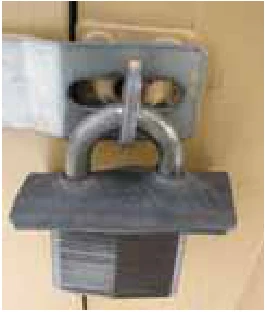
“In subfreezing temperatures, the padlock freezes up so hard I need my wife’s hair dryer to thaw it out.” To prevent moisture from entering the lock, he came up with what he calls a “Lock Bra”. It’s made from a small piece of heavy-duty inner tube off a tractor tire.

“I cut the piece of inner tube larger than the lock to create a somewhat flat umbrella and then use a leather punch to punch two holes in it, spaced to match the lock’s shackle,” says Geppert.

“The holes need to be much smaller than the shackle in order to provide a water-tight seal. It completely solved the problem.” Contact: FARM SHOW Followup, Ron Geppert, 124 Pfau St., Mankato, Minn. 56001 (ph 507 387-1247; [email protected]).

From the archive · Full text
Feature story

Jump Start Battery

Featured source:

“When my old portable jump start battery recently went bad, I got the idea to make my own. I kept the cables and bolted them to a side post car battery that I bought used for $10. Now I have a jump start battery with twice as much power as my old one, and it’ll last a lot longer, too,” says Larry Wood, Waldo, Ohio. He used a short length of pvc pipe and some nylon rope to make a handle to carry the battery around.

“It’s a simple idea but it’s really practical,” says Wood.

“Good used car batteries sell for $10 to $20. When I’m not using the battery, I double the cables back and clamp the leads onto them so they’re out of the way.”

Contact: FARM SHOW Followup, Larry Wood, 2081 Newmans Cardington Road, Waldo, Ohio 43356 (ph 740 360-1956; [email protected]).