Practical ideas from FARM SHOW MagazineSubscribe · Free issue · Send us your shop tip
Subscribe to FARM SHOW
Issues / Vol. 36, No. 1 (2012)

Vol. 36, No. 1 (2012)

Money-Saving Repairs & Maintenance Shortcuts · Printed section pp. 36–39

32 selected entries · Complete text of selected entries

This issue’s section includes reader tips and feature-length shop stories. Held items and editorial notices are not reproduced.

Archive text: prices, coupons, availability and contact details reflect the original publication, not current offers. Reader methods are not universal instructions; follow manufacturer guidance and proper safety practices.

Reader shop tips

From the archive · Full text
Reader shop tip

Edward Miller

Edward Miller, Batavia, N.Y.

“This is the handiest tool I’ve ever built for around the farm. I mounted a new compact air compressor on a 2-wheel hand truck and bought a new hose reel to mount above it. I can take it anywhere and run the hose out as needed. I’ve also got a hook on back to hold a grease gun.”

From the archive · Full text
Reader shop tip

Robert Brickler

Robert Brickler, LaFayette, Ind.

“To remove rust from chrome or stainless – or to take tar residue off auto glass – spray it with WD-40 or some kind of penetrating oil and let it soak. Use steel wool (no. 000 or 0000) to scrub the area – might take 2 to 3 applications. Will not scratch chrome or glass. Use only the lightest steel wool. Then wash with a soapy solution and apply wax.”

From the archive · Full text
Reader shop tip

Jerril Andres

Jerril Andres, Shafer, Minn.

“When I have trouble getting a good bead seal on a tractor tire, I cut a 3-in. band of rubber from an old inner tube and stretch it over the edge of the rim in the bead area. I’ve had good results getting a tight seal. Simple but it works.”

From the archive · Full text
Reader shop tip

Ken Brading

Ken Brading, Atascadero, Calif.

“In your last issue, a reader told how he bends thin wall tubing by filling it with sand and plugging both ends to keep it from collapsing.

“I once had to replumb the exhaust tube on an air compressor. The space was too tight to bend a simple elbow and still get the necessary insertion into the compression fittings on both ends. To get flexibility through length, I coiled a length of aluminum tubing as shown in the photo. I crimped one end of the tube closed, packed it full of extremely fine grain sand by tapping the crimped end on a bench vise, and then crimped the other end so the tube was tightly packed with sand. Wearing insulated gloves, I heated the packed tube with a propane torch and slowly fashioned it into a coil. The extra length in the coil gave enough flexibility to hook it up.”

From the archive · Full text
Reader shop tip

Rod Rhoades

Rod Rhoades, North Star, Alta

“Removing bad sealed bearings can be a difficult, slow process. So-called grease needles don’t work well or at all on shielded bearings. To grease sealed bearings I use a quality bit in a dremel-type tool to drill a 1/16-in. dia. hole in the shield. Then I use a pointed nozzle to inject synthetic grease and cover the hole with more grease. If I do that the bearings seem to run fine for years.”

From the archive · Full text
Reader shop tip 1 of 4

Bill Reeks

Individual tip 1 of 4 from this reader’s published contribution.
Bill Reeks, Cromwell, Ky.

“I used 2-in. angle iron to build a ‘push frame’ on front of my Sears Craftsman garden tractor. Metal braces extend from the top of the frame down at a 45 degree angle to the tractor frame. I attached a 1 7/8-in. ball hitch to it that lets me push small trailers around without having to look backward, which helps a lot because I have arthritis in my shoulders and neck. In fact, I’ve mounted push frame-mounted ball hitches on several garden tractors.

From the archive · Full text
Reader shop tip 2 of 4

Bill Reeks

Individual tip 2 of 4 from this reader’s published contribution.
Bill Reeks, Cromwell, Ky.

“I also attached an eyebolt on top of the push frame so I can lift the tractor with a chain hoist from the trusses in my pole barn. It’s really handy for sharpening the mower’s blades. I place a safety stand under the deck and then let the tractor down until it rests on the stand. Then I can sit in a chair and sharpen the blades without having to remove the deck or bend over.

From the archive · Full text
Reader shop tip 3 of 4

Bill Reeks

Individual tip 3 of 4 from this reader’s published contribution.
Bill Reeks, Cromwell, Ky.

“I remove the hood from every garden tractor I own as soon as I get it home and never put it back on. To me the tractor hood is just a nuisance. I use the open space in the engine compartment to store stuff that I want to bring with me, such as tools or an umbrella.

From the archive · Full text
Reader shop tip 4 of 4

Bill Reeks

Individual tip 4 of 4 from this reader’s published contribution.
Bill Reeks, Cromwell, Ky.

“I used a short length of wire to connect the chuck on my air compressor with the blow nozzle. That way the nozzle is always there when I need it. It’s really handy when blowing dust out of tractors or sweeping a floor.”

From the archive · Full text
Reader shop tip 1 of 2

Mike Halbirt

Individual tip 1 of 2 from this reader’s published contribution.
Mike Halbirt, Silverton, Ore.

“I used to have trouble getting the cap off the valve stem on the inner wheel of tractor duals. To solve the problem, I started using an 8-in. length of rubber hose with a slit in it. I slip it over the cap and twist. The hose holds onto the cap.

From the archive · Full text
Reader shop tip 2 of 2

Mike Halbirt

Individual tip 2 of 2 from this reader’s published contribution.
Mike Halbirt, Silverton, Ore.

“Frozen nuts on bolts can be hard to remove. One way is to use a torch to heat and loosen the nut up. When heating a nut this way, heat only one side of the nut because you want to obtain an elliptical shape. You’ll hear a little ‘tick’ as soon as the nut breaks loose.”

From the archive · Full text
Reader shop tip

Rex Gogerty

Rex Gogerty, Hubbard, Iowa

“Discarded tracks from an old crawler tractor, screwed to the floor of a flatbed trailer, can provide extra traction for loading 4-wheelers, garden tractors and skid loaders. My son found the tracks in a junk yard.”

From the archive · Full text
Reader shop tip 1 of 2

Mark Schneck

Individual tip 1 of 2 from this reader’s published contribution.
Mark Schneck, Hooper, Neb.

“Nebraska state law requires using a red flag for cargo extending past the pickup bed. But cloth flags take a beating at highway speeds. So I put a roll of high visibility marking ribbon in my glovebox. The pink day-glow color is highly visible, and I can throw the ribbon away once I reach my destination.

From the archive · Full text
Reader shop tip 2 of 2

Mark Schneck

Individual tip 2 of 2 from this reader’s published contribution.
Mark Schneck, Hooper, Neb.

“To pour small amounts of liquid from a new 5-gal. bucket, lay the bucket on its side with the opening at 12 o’ clock. After cracking open the cap, roll the full bucket to about 1 o’ clock. Beats lifting and aiming.”

From the archive · Full text
Reader shop tip

Elden Pohlman

Elden Pohlman, Caledonia, Minn.

“We had a bee infestation on a house and had used many cans of spray without much success. One morning I used a small shop vac to suck the bees up as they were coming and going out of the entrance hole. I used a few spikes to hold the shop vac’s wand in place and let it run for about 4 hrs. No stings. Worked good.”

From the archive · Full text
Reader shop tip

Bud Roenigk

Bud Roenigk, Cabot, Penn.

“I needed an inexpensive storage unit for my shop tools, such as saws and drills. I found a set of metal lockers that had been removed from a school during renovation. I stacked the lockers on their sides so the doors open down. My tools fit neatly into the lockers, and my cost was minimal.”

From the archive · Full text
Reader shop tip

Kerry Kligora

Kerry Kligora, Mineral Point, Wis.

“I came up with a simple way to fix hazy plastic headlight lenses on my vehicles. It’s the next best thing to installing a new lens assembly, greatly increasing the amount of light coming from the headlight.

“First, I use 0000 steel wool to lightly rub the lens. This process gets the heaviest of the haze off but leaves minor scratches in the lens. I use Mr. Clean Magic Eraser and rub the lens with the dry sponge, applying light pressure until major scratches caused by the steel wool are gone. Then I wet the Magic eraser with water and rub the lens, applying heavy pressure until most of the smaller scratches are gone. Finally, I apply a good car wax to the lens, let it dry, and then buff it out with a micro fiber cloth. I apply a second coat of car wax if I think it needs it. I usually have to redo this process twice a year, in the early spring and late fall. But it’s a lot cheaper than buying new lens assemblies.”

From the archive · Full text
Reader shop tip

Bill and Karen Hinckley

Bill and Karen Hinckley

“Empty 1-gal. metal cans can be used to make convenient bolt or parts bins. I use a knife to cut an opening in one side of the can and then bend the edges over to eliminate the sharp edge. Sometimes I cut the opening into one of the narrow sides of the can so it won’t take up as much room on a shelf. I use this idea to store parts when restoring a tractor, labeling each can with a piece of tape.”

From the archive · Full text
Reader shop tip

Tim Renger

Tim Renger, Bancroft, Iowa

“Changing oil on my 4-WD tractor was always one of the messiest and most back-wrenching jobs on the farm until my friend Mark Bauer came up with this two-wheeled oil caddy. Now I can wheel the cart under the tractor, reach under to remove the plug and drain the oil without spilling a drop.

“Bauer built the 24-in. tall caddy from an empty oil drum, a few pieces of scrap iron and two steel wheels. The 30-gal. oil drum was cut in half. He used the half-moon shaped end from another barrel for a baffle to keep oil from splashing back and forth when the caddy is moved.

“The extra long handles work really well to position the cart under my 4-WD tractor, which has a large fertilizer tank on front. A metal spigot on the wheeled end makes it easy to fill pails or jugs without spilling a drop.”

From the archive · Full text
Reader shop tip

Ken Grazier

Ken Grazier, Havre, Mont.

“I built this height adjustable work stool. I just use a finger to dial myself up or down as I sit in the chair.

“The stool rides on four small caster wheels. I used the seat and mounting frame from an old Sears riding mower, welding it on top of a screw jack off a Toyota car. The bottom of the jack is welded to a steel plate. The seat adjustment mechanism consists of a sprocket with an eyebolt welded onto one of the cogs.”

From the archive · Full text
Reader shop tip

Bucky Renger

Bucky Renger, Bancroft, Iowa

“When I built my new shop I wanted to make sure everything was either hanging from nice brackets on the wall, in a labeled drawer, or on a clearly visible bench or shelf. These brackets are the nicest I’ve ever seen for hanging brooms, scrapers, shovels and other long handle tools. They were custom made by Doug Droessler of Bancroft, Iowa (ph 515 341-5902).

“Droessler uses 1 1/2-in. tubing so the brackets are strong enough to hang up to 100 lbs. The protruding fingers on broom brackets are 13 in. apart and 5 in. long. Shovels, spades and other long handled tools easily slip into narrower brackets with fingers that are 5 in. apart and 13 in. long.

“The leading edges are beveled, seams are ground and buffed, and 1 1/2-in. spacers are welded on back. Droessler finishes the brackets with black powder coating so they look nice on a painted wall and resist rust. He will make any size custom bracket that people want.”

Shop feature stories

From the archive · Full text
Feature story

Filter System Purifies Oil On-The-Go

Featured source:

A bypass oil filtration system from Oil Purification Systems (OPS), filters out and also vaporizes contaminants. The company says Eco-Pur system will pay for itself in reduced oil changes alone. Add extended engine life and reduced downtime for maintenance and it all adds up to increased return on assets and a rapid payback on the product, says Greg Slawson, OPS.

“We’ve sold more than 25,000 systems for industrial use in transportation, oil and gas, sanitation, mining and agriculture,” says Slawson.

“It’s designed to work best on larger diesel engines performing in tough environments.” The unit mounts on the engine and diverts 5 percent of the oil through a pleated, microglass filter. The filter is 94 percent efficient at capturing three-micron particulates and effectively removes the 5 to 10-micron particles that cause most engine wear. It also removes water, fuel, acids and other liquids that can cause oxidation, corrosion, sludge and lubricity loss. Removing them keeps gaskets and other components from premature failure. Once contaminants have been captured, they “flow” across the surface of the filter to a heated plate. The electronically charged plate vaporizes contaminants. Any vapors are vented out of the filter chamber, leaving clean oil to return to the reservoir. The constant filtering of 5 percent of the flow maintains the oil at a high quality, eliminating the need for normally scheduled oil changes. Slawson recommends using the normal oil-drain schedule to replace Eco-Pur filters and to draw a sample of engine oil for testing. Since even clean oil won’t last forever, OPS advises using their own True-Test program for oil samples.

“It has a retail price of only $22.50, is performed by a third party laboratory, and provides a comprehensive diagnostic and preventative maintenance tool,” says Slawson.

“Simply change the oil when the sample results indicate the oil has reached the end of its useful life.” Eco-Pur Systems are sized by make and model of engine. Suggested retail price for the basic unit is $595.

“The Eco-Pur typically pays for itself in less than 12 months,” says Slawson. OPS sells Eco-Pur systems directly, as well as through approved distributors and installers. To see how an Eco-Pur customer installed a unit on his Volvo tractor, visit www.farmshow.com. Contact: FARM SHOW Followup, Oil Purification Systems, Inc., 2176 Thomaston Ave., Waterbury, Conn. 06704 (ph 866 645-7873; [email protected]; www.ops-1.com).

From the archive · Full text
Feature story

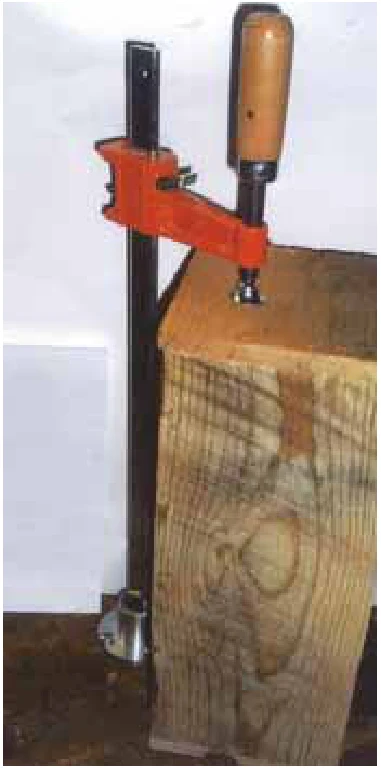
Kit Converts Handheld Clamp To Bench Mount

Featured source: Darrell Kittleson

“My patent pending ‘convert-a-clamp’ kit is designed to convert a handheld Jorgenson clamp to a bench or table-mounted device. It allows you to hold objects rigidly in place so you can use both hands when working,” says Darrell Kittleson, Amery, Wis. Kittleson’s kit consists of 2 round metal sleeves – an outer one that bolts to the workbench and an inner “sleeve” that’s free to rotate inside it. You remove the stationary jaw from the clamp and replace it with the inner sleeve, then line up holes in the sleeves and insert a 1/4-in. dia. metal pin through the inner sleeve and through a hole in the bar where the stationary jaw was riveted on.

“It’s a simple idea that makes the Jorgensen clamp a lot more useful. It’ll also work with any handheld, squeeze-type quick clamp,” says Kittleson.

“It works great for clamping two boards that you want to glue together because you can hold the boards vertically in place. If you want you can anchor extra long Jorgensen clamps to your floor for any really long pieces you need to hold in place.” The kit sells for $17.95 plus S&H. Contact: FARM SHOW Followup, Darrell Kittleson, Dar-sys, 1141A State Rd. 65, Amery, Wis. 54001 (ph 715 483-3979; [email protected]).

From the archive · Full text
Feature story

How To Upgrade Engines With Right-Sized Fuel Injector Kits

Featured source:

When upgrading a diesel engine to boost horsepower, pick your fuel injection kits carefully, warns Chad Flynn, owner of Flynn’s Shop, Alexander, Ill. He’s a much-quoted expert on diesel performance upgrades and says the wrong sized injectors, or injectors that are not tuned correctly, just waste fuel.

“There are tons of good companies making good products, but you need to get the right kit for your engine,” says Flynn.

“It comes down to a balance between cost and quality. Injectors can get pricey, and installation can be tricky.” He explains that upgrading to a bigger turbo allows you to upgrade to larger injectors. However, the injectors need to be sized to the proper volume of fuel flow with each stroke. Flynn recommends Swamp’s Diesel for injectors for Ford engines.

“I’ve used a lot of their injectors and never had a problem,” he says.

“They seem to be a little lower in cost and offer helpful tips for removal and installation on their website.” Dave Armstrong, Swamp’s Diesel, suggests that customers get a feel for where they want to go and get a set of injectors they can “grow” into.

“If a customer is never going to add a bigger turbo or other upgrades, it’s pointless to add larger injectors,” says Armstrong.

“However, if they plan to upgrade, they can get a larger injector. With today’s electronically-controlled engines, we can take an injector capable of making 600 hp and knock it down to match a stock turbo under 300 hp.” Swamp’s Diesel builds fuel injector kits, but they also do the software and tuning so customers get a matched set. Armstrong points out that knowing what you need is more important than trying for a certain horsepower rating. Many of his customers want a truck or car they can take to the track and think they need 500 hp.

“A guy may think he wants 500 hp, but would be perfectly satisfied with 425 to the tires and not have to mess around with upgrading valve stems, push rods, turbos and more,” notes Armstrong. Knowing what has to be done to complete the upgrade is key, adds Flynn. While he has extensive experience upgrading and modifying diesel engines, he points out how easily problems can happen.

“Every brand has its own sensitive areas,” he explains.

“You want to do research before you buy a set of injectors. I’ve done so many that it’s no big deal, but non professionals have to have pretty good mechanical skills.” Contact: FARM SHOW Followup, Flynn’s Shop, 1255 Franklin-Alexander Rd., Alexander, Ill. 62601 (ph 217 478-3811); or Swamp’s Diesel Performance, 304-A Sand Hill Rd., La Vergne, Tenn. 37086 (ph 866 595-8724 or 615 793-5573; [email protected]; www.swampsdiesel.com).

From the archive · Full text
Feature story

“Reinventing” The Floor Creeper

Featured source:

“It’s the only creeper with a frame built strong enough to protect you in case of an accident. It has a lot of other comfort features not found on conventional models,” says Erik Sieb, Creepex Co., about his new heavy-duty BodyGuard floor creeper. It rides on three 6-in. solid rubber caster wheels and measures 28 in. wide on front, narrowing to 12 in. wide on back. The operator lies comfortably on a vinyl-padded ergonomic backrest and a 4-position adjustable headrest. But what really gives the creeper a unique look – and added safety – is the frame. It’s made from 1 1/2-in. black powder coated steel tubing, allowing the creeper to withstand the weight and impact of a falling vehicle. The frame can sustain a constant load of 30,000 lbs. The creeper comes with wrist-activated brakes on the front wheels, a powerful 150 lumens cordless working light that clips onto the back part of the frame behind your head, and tool trays located on each side.

“It’s safer to use than any other floor creeper on the market and also provides extra comfort and maneuverability,” says Sieb.

“The solid rubber tires provide shock absorption and a smooth ride when traveling over rough floors or uneven surfaces. In fact, the BodyGuard creeper is as stable as a tripod on uneven surfaces. The wrist-activated brakes make it easy to hold the creeper in place.” While the BodyGuard is higher than a conventional creeper, you don’t need to raise the vehicle any higher than you do with a conventional floor creeper.

“The creeper’s highest point is no higher than the tip of your nose when laying down on a conventional creeper,” says Sieb. He adds that the BodyGuard’s frame can be custom painted to Deere or Caterpillar colors. Three different models are available. All models come with a standing bumper that lets you store the creeper in an upright position. The XT model comes with a non-adjustable backrest and headrest and no brakes, tool trays or light. The vinyl padding on it is available only in red. It sells for $949 including S&H. The XTpro includes all features, comes in black or white, and sells for $1,249 including S&H. The XTchrome includes all features and comes with a chrome-plated frame. It sells for $1,549 including S&H.

Contact: FARM SHOW Followup, Erik Sieb, Creepex (ph 877 273-3739; [email protected]; www.creepex.com).

From the archive · Full text
Feature story

Portable Air Compressor Built On Riding Mower Frame

Featured source:

“It’s easy to tow around to anywhere on the farm,” says Shane Myrick, Pleasanton, Kan., who mounted a 10 hp gas-powered air compressor on the front axle and frame of an old Snapper riding mower. He pulls the unit using a long metal handle that pins onto the front of the frame. He cut the front axle and part of the frame off the mower and found new wheels and an axle for the back. He welded the air tank to the mower frame, being careful not to burn a hole in the tank.

“It provides enough pressure to use it for arc welding or sandblasting,” says Myrick.

“I operate a welding shop in the country, and I often move it outside so I don’t have to listen to it run as I work inside.” Contact: FARM SHOW Followup, Shane Myrick, 17758 Vail Rd., Pleasanton, Kan. 66075 (ph 913 757-3309).

From the archive · Full text
Feature story

Need A Bike Or Part? Try “All Bikes” Salvage

Featured source: Ron Adler

Two acres of memories and toys – for children and adults – break up the desert landscape along Highway 87 in rural Payson, Ariz. Ron Adler, owner of All Bikes salvage yard, caters to people seeking parts for all kinds of 2 and 3-wheel bikes, from Honda to Harley motorcycles, to 3-wheel ATV’s and bicycles. It all started with his bicycle shop in Washington in 1970, where he also sold motorcycles and did repair work. In 1988, Adler moved his collection to Arizona. The scrap yard soon started growing rapidly.

“We ship all over the world,” Adler says, noting his collection includes motorized bikes from around the world. He also has new models, such as those he purchased from a Harley-Davidson dealership that sold out. The sight of old 3-wheelers attracts those nostalgic for the old ATV’s. But his non-motorized bikes are also a big draw.

“People are surprised to find their childhood bikes,” Adler says. One mother described her Schwinn bicycle that had been inadvertently sold at a yard sale when she was a girl. He had the same one in stock – baby blue with butterflies and daisies on the seat. She cried.

“I have bicycles from as far back as the 1800’s,” Adler adds. His oldest motorcycle was made in 1915. A personal favorite in his own collection is an Adler motorcycle from 1954, the year he was born. Many customers come to duplicate good memories for their children. For example, one father bought a motorcycle he had as a youngster – a Yamaha GT 80 – for his son. Adler continues to collect and add to his yard. He welcomes customers from around the world looking for that special bike or parts to fix one they have. Customers can also call, Wednesday through Sunday from 9 to 5, and Adler or an employee will check out the inventory to see if it’s available.

“I am always interested in hearing from people who find old bikes and motorbikes in their barns or sheds,” Adler adds. Contact: FARM SHOW Followup, All Bikes, 16603 N. Arizona Hwy. 87, Payson, Ariz. 85541 (ph 928 474-2526; [email protected]).

From the archive · Full text
Feature story

Simple Solution Stops Powerstroke Deadheading

Featured source:

You can eliminate “deadhead” problems in 1999 through 2003 Ford Powerstroke engines by installing a Fuel Rail Crossover (FRx) kit from Riffraff Diesel Performance, and improve mileage, power and reduce noise. The FRx kit doesn’t require cutting lines or installing compression fittings.

“A 7.3L Ford engine has no way for air in the fuel to get back to the tank, and it gets trapped at the injectors,” explains Clay Note, Riffraff Diesel Performance.

“There are a lot of really complex systems on the market that solve the problem, but they cost between $500 and $600. Ours is a simple bolt-on kit that costs less than $200.” The FRx simply connects the two heads to provide a return path for trapped air. The “complex” systems require major modifications of the fuel system and at least partial disassembly of the engine. Once modification is completed, it can’t be easily undone.

“You can install our system in your own driveway in a short amount of time,” explains Note.

“If you want to remove it, simply replace the original equipment. There are no permanent modifications to anything.” After more than 1,000 sales, Note reports 100 percent satisfaction among customers. Although the FRx is positioned simply as eliminating the deadheading common with Powerstroke engines, it has other benefits, too.

“We don’t claim more horsepower or better mileage,” he says.

“Those are just side effects of an engine that is running smoother and idling quieter. Users also experience better throttle response and longer injector life.” The list price for the new second generation FRx with Parker 304 Stainless Steel Braided lines is $187.37. Owners of first generation FRx kits can upgrade for only $100. Note adds that the newer Ford Powerstroke 6L engines suffer from similar deadheading problems. He says Riffraff Diesel Performance is working on a similarly simple solution for that product range. Contact: FARM SHOW Followup, Riffraff Diesel Performance, Inc., P.O. Box 416, Eagle Point, Ore. 97524 (ph 541 879-1052; toll free 866 446-3360; www.riffraffdiesel.com).

From the archive · Full text
Feature story

Grease Wheels Without Removing Hub

Featured source:

A simple tapered tip for the end of his grease gun saves Jim Rankin hours of labor greasing the wheels of 30 wagons used to raise tobacco. Because he doesn’t have to take the dust cap off the wheel hub, it takes a fraction of the time to apply grease. He drills a 1/4-in. hole in the center of the hub. It’s the right size for the 1 1/4-in. long cold round steel piece on his grease gun.

“I had several tips made up for my grease guns,” Rankin says.

“The tip screws on the end of the grease gun and has a small hole about 1/8-in. dia. The hole in the hub doesn’t have to be exact; that’s why I tapered the tip. Put the point in the hole, put pressure on it and squeeze the grease gun. Grease until it comes out of the backside.” When finished, he plugs the hole with a small rubber stopper. Rankin notes he has had more luck with his attachment than with grease fittings on the side of hubs that he thinks don’t do as good a job. The simple tip has been a huge time saver, Rankin says, and made it easy to grease his wheels through the years. Contact: FARM SHOW Followup, Jim Rankin, 1161 Hume Bedford Rd., Paris, Ky. 40361 (ph 859 221-9227; [email protected]).

From the archive · Full text
Feature story

Deutz Diesel Engine Mated To F-150 Pickup

Featured source:

“I got the idea for doing this after reading an article about Shade Tree Conversions in FARM SHOW a couple years ago,” Truman Miller says.

“The story said they had plans that could help a truck get up to 40 mpg, so I decided to buy their manual and give it a try.” After reading the Shade Tree manual (www.shadetreeconversions.com), Miller found a used 1997 Ford F-150 with 340,000 miles on the odometer. He bought it for $18,00 because the body and frame were in good shape and the cab was large enough to hold his family of four kids. Miller decided to repower the Ford with a Deutz Diesel because “they have a history of running well with very good fuel efficiency.” He found a 1997 5-cyl. Deutz on Craigslist, paying $1,500 for the engine, clutch and bell housing. Miller also found a NV4500 transmission from a 1999 Dodge truck for $900.

“My Ford engine compartment didn’t have as much room as the Chevy, so I had to cut out part of the grill, remove the radiator and block up the cab about 1 5/8 in. so the Deutz housing would slide into place,” Miller says.

“I also modified the engine mounts and I had to cut out part of a cross member on the frame and replace it with a different one so the oil pan would clear.” A machine shop built a 3/4-in. adapter plate to mate the bell housing on the Deutz to the Dodge tranny. Since the Deutz is air rather than liquid-cooled, he had to cover half the air intake so the engine would run warmer. Miller adapted the exhaust with a 3-in. flexible pipe and used existing lines for the tachometer, the heater and AC connections. He rigged a new mount for the power steering pump and the alternator and bought a new V belt to run it because the Ford had a serpentine belt. The Deutz already had a vacuum pump that worked fine. Miller’s repowered F-150 has a 5-speed transmission with a 3:08 rear end. That gives it enough power to easily pull a 5,000-lb. trailer. Top speed is in the 80 mph range.

“I’ve got about $3,700 into the engine and parts, and the rest is all labor,” Miller says.

“That’s quite a bit less than trading for a different truck, and I think this engine will probably run for a couple hundred thousand miles.” Although he hasn’t exactly documented mileage yet on the new setup, Miller says it’s about double the 16 mpg that the truck got originally. Miller says the manual from Shade Tree was very helpful and he recommends their book to others who aren’t afraid to tackle a project like this. Miller has several photos of the project on his Facebook page. Contact: FARM SHOW Followup, Truman Miller, Rte. 1, Box 1419D, Wheatland, Mo. 65779 (ph 417 309-1305; [email protected]).

From the archive · Full text
Feature story

Kits For DIY Engine Swaps

Featured source:

Anyone who’s into do-it-yourself engine swaps will be interested in these Cummins installation kits available from Auto World, Great Falls, Mont. The company says it’s been doing Cummins engine repowers for more than 20 years and offers motor mounts for many swap applications, including Cummins 6BT and 4BT engines. Motor mount kits include crossmember and mount sets, OEM alternator/air conditioning bracket sets, and tach adapter kits. The company also sells transmission adapters, flexplates, oil relocation kits, PCS transmission controllers and other performance items for diesel trucks.

“All our products are TIG welded/waterjet cut and made to order for your particular application. Instructions are provided with all our products, including wiring and tech help on all your other questions,” says Dawna Kraus.

“We make our own accessory brackets for Ford and Chevrolet pickups. Over the years we’ve done repowers for a lot of farmers and ranchers.” Their crossmembers are designed to fit older vehicles from 1967 to 1987 and up through 1991 in Chevrolets with the old body style. The company also sells the cross members needed for old body-style GM and Ford trucks, allowing you to easily equip them with a diesel engine.

“We’re partners with Destroked’s products and sell their adapter plates for transmissions and alternator brackets,” says Kraus. Contact: FARM SHOW Followup, Auto World, 9th St. and 6th Ave. N., Great Falls, Mont. 59401 (ph 406 727-8915; [email protected]; www.autoworldmt.com).

From the archive · Full text
Feature story

Controller Cures Overdrive Blues

Featured source:

“We sell to a lot of people putting overdrives in older trucks that didn’t have them,” says Jay Rohrbach of Powertrain Control Systems (PCS) about his company’s Simple Shift Transmission Controller.

“They are also popular when repowering an older truck with a Cummins diesel. You can get much better mileage with an overdrive and our controller.” The Simple Shift Transmission Controller lets an electronic overdrive shift smoothly whether under load or not, at lower rpm’s and with better fuel efficiency.

“Our controller will let you do 70 on the highway at 1,800 to 2,100 rpm’s like a normal truck, not turning the engine at 3,500,” says Rohrbach.

“The same holds for getting the most out of an overdrive when doing heavy towing or normal driving of anything from half-ton to one-ton trucks. It does more at a lower rpm’s, and that cuts fuel use.” High-performance operators often turn to programmable electronic controllers. However, most of these involve the use of a laptop in the truck and require extensive programming. With the Simple Shift the only thing added to the cab is a small control unit. The Simple Shift controller lets the operator adjust shift points, shift firmness and torque converter lockup. Easy to use dials adjust settings up or down. Simple Shift also offers complete diagnostics if problems occur with the transmission.

“It’s fully adjustable, so you can go in and adjust as needed,” says Rohrbach. The kit from PCS retails for $599 and is available for most domestic 4 and 5-speed transmissions. The kit is designed for do-it-yourself installation. It includes the complete wiring harness tailored to the specific transmission. Each connector is clearly labeled. Initial setup is carried out with the self-calibrating throttle on the Simple Shift control unit. Contact: FARM SHOW Followup, Powertrain Control Solutions, 11228 Hopson Rd., Ashland, Va. 23005 (ph 804 752-6025; [email protected]; www.powertraincontrolsolutions.com/dealers.php).