Practical ideas from FARM SHOW MagazineSubscribe · Free issue · Send us your shop tip
Subscribe to FARM SHOW
Issues / Vol. 35, No. 1 (2011)

Vol. 35, No. 1 (2011)

Money-Saving Repairs & Maintenance Shortcuts · Printed section pp. 36–39

35 selected entries · Complete text of selected entries

This issue’s section includes reader tips and feature-length shop stories. Held items and editorial notices are not reproduced.

Archive text: prices, coupons, availability and contact details reflect the original publication, not current offers. Reader methods are not universal instructions; follow manufacturer guidance and proper safety practices.

Reader shop tips

From the archive · Full text
Reader shop tip

James Jessiek

James Jessiek, Levering, Mich.

“I’ve found that ‘great stuff’ foam in a can, which is normally used for insulating nooks and crannies, also works great as a substitute for auto body filler. It’s quick, easy to use, and you can cut trim down as needed.”

From the archive · Full text
Reader shop tip

Lynette Croteau

Lynette Croteau, Winchester, N.H.

“I use large dryer hose clamps as ring compressors for large pistons. It’s a quick, simple solution to a job that’s often time-consuming and frustrating.”

From the archive · Full text
Reader shop tip

Wilson Rickenbaker

Wilson Rickenbaker, Lexington, S.C.

“I use a disposable cut-to-fit furnace filter between the radiator and grille to keep the radiator on my old Ford tractor from clogging up when mowing. To clean the filter in the field, I just beat it against one of the rear tires.”

From the archive · Full text
Reader shop tip

Dean Helms

Dean Helms, New Port Richey, Fla.

“I didn’t want to carry my electric-powered, 120 psi air compressor and air tank around by hand all the time - the compressor and tank together weigh at least 65 lbs. So I mounted the compressor on a 2-wheeled lawn seeder. It bolts onto a 1/2-in. thick plywood board that clamps onto the lawn seeder’s bucket. Works great for airing up tires in my yard or even out in the field. And it puts my lawn seeder on active duty.”

From the archive · Full text
Reader shop tip 1 of 2

Ted Slaght

Individual tip 1 of 2 from this reader’s published contribution.
Ted Slaght, Putney, Vt.

“My Ford 2N tractor doesn’t have good brakes. The seals leak all the time, allowing hydraulic and differential fluid to leak onto the brake shoes, especially when working on side hills. And once the shoes get wet they don’t work at all. It’s quite a job to change the seals, and eventually I’ll have the same problem all over again.

“To solve the problem, I cut a slot in the backing plate under the axle shaft and welded a metal trough on the inside part of the plate to catch any fluid that leaks down. Now any fluid that comes out runs into the trough and outside the backing plate, instead of running onto the brake shoes.

From the archive · Full text
Reader shop tip 2 of 2

Ted Slaght

Individual tip 2 of 2 from this reader’s published contribution.
Ted Slaght, Putney, Vt.

“Instead of installing brake shoes with factory linings, I chisel off the brake lining and use Liquid Nail to glue a 2-in. wide length of fabric belt (off a saw rig) onto the shoe. After the glue sets I drill holes through the back side of the shoe and through the belt. Then I use small brass bolts to make sure the belt stays on the shoe.

“It really works well. When I tap my foot lightly on the brake, I can’t believe how fast the tractor will stop.”

From the archive · Full text
Reader shop tip

Ken Lebold

Ken Lebold, Earlton, Ontario (ph 705 563-2958 or 2277)

“I operate a farm equipment repair shop, and recently heard that one of my customers used a shop vac to clean out sludge that had accumulated in the 25-gal. fuel tank on his Deere 2350 50 hp tractor. He emptied the tank out as much as possible by running the engine and then shoved the vac’s suction hose inside the tank filler hole. Then he rinsed out the tank with fuel to remove any remaining sludge and sucked it up.

“He knew there was a problem because dirt was accumulating in the tractor’s fuel filters and sediment bowls. He said it was a lot easier than removing the tank from the machine. In some cases, you may have to put another smaller hose on the end of the vac cleaner hose so it’ll fit into the filler hole. Be careful not to damage the tank’s sending unit, which is a float and rod that tells you how much fuel is in the tank. And of course avoid any flames or sparks.”

From the archive · Full text
Reader shop tip

Eugene P. Prunty

Eugene P. Prunty, Andover, S. Dak.

“I change light bulbs without having to climb a ladder by using an old telescoping window washer. I screw a metal can onto the end of the washer’s handle, then use electrical tape to attach two foam drinking cups inside the can. The cups grip the bulb. I use two cups just for reinforcement. The window washer is about 6 ft. long so I can reach up about 12 ft. Works great both in my house and barn.”

From the archive · Full text
Reader shop tip

Jeremy Row

Jeremy Row, Shickley, Neb., FFA vice president

“We turned an old weight machine into a handy portable table to hold a chop saw.

“The weight machine already had a wheel on front that retracted up out of the way when not in use so the machine wouldn’t roll around. It works great for a table because we can move it whenever we want, or keep it stationary.

“To make the table we cut the machine’s four uprights down to a height of 29 in., then made a square frame out of angle iron, welded it to the bottom of the uprights, and bolted a section of 1/2-in. plywood on top. The problem we ran into was getting the wheel to retract without contacting the table top. We solved the problem by spinning the wheel 180 degrees and cutting 30 in. off the handle. ”

From the archive · Full text
Reader shop tip

Ray Bittmann

Ray Bittmann, Anoka, Minn.

“Many shop vacs have big 3-in. dia. hoses, which makes it hard to get into tight spaces, like under a car seat. My solution is to take a long funnel – the kind used to drain transmission oil - and attach it to the end of the hose. The funnel tube friction fits into the end of the hose. Works great.”

From the archive · Full text
Reader shop tip

Jerry Hawkinson

Jerry Hawkinson, Gettysburg, S. Dak.

“The air conditioner on my Deere 7600 tractor wouldn’t keep the cab cool. I discovered the air conditioner has two circulating fans located under the seat. One of the fan motors didn’t work at all, and the other one was weak. My Deere dealer replaced both motors, which solved the problem.”

From the archive · Full text
Reader shop tip

Dave McAdoo

Dave McAdoo, Alvarado, Texas

“Maybe I’m a slow learner, but it was late in life before I learned the significant cost advantage of buying WD-40 by the gallon. But you need an effective way to dispense it.

“I tried using spray bottles and pump oil cans, but they always seemed to deliver too much product. I was about to switch back to spray cans when I discovered that the bottles they use for liquid Grecian Formula squirt a nice, thin stream right where you want it. It works so well that you might want to spend $14 for a bottle even if you don’t use the contents. It also works well for the 50/50 ATF and acetone do-it-yourself penetrating oil that I read about in FARM SHOW (Vol. 34, No. 3).”

From the archive · Full text
Reader shop tip

Richard Erickson

Richard Erickson, Farwell, Mich.

“Here’s a photo of several equipment holders that my grandson, Ryan Erickson of Tustin, Mich., built to hold small 3-pt. mounted implements. The carriers make hooking up equipment a much easier job. The upright posts measure 4 by 6 in., with 1-in. dia. well pipe cross bars.”

From the archive · Full text
Reader shop tip

Frank Miller

Frank Miller, Beecher City, Ill.

After operating a 25-man shop for 28 years, Frank retired and moved to the country. He wanted to make certain he could take his standby power wherever he wanted, so he bought a Harbor Freight trailer and mounted a gas welder and a generator on it. The generator is set up for either 110 or 220 volts and has an output of 10,000 watts. With 110 volts it has an output of 80 amps; 40 amps with 220 volts.

From the archive · Full text
Reader shop tip

Robert Nanius

Robert Nanius, Union Dale, Penn.

“Over the years I’ve seen all kinds of gadgets designed to lift riding mowers for doing maintenance work. The trouble is, they all get in the way when doing the repair work. The best thing I’ve found is to use a portable shop crane. Just hook the crane’s boom into the mower’s drawbar hole and raise it. Be sure to brace the rear wheels for safety.”

From the archive · Full text
Reader shop tip

Gene Lamb

Gene Lamb, Centralia, Wash.

“In the early 1970’s I bought a used Leland 384 70 hp tractor, which was my only tractor for many years. In the late 1980’s the clutch went bad so I tore it down, planning to install new clutch plates. Then I discovered the pin-bolts that hold the assembly together were about 3/8 in. into the main bell assembly.

“The dealer wouldn’t even try to repair it and said I needed a new unit that would cost about $700. Instead, I simply built up the worn areas with JB Weld. I let it cure for 24 hours, then put it in the kitchen oven for one hour at 200 degrees. I did this twice, and then put it all together again. The clutch was still running strong in 2007 when the engine failed. It turned out to be a pretty worthwhile $5 repair job.”

From the archive · Full text
Reader shop tip

Kenneth Gustafson

Kenneth Gustafson, Carney, Mich.

“I need to use an angle drill from time to time, but I didn’t want to spend the money for one as they cost anywhere from $200 to $400. So I bought an inexpensive handheld angle grinder at Harbor Freight for $8.88 and mounted a drill chuck on it. The adapter I made to mount it consists of a 3/4-in. nut with a cut-off threaded bolt welded onto it with 3/8 by 24 threading. Works great and I saved a lot of money.”

From the archive · Full text
Reader shop tip

Rex Gogerty

Rex Gogerty, Zearing, Iowa

“I have a gravity wagon with big flotation tires, and over the years the inside part of the tires wore out faster than the rest of the tires. The extra wear was so bad on one tire that I had to replace it. I know if I had rotated the tires they would have lasted longer. The tires should be cross switched front to back and left to right, and they should also be turned around.”

From the archive · Full text
Reader shop tip

Royal Weber

Royal Weber, Nokomis, Ill.

“I converted my old 8,000-watt, electric start Onan generator so I can move it around like a wheelbarrow. It mounts on a frame made from 1 1/4-in. steel tubing and rides on a pair of wheelchair wheels. A car exhaust and muffler help keep the noise down.

“The generator was given to me by someone in the welding business, who had used it in a truck to operate a welder. I use it when I go to motorcycle rallies. The wheelchair wheels bolt onto homemade metal brackets that are welded onto the frame. The bottom of the generator bolts onto steel cross members on the frame. The generator is rubber-mounted so there’s very little vibration. I can run the generator on either 220 or 110 volts.”

From the archive · Full text
Reader shop tip 1 of 2

Tom De Clerck

Individual tip 1 of 2 from this reader’s published contribution.
Tom De Clerck, Pana, Ill.

“I can store up to 200 ft. of air hose neatly out of the way with this homemade ‘split wheel’ holder. I cut a car wheel rim in half and welded a 4-ft. length of 4-in. channel iron to the back side of both rims. Then I bolted the channel iron to the wall. I just wind up the air hose in big loops on the rims. I mounted the unit near the door of my garage, where the air hose is readily available for any inside or outside job.

From the archive · Full text
Reader shop tip 2 of 2

Tom De Clerck

Individual tip 2 of 2 from this reader’s published contribution.
Tom De Clerck, Pana, Ill.

“I used a pair of wheel hubs to hang up the terminal clamps on my electric welder. First I welded an old tractor spindle to a length of angle iron, and then I welded both hubs to the ends of the spindle. Then I lag screwed the angle iron to the wall in my shop. What’s nice is that all edges are rounded so there’s nothing to catch or scratch. Also, I can unwind however much cord I want without having to drag it around.”

From the archive · Full text
Reader shop tip

Delbert E. Hayes

Delbert E. Hayes, Norwalk, Iowa

“I came up with this handy device to change oil or gearbox fluids in my 4-wheelers. I start with 2 pairs of car ramps and weld a 2-in. angle iron onto each one. Then I drill holes into the angle irons and bolt on a 2 by 10-in. plank between the ramps. I just drive on, change the oil, and drive off. If I want I can work from a creeper placed under the plank.”

Shop feature stories

From the archive · Full text
Feature story

Kastar Battery Carrier

Featured source: Kastar

The Kastar B600 heavy duty battery carrier has a sure-grip handle with non-slip rubber grip pads that grab the sides of the battery. Lets you carry the battery at your side, away from your clothes. Holds batteries up to 7 1/2 in. wide. Sells for $14.83 on amazon.com, and is sold at Sears and other tool outlets.

From the archive · Full text
Feature story

Eppco Nitrile Gloves

Featured source: Eppco

Eppco’s Black Gold Nitrile Mechanic’s gloves for mechanics are more resistant to chemicals than latex gloves but provide the same “skin-on-bolt” feel. They let you start screws and bolts and pick up small parts as if your hands were bare. The gloves are also puncture resistant. Available in 3 sizes, they sell for $14.99 per box of 100. Available at Sears, JC Whitney, and at Eppco.net.

From the archive · Full text
Feature story

Putting Old Cordless Drills To Work

Featured source: Glenn Fisher

Glenn Fisher, Homer, Ga., had a lot of old cordless shop tools with worn out batteries, and it wasn’t worth the cost to buy new replacement batteries. But he came up with a low-cost way to keep using the tools.

“It lets me hook up the drills to any 12-volt battery,” says Fisher. He removed the battery from each drill and soldered a pair of wires to the battery terminals inside the drill. Then he attached a 2-wire trailer light connector to the pair of wires. He attached the other side of the connector to about 10 ft. of low voltage wire, and a pair of alligator clips that connect to a battery.

“The trailer light connector makes it easy to change tools,” says Fisher.

“The connector I used is made by Hopkins (Basic no. 47965) and available at Tractor Supply Co. for about $3.

“It’s a really handy setup. I keep an old 12-volt car battery on the workbench in my shop and use it to power several different drills. I have a different-size bit in each drill or a screwdriver bit.

“If I want I can also use the cigarette lighter socket in my car as a power source, but all the tools work much better on the 12-volt car battery because it has more power.

“A big advantage is that without batteries, all the tools are very lightweight and easy to handle. They also have much more power and are easier to maneuver in tight situations. It doesn’t seem to matter if the drill’s original voltage was 6, 8, 12, or 18 volts.

“If I want I can even use the 12-volt batteries in my tractors and off-road vehicles to operate these tools in the field. When I do that I hook together two 10-ft. wires in the field to provide a little more work room.” Contact: FARM SHOW Followup, Glenn Fisher, 751 Boling Road, Homer, Ga. 30547 (ph 423 364-0158).

From the archive · Full text
Feature story

How To Cut Circles With A Cutting Torch

Featured source: Steve Troyer

“Flame-cutting circles in mild steel accurately with my acetylene torch is surprisingly easy with this attachment my grandfather made for it. It lets me cut neat holes up to 12 in. in dia.,” says Steven Troyer, Millersburg, Ohio. He uses a Smith acetylene-cutting torch with 3 in-line tubes that lead to the cutting head. The attachment consists of a pair of 4 1/2-in. long, 1-in. wide mild steel plates that go on both sides of the tubes. The plates are held together by 2 brazed-on bolts that straddle the tubes and a pair of wing nuts. A pointed 3/16-in. dia. metal rod is brazed to the edge of one plate and sticks out a bit farther than the cutting head. To set the diameter of the circle, Troyer loosens the thumbnuts and slides the attachment anywhere along the torch tubes. When he positions the torch on a center punch mark on a steel plate, the metal rod lifts the cutting head off whatever he’s cutting providing room for the flame to operate. Then Troyer ‘walks’ the torch 360 degrees around that point to cut the circle.

“The metal rod works like a pencil point and lifts the cutting head off the metal I’m cutting. It also locates the torch. As a result, I can cut a much more accurate hole – within 1/32 in. – than if I tried to follow a line visually,” says Troyer. Contact: FARM SHOW Followup, Steven Troyer, 3024 SR 39, Millersburg, Ohio 44654 (ph 330 893-3184; [email protected]).

From the archive · Full text
Feature story

Log Splitter Converts To Metal Bender

Featured source: Milan Hochstetler

“I made a metal bender to fit my log splitter. It lets me bend metal without dulling the wedge,” says Milan Hochstetler, Cumberland, Va. The bender consists of a short length of heavy angle iron that mounts on front of the splitter wedge. A horizontal steel plate that’s welded on top of the angle iron rests on top of the wedge, and a short length of strap iron welded to the bottom of the angle iron rests on the splitter table. Square tubing welded onto the middle of the horizontal plate fits down inside the hollow wedge to hold it in place when bending metal. To convert back to splitting wood, Hostetler simply pulls the bender off the wedge.

“The splitter has 22 tons of pressure so it can do some heavy duty bending,” says Hostetler.

“My son and I recently used it to straighten a 1 5/8-in. dia. solid steel bar. We also used it to straighten one of the tines on a forklift.” Contact: FARM SHOW Followup, Milan Hochstetler, 174 Vogel Rd., Cumberland, Va. 23040 (ph 804 492-4295).

From the archive · Full text
Feature story

“Wireless” Tachometer Ideal For Small Engine Maintenance

Featured source: Berge Baronian

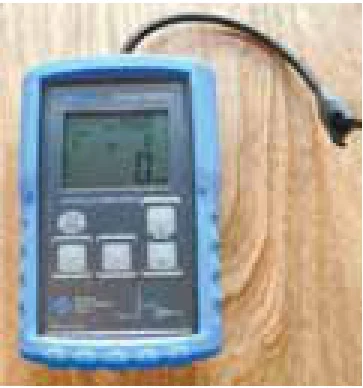
Troubleshooting and fine-tuning your small engines and older large engines is made a lot easier with the TA100 Smartach+. The wireless tachometer and engine analyzer provides rpm measurement and ignition peak voltage measurement using secondary ignition pickup. It also records minimum and maximum readings.

“It’s designed for distributorless, con-ventional, magneto and most spark ignition systems,” explains Berge Baronian, General Technologies Corp. (GTC).

“Where it will be most useful is on old tractors and trucks, forklifts and small gas engines.”

The hand-held, battery-powered TA100 has a view screen with touchpad and keys for a number of cycles (2, 4, 6 and DIS), number of cylinders (1 to 12) and functions (peak kV or rpm.) The secondary ignition pickup doesn’t require the unit to be part of an actual circuit. The attached, flexible antenna sen-sor provides readings simply by being held against spark plug/ignition coil wires or near the distributor, coil pack or closely gathered spark plug/ignition wires.

When GTC provided FARM SHOW with a unit to evaluate, we shared it with several professional mechanics. While all agreed that it had limited application in newer engines, especially those with on-board computer-controlled electronics, small engines were another story.

“This would have been great to have when I was setting up new mowers,” says Jerry McCabe, McCabe Repairs.

“Each one had to be tuned to the recommended rpm’s to optimize mowing. With this, you wouldn’t have to hook anything up to get a reading.”

McCabe allowed that it would make it easier for his small engine mechanic to de-termine whether a problem was electric or fuel-related.

The TA100 can be used to identify in-dividual cylinder rpm’s as well as overall engine rpm’s. The kV function displays the relative strength of the ignition pulses in spark plug wires. While variation in ignition peak voltage of 25 percent is normal, higher voltage readings can indicate a lean fuel mix-ture, too wide a spark plug gap, a damaged, loose or disconnected wire, or a broken core in the wire.

Readings that are abnormally low can indicate spark plug problems, a broken wire core, a short circuit or other partial or full disconnection, a rich fuel mixture or low cylinder compression pressure.

“If you have a 4-cylinder engine with one cylinder misfiring, you can find the problem cylinder quickly just by comparing the read-ings and looking for a variation on one,” says Baronian.

“We have built a great following for the TA100.”

Baronian adds that a new model is being introduced in 2011. It’s the TA500. It will offer the same functions, but is designed for use with newer engine ignition systems as well as conventional older engines.

The TA100 has a suggested retail price of $220. However, Baronian says it’s regularly discounted by retailers to around $150. The TA500 is expected to have a suggested retail price of around $500, but final costs are subject to component price increases.

Contact: FARM SHOW Followup, General Technologies Corp., #121 - 7350 72nd St., Delta, British Columbia, Canada V4G 1H9 (ph 604 952-6699; toll free 800 440-5582; [email protected]; www.gtc.ca).

From the archive · Full text
Feature story

Tool Set Restores Farmall Grilles

Featured source: Dick Sunsdahl

If you’ve got a Farmall tractor with a damaged grille, you’ll like these new grille repair tools.

“They can take the dents out in just a few minutes,” says Dick Sunsdahl, Sunsdahl’s Restoration Tooling, Faribault, Minn. Sunsdahl’s grille re-forming tools for Deere tractors have been featured before in FARM SHOW (Vol. 29, No. 4).

“We’ve had a lot of requests for Farmall tractors,” says Sunsdahl. His new 3-piece punch and die set is designed to fit the basic grilles produced for Farmall A, B and C models between 1939 and 1954. The tool set restores the horizontal bars of the grilles to original factory shape. The die also acts as a gauge for correct spacing between bars. Sunsdahl has also introduced a grille re-forming tool set for Farmall M and W-6 tractors; for H and W4 Farmalls; and for 600-650 and W9 models made from 1940-1958. All these tool sets sell for $59 plus $6 S&H. He has also introduced 5-piece sets to re-form the vertical and horizontal grille bars on Farmall 300-350 and 400-450 models ($100 plus $6 S&H); and he has introduced 2-piece sets for 1955 and newer Farmall Cub models and for 100 – 230 Farmall Cub models made from 1954 to 1958 ($40 plus S&H). Instructions and tips are included with the purchase of any grille tool set. Additional grille tool sets are also available for Oliver, Ford, Case and Minneapolis Moline tractors. Contact: FARM SHOW Followup, Sunsdahl’s Restoration Tooling, 1703 Greenwood Place, Faribault, Minn. 55021 (ph 507 334-8966; [email protected]; www.sunsdahltooling.com).

From the archive · Full text
Feature story

He Runs Cub Parts Business In His Spare Time

Featured source: Chris Westfall

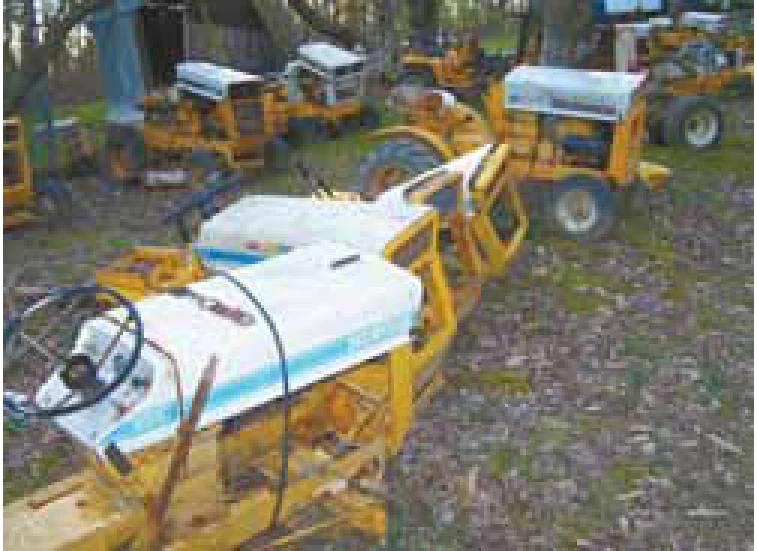
If you need a part for a Cub Cadet, Chris Westfall might have it. Westfall got into the used parts business when he went looking for a lawn mower and got hooked on Cub Cadets. Hundreds of tractors and 10 years later, he sells used Cub Cadet tractors and parts as a business.

“A friend had an old Cub Cadet in a barn. I found a mower, then a snow plow, followed by a tiller, and it just went from there,” says Westfall.

“Today I have a 28-ft. trailer filled with parts that I take to tractor shows. I try to keep from 50 to 100 tractors on site for parts. I also sell new Cub Cadet parts, as well as Kohler motor parts. It’s my second full-time job.”

Westfall often has 10 to 12 Cub Cadet tractors for sale. Where he once did restoration work as well, today he sells “as is”.

“I used to have three and do pulling with them, but now I’m down to one,” he says.

“I held on to a Cub 122, 12-hp model with a Hawk Bilt trencher that’s called a ground saw. It’s quite rare.”

When he finishes restoring the 122, it will serve as an eye-catcher at shows he attends. He also maintains a website.

“I’ve sold parts to collectors in Sweden and South Africa, as well as all over the U.S. and Canada. I also get a lot of business from word of mouth.”

Westfall uses past customers and acquain-tances to find tractors to add to his parts list or to resell. He says he is always looking and maintains a list of models that customers want.

“Prices depend on condition and model and can vary from $200 to $800 for gas or $1,400 for diesel,” he says.

“Some, like older models with fenders and headlights and creeper gear options, are very sought after. Other models are very plain Jane.”

Westfall operates the business evenings and weekends. He suggests calling after 4 p.m. Eastern time or contacting him by email.

Contact: FARM SHOW Followup, Chris Westfall, 3350 Hamburg Rd. S.W., Lancaster, Ohio 43130 (ph 740 808-4119 or 740 687-1067; [email protected]; www.cubclassics.com).

From the archive · Full text
Feature story

Bosch Power Box Brings Quality Sound To The Field

Featured source: Robert Bosch LLC

Enjoy “surround sound” out in the field or on any jobsite with Bosch’s tough new Power Box 360 radio. Five speakers and an integrated subwoofer deliver quality sound in every direction. Bosch’s familiar weatherproof, roll-cage design is the same as older models but the audio capabilities are a definite upgrade. The sound is more powerful, with twice the sound output in the Power Box 360S and up to five times the sound power output in the Power Box 360D. The system has four preset equalizer settings and a weather-sealed media bay for an Ipod or other device. Or, plug in a media card, USB drive, CD player or SIRIUS satellite radio device. The Power Box 360 can run on Bosch 14.4V or 18V lithium-ion power tool batteries and will also charge those batteries when plugged in. The USB port doubles as a charger for cell phones and other devices. The Power Box also has four GFCI outlets to power or charge tools or electronic devices, and a 12V DC (car charger) outlet.

The LCD display angles upward for easy viewing. The 360D model has a backlit front control panel for viewing in the dark and a remote control with onboard storage that works up to 40 ft. away. The 360S model sells for around $215, and the 360D model sells for around $270. They are available through many dealers found on Bosch’s website. Contact: Robert Bosch LLC, 38000 Hills Tech Dr., Farmington Hills, Mich. 48331 (ph 877 267 2499; www.boschtools.com).

From the archive · Full text
Feature story

Air Compressor Built From Cadillac Engine

Featured source: Dan Jamison

When a relative gave Dan Jamison a late 1970’s Cadillac, he decided to turn the car’s 425 cu. in. engine into a powerful air compressor/sandblaster like the one built by Harold Witulski and featured in FARM SHOW (Vol. 31, No. 2).

“I called Harold a couple times, and he was real helpful,” says Jamison.

“I pulled the engine and discarded the transmission, but kept the flexplate and torque converter. I stripped the front fenders, bumper, radiator support, etc. from the front clip and cut it free from the engine.”

He made an “A” frame hitch from rectangular tubing and welded it to the front axle. He then reinstalled the engine, radiator and alternator on the trailer.

Jamison stripped the rocker arms, push rods, intake valves, exhaust manifold and carburetor from the engine. In place of the carburetor, he attached a steel plate to the intake manifold and connected it to the original air cleaner housing and filter with a short, large diameter pipe.

He left the exhaust valves in place, but he replaced the factory intake springs with light springs from a hardware store. He welded flat washers to the tops on the intake valves to act as “keepers”. Once he drilled the porcelain centers out of the stock spark plugs, the four-stroke engine was effectively converted into a two-stroke compressor.

“Each downward piston move overcomes the light intake valve springs, letting air in,” explains Jamison.

“Each upward piston movement forces air out of the spark plug holes. A large amount of heat is produced when the air in the cylinder is forced through the spark plug hole. It’s important to drill the plugs out as much as possible to reduce heat buildup.”

To capture the air, Jamison welded a short piece of 3/8-in. diameter water pipe to each hollow spark plug. He mounted one-way check valves to each pipe.

“The larger the check valves and the closer they are mounted to the spark plugs, the less airflow is restricted,” notes Jamison.

To complete the manifold, he ran 1/2-in. diameter steel pipes from the check valves on each cylinder to larger 1-in. common rail pipes. The two rails were in turn connected to a single 1 1/2-in. pipe.

“I installed a quick-coupler for a 1-in. airline in the pipe, as well as a 125 psi pop-off safety valve,” says Jamison.

To drive the compressor, he used a pto driveline and stub shaft from a 1209 Deere haybine. He ground the hex stub shaft to fit into the torque converter and welded it in place.

“My 40-hp, 1955 60 Deere is able to handle the load, but I wouldn’t recommend anything smaller,” says Jamison.

For a sandblasting pot, Jamison welded three tube steel legs on one end of a 60-gal. LP tank. Also, on the bottom end he installed a 1-in. ball valve with a T fitting. A 20-ft., 1-in. air hose connects the compressor to the fitting. A 15-ft. blast hose connects to the other end of the T. A 20-ft., 3/8-in. air hose runs from the compressor to the top of the blast pot to pressurize the tank. Jamison also installed a 3-in. pipe and cap for sand fill at the top end of the tank.

Since getting the compressor/sandblaster operating, Jamison has used it to sandblast 4-H projects like lawn mowers and a 3-bottom plow.

“It’s a two-man operation,” he says.

“One holds onto the blast tip and hose. The other adjusts the 1-in. ball valve at the bottom of the tank to adjust the flow of sand into the air stream.”

Jamison is considering other uses for the compressor, including putting a ball valve on the pump discharge to create a “poor man’s dyno”.

“It would provide a steady load for engine break-in on smaller antique tractors,” says Jamison, who estimates he has only about $500 in the entire rig after selling off spare parts from the Cadillac.

“My biggest expense was the 8 one-way air valves,” he says.

“Most other parts were donated or already in my shop.”

Contact: FARM SHOW Followup, Dan Jamison, 25264 250th St., Princeton, Iowa 52768 (ph 563 529-7634; [email protected]).

From the archive · Full text
Feature story

New Way To Run Air Through A Shop

Featured source: IPEX USA LLC

Setting up a shop for air-powered tools is fast and easy with Duratec Airline from IPEX. An aluminum core with inner and outer layers of high-density polyethylene (HDPE) combines the best features of metal and plastic. The inner and outer linings eliminate problems common to metal air lines.

The rigid aluminum core bends and holds position where desired. The exterior and interior HDPE layers protect the aluminum core from rusting, scale, pitting, corrosion and even light impact.

The unique design is 75 percent lighter than traditional copper or schedule 40 carbon steel pipe. The HDPE resistance to scale and lack of rust or corrosion eliminates clogging of lines, as well as tools and fixtures. It also reduces friction that can cause pressure drops and airflow restrictions.

The composite airline is available in 4 sizes from 3/8-in. to 1-in. and can handle air pressure from 200 psi at 73°F to 160 psi at 140° F. It comes in 100 and 300-ft. rolls for longer runs without connections.

Line installation and installation of fittings is simple. The nickel-plated brass or stainless steel fittings use double O-ring seals for extended life. The fittings are both quickly assembled or removed. No threading, fusing or cementing is required.

To install a fitting, simply remove the nut and split ring from the fitting and push them onto the pipe. Using a Duratec beveling tool, enlarge the pipe for the fitting and slip the fitting into the pipe. Slide the O-ring and the nut back over the end of the pipe and tighten down over the fitting.

Duratec airline distributors in Canada and North America can be located by contacting the company directly by email at [email protected] or calling 866 473-9462. A 3/8-in., 100-ft. airline starts at $120.50 (U.S.). Fittings start at $9.65 (U.S.) for the smallest male thread adapter and increase with size and complexity.

Contact: FARM SHOW Followup, American Customers: IPEX USA LLC, 10100 Rodney St., Pineville, N.C. 28134 (ph 704 889-2431; toll free 800 463-9572; www.ipexamerica.com) or Canadian customers: IPEX Inc., 50 Valleybrook Drive, Don Mills, Ont., Canada M3B 2S9 (ph 416 445-3400; toll free: 866 473-9462; www.ipexinc.com).

From the archive · Full text
Feature story

“Sandable” Repair Compound Fixes Almost Anything

Featured source: Eric Gerlach

We were recently looking through a beekeeping magazine and noticed an ad for Fixit®, a synthetic repair compound that some beekeepers are using to repair wood beehives and frames. Turns out, the product has been around for more than a decade, but inventor David Brummel is still discovering uses for it in many different industries. He recently started raising bees and found it can be used to repair cracks, holes, animal damage, even some wood rot in hives,” says Erin Gerlach, Brummel’s daughter and sales director for the family’s business, Aves.

“Scrape away the rotted wood and repair it with Fixit. For $20 (1 lb.) you can repair many beehives.” Fixit is activated when two puttylike parts are mixed together. Gerlach says it differs from other repair products because it doesn’t puddle and is easily manipulated to hold form and shape. It’s safe and easy to use, doesn’t shrink or crack, hardens without baking and is very durable. It has a two-hour window to shape, and it dries as hard as a rock in 24 hours. It sands up beautifully and can be drilled, filed and carved. Customers use it for all types of repairs — outdoor statues, antiques, fixing tractor parts, water tanks, filling in rusted spots on vehicles, cracks in cement, and repairs on all types of materials from wood to plastic to cast iron.

“It’s permanent,” Gerlach says.

“And it’s water and weatherproof.” Fixit comes in white, black, aluminum, and bronze colors and various sizes starting at 1/4-lb. for $10, with discounts for large orders. Contact: FARM SHOW Followup, Aves, P.O. Box 344, River Falls, Wis. 54022 (ph 715 386-9097; www.avesstudio.com).