Practical ideas from FARM SHOW MagazineSubscribe · Free issue · Send us your shop tip
Subscribe to FARM SHOW
Issues / Vol. 30, No. 2 (2006)

Vol. 30, No. 2 (2006)

Money-Saving Repairs & Maintenance Shortcuts · Printed section pp. 36–39

45 selected entries · Complete text of selected entries

This issue’s section includes reader tips and feature-length shop stories. Held items and editorial notices are not reproduced.

Archive text: prices, coupons, availability and contact details reflect the original publication, not current offers. Reader methods are not universal instructions; follow manufacturer guidance and proper safety practices.

Reader shop tips

From the archive · Full text
Reader shop tip

James Alwill

James Alwill, Bradford, Ill.

“I keep a metal shovel in back of my pickup and spray paint the blade after every use to keep it from rusting. The paint wears off every time I use it. If there’s too much paint buildup, I just scrape it off with a wire wheel. It’s a good way to keep the blade from getting dull.”

From the archive · Full text
Reader shop tip 1 of 2

Richard Faber

Individual tip 1 of 2 from this reader’s published contribution.
Richard Faber, Tiffin, Ohio

“I had a drill press on a small table that I couldn’t raise or lower. So I took a bumper jack, clamped it at the top and bottom to the drill stand, and use that to raise and lower the table.

From the archive · Full text
Reader shop tip 2 of 2

Richard Faber

Individual tip 2 of 2 from this reader’s published contribution.
Richard Faber, Tiffin, Ohio

“I also took empty oil bottles and cut part-way through the top to make a lid that bends open as needed. I drilled a hole in the side and hang them on dry wall screws I store screws, nuts and bolts in them. The tops keep the dust out and are easy to take off the wall.”

From the archive · Full text
Reader shop tip

Elden D. Parkkonen

Elden D. Parkkonen, Champion, Mich.

“After decades of working on everything from stuck pulleys and stiff chains to frozen nuts and bolts, I finally came up with a method of freeing them up that works. I use a propane torch and an old candle. I heat up the part to be treated and when it’s real hot – but not red hot – I apply the candle to it. Then I let it cool off after which I can often remove the part by hand.

“I’ve been using this technique for over 10 years and I’m sure other guys also do it, but I just haven’t heard of any. If it doesn’t work the first time, just repeat another time or two.”

From the archive · Full text
Reader shop tip

Charles Gors

Charles Gors, Waverly, Iowa; ph 319- 352-3886

“The throttle control on my 2001 3/4-ton Chevy pickup is always sticking. When I release the foot feed it just keeps going. Many times when I push in the clutch, the engine revs up by itself. The power steering is weak and what I hate the most is that the pickup cannot be pull-started, which is one of the reasons I wanted a manual shift. Does anyone have an answer? The dealer has been no help.”

From the archive · Full text
Reader shop tip

Arco Rosenow

Arco Rosenow, Chillicothe, Ill.

“To make a rip and cross cut guide for panels, start with a piece of 1/4-in. thick plywood that’s 8 ft. long by 12 in. wide. Set your power saw on the plywood like you’re going to rip it, with the blade just touching the wood. Then measure over 1/4 in. away from the edge at both ends of the 8-ft. length, and snap a line from end to end. Screw a 1 by 2 to the plywood along the line, then place the edge of the saw’s shoe plate against the 1 by 2 and rip off the 1/4-in. excess. What you now have is an accurate rip and cross cut guide. Just position it on the mark to cut, clamp the guide to the panel you want to cut, and you’ll be able to make a cabinet grade cut.”

From the archive · Full text
Reader shop tip 1 of 2

H.J. Trahan

Individual tip 1 of 2 from this reader’s published contribution.
H.J. Trahan, Jennings, La.

“With old equipment, I always had trouble getting tires to pop onto the rim. I started using motor oil to make them slip on, but unfortunately when I tried that on my farm pickup and turned a corner, the tire came off the rim. Beware. It’s not a good idea.

From the archive · Full text
Reader shop tip 2 of 2

H.J. Trahan

Individual tip 2 of 2 from this reader’s published contribution.
H.J. Trahan, Jennings, La.

“I attached an old Ford starter to a Wisconsin V-4 air-cooled engine that powers an air compressor. In the past I had to hand crank the engine. It was a touchy job to line up the gears.”

From the archive · Full text
Reader shop tip

Don Holdeman

Don Holdeman, Elma, Iowa

“I got tired of paying a tire shop to fix flat tires. Also, our local shop isn’t open during evenings and weekends. That’s a real inconvenience because I have to do chores twice a day and therefore need to get any flat tires fixed right away.

“To solve the problem, I bought three tire spoons (20-in. long steel bars flattened at one end) which I use along with a front-end loader to break beads and remove tires. I lay the tire flat on the ground, then position the loader bucket so the edge runs straight up and down next to the wheel rim. Then I push the bucket down on a spoon to pop the bead off the rim. I rotate the tire until I’ve pushed all three tire spoons down. It lets me fix tires right away at no cost.”

From the archive · Full text
Reader shop tip 1 of 2

Charles Hodel

Individual tip 1 of 2 from this reader’s published contribution.
Charles Hodel, Eureka, Ill.

“You have to be careful with this idea around mufflers and other hot parts, but a spray can of starting fluid can be used as a very fast degreaser on parts and hydraulic connectors. The mess is washed away and dries in seconds.

From the archive · Full text
Reader shop tip 2 of 2

Charles Hodel

Individual tip 2 of 2 from this reader’s published contribution.
Charles Hodel, Eureka, Ill.

“I built a 3-ft. wide, 5-ft. deep, and 15-ft. long pit on one side of my shop which makes it easy to change oil and work under machinery. A sump pump and a fan for ventilation is required.”

From the archive · Full text
Reader shop tip

James Brooks

James Brooks, Homer, Ga.

“Getting a flat tire on a tubeless rim presents a challenge, because after the tire is repaired it’s hard to seat the tire on the rim. I just use a come-along wrapped around the center of the tire tread and tightened up real snug. This idea works better than anything I’ve tried.”

From the archive · Full text
Reader shop tip

Art Mangels

Art Mangels, Dillon, Mont.

“Our Rotary brand 12,000-lb. drive-on lift works great for servicing cars and farm vehicles. Ramps can be moved closer together for small loaders and 4-wheelers. The 4-post stand-alone units are manufactured by Dover Industries, Madison, Indiana ph 800 640-5438; www.rotarylift.com. It comes with complete installation instructions and shims for leveling when anchoring posts to a cement floor. An electric/hydraulic power unit powers a lift cylinder which is hooked to four cables enclosed in a frame. Each post has a safety lock. You need shop air to release the lock cylinders in order to lower the unit.

“This drive-on lift also makes a nice temporary table. We like the safety of the unit - we don’t have to worry about falling into a pit. We do a lot of welding and cutting and are aware that certain explosive gases can get trapped in a pit or floor drain. We had a similar drive-on hoist before we moved our farming operation to Dillon, Montana eight years ago. We only survived a year in our new shop without a hoist. My son John decided we needed a hoist again so I let him buy it. The Rotary was recommended as the best brand, and so far it has been trouble-free.”

From the archive · Full text
Reader shop tip 1 of 2

Doug Bonno

Individual tip 1 of 2 from this reader’s published contribution.
Doug Bonno, Iron River, Mich.

“Here’s an easy way to remove broken bolts from castings. Drill it out slightly under size and use a file to make three notches through the threads, then pick out the three pieces of the bolt. The threaded hole will still be usable.

From the archive · Full text
Reader shop tip 2 of 2

Doug Bonno

Individual tip 2 of 2 from this reader’s published contribution.
Doug Bonno, Iron River, Mich.

“I came up with my own overhead hoist system by using two in-ground hoists from an old gas station that was being torn down.”

From the archive · Full text
Reader shop tip 1 of 3

Michael Ray

Individual tip 1 of 3 from this reader’s published contribution.
Michael Ray, Bloomington, Ind.

“If gas is leaking out of the fuel tank on your tractor, drain all the fuel out of the tank and let it dry completely. Then apply three or four thin layers of Seal-All sealant, allowing each layer to dry good. Let it set for 24 hours, then fuel up and go (www.eclecticproducts.com; ph 800 767-4667).

From the archive · Full text
Reader shop tip 2 of 3

Michael Ray

Individual tip 2 of 3 from this reader’s published contribution.
Michael Ray, Bloomington, Ind.

“If rusty tractor wheels are a problem, try using a 50-50 mixture of anti-freeze and water. It adds good weight, won’t rust the wheels, and lasts for years.

From the archive · Full text
Reader shop tip 3 of 3

Michael Ray

Individual tip 3 of 3 from this reader’s published contribution.
Michael Ray, Bloomington, Ind.

“Maxima chain wax works great for motorcycle chains, as well as for linkages and hinges, etc. This product is paraffin based so it won’t fling off. It sets up good and stays put.”

From the archive · Full text
Reader shop tip

John Gruman

John Gruman, Waterloo, Iowa

“I eliminated conventional work benches from my shop, as they tend to get cluttered. Instead I have a portable steel table that can be easily moved to a project. The table can be reached from all sides and has to be kept clean.”

From the archive · Full text
Reader shop tip

Alvin C. Goldey

Alvin C. Goldey, Mt. Sterling, Ky.

“I made my own apparatus for putting fluid in tractor tires. It consists of an old water heater with a port on the bottom and a port on top for fluid. A fitting for an air hose forces fluid into the tire. Works great and is a lot cheaper than going to a repair shop.”

From the archive · Full text
Reader shop tip 1 of 2

Mark S. Yax

Individual tip 1 of 2 from this reader’s published contribution.
Mark S. Yax, Solon, Ohio

“Before using an aerosol can that has an extension tube to concentrate the spray in a certain area, I insert the tube and then apply a drop of super glue to the joint where the tube meets the nozzle. This helps the tube to stay on and not get lost.

From the archive · Full text
Reader shop tip 2 of 2

Mark S. Yax

Individual tip 2 of 2 from this reader’s published contribution.
Mark S. Yax, Solon, Ohio

“When dismantling a large shipping crate, I was having a hard time removing the old nails with a claw hammer. I found that a drop of oil placed on the exposed shanks of the nail made pulling out the old nails an almost effortless job. It takes a little more time but sure saves your wrists and arms.”

From the archive · Full text
Reader shop tip

Agri-Services

Agri-Services, 13899 North Road, Alden, N.Y. 14004 (ph 716 937-6618; www.wiringharnesses.com)

Agri-Services has developed a new circuit protection kit for two-cylinder diesel tractors, in order to pre-vent damage to the wiring harness and electrical components in case of a short circuit. A short in the 24-volt system, or either 12-volt system, can destroy the wiring harness before one can react to the smoke and disconnect the batteries.

Some of the possible short circuit scenarios include: allowing a tool to come in contact with exposed terminals, starter solenoid mal-function, a wire rubbing through the insulation, rodent damage to the wiring harness, wrong polarity of the generator, or voltage regulator malfunction. Deere recognized the need to offer a similar kit for the 24-volt New Generation diesels to prevent tractor fires and harness damage, but there have been no kits for two cylinder applications until now.

The kit protects both 12-volt legs of the 24-volt system and also the 12-volt ground circuit in the battery box. The kit includes two Type II circuit breakers (which will not reset until the power is shut off), an in-line fuse lead, mounting bracket, leads and instructions.

From the archive · Full text
Reader shop tip

Dave Nolan

Dave Nolan, ET&F Fastening Systems, 29019 Solon Road, Solon, Ohio 44139 (ph 800 248-2376 or 440 248-8655; www.etf- fastening.com)

“Our heavy duty pneumatic nail gun works great for fastening steel or wood to concrete. For example, attaching plywood, OSB, or other wood underlayment to concrete. It’s ergonomically designed for greater operator comfort and easier handling. The magazine and air hose connection are on the same side, allowing the unit to fit easily into tight corners. Power is supplied by a 1 1/2 hp electric compressor. It sells for about $1,200.”

From the archive · Full text
Reader shop tip

Rex Gogerty

Rex Gogerty, Hubbard, Iowa

“An unused old refrigerator provides dust-proof, moisture-proof storage for planter units, monitors, etc. I installed a latch on the door so that if a kid gets inside, all it takes is a good nudge and the door will bust right open.”

From the archive · Full text
Reader shop tip 1 of 2

Walter Fuoss

Individual tip 1 of 2 from this reader’s published contribution.
Walter Fuoss, Oakley, Mich.

“To make it easier to start my wood splitter in cold weather, I put a styrofoam box around the engine and hydraulic pump. Then I placed a Halogen light under the box for an hour or so to warm up everything.

From the archive · Full text
Reader shop tip 2 of 2

Walter Fuoss

Individual tip 2 of 2 from this reader’s published contribution.
Walter Fuoss, Oakley, Mich.

“This photo shows how I use boards to keep my chain saw chains from knotting up.

I drill a screw into the top of the board and place a spring on it, and also drill a screw into the bottom. Then I wrap one end of the chain around the bottom screw and connect the other end to the spring. Tension from the spring keeps the chain tight at all times. It’s a quick and easy way to keep chains straight so they stay clean and are always ready to go.”

From the archive · Full text
Reader shop tip

Jack W. Kreeger

Jack W. Kreeger, 7529 Bedford Ave., Omaha, Neb. 68134; ph 402 571-2824

“I’ve put together a shop manual that covers the L, LA, LI tractors and LU engines produced by John Deere from 1937 to 1945. These tractors were equipped with either Hercules or Deere engines and had from 10 to 13 hp. The 165-page manual contains specs, repair ideas, service hints, information on magnetos and carburetors, etc. Deere never produced a shop manual for these tractors. Sells for $25 including S&H; $27 in Canada.”

From the archive · Full text
Reader shop tip

Ed Doucette

Ed Doucette, Fort Ripley, Minn.

He wired a line-voltage thermostat with male and female cord ends and uses it to control the temperature on electric space heaters. He says it’s easy to do and works great. You can also use the idea to add a thermostat to electric livestock tanks, birdbaths or pet water bowl heaters. Let the thermostat turn them on and off when the temperature dips or rises. Any electric heating device or fan without a thermostat of its own can be adapted quickly.

From the archive · Full text
Reader shop tip

Hold-It, Inc.

Hold-It, Inc., 3724 FM 1960 West, Suite 300D, Houston, Texas 77068 (ph 281 440-1655; www.hold-it.net)

If you hate losing those little straws that come with aerosol cans, such as WD-40, you need a Hold-It. They’re stretchable plastic “lassoes” that hold the straw to the can. An envelope of 12 sells for $4.99 plus $2.95 S&H.

Shop feature stories

From the archive · Full text
Feature story

Clutch Kit For Deere 2-Cyl. Tractors

Featured source: WTR Parts

If you own an old Deere 2-cyl. tractor you’ll be interested in these new kits that contain everything you need to install a new clutch. The kit can save you big money compared to buying individual components, says manufacturer WTR Parts of Tyndall, S. Dak.

As an example, the kit for 50, 520, and 530 Deeres contains bonded disks, floating disks, pulley brake pad, clutch springs, spring washers, castellated nuts and pins.

“As far as I know it’s the first time anyone has put all the components together in kit form to replace a clutch on these tractors,” says Dennis Weber.

“If you were to buy these same parts from Deere you’d probably have to spend twice as much.”

According to Weber, the kit can also save a lot of hassle.

“Sometimes when you try to remove a clutch, it’s easy to ruin or lose some of the parts, such as cotter pins. As a result, sometimes you end up substituting nails or pieces of wire. Our kits contain all the replacement parts you could ever need.”

The clutch kit for the 50, 520, and 530 Deeres sells for $95.

Clutch kit are also available for the Deere 60, 620, and 630 models ($75); 70, 720, and 730 models ($115); 80, 820, and 830 models ($325); and the model R ($235). Add $7.95 per order for Priority Mail shipping.

Contact: FARM SHOW Followup, WTR Parts, 909 Fir, Tyndall, S. Dak. 57066 (ph 605 589-3128; [email protected]; www.wtrparts.com).

From the archive · Full text
Feature story

Deep Freezer Sand Blasting Cabinet

Featured source: Casey Grant

Casey Grant needed a sandblasting cabinet but didn’t want to spend $1,000 or more for one. So he came up with the idea of using a deep freezer as the cabinet, which kept the cost down to $150.

The project worked so well the Alliance, Ohio, man is putting two freezers together so he can sandblast big parts off an old 1977 Ford pickup he’s restoring.

A local dealer gave him a broken deep freezer. He set it on a plywood platform with caster wheels so he can roll it around.

He cut a 12 by 24 in. opening in the center of the door and inserted plate glass on the outside and duct taped a pane of glass on the inside.

“When the glass gets scratched up, it’s easy to replace,” he says.

He cut a pair of 6-in. dia. arm holes spaced 15 in. apart at the front of the freezer and fit two coffee cans extended thru and extending extra 1 1/2 in. inside. He bent the outside edges of the cans flat and riveted them to the freezer.

Grant took the pant legs from some old overalls, doubled them up and sewed them to leather welding gloves. The pant legs fit over the inside edges of the coffee cans. Flat bands of aluminum bolted together hold them in place.

“My hands don’t sweat at all because of the leather,” he says.

He also cut a 4-in. hole to insert the suction pipe coming from a Craftsman dust collector he bought used.

An air compressor attached to his old sandblaster pushes air through the blaster into the freezer.

Because the sand would eventually destroy the rubber seal, Grant put a lightweight piece of galvanized steel around the inside of the lid.

He also cut a 4-in. vent hole that fits a coffee can covered by a small metal box inside the freezer so air circulates as he’s working.

He wired a couple lights into the blast cabinet protected by sheet metal cone He installed a metal grate on top of the compressor housing at the bottom of the freezer. Angle iron from an old bed frame and metal screws hold it in place. The grate comes out for cleaning when the pressure sand blaster goes empty after 100 lbs. of sand is used up.

“I love using this cabinet. It does a super job sandblasting everything.”

Contact: FARM SHOW Followup, Casey Grant, 14730 Cenfield St. NE, Alliance, Ohio 44601 (ph 330 823-8373).

From the archive · Full text
Feature story

Splitting A Nut With A Drill

Featured source: Arco Rosenow

Arco Rosenow, Chillicothe, Ill., says you can use a power drill to safely split a stubborn nut off its stud.

“Rather than risk twisting a stud off, or accidentally cracking a casting with a hammer and chisel, I use a power drill with a 1/ 4-in. dia. bit. I clamp another nut against the frozen nut, then center punch into the seam and drill a 1/8-in. dia. hole. I increase the drill bit size until the bit just touches the stud’s threads. Then I use a breaker bar to work the nut back and forth. Once the nut comes loose it tends to work like a thread chaser.

“I usually clean the exposed threads and then apply penetrating oil before I use the breaker bar. If the nut is really stubborn, I repeat the procedure on the other side of it.

“The best thing about this method is that I can still use a socket wrench on the nut,” says Rosenow.

Contact: FARM SHOW Followup, Arco and Judy Rosenow, 1223 Hallock Hollow, Chillicothe, Ill. 62523 (ph 309 274-2107).

From the archive · Full text
Feature story

Traveling Workbench

Featured source: Brian Matthews

Here’s an idea we spotted at a recent farm show in England. It’s a portable workbench that you can take out to the field to work on machinery.

The GenBench is 37 in. high with an 8 1/2 by 4-ft. working area. It weighs 1,411 lbs. empty and up to 1 1/2 tons full.

It mounts on a front or rear 3-pt. hitch and has pallet tine slots underneath so forklifts can haul it.

The bench includes different-sized storage compartments to hold a welder, pto generator, and 17 plastic trays for other tools. Wrenches hang on the door racks which lock to deter theft.

“It can reduce breakdown costs and down time, saving you money,” says inventor Brian Matthews.

“An assortment of trays and fittings hold a wide variety of tools, parts and fixings - everything you need to fix equipment in the field.”

You can also use it as your primary workbench back in the shop.

Matthews points out that the GenBench could also be used to run a sideline welding and equipment repair business.

Contact: FARM SHOW Followup, Brian Matthews, GenBench, Crosslanes Farm, Bissoe, Truro, England TR4 8LD (ph 01872 560067 or 07887 707586; enquiries@ genbench.co.uk; www.genbench.co.uk).

From the archive · Full text
Feature story

Oil Filter “Drain Tool” Leaves No Mess

Featured source: Simon Peavey

Changing an oil filter on any big vehicle can be a messy job, especially if you end up with oil running down your arm. Simon Peavey solved the problem by designing a drain tool for oil filters that doesn’t make a mess.

“It makes changing the oil on big trucks and tractors a much cleaner job,” says Peavey.

The tool slips over the bottom of a filter and pokes a hole in the bottom to drain away the oil inside. A tube carries oil away to a drain pan. If the spear won’t penetrate the filter, you can use a hammer to tap on a metal knob next to the spear.

“It’s a pretty simple tool, but it works,” says Peavey.

“I’m a professional truck driver and I built it for my semi tractor which is equipped with a Detroit 60 diesel engine. I had been loosening the filter and then using a hammer and screwdriver to drive a hole through the bottom of the filter. But oil would run down all over my arm as soon as I pulled out the screwdriver.

“My oil filter drain tool could be used on any filter where there’s enough room to get the tool in between the frame and the filter.”

Peavey says he’s looking for someone to manufacture and market the tool.

Contact: FARM SHOW Followup, Simon Peavey, 2952 E. View Dr., Grand Junction, Colo. 81504 (ph/fax 970 242-3433).

From the archive · Full text
Feature story

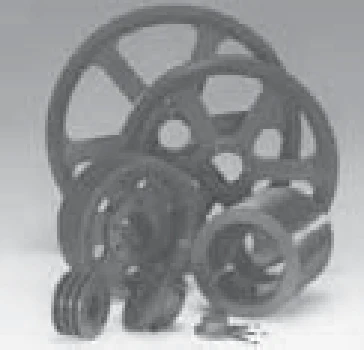
Save Money On Belts, Pulleys

Featured source: Menno Beiler

“We can save you 30 to 50 percent compared to buying from your local implement dealer,” says Menno Beiler, Georgetown Hydraulics, a supplier of V-belts and pulleys at discount prices.

Menno says the company’s main business is in hydraulics and power drives, but they also sell a lot of belts, pulleys, and bearings.

“We buy pulleys by the container load from a Wisconsin company. We have more than 100 dealers throughout the U. S. The pulleys we sell range anywhere from 2 to 50 in. in diameter, and are available with anywhere from one to 10 grooves. In many cases we can supply drive belts and pulleys that are no longer available from equipment dealers or salvage yards.”

Contact: FARM SHOW Followup, Georgetown Hydraulics LLC, 343 Christiana Pike, Christiana, Penn. 17509 (ph 610 593-2753).

From the archive · Full text
Feature story

Made-It-Myself Portable Pipe Flattener

Featured source: James H. Eastman

“It’s easy to build and anyone with mechanical sense could make one,” says Jim Eastman, Eskridge, Kansas, about the electric/hydraulic portable pipe flattener he built from a used cylinder and scrap steel.

Eastman and his sons have a sideline fencing business and needed a fast way to flatten the ends of pipe to weld it to pipe posts.

Before this, they used a sledge hammer and anvil to flatten pipe.

“If you have a lot of pipes to flatten, that gets old in a hurry,” he says.

A 25-ton 6-in. stroke hydraulic cylinder mounts inside a 24-in. tall rectangular frame made from lengths of 1 and 2-in. thick solid steel bar. He added a handle and two small cylinder stabilizers that function as brackets when hinged to the pickup bed.

It’s powered by an electric/hydraulic pump that operates off the portable welder/generator, or with a hand pump.

He welded a 1 by 3 by 4-in. steel bar to the end of the cylinder to flatten the pipe ends and added metal guides to the sides.

Although one person can use it, Eastman says he has another hold the end of an 8-ft. length to ensure that both ends are parallel when flattened.

“You can stick the pipe in there flush but the cylinder wants to push it out as you’re flattening it,” he says.

“I usually push the pipe in about an extra 1/2 in. so it doesn’t do this.

“The biggest pipe we can flatten is 3 1/2 in.,” he says.

“It works great.”

Contact: FARM SHOW Followup, James H. Eastman, 26792 Snokomo Rd., Eskridge, Kansas 66423 (ph 785 256-6422; [email protected]).

From the archive · Full text
Feature story

He Puts His Shop Tools On Wheels

Featured source: Dan Neuman

Whatever the shop tool, if he can put it on wheels, Dan Neuman, Loami, Ill., does just that. Here are four examples: est “tool” is his portable table, or work bench. It’s made entirely from steel and has a heavy steel plate for a table top. Caster wheels allow the work bench to be moved anywhere, and there’s a handle on one side that lets Neuman guide it there. The table also has its own electrical plug-in box.

Drill Press - This drill press is equipped with a specially designed carriage. It looks like a tall chair with two rubber wheels on back. The front legs rest on the floor. The design allows Neuman to maneuver the drill around his shop by simply grabbing a high rod on back and leaning the unit backward.

Welder - Neuman mounted his welder on individually designed carts that ride on wheels. The welder has two conventional rubber wheels on back and two small caster wheels on front.

Chop Saw - It mounts on a cart equipped with two wheels on back and two legs on front. The saw is located at a convenient working height.

Contact: FARM SHOW Followup, Dan Neuman, 9800 Mansion Rd., Loami, Ill. 62661 (ph 217 626-2200).

From the archive · Full text
Feature story

Grease Gun Holder

Featured source: Joe Montgomery

“You set the Easy Greasy on the ground, table or bench and it lets you pump the grease gun with one hand or foot,” says Joe Montgomery, Springfield, Mo., about his aluminum holder for standard grease guns.

“I like lever-action grease guns because they give me more leverage than a pistol grip and this device makes them easy to use. It acts like a third arm.”

You simply clamp your grease gun in and hook the spring to the handle.

Comes with 8 ft. of hose. (Grease gun not included). Sells for $37.50 plus S&H.

Contact: FARM SHOW Followup, Montgomery Metal Craft, Inc., 3925 North Farm Road 143, Springfield, Mo. 65803 (ph 417 833-1515; fax 417 833-4132).

From the archive · Full text
Feature story

Wood Splitter Doubles As A Portable Welder

Featured source: Lloyd Lundblad

If you look at Lloyd Lundblad’s home-built machine from one side, you’ll see a wood splitter. Walk around to the other side and you’ll see a welder.

“I always wanted a wood splitter and I needed a welder, too, so I used one engine for both,” he says.

He used parts from a #25 Deere 2-cyl.combine from around 1950 including its engine, wheels and frame.

The engine direct-drives a hydraulic pump that powers the splitting cylinder mounted on the left rear corner. He uses it on birch logs up to about 20 in. long.

The engine also belt-drives a surplus aircraft generator that provides power for the welder. The generator mounts on the back right side.

All Lundblad had to buy was the hydraulic cylinder on the splitter. Since it has a Deere engine, Lundblad painted the whole thing green and yellow.

“It may be the only Deere wood splitter in the world,” he says.

Contact: FARM SHOW Followup, Lloyd Lundblad, Box 147, Valleyview, Alberta, Canada T0H 3N0 (ph 780 524-2133).

From the archive · Full text
Feature story

“Do It All” Portable Power System

Featured source: Air N Arc Mfg., Inc.

This new compact portable power system puts a welder, generator, air compressor, and battery charger all together in one lightweight unit.

The Air N Arc system consists of a 2-wheeled platform with a handle at one end. By removing the wheels, you can bolt the platform directly to a pickup bed.

The system’s components include a Volt Master generator, a Zena high frequency 100 percent duty cycle arc welder, a Honda 13 hp electric start engine, two 8-gal. air tanks, an Interstate battery, and a Puma air compressor. A serpentine drive belt powers the various components. The unit weighs just 425 lbs.

“It’s a lightweight, affordable unit that doesn’t take up much more space than a con-ventional air compressor. It eliminates the need for two or three different sets of equipment,” says inventor Kris Kessler, Scott City, Kansas.

“With this system you’re ready for any service work, anywhere, any time.

“I came up with the idea because I have farms that are spread out about 100 miles apart. I needed repair and service equipment with me at all times, without having to lug around a lot of weight.

“The Zena welder is specially designed for us and is the most compact welder in the world. Another key to our design is the ser-pentine belt system. It offers a 10,000 hour life expectancy which is much longer than the life expectancy of a typical V-belt. An-other key feature is that the air tanks are separate from the air compressor. On a conventional air compressor, the air tanks are welded to a steel platform and support the weight of the entire machine, and therefore take on all the vibration. On our power unit, the air tanks are surrounded and protected by the platform so they don’t receive direct vibration. Therefore, we can mount equipment on top of the tanks without endangering their integrity.”

Options include a 150-amp battery charger with booster cables, which turns welding current into regulated DC charging current; a spool gun for wire welding in the field; welding cable extension segments in 20, 30, 40, and 50-ft. lengths; an air hose reel that lets you clip the hose reel onto the handle; and a cover for the entire unit. Custom controls and features are available upon request.

Sells for $3,495. A model equipped with a 30-gal. air tank and a 24 hp engine is also available. It sells for $5,000.

Contact: FARM SHOW Followup, Air N Arc Mfg., Inc., Rt. 3, Box 90, Scott City, Kansas 67871 (ph 888 872-7151 or 620 872-7151; www.air-n-arc.com).

From the archive · Full text
Feature story

He Uses Air To Power All His Shop Tools

Featured source: Harlan Weaver

Harlan Weaver operates a light manufacturing company on his farm near Shobonier, Ill., where he builds conveyors with wooden and plastic housings. Because he is Amish he doesn’t use any electricity in his shop. Instead, he uses only pneumatic power to operate his shop tools which include a pneumatic air drill, jig saw, and nail gun.

To supply the air power, Weaver bought a commercial diesel power unit and mounted it on a concrete pad inside a utility room in the shop. The power unit uses a 40 hp diesel engine to belt-drive a line shaft, which in turn belt-drives an air compressor, a hydraulic pump, and a blower that takes sawdust away from his saws. Air is pumped into a 900-gal. compression tank located outside the shop. The engine requires 3/4 gal. of fuel per hour.

Pneumatic power is also used to operate a large ceiling fan in the shop, via a small air motor mounted just above the fan. By turning a valve, Weaver can direct compressed air through a line mounted at ceiling level to the air motor above the fan.

Contact: FARM SHOW Followup, Harlan Weaver, Rt. 1, Box 138, Shobonier, Ill. 62885 (ph 618 349-6177).

From the archive · Full text
Feature story

Add-On Filter System Extends Oil Life

Featured source: Bob Jones

If a little filtration is good, a lot of filtration is even better, according to Bob Jones at Ecofil International, manufacturer of add-on oil filteration systems.

Conventional oil filters remove particles in the 25 to 40 micron and up range. Ecofil systems take out particles as small as 6 microns in engine oil and 3 microns in hydraulic and other equipment oils. By comparison, a human hair is roughly 200 microns in diameter.

“It’s like having an oil change every minute because it purifies oil at the rate of a gallon per minute,” says Jones.

“It takes out the impurities that would otherwise form into acids that damage system components.”

For the past 10 years, Jones has been distributing the Ecofil micro-filtration system in Canada. This year he is expanding distribution to the U.S. Ecofil originates in Slovakia, but some components are made in North America.

Chris Bogaert is an Ontario dealer of Ecofil. He uses the system on a Dodge Diesel truck and only changes oil every 100,000 miles based on oil analysis. He changes the bypass filtration system filter cartridges every 25,000 miles. Standard recommendations with the system are for filter cartridge changes every 6,000 miles and oil changes every 60,000 miles.

The Ecofil system mounts outside the main oil circulation system. It not only removes particles, but also absorbs water, extending the life of the engine oil up to 10 times. On hydraulic systems, it virtually eliminates changing fluids or filters.

Bogaert has sent customer oil to a lab for analysis 24 hours after installing the system and been told the oil is cleaner than new oil.

“The misconception is that oil loses its properties,” says Bogaert.

“It doesn’t. It just gets contaminated. Construction, with its harsh working conditions, is where Ecofil really works well. The contamination tears everything apart. If the hydraulics go out on a bulldozer, you have a big expense.”

The Ecofil filtration system is priced at $795 with replacement cartridges priced at $35. This compares favorably with dual oil filters, which can cost $70 to replace. If their effective use life is extended 10 times, the system quickly pays for itself. Add to that reduced maintenance and extended engine and hydraulic system life, and the Ecofil looks pretty attractive.

Contact: FARM SHOW Followup, Bob Jones, Ecofil International, 1497 Jordan, P.O. Box 958, Sutton, Quebec, Canada J0E 2K0 (ph 450 538-5656; [email protected]).