Practical ideas from FARM SHOW MagazineSubscribe · Free issue · Send us your shop tip
Subscribe to FARM SHOW
Issues / Vol. 29, No. 5 (2005)

Vol. 29, No. 5 (2005)

Money-Saving Repairs & Maintenance Shortcuts · Printed section pp. 36–39

28 selected entries · Complete text of selected entries

This issue’s section includes reader tips and feature-length shop stories. Held items and editorial notices are not reproduced.

Archive text: prices, coupons, availability and contact details reflect the original publication, not current offers. Reader methods are not universal instructions; follow manufacturer guidance and proper safety practices.

Reader shop tips

From the archive · Full text
Reader shop tip

Leonard Seltzer

Leonard Seltzer, Manhattan, Ill. ph 815 478-3578

“I came up with a simple T-shaped metal bracket made from 1 1/2-in. angle iron and flat steel plate that makes it easy to weld two pipes together at a 90 degree angle. It keeps the pipes from rolling around and getting off center.

“The bracket measures about 8 in. long by 5 in. wide. I use a small square to line up the pipes and a pair of vise grips to secure the pipes to the bracket.

“The bracket could be made to any size, depending on your needs.”

From the archive · Full text
Reader shop tip 1 of 2

Doug Brown

Individual tip 1 of 2 from this reader’s published contribution.
Doug Brown, Columbia, Tenn.

“I converted a 6-ft. long, stainless steel hospital guerney into a rolling tool bench. The gur-ney rides on big caster wheels which work beautifully on gravel. I can just roll the gur-ney out of my shop to whatever piece of equipment I need to work on. Gurneys are the mobile units used by hospitals to roll people around. I got mine from a local hospital that was going to throw it away, even though it was in like-new condition.

“The gurney has brakes on it, and I can

lock any of the wheels to run straight. Several of my neighbors also use gurneys to haul stuff around their businesses.

“I added a 1 by 4 board to each side of the gurney to keep tools from falling off, and bolted a smaller piece on top of the 1 by 4 to hold screwdrivers. I keep a tray at one end of the gurney for sockets, and an ice cream bucket at the other end for parts.

From the archive · Full text
Reader shop tip 2 of 2

Doug Brown

Individual tip 2 of 2 from this reader’s published contribution.
Doug Brown, Columbia, Tenn.

I re-moved the chrome arm rails and mounted them on front of my Chevy S-10 pickup to

serve as a grill guard. It fit perfectly and the pickup headlights fit right through it.

From the archive · Full text
Reader shop tip

Arco Rosenow

Arco Rosenow, 1223 Hallock Hollow, Chillicothe, Ill. 61523 ph and fax 309 274- 2107

“When doing shop work, I often have trouble adding and dividing fractions. For example, adding 11 7/16 and 7/32 and then dividing by two. If you think about it, most important things are divisible by 12 such as a 24-hour day, 60-minute hour, 360 degrees in a circle, etc., so why not convert the inch so it’s divisible by 12?

“Someone else thought about this before I did and designed a ruler that has each inch divided into 24 marks. He calls each mark a ‘bob’. It doesn’t sound like a big deal but after playing with it for a day I quit using my other rulers. The 1/4, 1/2, 3/4 and 1-in. dimensions all measure exactly the same. Where this ruler really shines is when you’re measuring odd dimensions, or you have to cut a board to fit accurately within 1/100 of an inch without guessing. These rulers aren’t widely available and the stainless steel one, because it is handmade, is horribly expensive at more than $100 for a 24-in. ruler. However, I was able to buy a few 16-ft. re-tractable-type measurers at a decent price and am willing to pass them onto your readers for $10 each plus $4.95 S&H. Once you try this ruler it really makes a lot of sense.”

From the archive · Full text
Reader shop tip

Don Rickard

Don Rickard, Russellville, Ark.

“I had lots of short lengths of angle iron and pvc pipe that were difficult to locate in boxes and piles around my shop.

“So I took two lengths of 2 by 4-in. fence wire and attached it to the rafters a few feet apart. You have to attach it securely because the weight of the steel adds up.

“With this system, you can locate whatever you need at a glance.”

From the archive · Full text
Reader shop tip

Bill Varcasio

Bill Varcasio, Waterford, N.Y.

“To make a cheap homemade step for my Ford 3600, I took a 30-in. long piece of metal bracing and bent it to form an arc. Then I drilled some holes on the existing tractor step, securing the stirrup with nuts and bolts. It works great.”

From the archive · Full text
Reader shop tip

Rich Vink

Rich Vink, Topeka, Kansas

“To prevent flash burns while welding, I cut the sleeve off an old sweatshirt, sewed elastic into the cut-off end, and put it on the arm opposite the welder.”

From the archive · Full text
Reader shop tip

Vilas Noyes

Vilas Noyes, Montfort, Wis.

“I was mounting an engine on a metal frame and had trouble marking where to drill holes with my drill press. I couldn’t get a punch in there and I don’t have an angle-head drill.

“So I took a drill bit of the size to fit the hole and forced a 2-in. piece of rubber hose on the end it. I put another drill bit the same size in my electric drill and punched it into the rubber tape to make a flexible shaft.

“I couldn’t put much pressure on it since the drill just pushed deeper into the hose but I did get a perfect punch mark for my drill press.”

From the archive · Full text
Reader shop tip 1 of 2

Noel Hicks

Individual tip 1 of 2 from this reader’s published contribution.
Noel Hicks, Palmyra, Ill.

He took an old foot-powered grindstone, built a stand for it and motorized the grindstone. It works a lot better than modern high-speed grinders because it grinds slowly and doesn’t burn the edges as fast, says Hicks.

From the archive · Full text
Reader shop tip 2 of 2

Noel Hicks

Individual tip 2 of 2 from this reader’s published contribution.
Noel Hicks, Palmyra, Ill.

To store steel rods and gas pipes, Hicks took an old harrow, backfolded it and welded it into that position. It’s an inverted “V” with harrow spikes sticking out. It gives him plenty of storage space for metal rods, angle iron, and other odds and ends. It’s easy to see what’s on there, he notes.

From the archive · Full text
Reader shop tip

Arco Rosenow

Arco Rosenow, Chillicothe, Ill.

“Over the winter the carburetor on my mower varnished up. It’s one of those sealed units that is hard to take apart. I tried spraying carburetor cleaner through it but it didn’t really work. I took the carburetor off, putin a jar with water, and dropped in a couple of denture cleaner tablets. The next morning I sprayed cleaner through the carburetor and mounted it on the mower, and it ran great. My neighbor laughed at this ‘tightwad’ cleaning idea, but later he tried the same idea on a plugged fuel carburetor and it worked for him, too.”

From the archive · Full text
Reader shop tip

Dennis and Roger Koelling

Dennis and Roger Koelling, Bartelso, Ill.

“By mounting our Lincoln AC-DC electric welder on the deck of an old 22-in. push mower, we can easily move the welder anywhere inside our shop.

We stripped the engine and removed the blades from the deck, keeping the handle intact. The welder bolts to the deck, with a pair of 1 by 4 wooden boards providing an even surface for it to rest on.

“It’s nothing fancy or complicated, but it lets us move the welder right to the job without spending money on longer leads. We use the mower’s handle to hold a heavy duty extension cord which we can plug into a 220-volt outlet. We have two 220-volt outlets, one

on each side of our shop.

“We got the idea after my dad decided he needed something better than his 40-year-old AC welder, which was permanently mounted in a corner of our shop. It had long leads, but we had a big welding project to do and needed DC capabilities so we decided to buy the AC-DC welder. The new welder came with two tiny wheels, which were almost useless, and it also had much shorter leads. We could have bought longer leads for it. Instead, we decided to save money by mounting the welder on the deck so that we can move it around. If the new welder would’ve had longer leads or bigger wheels, we probably wouldn’t have needed to mount it on the mower deck, but it has worked out fine for us.”

From the archive · Full text
Reader shop tip

Clair & Warren Wilson

Clair & Warren Wilson, Winchester, Ill.

The Wilson brothers are innovative operators who farm and also do a bit of light manufacturing in their farm shop. They live near St. Louis, Mo., so they frequently find opportunities to make good buys of shop equipment from companies that are either going out of business or upgrading their equipment. That’s how they came up the 6 drill presses

that stand side by side along one wall of their shop.

“Anytime we can pick up a drill press for $50 or so, we buy it,” says Clair.

“It’s easier for us to have a bunch of drills with different size bits than to have to continually change bits whenever we want to use a drill. Saves time to have the most common bits all ready to go.”

From the archive · Full text
Reader shop tip

Dwight Shiels

Dwight Shiels, Stoughton, Sask.

“I saved close to $900 by making my own portable hydraulic power pack. The unit is great for running a bin sweep or raising a field implement without the need for a tractor.

“I used a hydraulic pump from a Massey Super 92 combine powered by a 5 hp Briggs and Stratton motor. It could be used to power a post pounder or log splitter. The whole thing is mounted on a frame for easy transport, and it weighs only about 75 pounds so it’s very portable.

“The unit cost me $125 for materials and I would have had to spend close to $1,000 to buy a commercial unit.”

From the archive · Full text
Reader shop tip 1 of 2

Leon Bailey

Individual tip 1 of 2 from this reader’s published contribution.
Leon Bailey, Elkton, Virg.

“I broke the cable inside the shaft on my Weedeater trimmer. A new cable would have been expensive so I welded mine using a mig welder. I just welded a little bit at a time so it wouldn’t get too hot, and then I dipped it in oil while it was still hot. Works fine now and I saved some money.

From the archive · Full text
Reader shop tip 2 of 2

Leon Bailey

Individual tip 2 of 2 from this reader’s published contribution.
Leon Bailey, Elkton, Virg.

“To protect the hydraulic lines on my front-end loader, I bolted pieces of angle iron over them. Works good.”

Shop feature stories

From the archive · Full text
Feature story

Retractable Toolbox Powered By Satellite Worm Gear

Featured source: Marshall Litchfield

Marshall Litchfield, Macomb, Ill., wanted a retractable toolbox on the side of his pickup so he wouldn’t have to climb into the truck every time he needed a tool. So he made a one-of-a-kind toolbox that sits in the middle of the pickup bed when it’s not needed and rotates up and over to the side of the bed at the flip of a switch.

He designed a hinged metal frame for the toolbox and used the worm gear to raise and lower it. The worm gear is powered off the truck’s battery.

“The toolbox lays over in a horizontal position on the pickup bed while I’m traveling, but then raises to an upright position when I need a tool,” says Litchfield.

The worm gear is actually a telescoping linear actuator that was originally used to position a satellite dish. The actuator shaft extends the width of the pickup bed and mounts on a metal frame. The toolbox is hinged to the pickup bed, directly below the frame, by a single pin.

A switch under the dash inside the cab controls the toolbox. A microswitch on the actuator automatically shuts it off as soon as the toolbox is all the way up or down.

The actuator connects to a trailer plug on the frame that supports the toolbox.

“By disconnecting the plug and removing one screw I can slide the entire frame out.

“It’s really handy to use. All my tools are right there where I have easy access to them,” says Litchfield, who uses the toolbox on his Dodge Dakota 1/2-ton pickup.

“I built a metal lip on front of the toolbox that comes out over the side of the pickup bed 3 or 4 inches, so when the toolbox is open I have a place to lay my tools.”

Contact: FARM SHOW Followup, Marshall Litchfield, 15495 N 700th Rd., Macomb, Ill. 61455 (ph 309 254-3481).

From the archive · Full text
Feature story

Hard-To-Find Chains Found Here

Featured source: Ken Novak

Finding chain for chain-driven farm machinery is getting tougher and tougher as old companies go out of business and new machinery switches to belts or hydraulic drives.

That’s why business is booming at Farmchains.com. Owner Ken Novak, self-styled “Krazy Ken, the Farmer’s Friend,” says customers can order chains from his website, from the catalog or over the phone.

“About a year and a half ago, I started selling direct,” explains Novak.

“All I sell are chains. I offer different quality levels of common chains and some chains that are hardly used anymore except by the Amish.”

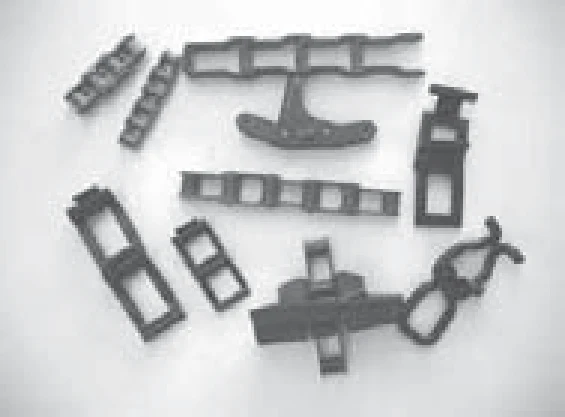
Novak carries gathering chains, precision welded chains, rod and pintle chains, T-Bar and T-Rod chains, agricultural roller chains, and more. He also carries rare chains like steel detachable.

“I have guys calling up looking for it for 40 to 50-year-old machines,” he says.

“It was the first real ‘ag’ chain. I deal direct with the only manufacturer of steel detachable chain left in the world.”

Even Novak can be stumped when it comes to some kinds of chains. A close working relationship with Allied Lock Industries comes in handy then.

“Their engineers have helped my customers design around obsolete chain problems,” explains Novak.

“Sometimes it simply requires a sprocket change.”

Contact: FARM SHOW Followup, Ken Novak, Farmchains.com, P.O. Box 77, Dixon, Ill. 61021 (ph 800 648-5429; fax 915 288-6790; [email protected]; www.farmchains.com).

From the archive · Full text
Feature story

3-Ton Coil Spring Compressor

Featured source: Peter Amstutz

“It’ll service 99 percent of the shocks and struts on the market today, and get the job done a lot more safely,” says Peter Amstutz, North Lancaster, Ontario, about his new 3-ton hydraulic coil spring compressor. It can be used to remove damaged coil springs from most cars and pickups as well as ATV’s and other equipment.

Amstutz is a licensed mechanic who at one time was also a tool salesman.

“While on the road I saw a lot of problems with the strut spring replacement tools that mechanics were using. The tools required the use of an air gun or impact wrench, which acted on a threaded bolt to squeeze the spring enough that it could be removed from the car. The operator had to bend over the spring, and a lot of guys got hurt when the spring released under compression,” says Amstutz.

His tool can handle springs from 3 to 12 in. in diameter, including non-concentric models. It makes use of a hydraulic jack and allows the mechanic to work at eye level, thereby staying out of the spring’s potential trajectory. A safety tie-down chain, combined with the double cross system, makes the compressor much safer to use, says Amstutz.

The tool has a double cross design, with a pair of self-locking horizontal arms. Each arm has its own vertical adjustment. The spring hooks on between the arms and is held secure by either hooks or angle irons. The jack is located about 1 ft. off the floor next to a 6-ft. high vertical steel pipe. The jack lifts a T-bar section that pushes against the upper arm, which is stationary, to compress the spring. Once the spring has been compressed, a new shock can be installed.

The horizontal arms can be adjusted to accept springs ranging up to 12 in. in dia. Adjustable screws on each arm allow different shapes and sizes of springs to be used.

“With the right combination of hooks and angle irons, coil springs can be compressed with a minimal amount of force, which re-duces the risk of weakening or breaking the spring. This feature also allows for the spring to be quickly repositioned,” notes Amstutz.

The tool sells for $790. Amstutz is looking for distributors. Contact: FARM SHOW Followup, Peter Amstutz, Rt. 1, North Lancaster, Ontario, Canada K0C 1Z0 (ph 613 347-1124; fax 613 347-2746; website: www.iss-sales-service.com/amstutz).

From the archive · Full text
Feature story

Mower Lift Makes Maintenance Simple

Featured source: Harold Fratzke

You don’t have to worry about bending decks or other components with this new universal mower lift. It’s designed to raise any garden tractor, zero turn mower, or ATV.

“It provides you with a safe and easy way to clean the deck and sharpen the blades on virtually any riding mower,” says inventor Harold Fratzke, who won a Gold award at this year’s Minnesota Inventors Congress.

The 2-wheeled “Niffty Lift” consists of a pair of lift arms with forks on front. It comes with an adjustable, telescoping safety T-bar that slides out and acts as a stop. The safety T-bar and safety pin holders hold the mower stable.

“It’s a simple solution to an old problem,” says Fratzke.

“On most riding mowers you can’t change the blades or clean out grass without taking the deck off or tipping the machine over and spilling gas and oil. It also makes it easier to change belts.

“I built as much safety as I could into the lift. Once the mower is raised and the handlebars are on the ground, the T-bar extends out under the mower so someone can’t grab the handlebars and dump the mower on you.”

The unit can even be used to move small trailers around, using an optional ball hitch.

Suggested retail price from $199 to $220.

Contact: FARM SHOW Followup, Harold Fratzke, 234 Shoreview Dr., Cottonwood, Minn. 56229 (ph 507 423-6341; [email protected]) or Pete’s Small Engine, Marshall, Mn. (ph 507 537-1780).

From the archive · Full text
Feature story

“Slide Sledge” Designed For Tough Jobs

Featured source: Chad Kirschner

If you’ve ever held a chisel for someone swinging a sledge hammer, you know it wouldn’t take much to smash a hand. With the new “Slide Sledge”, no one has to hold the chisel.

“It’s the ultimate tool for heavy equipment repair, turning many two-man jobs into one-man jobs. It’s ideal for field maintenance and repairs,” says Chad Kirschner, Slide Sledge, LLC, Hoffman Estates, Ill.

The Slide Sledge consists of a heavy metal bar inside a long steel tube. You hold the tube with one hand and the plunger with the other.

More than 20 different interchangeable tips are available. A large compression spring holds the tip on. No tools are needed to change tips.

The tool is available with four different sizes of plunger-hammers. One has a 9-lb. drive bar and measures 30 in. long; the second has a 13-lb. drive bar and measures 46 in. long; the third has a 14-lb. drive bar and measures 30 in. long; and the fourth has a 21-lb. drive bar and measures 46 in. long. It delivers a maximum force of more than 15,000 psi.

“It can generate more impact force than a sledge hammer of similar weight because the force is linear and because it’s always accurate,” says Kirschner.

“To remove the teeth on a loader bucket you want something shorter and more maneuverable. But if you need all-out power to remove 3-in. dia. excavator bucket pins, you’ll want the largest and longest tool. If you want a long hammer to chip away material in a place where you can still maneuver around, the 13-lb., 46-in. model, equipped with a curved chisel, would be ideal.

“It works great for removing tie rods and ball joints, ripper teeth, and loosening beads on large tires.”

The Slide Sledge is available in kits that include one tool and up to six different size pin drivers ranging from 1/2 to 3 in. in diameter. Each kit includes a nylon carrying bag with inner pockets to transport and store tool and tips.

Tool kits sell for $300 to $400. Tips sell for $30 to $40 apiece. The company does not sell direct and suggests that you contact its website for the distributor nearest you.

Contact: FARM SHOW Followup, Slide Sledge, LLC, 2500 W. Higgins Road, Suite 1050, Hoffman Estates, Ill. 60195 (ph 800 276-0311; fax 877 477-3356; chadk @slidesledge.com; www.slidesledge.com).

From the archive · Full text
Feature story

Fuel Tank “Blaster” Has Room For Big Parts

Featured source: Marshall Litchfield

Marshall Litchfield, Macomb, Ill., used an old 300-gal. fuel tank to build a state-of-the-art sand blaster.

“It works great and cost only about $100,” says Litchfield.

He cut out one end of the tank to make an access door and cut off the bottom of the tank to weld in a home-built metal hopper. A grate on top of the hopper serves as a table to work on and allows the sand to fall below for re-use.

The tank is equipped with an air-powered blast gun that’s pre-plumbed into a quick-tach air hose. A siphon hose runs from the gun down into the sand. When he pulls the trigger on the gun, sand is sucked up out of a bucket and blown out. A 12-volt fan mounts in a metal box at one end of the tank and re-moves dust during sand blasting. The fan is from an old furnace and so is the filter chamber. An ordinary furnace filter is used to remove dust and debris. A commercial air cleaner equalizes pressure inside the tank.

A 4-ft. long fluorescent light mounts in a rectangular box on top of the tank. The light shines through a plexiglass window that Litchfield cut into the tank.

Litchfield does quite a bit of work restoring antique tractors and says he needed a big sand blaster to work on light metal.

“Commercial cabinet sandblasters aren’t big enough to accommodate things like tractor fenders and hoods. We have a big sandblaster that’s engine-driven that we use outside. However, it has such force that it can swell up light metal and warp it. With a smaller cabinet sand blaster there’s less pressure and we can use a finer grit.”

To reduce the danger of an explosion when cutting the tank apart, he cleaned out the tank and then hooked up to the exhaust on his pickup to fill the tank with exhaust fumes.

“The exhaust is non combustible,” notes Litchfield.

Contact: FARM SHOW Followup, Marshall Litchfield, 15495 N 700th Rd., Macomb, Ill. 61455 (ph 309 254-3481).

From the archive · Full text
Feature story

Wood Splitter Breaks Tire Beads

Featured source: B. Roy Landis

Wood splitters make good bead breakers, says B. Roy Landis, Cooks, Mich.

He got the idea when working on an old tire with a stubborn bead. He tried a jack and a pry bar, and even considered using a shop press - but the tire was too big.

Finally, he put some wood blocks in his wood splitter and the tire in between.

“It popped on the first try,” Landis says.

Contact: FARM SHOW Followup, B. Roy Landis, 1051 S County Rd. 442, Cooks, Mich. 49817 (ph 906 644-2282).

From the archive · Full text
Feature story

Simple Tool Solves Hydraulic Pressure Problems

Featured source: George Waite

A simple tool invented by George Waite makes releasing pressurized hydraulic couplers as easy as turning on a water faucet.

Waite’s Hydraulic Pressure Relief Tool works like pliers to grip the valve end. Turn a simple tap on one side of the pliers, and it slowly presses on the male fitting, gradually releasing pressure as needed. The controlled release keeps fluid from shooting all over you and the equipment and prevents damage to the coupler.

“You can release pressure and fluid into a Dixie cup with this tool,” says Waite.

“You don’t have to try to unscrew the hose or force the coupler.”

A universal reaction from people who see the patent pending tool for the first time is “’Why didn’t I think of that?,’” says Waite. The next question is, “Where can I get one?” One such person, Roger Hessler, a Colorado State Transportation Dept. worker and a personal friend of Waite, saw him fiddling with a wooden mockup.

“He said he wanted one,” recalls Waite.

“I said, you don’t even know what it is and he replied, yes, I do. I’ve been looking for one for 40 years. I just didn’t know what it was going to look like.”

Hessler showed a working model to his boss, who promptly ordered 100 of the tools. Waite also received the 2005 Colorado Dept. of Transportation Safety and Innovation Award for his invention.

A laser cutter cuts out pieces for the tool. At this time, Waite and his wife, Ruth, still do all needed welding and assembly, including painting and silk-screening the name and other information. They also handle all sales, either by phone or from their website.

The tools are priced at only $24.95 for 5/ 8-in. couplings and $34.95 for 3/4-in. and skid steer size couplings. Waite points out that the tool costs less than replacing three damaged male fittings. Controlled pressure release with the tool reduces potential contamination to the hydraulic system, decreases hook up time and reduces equipment down time. It also reduces risk of injury to employees from fluid discharge or tools slick with hydraulic fluid.

Contact: FARM SHOW Followup, George Waite, Waite’s Tools, P.O. Box 66, Atwood, Colo. 80722 (ph 970 522-5696; bramma @kci.net; www.waites-tools.com).

From the archive · Full text
Feature story

Pressure Gauges Troubleshoot Brakes

Featured source: Peter Vinci

Figuring out why one disc brake is worn and the other isn’t can be a mystery. The quick solution is to replace the calipers and pads on the worn brake. But what do you do if a few weeks later the same brake fails again.

“It could be a bad hose, stuck slide, bad proportioning valve or something else,” says Peter Vinci, president, Innovative Products of America.

To help troubleshoot that and other pressure related problems, Vinci developed and introduced the Disc Brake System Analyzer. The Analyzer consists of two 5,000-lb. load cells attached to analog gauges that read in 0-5,000 psi and 0-350 BAR. A red “tell tale” memory needle on the dial allows one-man testing by retaining and indicating the most recent pressure reading. The gauges are packed in a wooden case and are priced at $159.95.

In the case of the mysterious bad brake, replacing the brake pad with one of the load cells can identify a bad hose. Step on the brake and the gauge should indicate appropriate pressure. Take the foot off the brake, and the needle on the gauge should snap back to zero. If a hose is bad, pressure will either not be indicated or may continue after the foot has been removed from the brake.

“If you compare pressure on the left and right brakes, and one is at 1,000 psi and the other at 2,000 psi, but both snap back when the foot comes off the brake, the pro-portioning valve may be faulty,” says Vinci. The analyzer can also indicate air in the system, bypassing or leaking master cylinders and incorrect rear lining to drum adjustment.

“You can use these load cells to measure the pressure exerted by any fixture that uses jaws to squeeze shut on a part,” says Vinci.

Contact: FARM SHOW Followup, Peter Vinci, Innovative Products of America, 5401 Rt. 212, P.O. Box 266, Mt. Tremper, N.Y.

12457 (ph 845 688-2300 or 888 786-7899; fax 845 688-2400; [email protected]; www.ipatools.com).

From the archive · Full text
Feature story

Where To Buy Parts For ATV’s (Or Sell Wrecked Machines)

Featured source:

ATV Parts Depot

Offers a wide variety of new parts and accessories including tires, fenders, racks, winches, gas tanks, brakes, cables, ramps, seats, exhaust, levers, seat covers, pistons, rings, gaskets, chain, mufflers, sprockets, bearings, seals, ATV locker (converts limited-slip front differential to fully locked, true 4-WD), lift kits, heat fighter kits, and more.

Contact: FARM SHOW Followup, ATV Parts Depot, Manchester, Mo. (ph 800 945-1850; www.atvpartsdepot.com).

Bell’s Suzuki

They carry a complete line of Honda, Suzuki, and Kawasaki accessories.

Contact: FARM SHOW Followup, Bell’s Suzuki, 667 New Circle Rd., Lexington, Ky. 40505 (ph 859 299-3521; www.bellssuzuki.com).

Pat’s Small Engine Plus

They carry ATV parts and accessories, ATV helmets, etc.

Contact: FARM SHOW Followup, Pat’s Small Engine Plus, 23416 Baltimore St. N.E., East Bethel, Minn. 55055 (ph 763 413-1344; [email protected]; www.psep.biz).

Cycle Pros Salvage

One of the largest inventories of used ATV and dirt bike parts on the East Coast. All parts are inspected, tagged, and stored inside. Same day shipping by UPS.

Contact: FARM SHOW Followup, Cycle Pros Salvage, 456 Bedford St., Bridgewater, Mass. 02324 (ph 508 697-2611; www.cycleprossalvage.com).

HyperParts.com

If you need ATV brake shoes, brake pads, air filters, oil filters, bearings, seals, pistons, rings and other replacement parts, HyperParts stocks Arctic Cat, Honda, Kawasaki, Polaris, Suzuki, and Yamaha.

Contact: FARM SHOW Followup, HyperParts, LLC, 623 Mulberry Point, Aliceville, Ala. 35442 www.hyperparts.com).

ATV Tire Superstore

This website will help you make an informed decision on which tires are best for your ATV. They carry a wide array of tires from ITP, Maxxis, Kenda, Titan, Goodyear, and more. You can read about each tire and compare it to others in that category.

Contact: FARM SHOW Followup, (ph 888 481-9852; www.atv-tires-superstore.com).

Steve’s Cycle

Steve’s Cycle specializes in used and new parts for all Japanese motorcycles and ATV’s. The company has salvaged more than 30,000 machines and has 2 acres of parts under roof, plus another 7 acres where parts and machines are kept outside. Steve’s also has a connection with a nationwide cycle/ATV parts network, so if they don’t have what you’re looking for, they can usually find it.

In addition to selling parts and even whole machines, Steve’s also buys wrecked, burned or non-working machines from individuals, insurance companies and even dealers who take in older used machines on trade that they don’t want to resell for whatever reason.

Contact: FARM SHOW Followup, Mike or Alex, Steve’s Cycle, 25 U.S. Hwy. 319 N., Tifton, Ga. 31794 (ph 800 622-9253; [email protected]).

East Coast ATV

East Coast buys used or wrecked ATV’s and offers a large selection of aftermarket and factory parts. Used parts sell for 40 to 50 percent less than new. The company says it can locate hard-to-find dirt bike and ATV parts, usually within 24 hours. Discount factory parts are available for all makes and models. Contact: FARM SHOW Followup, East Coast ATV, 1862 B Tollgate Road Unit 3, Palm Industrial Center, Palm, Penn. 18070 (ph 215 541-4985; fax 215 541-0433; www.eastcoastatv.com).