Practical ideas from FARM SHOW MagazineSubscribe · Free issue · Send us your shop tip
Subscribe to FARM SHOW
Issues / Vol. 26, No. 3 (2002)

Vol. 26, No. 3 (2002)

Money-Saving Repairs & Maintenance Shortcuts · Printed section pp. 38–41

31 selected entries · Complete text of selected entries

This issue’s section includes reader tips and feature-length shop stories. Held items and editorial notices are not reproduced.

Archive text: prices, coupons, availability and contact details reflect the original publication, not current offers. Reader methods are not universal instructions; follow manufacturer guidance and proper safety practices.

Reader shop tips

From the archive · Full text
Reader shop tip

Ethelbert Heck

Ethelbert Heck, Double E Farms Ltd., Box 47, Liebenthal, Sask. S0NB 1L0 Canada (ph 306 628-4250)

“All GM Duramax diesel truck owners know it’s a good truck. But GM engineers forgot that these trucks get driven on gravel roads, through brush, and under other tough conditions. Off-road driving can take out the fuel cooler located in front of the fuel tank. We eliminated the problem by making a fuel cooler protector that bolts in front of the fuel cooler. It consists of a curved expanded metal guard that wraps under the cooler. We also make a filter protector for Allison automatic transmissions.

“The Fuel Cooler Protector sells for $40 (Canadian) and the Transmission Filter Protector for $30, plus shipping. They take only about 15 min. to install each.”

From the archive · Full text
Reader shop tip 1 of 2

Pete Peters

Individual tip 1 of 2 from this reader’s published contribution.
Pete Peters, Osler, Sask.

“I’ve found that the empty spools from rolls of wire make good hose hangars on the wall of my shop. Just nail or screw them to the wall. Works great for hoses, extension cords, and rope.

From the archive · Full text
Reader shop tip 2 of 2

Pete Peters

Individual tip 2 of 2 from this reader’s published contribution.
Pete Peters, Osler, Sask.

“I made this chimney scraper for cleaning out creosote buildup that a chimney brush will not take out. It consists of a small square box – open on the bottom – with sharpened edges. Mounts on the end of a pole which you can extend as long as needed. Works great on square chimneys.”

From the archive · Full text
Reader shop tip

John Rember

John Rember, 1712 Upper Concession, Ormstown, Quebec

“We had a problem with the parallel linkage on the gang on our Case IH 183 row crop cultivator. The Case IH system consists of only one set of parallel arms per gang. The cultivator was bought used and did not seem to have been used much. However, the linkages and bushings were so badly worn that the gangs would not trail straight and would tip to one side or the other, depending on which C-shank would dig into the soil first. The linkage bars were strong enough but only about 1 1/2 in. wide, so they didn’t offer much stability. We solved the problem by widening the parallel linkage supports to 6 1/4 in. to receive a 2 by 6-in. piece of square tubing, cut to the same length as the original. On each side of the 2 by 6 we drilled two 1-in. dia. holes, 15 in. apart. Into these holes we welded bushings with an inner diameter of 5/8-in. These bushings were tapped for grease fittings. To mount the new parts, we used 5/8 by 8-in. carriage bolts, lock nuts, and 1/8-in. plastic wear washers. We now have gangs with no play. Our total cost was about $300 and about 4 days work in the shop.”

From the archive · Full text
Reader shop tip

Robert E. Jensen

Robert E. Jensen, Edmore, Mich.

“Here’s how I remove frozen nuts or bearings. Use a torch to make two cuts 180° apart. Use oxygen in slow, short bursts. Stop just before getting to the shaft and then hit with a hammer and it’ll come off in two pieces with no damage to the shaft or bolt. Works great in many situations.”

From the archive · Full text
Reader shop tip

Roger Kuntz

Roger Kuntz, K-Tech, 5251 County Rd. X, Grainfield, Kan. 67737 (ph 785-673- 5560)

“K-Tech has been specializing in Blade Plow Leveling and tillage performance for over 20 years. A new breakthrough in engineering has allowed us to update the old blade plows with a new rockshaft bearing system. Rockshaft bearings are the primary wear zone responsible for out-of-level axles. The program is easy and inexpensive to have installed.”

From the archive · Full text
Reader shop tip

Daniel M. Swanson

Daniel M. Swanson, Cambridge, Ill.

“With ever-increasing demand in the tractor for 12-volt power - grain drill monitor, grinder scale, sprayer monitor, etc. - I came up with a simple idea that makes hookups a lot easier. I simply connected a common 110-volt AC outlet, with ground, to the tractor battery and then attached 3-prong plugs to the monitors so I can plug them into it. Makes hookups easy and I can use the tractor battery so no need to worry about having charged-up batteries.

“To install the outlet, I wired the two ‘spades’ off the positive post and ground off the negative post. I also wired an in-line fuse into the positive wire side.

“Not only is this convenient for power monitors and the like, but I can also carry an extension cord with me to run to the 12-volt pump on my diesel fuel transfer tank and to chemical mini-bunk tanks. Very convenient.”

From the archive · Full text
Reader shop tip

Gary Bannister

Gary Bannister, Boenne, Texas

“I have a simple method for stopping leaks in small metal tubing like power steering lines. I just use rubber gas hose with small clamps on either side of the leak. Works good and much cheaper and easier than replacing a metal line.”

From the archive · Full text
Reader shop tip

T.E. Salsman

T.E. Salsman, Richmond, Ky.

“My son-in-law operates Circle Seal & Gasket, a company that makes custom-sized O-rings for various industries. O-ring material is cut to precision length and the ends joined by a heat process. As the company has been in business for only about a year, close management of operating costs is mandatory. At first they used a hand-operated cutter to cut all raw material, but it’s a tiring, labor-intensive operation. There was nothing on the market that could do the job at a price they could justify.

“So I started developing an air-operated cutter. As it turns out, my crude prototype has been in daily use for months and has cut material for several thousand O-rings. My billed cost for parts in building it was only $55.

“The cutter operates at about 90 lbs. air pressure and drives a 1 1/2-in. air cylinder with a 2-in. stroke. The push rods are two grade 5 bolts that operate through bronze bushings (replaceable at Ace Hardware store for $1.49 each). The cutterhead, which has a 1/8-in. key fixed in place with JB Weld, drives a Stanley commercial grade box knife blade. The cutterhead is controlled by a 1-in. shaft with 1/8-in. keyways at 30, 45, and 90 degrees, to cut the material as required by the type splice for that particular O-ring. Moveable guides keep the material aligned for cutting.

“I’m now looking for a source of knives which will increase the tool’s cutting capability.”

From the archive · Full text
Reader shop tip

Clarence R. Marshall

Clarence R. Marshall, Warsaw, Ill. (ph 217 847-2197)

“Anyone restoring an older tractor maybe interested in my sideline business. I repair magnetoes, which after must be replaced when doing a restoration. I have new and rebuilt magnetoes available for either sale or trade.”

From the archive · Full text
Reader shop tip

Robinson Lawn & Garden

Robinson Lawn & Garden, 110 SE 2nd St., Stigler, Okla. 74462 (ph 918 967-8662)

“I came up with a V-belt measuring device that lets me know what length V-belt I need whenever an existing belt breaks or wears out and I don’t know how long it was. Using contact cement, I glued a cloth or plastic ruler onto the back side of a 1/2-in. wide, 100-in. long used V-belt, covering its entire length. I wrap the belt around the idler and pulleys, and wherever the end of the belt comes to on the ruler tells me the belt length that I need. The belt could be of any length. I’m in the lawn and garden business and find that a 100-in. ruler works best for my needs.”

From the archive · Full text
Reader shop tip

Richard B. Allen

Richard B. Allen, South Brookfield, Nova Scotia

“During the past three years I’ve had trouble seeing the string when making hay with my New Holland 630 round baler. I couldn’t tell if the string was moving or not, which caused me considerable grief. I was dumping out bales without them being tied and also had bales with string wrapped all through them because the string didn’t cut off and I didn’t realize it was still going out. The problem was especially bad if the sun was shining toward the back window of the tractor.

“I solved the problem by mounting a small pulley on front of the baler for the string to travel under. When the string moves, the pulley moves, too. I painted part of the pulley black so that I can see at a glance whether the string is moving or not. The pulley - which came off a boat steering apparatus - is simply bolted in place.”

From the archive · Full text
Reader shop tip

Ray Jensen

Ray Jensen, Dell Rapids, S. Dak.

“I obtained a low-cost skid steer loader by repowering an early 1970’s Bobcat 500 which I bought for $1,100. The original Kohler 22 hp, 2-cyl. gas engine was worn out, so I replaced it with another Kohler engine that I took off a riding mower I already had. The replacement engine is also a 22 hp, 2-cyl. model but it runs at 3,600 rpm’s compared to only 2,100 rpm’s for the original engine. As a result it’ll last a lot longer.

“The original engine was used to direct-drive a hydraulic pump on the right side of the machine, and to belt-drive a variable speed pulley on the left side. The variable speed pulley was used to mechanically adjust the machine’s speed. The engine was equipped with a tapered roller bearing which took pressure from the belt pulley off the engine crankshaft. However, the new engine had a roller bearing instead of a thrust bearing which resulted in a ruined crankshaft.

“To solve the problem, I installed a jackshaft that’s belt-driven off the engine and runs both the hydraulic pump and variable speed pulley. One end of the jackshaft runs the hydraulic pump and the other end runs the variable speed pulley.

“The jackshaft mounts on a bracket that bolts to another bracket that bolts onto the skid loader’s frame. A threaded bolt that connects both brackets is used to adjust belt tension. The replacement engine mounts on a frame above the jackshaft.

“I would have had to spend $2,500 for a new engine like the original one. I didn’t want to spend that much money because this engine has a bad reputation. My Bobcat 500 was in almost perfect shape because the engine didn’t have enough power to wear it out. A new engine like the one I used can be bought for about $1,200.”

From the archive · Full text
Reader shop tip 1 of 2

Neal McCleary

Individual tip 1 of 2 from this reader’s published contribution.
Neal McCleary, Elkton, Md.

“I widened the pickup on my Deere 336 baler in order to make it easier to pick up wide windrows. I cut the pickup in half and welded four 6-in. spacers in to make room for another set of four teeth. Metal was also cut off the outside and inside windrow dividers. It was a great improvement.

From the archive · Full text
Reader shop tip 2 of 2

Neal McCleary

Individual tip 2 of 2 from this reader’s published contribution.
Neal McCleary, Elkton, Md.

“When the tongue on the same baler broke off, I replaced it with an extendable tongue off an old Fox chopper. I welded on a length of box beam to make the tongue the right length. The tongue is now stronger and can be extended for easier hookups.”

From the archive · Full text
Reader shop tip

Steven S. Kling

Steven S. Kling, Taylor, Wis.

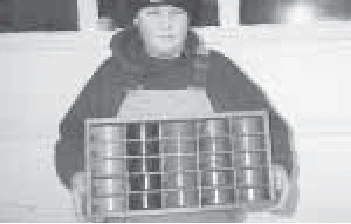
“My son Samuel came up with a low-cost screw and nut holder as part of a 4-H project. He uses old tuna fish cans held in a homemade wooden frame with 20 compartments. He paints the cans different colors to identify screws, nuts, etc. It cost very little to make, and the tin cans are more sturdy than the plastic drawers found on commercial parts bins.”

From the archive · Full text
Reader shop tip

Tom Bonner

Tom Bonner, Section, Alabama

He restores IH Cubs and Cub Cadets and has found that the tie-rod ends are usually worn out or bent so they can’t be reused.

“The last time I tried to buy a set of used tie rod ends for a restoration, the dealer wanted more than $100 for a set,” he says.

“I told him ‘no thanks’, and went home and made a set in my shop. It only took me a couple of hours.”

Since then, Bonner has made close to 50 sets of tie-rod ends for his own use and for friends and neighbors who have Cubs and Cub Cadets. With time and materials included, Bonner figures his tie-rod ends cost about $50 to make.

He says they’re not exactly easy to make with a regular lathe, but figures any competent machinist can do it.

“If you had a CNC machine, you could make them even faster and for less money,” he believes. He’d be happy to give advice or answer any questions others might have about making their own.

Contact: FARM SHOW Followup, Tom Bonner, 424 Rock City Road, Section, Ala. 35771 (ph 256 228-3204).

From the archive · Full text
Reader shop tip

Otto Wenz

Otto Wenz, Wenz Service, Inc., 1606 L Street, Tekamah, Neb. 68061-1289 ph 800 808-7885 or 402 374-2202)

“If your older IH tractor sometimes jumps out of gear or locks in gear, or if you’re just frustrated with the way it shifts, we can probably help. We had some of the same problems with our own tractor and figured out a way to fix it that worked better than anything we could find at the time.

“We now offer complete kits to solve shifting problems for IH models from the 706 up to the 6788. Most of the problems with these tractors come from the gears in the transmission not being fully engaged. Different tractors need different parts, so while we do have complete repair kits, we’d prefer to sell only the parts needed For this reason, farmers or their mechanics should call for parts and prices.

“All of our transmission repair parts are guaranteed. We guarantee the ’06 series parts for the life of our business. As long as I’m around, we’ll replace anything we’ve sold for them. Kits for most other models come with a 10 year guarantee.

“In addition to IH transmission repair parts, we also sell a number of new after-market parts for almost any make of tractor.”

From the archive · Full text
Reader shop tip 1 of 2

Samuel Wurz

Individual tip 1 of 2 from this reader’s published contribution.
Samuel Wurz, Box 1060, Vulcan, Alberta, Canada T0L 2B0

“Fixing a flat truck tire can be a frustrating experience, because the sidewalls are so thick that you can’t hold them open with your hands. To solve the problem, I came up with a hook system. I set the tire on top of a steel frame, then hook it in and pull the sidewalls apart so that you have enough space to work with a grinder or other power tools. It has a pair of steel hooks on one side and a handle on the other side. You set the hooks on one side of the wall and then pull the handle back over center until it locks in position.

“We always set the tire inside a steel cage to protect the operator in case the tire explodes. The cage was built from 1-in. solid steel rods.

From the archive · Full text
Reader shop tip 2 of 2

Samuel Wurz

Individual tip 2 of 2 from this reader’s published contribution.
Samuel Wurz, Box 1060, Vulcan, Alberta, Canada T0L 2B0

“We came up with a portable scaffold that serves as a handy step ladder and folds up like a book for use in tight spaces or for storage. It mounts on four castor wheels so it can be rolled around wherever its needed. The scaffold measures 5 ft. long and 6 ft. high and is 2 1/2 ft. wide when folded all the way out. It folds to a width of only about 1 ft..

The stepladder is formed by hooking three metal steps between the sides. By removing the steps and then grabbing hinged arms at the middle of the scaffold, you can collapse the sides in toward each other. The wheels are equipped with brakes.

“Works great for painting, working on ceiling lights, welding, etc.”

From the archive · Full text
Reader shop tip

Don McColl

Don McColl, Neidpath, Sask.

“I’m in the earth moving business and when the floor in my big earth-moving scraper got bent, I had to find a way to straighten the floor. I decided to make a giant press using big sections of channel iron from a demolished grain elevator and two 20-ton hydraulic jacks.

“It eliminated the need to do a lot of cutting with a torch, which would then have to be rewelded and reinforced. I used it only for this one job, but it’s always there ready to be used again. The floor will eventually bend again.

“I used railroad ties to space the two pairs of channel irons about 2 ft. apart. A pair of heavy steel arms hold the two pairs of channel irons together. The scraper floor was positioned part way between the two sets of channel irons. A pair of hydraulic jacks were placed side by side on top of the floor. By raising the jacks up against the top channel irons I was able to exert downward pressure on the floor and straighten it out.

“It worked as well as I hoped it would. The main top channel iron was bending upward slightly so I chained another, shorter length of channel iron on top of it for extra strength.”

From the archive · Full text
Reader shop tip

Matt Throener

Matt Throener, Matt’s Ag Service, Carnegie, Okla.

Transmission and power take off repairs on tractors can be done faster and easier if the cab is removed, says Throener.

Many of the farm tractors that come into his shop for repairs are Deere, from the company’s 30 through 60 series.

“The cabs on these tractors all have lift pockets built into them, but they’re only 1/2 in. wide,” Throener says.

“You can’t pick them up with normal flat forks. You’re supposed to buy a special tool to lift the cabs off these tractors, but it costs $4,000 to $5,000.”

Throener decided to make forks to fit the pockets himself. He cut two 4-ft. lengths of 1/2 by 4-in. flat steel bar.

“I had to machine 1/2 in. off the top edges on the front in order to make them fit into the lift pockets, but on the back ends, I left the forks 4 inches wide.

This makes a stop on the forks, so the cab can’t slide back on them too far,” he says.

He welded his forks to quick-tach brackets he made from 3-in. sq. steel tubing and angle iron.

“To lift a cab off a tractor, I first put the forks into the pockets by hand. Then I move the loader into position under the forks and raise it up so the quick-tach brackets engage. Then I just lift up and back away,” he says.

“It takes about an hour to disconnect all the mountings and wiring from the cab.

“But having the cab out of the way can save eight or ten hours on a transmission or power take off repair because you’re not trying to crawl in under the tractor all the time,” he says.

“It’s safer this way, too. In the past we would split the transmission, block up the front end, and then roll the rear end back out of the way.”

From the archive · Full text
Reader shop tip 1 of 2

Bob Timan

Individual tip 1 of 2 from this reader’s published contribution.
Bob Timan

“Old refrigerators are great for tool cabinets. I use one to store welding rods. You can put a lightbulb inside to keep out the moisture. We’ve never had a problem. We also use one for shop manuals and other paperwork.

“You can keep an open box of baking soda in the door of each to keep the odor down. “We have another one for electric and air tools. And one for small ignition parts. You can easily add shelves inside.”

Shop feature stories

From the archive · Full text
Feature story

Salvage Yard Sells Parts Overseas

Featured source:

“We’d like to tell your readers about our salvage yard, which has grown into one of the largest and best-organized sources of used parts in North America. It was started as a family business in 1988 and has continued to grow rapidly every year since,” says Karen Larson of Gratton Coulee Agri Parts.

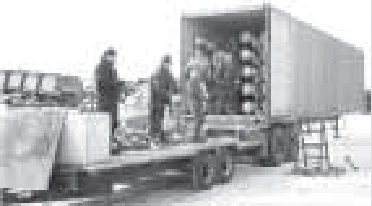
“We are located in Alberta, Canada but can ship parts anywhere. In fact, we recently sent a container load of combine parts to Malaysia. We’ve also ship parts to Australia, Germany, New Zealand, Mexico, France, England, and all over the U.S.

“We employ 14 people. We believe our computer system surpasses what any salvage yard offers. You can check our web site (www.gcparts.com) for many of our parts, including a wide range of combine and tractor parts of all kinds.

“Or contact us at: Gratton Coulee Agri Parts Ltd., Box 41, Irma, Alta. T0B 2H0 Canada (ph 888 327-6767; 780 754-2303; E-mail: [email protected]).”

From the archive · Full text
Feature story

Plastic Bushings Replaced With Longer-Wearing Metal

Featured source:

When Bob and Melvin Gillespie, Pullman, Washington, needed to replace the worn out plastic bushings that attach the drill openers on their Case IH 5300 grain drills, they went looking for something a little more durable than the original plastic, but couldn’t find what they needed at any of the parts stores.

So they went to Randy Douglas, owner of Paradise Ridge Machine, Inc., Moscow, Idaho. Douglas carefully measured the problem bushings and set up his CNC (computer numerical control) lathe to make metal replacement bushings for them.

Douglas used an iron-lead alloy material called Leadloy. Gillespie had the completed bushings plated with zinc, similar to galvanizing, to keep them from rusting. It also gives them a brassy appearance.

“I could have made them from brass or bronze just as easily, but they would have cost more,” Douglas says.

Even with the zinc plating, the custom-made bushings were just a few cents apiece more than the plastic ones the Gillespie brothers had been buying from their Case IH dealer.

“I don’t think we’ll ever have to replace these,” he says.

“It’s quite inconvenient to take the drill apart to replace the bushings during planting season.”

Douglas says the Leadloy bushings were the first he’s made for farm equipment, but says he’d be willing to make more if farmers want them.

“I can make just about any size bushing you’d want with this machine, in about any quantity,” he says. He’d prefer to have the bushing he’s duplicating as a pattern, but notes that if farmers can provide accurate measurements, he can use those to program the CNC machine.

“Once the machine is set up, it takes very little time to make them,” he says.

Contact: FARM SHOW Followup, Randy Douglas, Paradise Ridge Machine, Inc., 2536 Blaine Road, Moscow, Id. 83843 (ph 208 882-5130; fax: 208 882-5131); or Bob Gillespie, 602 Kamerrer Road, Pullman, Wash. 99163 (ph 509 334-3757; E-mail: [email protected]).

From the archive · Full text
Feature story

Sharpener Works On Big Drill Bits

Featured source:

A couple years ago FARM SHOW reported on an inexpensive new drill bit sharpener invented by Stan McDonald, Foxboro, Ontario (Vol. 24, No. 6). It was an attachment for benchtop grinders that sharpened any bit up to 1-in. dia., regardless of length.

After the story was published, McDonald had a lot of requests for a larger bit sharpener. It prompted him to came up with a new model that will sharpen any bit up to 3 in. in diameter. It’ll handle tapered or straight shank bits with two, three, or four flutes.

McDonald says bits sharpened by his sharpener often work better job than new drill bits because you can improve them with his “four facet” sharpening method (see photos at right).

“The result is a high-performance bit that will last longer and cut faster,” he says.

The sharpener weighs 75 lbs. and is designed to attach to a bench grinder.

“It compares favorably with sharpeners that cost thousands of dollars. It’s easy to use and built to last,” says McDonald.

The sharpener sells for $550 (U.S.) plus S&H.

Contact: FARM SHOW Followup, Stan McDonald, 402 Rosedale Ave., Foxboro, Ontario, Canada K0K 2B0 (ph 613 968-9516; E-mail: [email protected]).

From the archive · Full text
Feature story

Carburated Ford 351 Engine Converted To Fuel Injection

Featured source:

After 200,000-plus miles, the 351 engine in the 1990 Ford F-250 pickup on the Allspach Farm, Mt. Pulaski, Ill., needed a major overhaul.

A number of Allspach family members and employees depend on the pickup which, despite its age, is still in great condition.

Rather than trade it off, they bought a rebuilt 351 engine that came from an older truck.

“It was built in 1976, so it didn’t have electronic fuel injection like the one in our 1990 model,” says George Allspach.

“While they changed the injection and ignition on the newer engines, Ford hadn’t changed the block itself,” he continues.

“We were able to salvage the electronics from the worn-out engine and install everything on the older rebuilt engine. We just took the carburetor off the replacement engine. Then, from the 1990 engine, we installed the intake manifold, distributor, water pump, timing chain housing, starter gear, the counterbalanced pulley from the front of the crankshaft, the oil pan and the oil pump. We had to reposition the oil dipstick so it would clear the power brake cylinder. That was probably the trickiest part.

“Even though the replacement engine was 14 years older than the original, Ford evidently used existing mounting holes in the 351 block and heads when they switched over to electronic injection and ignition. We didn’t have to do any machining on the block to fit the manifold and electronics to it,” Allspach says.

The rebuilt 1976 engine runs just like the one that came in the truck.

“In fact, it may be a little more fuel efficient than the original,” he adds.

“It saved us the time and trouble of rebuilding the engine ourselves, and the older rebuilt engine was less expensive than buying a newer rebuilt engine with all the electronics on it.”

“Dad had heard about someone else who had done the same thing, so we were sure it could be done before we bought the engine,” Allspach says.

“Any competent mechanic could do it.”

Contact: FARM SHOW Followup, George Allspach, Allspach Brothers Farm, 1300 50th St., Mt. Pulaski, Ill. 62548 (217 792-5231).

From the archive · Full text
Feature story

Mower Blade Sharpener

Featured source:

“It sharpens perfectly every time and the sharpened angle of the blade remains the same next time you sharpen it,” says R.A. Wagner, Sumner, Ill., about his home-built mower blade sharpener designed to fit onto any 6 or 8-in. bench grinder. It was made from several pieces of angle iron, a piece of pipe, and a steel rod. It bolts to the work bench with a single bolt.

The blade is held in place on the horizontally-mounted piece of angle iron by a C-clamp. It pivots in and out from the grinding wheel on a single bolt pivot. The entire assembly slides back and forth on a piece of steel rod, mounted horizontally just above the workbench. A short piece of pipe welds to the underside of a piece of angle iron at the base of the unit.

“You can adjust it to fit the cutting edge on any blade. You slide the blade back and forth until sharpening is complete, and then flip the blade end-for-end and repeat the process,” says Wagner.

Contact: FARM SHOW Followup, R.A.

Wagner, Rt 2, Box 99, Sumner, Ill. 62466 (ph 618 936-2050).

From the archive · Full text
Feature story

State-Of-The-Art Sand Blasting

Featured source:

Jim Deardorff, Chillicothe, Missouri, who has been cleaning and painting old steel for more than 20 years, has discovered a better way to sandblast.

“Most people use sandblast sand to clean paint and rust off old equipment,” he says.

“But for antique tractors, classic cars and even vintage airplane parts, I’ve found that a blend of iron aluminum oxide and ground-up black walnut shells cleans better and more gently than sand. It can be used at lower pressures, doesn’t damage fragile parts and is dustless, so parts cleaned with it don’t require pre-paint preparation.”

He has a unique way to promote his new sand blasting medium to car and tractor collectors.

“I can take all the paint off a pop can without damaging the aluminum,” he says.

“You can’t do that with conventional sand blasting.”

Deardorff discovered his new sandblast mix by accident.

“I normally re-use aluminum oxide blasting material. One day as I was re-using some after using it to clean up parts that were sitting on wooden pallets, I noticed the parts I was cleaning with it immediately became bright and shiny. I looked at the material and saw that small bits of wood from the pallets had actually been blasted off and were mixed in with the aluminum oxide,” he says.

“I wondered if the wood had anything to do with how clean and bright the steel looked. I sometimes use ground black walnut shells for cleaning parts in food processing plants or petroleum pipelines where sand might cause problems with bearings, manifolds or pumps, so I mixed some of the walnut shells into the aluminum oxide and the results were even better,” he says.

Deardorff found that this mixture not only cleans up the metal without pitting or scratching it, but it also helps prevent rust.

“I’ve had some customers tell me they’ve let parts sit for up to a year without any recurrence of rust,” he says.

“I’m not sure why this is. Perhaps it just does such a good job of cleaning the metal that it’s harder for rust to develop on the surface.

“I’ve taken parts I’ve cleaned with this mixture to metallurgists at the University of Missouri-Rolla School of Mining and Engineering for evaluation and am hoping they’ll be able to tell me why this happens,” he says.

Using his mixture of walnut shells and aluminum oxide, Deardorff has been able to reduce the amount of pressure needed to clean paint and rust from fragile parts.

“I normally use about 35 psi and rarely more than 50 psi to clean with this mixture,” he says.

Deardorff says parts cleaned with his mixture can usually be primed immediately with no further brushing or washing.

While his mixture is initially more expensive than sand, it can be reused numerous times, limited only by the amount of contaminants that build up in it after each use.

“It takes 10 reuses to break even with it,” he adds.

“And when it can no longer be used for parts cleaning, I use it one more time to brush-blast galvanized steel buildings before repainting. I’ve found this is much more effective for removal of oxidation (chalking) and rust than power washing. And then, we can paint the same day. With power washing, we have to wait for the siding to dry.”

Using his walnut shell mixture, Deardorff can strip the paint from an entire medium sized tractor in 4 to 6 hours.

You can use the new mix with any sandblaster but Deardorff recommends a closed-top sandblast pot, which uses vacuum to pull media into the chamber.

“This is the only thing I’ve found that works at low pressure,” he says. It allows him to drop the nozzle pressure without losing pressurization of the blasting media. He also uses an air-induction nozzle, which mixes outside air with compressor air and the media.

“This increases the air volume, which gives a more uniform blast pattern without reducing media impact speed,” he explains.

“It will work with as little as 5 psi, which is what I use for cleaning off pop cans.”

Deardorff packages his special blasting mix in 50-lb. bags. It’s called Classic Blast™.

“We hope to have it priced at less than $20 per bag, plus shipping,” he says.

Contact: FARM SHOW Followup, Jim Deardorff, Box 317, Chillicothe, Mo. 64601 (ph 660 646-6355; fax 660 646-3329; E-mail: [email protected]).

From the archive · Full text
Feature story

Unique “Brake Fix” For Ford N-Series Tractors

Featured source:

Tractor restorer Dale Cottrill, Marietta, Ohio, specializes in Ford N-Series tractors, which are popular for use on hobby farms and small acreages.

“The brakes on these tractors were never very good, especially in reverse,” he says.

“People put up with them because you normally don’t have to use the brakes all that much.”

In trying to come up with a “fix” for the tractors he restores, Cottrill thought back to years ago when he operated a mobile crane.

“The cable drums on those cranes worked with bands, similar to the brakes on the old Ford tractors,” he says.

“They tended to glaze over and didn’t work as well as they should have, especially when hot. I carried a can of Bon Ami powdered cleaner with me and when they began to slip a little, I’d shake some of that down into the drums.”

Cottrill figured since the cleaning powder worked on the crane’s brake drums, it would work on N-Series brakes, too.

“I shook some down into the brakes on a 2N and it worked great,” he says.

That gave him the idea for a system that would automatically pump a little of the powder into the brakes whenever needed.

“I drilled holes in back plates of the brake drums and ran a pipe from those to a box I made to hold the powder. This is connected to a small air tank made from a piece of 4-in. pipe. If the brakes slip a little, you just blow a little powdered cleaner into the drums by releasing a little air from the pipe into the box,” he says.

Cottrill says the system works so well he mounts it on every N-Series he restores. He also adds a hand brake lever on the left side of the tractor to lock the brakes when parking.

“The original brake lock on N-Series tractors was clumsy and difficult to get to, so few people ever set the brakes on them,” he says.

“There are times when the tractor needs to be left running when it’s parked though, and the brakes need to be set.”

Cottrill has also come up with a power steering system for N-Series tractors that runs off a pto-powered pump.

“I put an extension on the pto shaft so it can still be used for mowers and other equipment, and mount a pulley on the shaft to drive a V-belt to the power steering pump. I’ve been testing it on a 2N and still have a few problems to work out, but expect to have it ready to sell soon,” he says.

Because the N-Series tractors don’t have live pto, the power steering will work only as long as the clutch is engaged.

Besides fixing the braking problem and adding power steering, Cottrill is also making a jack for N-series tractors that mounts on the lower arms of the three-point hitch. With it, he can lift the rear wheels- or even all four wheels - off the ground for service.

Contact: FARM SHOW Followup, Dale Cottrill, 102 Wynnwood Drive, Marietta, Ohio 45750 (ph 740 374-6722; E-mail: [email protected]).