From the archive · Full text
Reader shop tip
John R. Clouser
“I re-cently installed platinum plugs in my pickup and increased gas mileage by 2 miles per gallon. The plugs are not that expensive and you can get them at most parts stores.”
Money-Saving Repairs & Maintenance Shortcuts · Printed section pp. 38–41
23 selected entries · Complete text of selected entries
This issue’s section includes reader tips and feature-length shop stories. Held items and editorial notices are not reproduced.
“I re-cently installed platinum plugs in my pickup and increased gas mileage by 2 miles per gallon. The plugs are not that expensive and you can get them at most parts stores.”
“To keep track of maintenance chores, I made a list of each engine I have – car, truck and tractor – with oil capacity and filter number. I cover the list with a piece of plexiglass and note the date and hours or mileage of each oil change using a grease pencil. That way I can rub it off each time. Makes it easy to tell at a glance what needs servicing.”
“Here’s a vise I made for sharpening saw chains. To build it, I mounted a small vise on a stand and extended the width of the vise jaws to 10 in. by welding two pieces of flat iron, 1/2 in. thick by 1 in. wide and 10 in. long, to the existing jaws. This 10-in. wide clamp holds a large section of chain which can then be sharpened easily.
“I also made this bearing race removal tool. It consists of a 3-in. piece of 3/4-in. steel rod and an 8-in. piece of 2-in. sq. tubing. I drill a hole in the piece of tubing and stick the rod through it and weld it in place about 10 in. from the end of the rod.
“Next, I weld the tip of a steel chisel to the end of the rod, positioned at a backward angle. Now you’re ready to go.
“Slip the rod into the race and hook the chisel tip onto the inside. Then pound on the sq. tubing with a hammer to pull it out.”
Do you have trouble keeping the nozzle clean on your grease gun? Richard has a simple solution. He covers the tip of his gun with an empty 20-ga. shotgun shell.
“When my gas barbeque grill wore out, I discarded the grill and turned the rolling stand into a portable miter saw table.
“I left the side shelves on and built a table to fit on top. At each end, I attached 6-in. wide boards that are level with the surface of the miter saw to provide extra support. I fastened the saw down with just two bolts so it can be removed easily. The shelf below carries spare parts and tools.
“Being portable, it’s now easy to roll the saw outside the shop to cut down on dust inside.”
“A lot of guys use plastic oil and anti-freeze jugs to store parts and hardware. One thing I’ve learned is that lighter-colored jugs - yellow or white - work better than black jugs because it’s so much easier to see inside them.
“I use yellow 1-gal. jugs. I cut the top off each jug and use a permanent marker to indicate on the jug the size nuts or bolts that it holds. I used old 2 by 6 wooden boards to make shelves for the jugs.
“The jugs are easy to use - whenever I want a part I can either reach into the jug or grab the handle and pull the jug off the shelf and take it with me.”
“We came up with our own ‘no spill’ oil recycling tank. We started with a 700-gal. tank and bolted a 1 1/2-ft. sq. metal container on top of it. The container has a 2-in. dia. opening at the bottom that allows oil to drain into the tank. The container’s hinged lid is held in place by a length of chain. The big advantage compared to using a funnel is that we can pour an entire 5-gal. pail of oil into the container without having to wait for it to drain. And, you don’t get the mess you get with a funnel. Everything stays nice and clean.”
“A friend of mine who worked in a bakery gave me some bread pans that they were planning to discard. I decided to convert the pans into a Lazy Susan rack which I use in my shop to hold bolts, nuts, and small parts.
“The metal pans came connected together in trays, with four pans per tray. Each tray measures about 1 1/2 ft. wide by 3 ft. long. There’s an opening between each pan. The Lazy Susan consists of a 7-ft. length of sq. tubing that rotates at the bottom on a front wheel spindle off an old tractor. The spindle mounts on a big truck wheel rim that serves as a base. To mount the trays, I welded a series of steel rods at right angles to the tubing to match the openings on the pans. The pans simply rest on top of these rods. There are 36 trays in all.
“It turns easy yet it’s built strong enough to support a lot of weight. I estimate that all the trays together hold a total of 500 to 800 lbs. of parts.”
“I designed a set of steel pins to keep the stabilizer arms and lower lift arms on my MF 35 tractor in place on my tractor’s 3-pt. hitch even when the 3-pt. isn’t hooked up to an implement. The 7/8-in. dia., 3-in. long pins are designed to insert through both the lower lift arm and stabilizer bar and are held in place by a snap ring.
“My pins keep the stabilizer bars from flop-ping around and getting bent. They also keep the lower lift arms from swinging sideways and getting caught in the pto shaft or hydraulic hoses as you make a turn.
“Stabilizer bars are commonly found on tractors with less than 75 horsepower. Some of the newer tractor models are equipped with sway blocks that mount on the inside of the lower lift arms and prevent the arms from swinging sideways. Most of the real big tractors made today are equipped with A-frame hitches so there’s no problem. However, even some fairly late bigger tractors still have stabilizer bars.
“The small, compact pins allow only about 2 inches of sideways movement whereas ordinary hitch pins are much longer and would allow much more movement. They’re small enough that when you don’t need them you can throw them in a toolbox without taking up a lot of space.
“A set of pins sells for $9.95 plus S&H.”
“Lately I’ve been using epoxy to make repairs on all kinds of things. I’ve found a way to make epoxy less of a mess to handle. I bought a gallon of West System epoxy and a quart of hardener, along with plunger pumps that mount on top of each can. The pumps are set up to provide the right mixture ratio. For example, I might mix two pump strokes of the epoxy with two pump strokes of the hardener. It sure beats having to squeeze epoxy out of a tube or scrape it out of a can. Also, I can leave the pumps set up on top of the cans for quick access.”
“I came up with a way to stop denting the side of my car while opening car doors in a double car garage. I used about 14 ft. of 3/4-in. dia. PVC pipe, two 3/4-in. dia. elbows, and two 3/4-in. dia. caps. Using a 3/4-in. dia. masonary drill bit, I drilled two holes in the cement floor 8 ft. apart midway between the cars. I also drilled holes through the caps and used masonary screws to fasten both caps to the floor. Then I secured two 33-in. long PVC uprights to the floor and placed the elbows on the uprights, then pushed an 8-ft. length of PVC pipe horizontally into the caps. If you open a car door and it hits the pipe, the pipe will give and then return to its former place once the door has been closed. The cost for materials was less than $10.”
“My wife Sharon drives a 1998 GMC Sonoma 1/ 2-ton, extended cab, 4-WD pickup on her rural mail route. She puts on about 750 miles a week and was wearing out the rear disc rotors and brake pads way too fast due to all the mud and gravel on our roads. She drives a 135-mile route every day on roads made from clay, rock, and gravel. In fact, at one point she went through two sets of rotors in only about 1,000 miles. GM replaced two sets of rotors and pads under warranty.
“To solve the problem I went to Beloit Motor Co. of Beloit, Kan., where a mechanic designed a shielding apparatus. The patent pending, one-piece shield keeps foreign material and water from interfering with the brakes. It’s made from lightweight metal and simply bolts onto the wheel hub. We installed the shields last fall and since then my wife has put on thousands of miles in muddy conditions, yet the brake pads have worked beautifully and have shown less wear than would be expected even under normal driving conditions. No problems at all.
“I think any 4-WD pickup that rides low to the ground, is used extensively in muddy conditions, and is equipped with rear disc brakes could develop the same problems we had. Apparently 1998 was the first year rear disc brakes were used on the Sonoma and Chevy S-10 pickups. New full-size Chevrolet and GM pickups now also come equipped with rear disc brakes. However, Dodge and Ford 4-WD pickups still have rear drum brakes, with the drums protecting the brakes from mud and grime. Beloit Motor would like to hear from anyone else who’s had these problems. They can contact Steve Criswell at Beloit Motor Co., 223 East Main St., Beloit, Kansas 67420 ph 785 738-3511; fax 2645.”
Rocks can put some impressive bends in the flighting on combine header augers. There aren’t many effective ways of straightening them out unless you count hammers, vice grips, adjustable wrenches, or even pipe wrenches.
But bent flighting isn’t much of a problem for Montana grain farmer Bob Lassila since he came up with a simple straightener tool.
“I started with a 4-ft. length of used 7/8-in. square bar stock. It’s high tensile steel from an old rod weeder, so it makes a good lever because it won’t bend,” he explains.
“I used the bar stock because I had it on hand, but you could make a lever from any kind bar, rod or pipe, as long as it won’t bend.”
Lassila simply cut a hole in a 4-in. length of 3 1/2-in. angle iron so that it slides up and down the bar. To use, he simply sets the bar on the side of the flighting away from the bend and slides the angle iron piece down over the flighting.
“The bar is long enough that it gives me plenty of leverage to straighten the bend easily,” he says.
“We keep the tool in our truck when we’re combining so it’s right there if we need it. When we have to run the header low to the ground, we use it a lot,” he says.
The straightener works on any size flighting.
“It’s just a simple thing, but it works great. Several times, we’ve been able to straighten out a bend that might have otherwise required us to replace an auger,” he says.
Contact: FARM SHOW Followup, Bob Lassila, Plains Grains, 149 Bickford Road, Great Falls, Montana 59405 (ph 406 727-8235).
If you could use a sheet metal brake from time to time but don’t need a full-size machine, you might want to consider the Vise-Brake, from Brut Manufacturing Company, Navarre, Ohio. It fits into an ordinary shop vise.
Brut Manufacturing, which makes auto body tools, put together the 20-in. brake for smaller shops. While it can be mounted permanently on a workbench or stand, the Vise-Brake can also be mounted solidly in any shop vise and then put away again after use so it doesn’t take up valuable bench space.
The Vise-Brake will easily handle 20- in. wide sheets of 18-gauge steel and heavier gauges in narrower widths. It has two vinyl grip handles, giving it plenty of leverage for easy bending.
Because it’s lightweight (shipping weight of under 40 lbs.) and not permanently mounted, the Vise-Brake can be used in the field on a pickup-mounted vise to make brackets from strap iron or bend sheet metal into repair or replacement panels, covers, etc.
Contact: FARM SHOW Followup, Brut Manufacturing Company, 4680 Alabama Avenue S.W. Navarre, Ohio 4466 (ph 800 362-4077; E-mail: [email protected]; Website: www.brutmfg.com ).
“We came up with the idea because commercial oil drain pans were too small for our equipment,” say Roger and Bruce Elliott, Montrose, Ill., who built a big 3-ft. dia. oil drain pan - equipped with castor wheels - that they use in their farm shop.
The metal drain pan measures 37 in. in diameter and has 9 1/2 in. high sides. It rides on three 4-in. dia. castor wheels. It’s made from scrap sheet metal with three lengths of 1 1/2-in. channel iron across the bottom to provide additional support. A local machine shop sheared and rolled the metal.
“It’ll hold more than 30 gallons of oil, which is big enough to handle all the different fluids in any of our tractors or combines, including engine oil, transmission fluid, hydraulic fluid, and coolant. We like it so much that we built two of them,” says Roger.
“We got the idea when we were working at an Allis-Chalmers dealer. Sometimes we had to open six drain plugs just to empty all the tractor’s cavities. We were using buckets and ended up with a mess everywhere.”
Contact: FARM SHOW Followup, Elliott Brothers, 19478 North 400 St., Montrose, Ill. 62445 (ph 217 924-4350).
Nelson Benson, Beaver Creek, Minn., came up with an easy way to change the deck or sharpen the blades on his Kubota garden tractor equipped with a 72-in. mower deck.
He put an anchor in the concrete pad outside his shop and runs a chain from the anchor to the tractor’s rollbar. He sets a heavy-built stand on the pad just ahead of the tractor and then slowly drives forward until the front wheels are about 2 ft. off the floor, just above a notch cut into the top of the safety stand.
When he’s finished working, he moves the stand out of the way and then slowly backs up to lower the front wheels.
“It’s an easy way to do blade work on a garden tractor,” says Benson.
“I think this method is safer than using blocks or a front-end loader because if anything goes wrong the safety stand will hold the tractor.”
Benson made the safety stand by welding 4-in. sq. tubing onto a 24-in. diameter disc blade.
Contact: FARM SHOW Followup, Nelson Benson, Rt. 1, Box 55A, Beaver Creek, Minn. 56116 (ph 507 755-6244).
Francois Allard made a scrap steel bin for recycling that hangs by chains from a front-end loader and dumps when the bucket dumps.
“We use it for smaller items like cultivator shovels, cut-off scraps, etc. In the past I always had a bunch of buckets sitting around. Now I just dump them in this bin,” Allard says.
He started with a 5-ft. box scraper and welded some old combine rasp bars under one side to make the bin even at the top. He used some angle iron taken from the scraper hitch to make a frame, which he welded underneath.
“I used a cutting torch to make a few holes in the bottom so water can drain out,” he says.
“The bin sits outside our shop until it’s full, and then we pick it up with chains hooked to the front and back of the loader bucket. We dump it into a big bin we get from our local recycling company.”
Contact: FARM SHOW followup, Francois Allard, Box 1188, St.-Isidore, Alberta, Canada T0H 3B0 (ph 780 624-3435; fax 780 624-9630); E-mail: [email protected]).
Frustration with a mobile work seat that would not roll easily on a concrete shop floor led Mark Denlinger, Eldorado, Ohio, to develop this all-terrain shop seat with 8-in. pneumatic tires.
It worked so well – even on dirt and gravel – that the heavy-built “Super Scuter” is now on the market from Ace Industries for $169 plus S&H.
Denlinger says the 3-wheel caster design rolls easier than 4-wheel stools. The cushioned seat easily adjusts between 13 and 20 in. in height and he says the triangular-shaped stool is easy to get on and off.
Available in Deere green, Case-IH red, Ford blue and Cat yellow.
Contact: FARM SHOW Followup, Mark Denlinger, Ace Industries, 12018 Pence Shewman Rd., Eldorado, Ohio 45321 (ph 937 273-8256; fax 2114).
It takes less than a minute to set up this heavy duty portable work bench. When you’re done, it folds up out of the way.
The “Lee Unlimited Power Bench” consists of a drop center table with two heavy duty wings supported by adjustable folding legs. The bench is adjustable in height from 28 to 40 in. and measures 2 ft. wide by 9 ft. long. The entire unit folds up to just 6 in. wide and 56 long. A pair of wheels lets you roll it around like a 2-wheeled handcart.
“You can use your imagination to make this bench work for you in a lot of different ways,” says Birkeland.
“It’s ideal for holding a metal chop saw or power miter, or other table saw. Or you can just use it as a sawhorse. It can also be used to do welding work, and it has a built-in wire reel holder. By placing a length of plywood on top of the stand you can convert it into a work bench for machine work. By dropping the center table three hole settings it’s just right to make most any brand or type of cut-off saw level with the outer wings.”
Sells for $419. Contact: FARM SHOW Followup, Clint Birkeland, Box 336, 336 UC Road, Dupree, S. Dak. 57623 (ph 605 365-5430 or 6968 (cell); fax 5431).
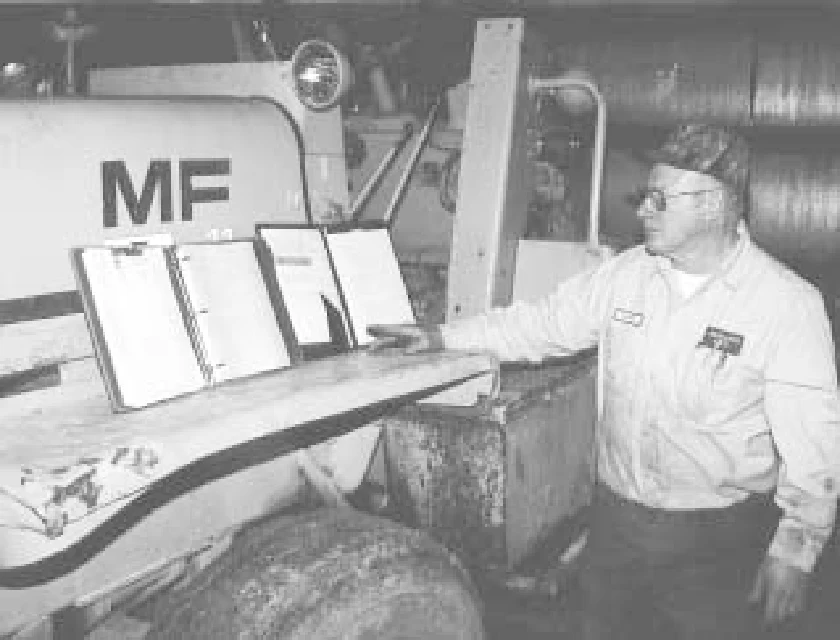
With implement dealers getting farther apart, and good farm mechanics becoming harder to find, the need for preventive maintenance has never been greater. It led mechanic Veryl Reiher, Gillespie, Ill., to set up a full-time business contracting with area farmers to maintain their equipment on a regular basis.
Reiher spent 30 years as a mechanic for local Massey and Deere implement dealers, “moonlighting” for 25 of those years. Now he works full time maintaining machinery for several nearby farmers.
He works on tractors, trucks, combines, and whatever else needs regular maintenance or repair. Farmers generally haul equipment to Reiher’s shop for repairs. However, he travels to farms for routine maintenance. Much of the equipment he maintains is owned by larger farmers and is of older vintage - 1980 or older. He keeps careful records of each machine.
“The number one reason farmers want my service is that they hate downtime. They know it’s less expensive to do regular maintenance than it is to fix it later,” says Reiher.
“I charge $40 per hour but may soon raise that to $50 per hour, which is what local implement dealers are charging.”
Reiher works on a lot of “orphaned” brands including Massey Ferguson, Minneapolis Moline, Allis-Chalmers, and even Volkswagen cars.
“In most cases the mechanics at implement dealers have have no idea how to work on this older equipment. That’s a real problem because it’s the old machinery that breaks down most often. One of my customers lives about 40 miles away and drives by two implement dealers just to get to my shop. He recently had the transmission go out on a big Massey Ferguson 4-WD tractor. He brought me the entire transmission assembly including the final drives, rear end, and hydraulic pump.”
Reiher says that by contracting with a limited number of people he can learn to read them and know what they want.
“I promise them I’ll look over their equipment periodically. For example, I might schedule to work on their equipment one day a month, or two half days a month, etc. The timing depends on the kind of equipment and how many hours it’s used each year. In some cases I keep the service schedule books, and in other cases the farmer does that. The only time I call them is when there’s a borderline case between repairing or buying new.
“I’ve built up an extensive supply of parts through local dealers which reduces the time I have to spend looking for parts. I have aftermarket parts contracts with companies such as TISCO, AMI, BMD, and Ag Parts. They order the parts I need and send them directly to me. I’m also a TISCO dealer. However, I’m not in the business of making money by selling parts, but by selling service. Therefore I’m not afraid to use rebuilt or used parts.”
Contact: FARM SHOW Followup, Veryl Reiher, 15253 Deerfield Dr., Carlinville, Ill. 62626 (ph 217 854-3360).
In the last issue of FARM SHOW we reported on a new “Power Box” that’s said to boost Deere engine horsepower. After the story ran we heard about a similar but less expensive power booster.
The Schlagel “Power Chip” works on Deere 7.6L and 8.1L electronically-controlled diesel enignes, which are found on 8100, 8200, 8300, 8400, and 9100 tractors and 10 series tractors and 9000 series combines with Bosch fuel injection systems. The engines are also found in cotton pickers and other self-propelled machinery.
The Power Chip plugs into the existing wiring harness at the fuel pump, electronically boosting output of the injector pump. It’s just like cranking up the fuel pump on an older, non-electronic engine, say farmers who’ve tried it.
Six models are available, says Dave Zimmerer, Schlagel Mfg.
“They’re designed to boost horsepower by 10, 20, or 30 percent on 8.1-liter and 7.6-liter engines. Power chips can be used for more than one engine as long as the engine size is the same. For example, a Deere 8300 and 8400 will take the same power chip if the engine size is the same. This is also true with the Deere 9000 series combines. The chips will not function when installed on the wrong size engine.”
The Power Chip installs quickly and eas-ily, says Zimmerer.
“All you do is plug it into the existing wiring coming from the injection pump and attach it to an existing fastener. As a result, you can boost the horsepower when you need it the most and simply remove it when the extra power is not needed. The chip does not show up on tractor diagnostics and will not bring up malfunction codes when the tractor is scanned.”
Sells for $400 plus $10 S&H. Comes with a 30-day limited warranty. The Power Chip is not endorsed by Deere & Co. and may void warranties.
Contact: FARM SHOW Followup, Schlagel Mfg., Rt. 1, Box 155C, Torrington, Wyo. 82240 (ph 888 889-1504 or 307 532-4451; fax 307 532-8994; E-mail: [email protected]; Website: www.schlagel.net).
After years of producing some of the best reproduction parts available for Ford cars, Dennis Carpenter, Concord, North Carolina, has added a line of “as original” N-Series Ford tractor reproduction parts.
The line includes tractor lights with the Ford script engraved into the lenses, and the very difficult-to-find complete grille assemblies with air foil-shaped cross section grille bars that exactly match the original air foil-shaped cross section grille bars.
“In some of the replacement grilles available, the cross section bars are made of round steel bar or tubing. Ours are made exactly like the originals,” says Terry Rodenhuis. Prices for grille assemblies range from $250 to $325, depending on the year.
Rodenhuis says the company also makes a number of other N series parts, including wiring harnesses and many molded rubber parts, such as gear shift boots and steering column dash grommets.
“Many of our Dennis Carpenter parts are made on-site to insure quality and attention to detail, so the buyer gets a replica part that is 100 percent accurate in every aspect, from appearance to fit,” he says.
A catalog of tractor parts can be ordered for $3, or downloaded free from the company’s Website. In addition to parts for collectible Ford cars, pickups and tractors, Dennis Carpenter also makes authentic replacement parts for Cushman motor scooters.
Contact: FARM SHOW Followup, Terry Rodenhuis, Dennis Carpenter Ford Products, Box 26398, Charlotte, N. Carolina 28221 (ph 704 786-8139 or 800 476-9653; fax 704 786-8180; E-mail: [email protected]; Website: www.dennis-carpenter.com).