Practical ideas from FARM SHOW MagazineSubscribe · Free issue · Send us your shop tip
Subscribe to FARM SHOW
Issues / Vol. 22, No. 6 (1998)

Vol. 22, No. 6 (1998)

Money-Saving Repairs & Maintenance Shortcuts · Printed section pp. 38–39

17 selected entries · Complete text of selected entries

This issue’s section includes reader tips and feature-length shop stories. Held items and editorial notices are not reproduced.

Archive text: prices, coupons, availability and contact details reflect the original publication, not current offers. Reader methods are not universal instructions; follow manufacturer guidance and proper safety practices.

Reader shop tips

From the archive · Full text
Reader shop tip 1 of 2

Eddie Kohler

Individual tip 1 of 2 from this reader’s published contribution.
Eddie Kohler, Walbeck, Neb.

“Plastic 1-gal. bottles of Tide liquid detergent work great for pouring gas into small engines without spilling. The bottles have a big cap with a built-in funnel. The gas comes out in a narrow stream that’s easy to control. Just be sure to thoroughly rinse out the bottles before using them.

From the archive · Full text
Reader shop tip 2 of 2

Eddie Kohler

Individual tip 2 of 2 from this reader’s published contribution.
Eddie Kohler, Walbeck, Neb.

“Another idea is to screw a push-pull cap from a plastic bottle of liquid dish washing soap onto a 1-qt. oil bottle. Lets you squeeze oil out in a thin stream that’s easy to control. When you’re done just push the button back down. There’s no spilling and the bottle always stays clean. Works great for lubricating chains on machinery. I’ve found that Dawn soap bottle caps work the best.”

From the archive · Full text
Reader shop tip

Danny Shaffer

Danny Shaffer, Rt. 2, Box 455, Perkins, Okla. 74059 ph 405 372-7351

“My Clip Key makes it easy to attach or remove T-post clips. It’s used to bend either side of the clip under to attach or unbend them for removal. I came up with the idea because using a screwdriver, pliers, or other tool made my wrist bend an awful lot and caused a dull ache to set in. I thought there had to be a better way. Using the Clip Key I don’t have to bend my wrist at all. A single clip key sells for $7.50; two for $14.50; three for $21; four for $27, and five for $32.50. All prices include S&H.”

From the archive · Full text
Reader shop tip

Don McColl

Don McColl, Neidpath, Sask.

“I use my shop-built boring bar to re-cut worn hitch pin holes and make them round again. For example, I’ve used it to bore out a V-ripper hitch that hooks up to my Caterpillar tractor. The 2-in. dia. holes were worn out oblong to almost 2 7/16 in. diameter so I cut them perfectly round to a 2 1/2 in. diameter. The system uses an old blacksmith shop drill, electric motor, and lathe cutting tool. The bar is a 1 1/2-in. dia. steel shaft with a regular carbide lathe tool (5/16 in. sq., about 1 1/4 in. long) driven by the drill. The drill is belted down to run at 30 revolutions per minute. In one photo you can see my left hand feeding the cutting tool into the bore. The other photo shows the hinge ripper with the two 3-in. wide pin bosses. You can see the two self-aligning bearings and 3-hole pillow blocks. They have a slip fit over the bar allowing it to move freely. The two bottom pillow block holes are bolted to an angle iron which is welded to the ripper hitch. The top hole takes a bolt with head welded to the hitch. The bolt allows for some adjustment for the bearing.

“The drill is bolted to two angle irons which in turn are bolted to the ripper hitch. Everything is bolted to my homemade engine stand.

“Machine shops wanted $600 to do this job but I thought if I could find a way to hold and adjust the cutting tool in the bar the rest would be easy.”

From the archive · Full text
Reader shop tip

Larry Wiebe

Larry Wiebe, Whitewater, Kan.

“I had problems with the radiator overheating in my 1977 Chevrolet pickup equipped with a 454 cu. in. gas engine. The problem was that hot water from the heater core was being returned through the heater hose to the cool water side of the radiator tank. I solved the problem by cutting the hose and installing a shut-off valve on the hose.”

From the archive · Full text
Reader shop tip

Wilbur Tiahrt

Wilbur Tiahrt, 45808 313th St., Meckling, S. Dak. 57044 ph 605 624-2458

“I made an adjustable welding clamp that works to hold a variety of objects together. A vice grip pliers holds one object in place like a third hand. It consists of a heavy duty 3 or 4-in. C clamp; two 3/8-in. dia., 18-in. long steel rods; eight 3/8 by 1-in. machine bolts with self-locking burrs; and eight pieces of 1-in. sq., 1/4-in. thick metal. The C clamp attaches to the welding table and is used to support the rods, which rotate around the bolts and can be adjusted at any angle - up, down, sideways, or backward. To move the object you simply grab the vice-grip.

I’m willing to build the welding clamp for $35 plus the price of a pair of vice grip pliers (postpaid). You can choose whatever size vice-grips you prefer.”

From the archive · Full text
Reader shop tip

Robert Walton

Robert Walton, Rosebush, Mich.

“I mount a 55-gal. rinse tank (an old horse feeder) on front of my tractor when planting. It allows me to rinse out the sprayer pump and nozzles when banding herbicides. A clear plastic line runs from the tank back to the sprayer pump. In the past I’ve found that if my planter breaks down and I have to shut off the saddle tanks, the pump and nozzles often plug up. By opening a valve on the rinse tank I can flush everything out. The same tank can be used for emergency rinsing in the field in case of a spill. It also makes it easier to pre-rinse the saddle tanks right in the field.”

From the archive · Full text
Reader shop tip

John Gipson

John Gipson, Gilmer, Texas

“I turned an old 5-ft. long casket stand, which I got free from a local funeral home, into a nifty shop work bench. The funeral home had used the casket stand for chapel funerals. The stand was about 40 to 45 years old and was coming apart. I took it to my shop and repaired it. I wrapped 1-in. angle iron around the sides and welded a piece of 3/16-in. thick sheet metal to the angle iron in order to reinforce the top of the stand. I also painted the stand red.

“The stand mounts on wheels so it can be easily rolled around and is just the right height for working on repair projects. It also comes in handy when I have to unload something heavy out of my pickup. I just roll the stand up to the back of the pickup and let the tailgate down, then slide the object out onto the stand and roll it into my shop.”

From the archive · Full text
Reader shop tip 1 of 2

Roger and Bruce Elliott

Individual tip 1 of 2 from this reader’s published contribution.
Roger and Bruce Elliott, Montrose, Ill.

“To get more light in our shop exactly where we want it, we hung garage door tracks above our lathe and milling machines. We welded two pieces of track together end to end to make a 16-ft. long track. Then we attached 6-in. rods - bent at a 90 degree angle - to the door rollers. Then we mounted hooks on the rods and attached a 4-ft. long shop light. We also welded a piece of strap iron between the rollers to keep them in line. The light simply rolls back and forth on the track.

From the archive · Full text
Reader shop tip 2 of 2

Roger and Bruce Elliott

Individual tip 2 of 2 from this reader’s published contribution.
Roger and Bruce Elliott, Montrose, Ill.

“We also made a 54-compartment, 6 1/2-ft. high Lazy Susan for storing bolts and screws. It mounts on caster wheels, allowing us to roll it anywhere in our shop. It mounts on a 20-in. implement wheel, hub and axle, which allows the unit to rotate. We made the bins by cutting the center out of fan shrouds. There are six bins around the unit. A series of 27-in. wide, 16-gauge steel plates provide vertical dividers between the bins.

“We unbolted the hub from the rim of the tire, then cut one of the beads off the rim and bolted the hub back onto the rim. Then we welded the spindle to a steel pipe that runs all the way to the top of the bins. Then we mounted heavy duty caster wheels onto strap iron braces under the wheel.”

From the archive · Full text
Reader shop tip

Ray V. McDeid

Ray V. McDeid, Mead, Wash.

“I use a little dab of silicone sealer between the throttle shaft and carburetor body on old Wisconsin engines to avoid having to replace the carburetor. It’s a much faster, cheaper alternative than having to re-sleeve the shaft, and it works just as well.

“I use black rubber plastic silicone, the kind you buy at any auto parts store for $3 or $4 per tube. I put a little on the end of my finger and simply wipe it around both ends of the shaft. This stops vibrations and, thus, prevents air leaks from developing to make carburetors last longer.

“I first tried it on the 2-cyl. Wisconsin engine in my 30-year-old Deere 24T baler and the 4-cyl. Wisconsin engine in my 30-year-old Case 950 swather five years ago. Haven’t had any problems with either one yet.”

From the archive · Full text
Reader shop tip

Rita Adcock

Rita Adcock, Pilot Butte, Sask.

Rita’s company, Dutch Industries, sells a new carbon and micron air filter for implement cabs that is said to last four times longer than con-ventional paper filters. It controls up to 99.9 percent of dust, pollen and odors and fits any tractor or sprayer cab and most combine cabs on the market. It installs in just five minutes and once installed, you replace only the medium, not the entire filter, when it’s time to change filters.

One filter and medium, Carbo-Gran, is used for most applications, while Ammo-gran is used for ammonia drift.

Available in roughly 150 styles and sizes (custom-made also available). Prices range from $96 up to $210 (Canadian).

Contact: FARM SHOW Followup, Dutch Industries Ltd., P.O. Box 568, Pilot Butte, Sask., Canada S0G 3Z0 (ph 800 663-8824 or 306 781-4820).

From the archive · Full text
Reader shop tip

Keith Berglind

Keith Berglind, Sandy Hook, Manitoba

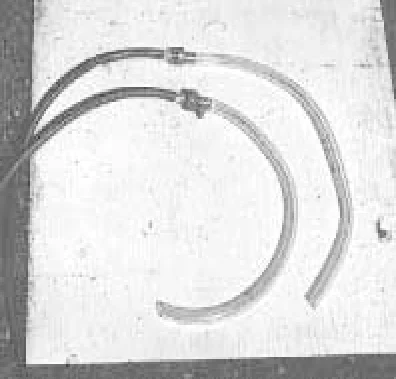
“I use an ordinary garden hose full of water as a long level for leveling buildings and doing landscaping.

“The problem is that it is often hard to see the water level through a dark green hose, no matter how transparent it is.

“To avoid this, I made these 2-ft. clear plastic extensions for my garden hose. I salvaged the male and female ends from an old garden hose, then clamped the clear plastic hose, the kind you can buy at a hardware store for about 10 cents per foot, to the ends. A nail at the end of the hose makes it easy to attach to a building or ground stake.

“You can add a few drops of very light oil to the water levels to make the water lay perfectly flat, instead of curving up the wall of the hose.”

From the archive · Full text
Reader shop tip

Fred Mueller

Fred Mueller, Sheridan, Wyo.

You can make your own tow ropes, lead ropes, catch or show ropes, piggin’ strings and lariats with this old-style rope-maker that Fred re-cently brought back into production.

Measuring 20 in. high and weighing 30 lbs., the “Rope Master” is made of cast iron and steel with a wooden hand crank. It takes three people to operate it - one to operate the crank, one to hold the swivel, and one to run the guide.

“It makes ropes in up to five different diameters,” says Fred.

“We recommend that the length not exceed 100 ft., although one of our customers reported making a rope 300 ft. long. You can use many different materials, such as baler twine, cotton, wool, rawhide and even parachute cord, to make ropes.”

Sells for $175 plus S&H. Contact: FARM SHOW Followup, Fred Mueller, 5947 Coffeen Ave., Sheridan, Wyo. 82801 (ph 307 672-2513).

Shop feature stories

From the archive · Full text
Feature story

“Spring Cushion” Seats For Older Deere Tractors

Featured source:

If you’ve got an older model Deere tractor with a “hard as a rock” seat, you’ll be interested in the spring cushion seats sold by Leland Schwandt of Wilmot, S. Dak.

Schwandt makes spring cushion seats for all Deere tractor models made from 1947 to 1960. The seats have six rows of zig zag springs inside a steel frame equipped with heavy duty metal corners.

“In 1947 Deere started making its tractors with spring cushion seats, with the battery located under the seat,” says Schwandt.

“However, the spring cushion seats were expensive so they switched to the foam cushion seats which weren’t very comfortable. When the driver went over a bump and hit the bottom of the seat, it was like hitting a board.

“My spring cushion seats are hand made just like the originals, right down to the shiny rivets on the backrest,” says Schwandt.

“I sell the entire seat or I can recover the backrests and spring cushion seats. But usually the springs are broke or rusty and pitted and could break later so you’d be wasting your money. I also make 3-in. thick foam cushion seats for newer Deere tractor models.”

The spring cushion seats sell for $84; the foam cushion seats for $32. Back rests equipped with shiny rivets sell for $44.

Contact: FARM SHOW Followup, Leland Schwandt, 14215 468th Ave., Wilmot, S. Dak. 57279 (ph 605 432-6192).

From the archive · Full text
Feature story

Alternator Conversion Kit For Older Cat Crawlers

Featured source:

Anyone with an older Cat crawler will want to take a look at this new converter that lets you mount an alternator in place of the gear-driven generator.

“Most generators on older Cats are 6 or 12-volt,” says Jim Zimmerman of Machine Shop Services, manufacturer.

“If you want to install a 24-volt direct electrical starter, there is really no place on the Cat to mount a 24-volt charging system.”

The solution is Zimmerman’s conversion kit. He says an alternator will last longer and require much less maintenance than the original generator.

To install, you pull the generator off the Cat and place the gear off the generator on the alternator bracket. You then bolt the unit in place where the generator was and wire it to the starter solenoid.

Installation takes an hour to an hour and a half, Zimmerman says.

Available for Cat D2, D4, D6, D7, and D8 crawlers (1940’s through the 1960’s).

Sells for $385 plus S&H with alternator; $310 without alternator.

Contact: FARM SHOW Followup, James N. Zimmerman, Machine Shop Services, 3128 Mitchell Line St., Orchard, Iowa 50460-8003 (ph 515 982-4207).

From the archive · Full text
Feature story

Shop Curtains Raise, Lower Automatically

Featured source:

“We wanted an easy way to partition off part of our 50 by 50-ft. shop so we could wash or paint equipment without getting water or paint all over everything,” says John Imhoff, who, along with Dave and Ivan Kindig, set up four automatic curtains in his farm shop.

Each curtain is simply a 20 by 50-ft. con-ventional plastic tarp hung from the rafters. An electric gear motor attaches to one end of a 2 in. dia. steel pipe sewn into the bottom of the curtain. The motor “walks” up and down on a piece of sq. tubing that runs from floor to ceiling, rolling - or unrolling - the curtain as it goes.

A cable runs from the motor up over a pulley and down to a counterweight on back of the curtain so it raises evenly without binding.

To raise and lower the curtains, Imhoff simply throws an electric switch.

“It could be adapted to work on any size curtains,” he says.

“It works so well, we’re in the process of patenting it.”

Contact: FARM SHOW Followup, John Imhoff, R.R. 2, Box 52, Roanoke, Ill. 61561 (ph toll-free 888 817-5646 or 309 923-7345; fax 7845; E-mail [email protected]).