From the archive · Full text
Reader shop tip
Gary Sampson
“Need a custom brush? Use a heat gun to carefully heat the handle of a plastic-handled brush, then bend it as desired.”
Money-Saving Repairs & Maintenance Shortcuts · Printed section pp. 32–35
33 selected entries · Complete text of selected entries
This issue’s section includes reader tips and feature-length shop stories. Held items and editorial notices are not reproduced.
“Need a custom brush? Use a heat gun to carefully heat the handle of a plastic-handled brush, then bend it as desired.”
“I took a truck axle and cut it to length for a hitch pin. I welded a loop on top and drilled a hole for a latch pin. I was able to make it longer so I could hook a clevis to a clevis. It works well.”
“It can be impossible to get WD-40 and other spray cans into tight spots. A piece of hospital nasal tubing fits tightly on spray cans. Lead the end to the place you need to lube and spray. Nasal tubing is thrown away by hospitals daily. You might be able to get it from someone who needs home oxygen.
“A twin halogen light is really good for engine work. It can also be used to light up a whole room or the garage by placing it in a corner.
“Before putting away any tape, fold over the end. This saves digging for the glued-down end with a razor blade, which is very dangerous.”
“I paint the tire pressure specs close to the tires on the frame or body of all my lawn equipment with a paint stick. I also write the oil changes and service times on someplace hidden.”
“I use a plastic syringe to apply gasket adhesive in tight places. This allows better control over the tube it comes in, and you have the syringe tip to reach into tight places. It’s also easier to apply even pressure with the syringe.”
“When you have a rusted flat-head bolt, weld a hex nut to the top of it.
“If you have a bent and twisted piece of sheet metal, the fastest way to straighten it is to use two bars of metal in the press brake or shop press and use those to straighten it.
“We recently put up a 1-ton bridge crane in our shop, and it makes handling parts so much better.”
“I installed a 3/8-in. angle valve at the end of my pressure washer hose, right before the wand. I open it to allow free flow, then start the engine. The pump never loads up.”
“I built roll-around frames for all my woodworking equipment with screw-down locks to secure them in place, but I can move them when needed.”
“I get frustrated with equipment that has a grease zerk you can’t reach, so I modify it with an elbow from a parts store.
“It only takes a few minutes to remove the zerk and add the elbow, but it can save a lot of time down the road. I’ve found that if a zerk isn’t easy to reach, the bearing doesn’t get greased and eventually goes out. Fixing it takes a lot more time and costs a lot more money.”
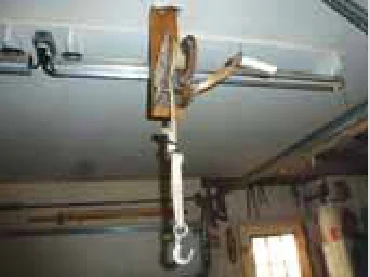
“Lifting heavy equipment (generators, pumps, mowers, etc.) is always difficult or impossible. I mounted a 2 by 4 to a heavy crossbeam in the structure of the attic and extended it through the ceiling into the workshop. I mounted an unused boat trailer winch to it. Now, I lift heavy items onto a small rolling table and move it to the main workbench. Works very well.
“My 4-car attached garage has never seen a car as it’s my workshop. I installed my tall 60-gal. air compressor in the attic above. I dropped the drain through the ceiling into a reservoir with the drain at the bottom. This way, it doesn’t get ignored as most drains do, allowing the compressor tank to rust out. I can get to the drain easily, and I’m reminded of it every time I see it. I also brought the air feed through the ceiling with an iron pipe and a valve before it continues to the outlets around the shop. That way, I won’t blow a hose when I’m gone and burn out the compressor motor. I shut it off every time I end work. This system is easy and works great.”
“The newer Honda self-propelled small engines don’t have oil drain plugs for changing the oil. You need to lay the mower on its side to drain the oil through the dipstick tube. However, I made a suction device to remove the used oil. It’s a 5-gal. bucket with a sealed lid. I cut a hole large enough to fit a 3-in. vacuum hose and another hole just big enough for a flexible, clear hose. The larger hose is attached to my shop vac. The smaller hose, with a piece of brake line, goes into the filler neck.”
“Ever try to keep a belt on but have it fall off before you can tighten it? I used a magnet tray on the pulley to hold it in place while I tightened it. Any magnet would work.”
“I had a 3-pt. on a Case tractor not working because it was stuck. I put a 20K load on the hitch, and it dropped.
“If an oil filter is stuck, use a #3 screwdriver to help remove the filter.”
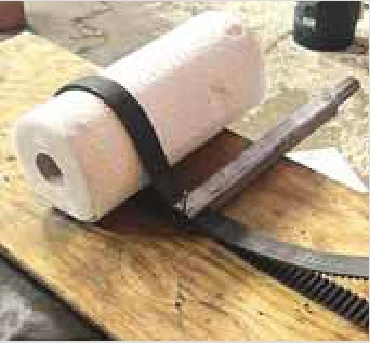
“I made a rugged, simple HD oil filter wrench. It’s made from an old cogged timing belt, 1-in. slotted square steel tubing, a 13/16-in. connector nut, and a locking cotter pin. The slotted tubing is only wide enough to allow the folded belt to slide in when the cogs are engaged. The wrench is adjustable, locks at several diameters, and is very inexpensive to build.”
Retired farmer Brian Haubrich enjoyed planning and developing new ideas while he was still actively farming. His ideas have been featured in FARM SHOW several times over the years, and his shop tool tree was featured in Vol. 49, No. 5.
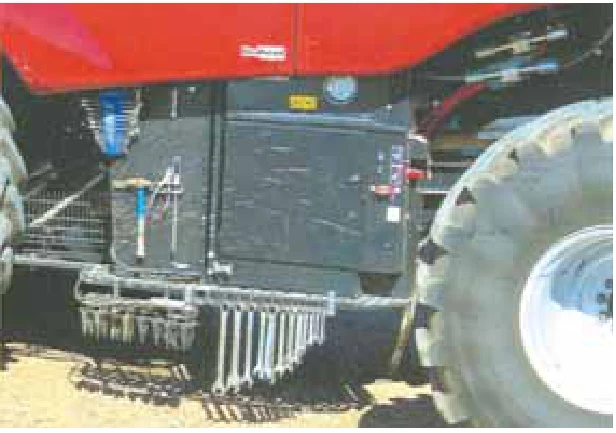
“I hate toolboxes. When you want a small tool, you have to dig through the chaff to find it. I created tool storage on the outside of the combine so you can see and find the tool when you need it,” says Haubrich.
“There’s also a guard rack for the header knife guards. I’ve given some of these racks to others, and everyone really likes them,” says Haubrich.
Contact: FARM SHOW Followup, Brian Haubrich, Glenbain, Sask., Canada S0N 0X0 (ph 306-264-3809).
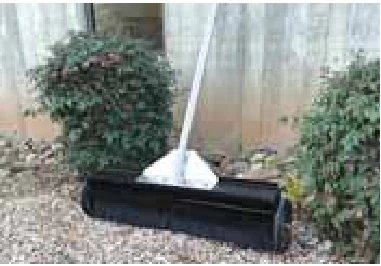
The Pivot-All Mechanical Push Broom makes cleaning floors faster and more efficient.
“It’s built with a patent-pending 24-in. wide drum design and has a fully mechanical, dual-rotating drum, eliminating the repetitive motion of a standard push broom,” says company owner Emmanuel Carlos.
“A single pass leaves a cleaner floor.”
Carlos initially created the broom for use in his fabrication shop.
“We clean our shop daily and found that we spend way too much time and energy on the shop floor. I made a crude prototype to try to speed up the sweeping, and it worked.”
The resulting broom covers more surface area in less time and with less effort, making it ideal for heavy-duty use in garages, job sites and workshops.
“Our design has six rotating bristles that spin in reverse to propel the trash, dirt and dust forward in the same way a standard push broom does,” Carlos says.
“We eliminate the repetitive back-and-forth jerking motion that’s needed with a standard push broom. You just steadily walk behind the broom, finishing the job in about half the time.”
The Pivot-All Mechanical Push Broom is designed for contractors and industrial use, but it’s also ideal for anyone needing a dependable, high-performance cleaning tool. Despite its rugged build, the broom weighs only 15 lbs.
Pivot-All Brooms are manufactured in the U.S. and cost $160 plus S&H, with a current lead time of three to four weeks. The company recommends spraying the wheels with WD-40 before first use and then as needed.
Contact: FARM SHOW Followup, Pivot-All Motion Tools, 1444 Pioneer Way, Suite 17, El Cajon, Calif. 92020 (ph 619-631-6644; [email protected]; www.pivot-allmotiontools.com).
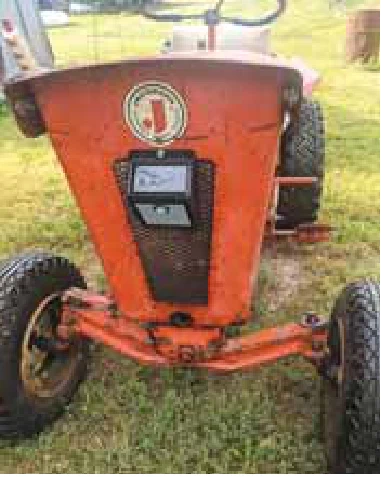
Steve Dietrich of Morton, Ill., upgraded his 1961 Jacobsen lawn tractor by repowering it with a 6.5-hp Predator engine.
“I use it mostly as a powered wheelchair around the farm. Sometimes I need it after dark and wanted to find lights that would work well and fit,” says Dietrich.
He used solar porch lights from Harbor Freight and mounted them on the front and rear of the tractor.
“They work great, with no wires and free power. The lights are motion-activated and dim to half power when no motion is detected. It’s still easy to see around the tractor. They make a nice 50 ft. half-circle of light that’s easy to see.”
Dietrich bought the lights for $13 each and added the 2-year warranty for an additional $3 per light.
Contact: FARM SHOW Followup, Steve Dietrich, Morton, Ill.
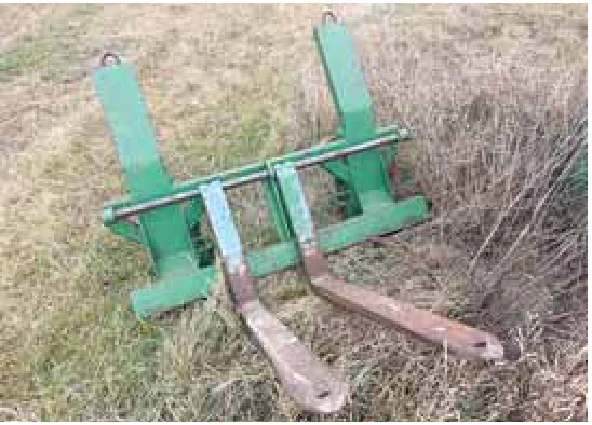
Roger Gutschmidt built his first set of tractor loader pallet forks more than 30 years ago. Soon after, he crafted similar sets for his brother and several customers. The frames were fitted with 4-in. by 1 1/2-in. forks. They were tough, but not tough enough for Gutschmidt. A decade later, he made a replacement for himself.
“I found tougher forks that were 4 in. wide by 2 in. thick,” says Gutschmidt.
“My brother and the others never replaced theirs. Every once in a while, they bend a fork tine and bring it back to be straightened. If you get pallet forks, they have to be strong. You never know what you’ll try to lift.”
The forks themselves weren’t the only strong component. The mast posts were made from 6 by 2-in., 3/8-in. channel iron. At the bottom of the posts, Gutschmidt used 4 by 6-in. angle iron for the kick plate that the forks rest against.
“That bottom plate has to be really strong as it takes the force of the forks and ties the mast together,” he says.
“The upper horizontal is also strong. It’s 2 by 4-in., 1/4-in. thick rectangular steel tubing. The pipe the forks pivot on is 3 1/2-in., 1/2-in. thick pipe.”
Gutschmidt notes that pipe is often superior to solid shaft because it’ll give a little under extreme pressure, whereas the shaft may snap.
The pipe rides in sockets at either end and in the center of the 2 by 4-in. tubing. He gusseted the horizontal to the verticals with angled pieces of the same rectangular tubing.
He further reinforced the mast by welding a 4-in. wide piece of 1-in. flat steel to the backs of both horizontals, centered on them. A 1-in. steel piece welded perpendicularly to the flat steel adds extra strength.
Gutschmidt notes that the mast uprights tilt slightly backward just above the upper horizontal, making them perpendicular to the angle of the objects being lifted. At the top of each upright is a horseshoe-shaped piece of steel rod.
“I heated them red-hot with a torch, welded one end, bent the other over, and welded it,” says Gutschmidt.
“It’s easy to do, and they’re handy for securing tarp straps and such.”
As a final touch, he painted the pipe with Slip Plate and attached short chains to the forks where they rest against the mast.
“Slip Plate lets the forks slide easily, and it doesn’t wear off,” says Gutschmidt.
“The chains prevent the forks from tipping too far forward, which can be a problem when trying to slip away from a pallet or odd-shaped loads.”
While Gutschmidt built the frames for the front-end loader pallet forks back then, he wouldn’t recommend others do the same today.
“It was complicated to weld all the tubing square and straight to match the loader,” recalls Gutschmidt.
“My brother is an engineer, and I don’t know if I’d have built them as well without his help. Today, there are lots of sources for pallet forks for tractor loaders and skid steers. Just make sure the one you buy is strong enough for what you expect to lift.”
Contact: FARM SHOW Followup, Roger Gutschmidt, Gutschmidt Manufacturing, 6651 Hwy. 56, Gackle, N.D. 58442 (ph 701-698-2310; [email protected]).
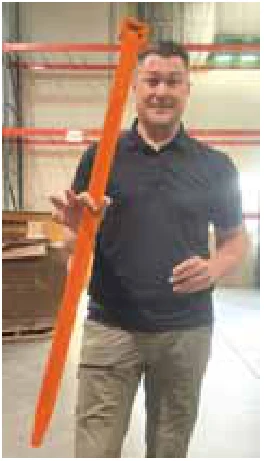
Caleb Perkins, president of U.S. operations for Cable Tie Link, was seeking new and innovative ways to improve cable tie installations when the folks at Cable Tie Link stumbled on an idea to make a giant zip tie as a show prop. One thing led to another, and people started finding uses for it.
“We found it held a lot of weight and was easy to use,” says Perkins.
“The world’s largest and strongest cable tie is now available and made in the USA.”
The 47-in. long by 2-in. wide reusable zip tie can replace rope or straps for tools and equipment. It features a release tab that allows it to be moved and reused. It’s been tested to hold over 1,300 lbs., or up to 2,000 lbs. with an optional pin.
Prices start at $75 plus S&H. Ties come in orange, black, military green and gray.
“You might think this is ridiculous at first, but we know you have a reason to use it,” says Perkins.
The company offers a hassle-free exchange policy. Purchase online at the company’s website.
Contact: FARM SHOW Followup, Cable Tie Link, Salt Lake City, Utah ([email protected]; www.cabletielink.com).
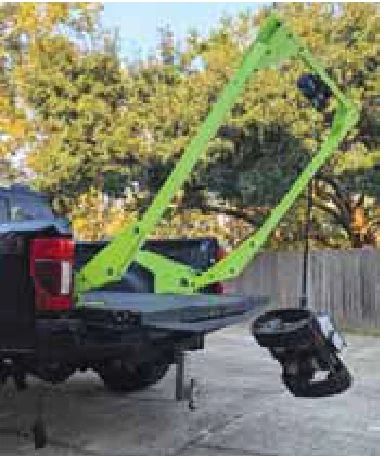
Craig Joseph Gaspard Jr. of Prairieville, La., has developed a prototype of the BedNinja, a compact hydraulic lift system that mounts directly inside a truck bed. It’s designed to lift and load up to 1,200 lbs., making it ideal for motorcycles, jet skis, generators, pallets of shingles, and nearly anything else too heavy to lift manually.
“The BedNinja gives truck owners true hydraulic power and added versatility— turning their vehicle into both a lift and a lighting solution,” Gaspard says.
“The system adjusts to fit any size truck bed using model-specific mounting brackets. It’s currently designed for the Ford F-250, with additional models in development.”
Gaspard became inspired after years of lifting heavy equipment.
“I realized how often people don’t have access to a forklift when moving large items,” he says.
“Whether it’s loading materials on a job site, moving a generator after a storm, or hauling recreational gear, I wanted a safe, self-contained lifting system that could go anywhere.”
He started with a simple proof of concept to test its practicality.
“It worked so well that I’ve been using that first version for over a year,” Gaspard says.
“From there, I developed full CAD models and rebuilt it using much heavier steel and refined hydraulics. The system is now extremely robust, and I continue to improve and fine-tune it daily to increase strength, stability, and ease of use.”
The resulting model is ideal for contractors, ranchers, first responders, and outdoor enthusiasts who often handle heavy or awkward loads.
“It’s also great for lifted-truck owners or anyone looking for a safer, more efficient way to lift and load equipment without additional help or risk of injury,” says Gaspard.
“When fully deployed in a vertical position, the BedNinja doubles as a portable light plant, providing 360 degrees of high-power illumination—perfect for job sites, roadside assistance or night operations. When not in use, it folds neatly out of sight, keeping the truck bed completely functional.”
Gaspard is finalizing his production-ready model and expanding the mounting bracket system to support additional truck makes and models.
“The next phase includes load certification, light integration testing, and partnerships with manufacturers and distributors to bring the BedNinja to market,” he says.
“Anyone interested can contact me directly through Instagram. I’m open to collaborations, pilot installations, and investment opportunities as we move toward production.”
Contact: FARM SHOW Followup, Craig Joseph Gaspard Jr. ([email protected]; Instagram: @CraigJosephGaspardJr).
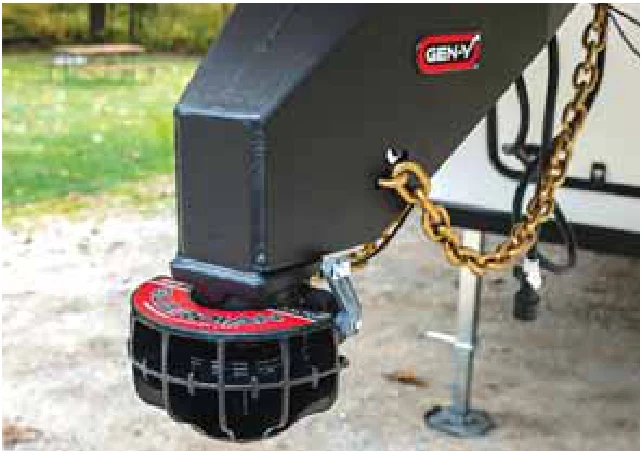
GEN-Y and Altor have partnered to develop the Guardian Lock, a device that secures Spartan, Viking and Executive GEN-Y gooseneck hitches.
“The GEN-Y Guardian by Altor™ advances The ICON™ Trailer Lock product line’s mission to redefine trailer security with true power-tool resistance,” says Nik Risser, Creative Manager at GEN-Y Hitch.
“It’s built on the same patented design technology that established The ICON as the benchmark for bumper-pull protection. The Guardian delivers uncompromising security for GEN-Y’s heavy-duty gooseneck couplers.”
The Guardian lock was developed through close collaboration with GEN-Y Hitch.
“It features the patented radial fin architecture engineered specifically to counter modern, power-tool-driven theft,” Risser says.
“It’s purpose-built for GEN-Y’s gooseneck systems, ensuring a secure, precision-fit installation.”
The lock is constructed from hardened steel and features a premium, high-security disc detainer core.
“It’s engineered to resist picking, cutting, grinding and brute-force attacks,” Risser says.
“This is protection you can see and feel, delivering next-level security for high-value trailers and RVs.”
Guardian Lock is expected to be released between late January and mid-February, with pricing details to follow.
Contact: FARM SHOW Followup, GEN-Y Hitch, 3400 W. Market St., Nappanee, Ind. 46550 (ph 574-218-6363; sales@genyhitch; www.genyhitch.com).
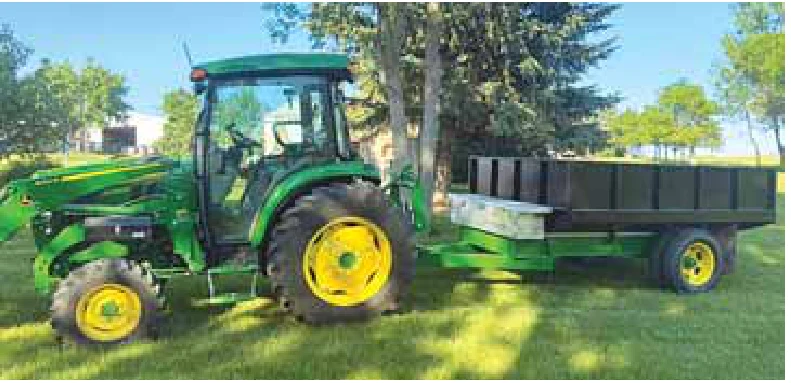
Retired farmer Rick Schlosser always wanted a small dump trailer, but the purchase price was too high for how much use it’d get.
One day, as he tinkered in his shop, an old John Deere axle from a 1950s equipment transport and unused rock picker’s 3 by 24-in. hydraulic cylinders sparked his imagination to build his own trailer.
“I’ve always had some projects in mind that I should deal with, like moving firewood, carrying rocks or completing landscape jobs, so I thought I could put something together to make those kinds of things work,” Schlosser says.
He had plenty of metal in storage, so he used it to build the box frame. For the walls, he adapted extensions from an old fertilizer applicator. The wheels and rims came from the old transport axle, and he ordered new 750 by 15-in. dual tires to replace the worn and damaged originals. To complete the floor and hoist, he purchased 2 by 8-in. planks and an electric-over-hydraulic pump to lift the box. A remote control lets him operate the unit from the cab.
Schlosser installed a truck or tractor-capable ball-hitch system to make it multi-purpose.
“I worried about the mounting points for the hoist to angle and dump properly, so I took some straight edges and chalk, laid everything out on the shop floor, measured it up, and put it together,” he says.
“When I tried it, I crossed my fingers that it would work. It operated perfectly.”
Schlosser estimates he put about $2,000 and 30 hrs. of work into the finished 7 by 9-ft. dump-trailer box project. Contact: FARM SHOW Followup, Rick Schlosser, Mandan, N.D. 58554 ([email protected]).
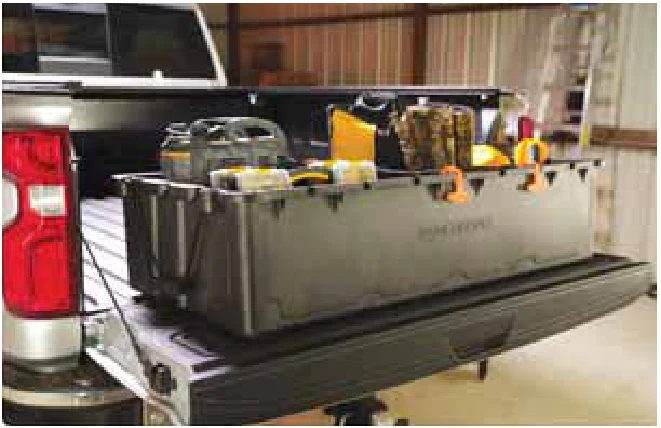
“We began to notice after every drive to work or every adventure, whatever gear we carried in our truck beds was all over the place, tangled and sometimes even broken. We were tired of wasting time reorganizing or wasting money fixing broken or worn-down gear.
“Every truck bed solution we searched for was either too small, too permanent, too flimsy and low quality, or too expensive. From our frustration, combined with our plastics expertise, RANCH ROAD® Cargo Systems was born,” says founder Greg Brown.
Made in the U.S., it’s five times thicker than traditional plastic storage, fits between most wheel wells and under bed covers, has non-slip rubber feet, and is modular for complete customization to fit your gear.
It features six latches, four dividers, and two tie-downs to customize the system for your vehicle. There are slots for subdividers every 6 in., multiple anchor points for tie-downs, and 12 drain holes to prevent water from pooling.
“Well built and made in the USA. I’ve had four different systems in my truck, and this is by far the best. It fits awesome in my truck,” Bill S., from online reviews.
Prices start at $299, with color options for the base and latches that can be specified when ordering. Bundles are available, along with accessories such as a cargo net, dividers and a 5-gal. utility jug. Shipping costs are extra and vary by location. The Cargo System comes with a 5-year limited warranty.
They also sell G2 work gloves made from top-grain goat-skin leather with keystone thumb construction. They’re available in sizes 7 through 11 to ensure the right fit.
Products can be purchased on the company’s website and through other online retailers, including Amazon.
Contact: FARM SHOW Followup, Ranch Road Cargo, Leander, Texas 78641 ([email protected]; https://ranchroadcargo.com).
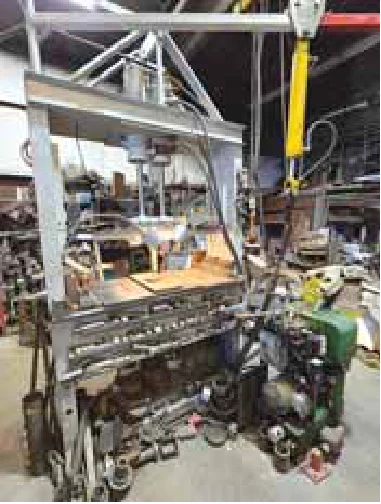
Albert Stier’s 50-ton press can handle any job, from a few inches high to too large to handle by hand. If the 22-in. reach of the paired 5 1/2-in. cylinders doesn’t provide enough flexibility, he can raise or lower the massive steel tabletop. If the workpiece is extra-large, he uses the lift cylinder suspended from a carriage that travels along a 7-ft. long, 2 by 2-in. sq. steel tube that pivots off one end of the press.
“I can set an 8-ft. long beam on the press and work on one end while the rest sticks out about waist high, supported by the lift cylinder,” says Stier.
“The other day, a fellow brought in a forklift from a pallet mover. It had a bend in a 2 1/2 by 4-in. beam. I used the lift cylinder to set it on the table, pressed it straight, and sent him on his way.”
Stier is rightly proud that the press was fabricated from virtually all salvaged parts. The vertical posts and the 4-ft. wide, 17-in. deep steel tabletop are channel iron from old bridge beams. The cylinders push against a V-framework welded to the tops of the vertical posts. They pass through and are retained by 8-in. channel iron, which is reinforced with a 3/4-in. thick steel plate to house the cylinders.
“I bought the framework with the tabletop from another welder in the area,” says Stier.
“I added the cylinders for the press, the hydraulic pump, and the lift mechanism.”
The cylinders had never been used when Stier got them, but he paid less than salvage.
“We had a John Deere dealer who sold out and was cleaning out the shop before the change in ownership,” recalls Stier.
“He found the cylinders under a workbench and offered them to me for $5. I jumped at the deal.”
Other components were mostly scrap leftover from other projects.
“If I see some good potential in something, I don’t throw it away,” says Stier.
“I’m 85 years old and have lived here for 60 years. I’ve accumulated a lot of stuff over the years.”
To the right of the press is a 2-hp, 3-phase electric motor that powers a hydraulic pump supplying all three cylinders. The pump and its tank came from an old combine. A two-spool directional control valve from an old loader allows him to engage either the press cylinders or the lift cylinder.
An angle-iron stabilizing bar is suspended from the press rams. It rides between pairs of angle iron welded to the vertical channel iron at either end of the press. Stier attached flex-neck lights to the stabilizing bar.
“The lights ride up and down with the press, so I always have good light on the workpiece,” says Stier.
“On one side of the press, I mounted a piece of ruler to indicate if the rams are maxed out. If 9 1/2 in. isn’t enough, I can bring it down to 9 3/4.”
True to his philosophy of using leftovers whenever possible, the lights are encased in cut-off soup cans, which further reflect the light where he wants it.
Stier mounted scrap angle iron to the front face of the press table. The angle iron holds parts and miscellaneous pieces. He keeps sections of steel from an old plow beam on the press table.
“I can stack them or lay them down flat as needed to hold workpieces,” says Stier.
Stier uses the sides of the vertical channel-iron frame facing away from the press, as well as the edges. He welds hooks onto them for hanging chains and adapters.
The chains come in handy if he needs to adjust the worktable. He simply wraps a chain around the table and hooks it to the press. The table is pinned to the verticals and can be lifted or lowered and then re-pinned.
“I don’t have to move the table very often, but it’s an option,” says Stier.
“When I built the press, I didn’t think I would use it much, but sometimes I use it twice a day and two or three times a week.”
Stier has contributed several articles to FARM SHOW over the years. At 85, he’s in great health and remains busy.
“If it’s broke, it can be fixed, and if someone made it, I can make it work again,” he says.
Contact: FARM SHOW Followup, Albert Stier, 16067 Newmansville Ave., Petersburg, Ill. 62675 (ph 217-632-2339; cell 217-652-2651).
Flatlander Offroad LLC of Kindred, N.D., manufactures and sells 4-door Strut Kits for 2019 to 2026 XP1000 Crew models and all 1000 Crew Polaris Rangers.
“Our family started off-roading in 2000 with our first Toyota Land Cruiser,” says Seth Sauvageau, owner of Flatlander Of-froad LLC.
“Over the years, we transitioned to side-by-sides like Polaris Rangers and RZRs.”
Sauvageau notes that Polaris Rangers and similar vehicles have doors that require extra caution on hills and in windy conditions.
“The doors are large and heavy, and either close on your legs as you are getting in or open too far so you can’t reach them from inside to close them. Worse, if the wind catches them and blows them open too far, the hinges get bent, and the door will be misaligned and not close right.”
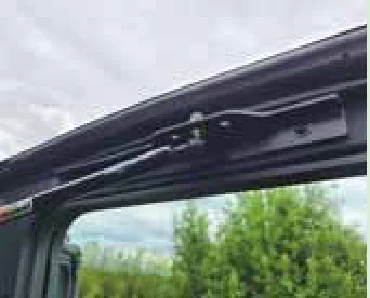
Sauvageau developed brackets to mount using the existing holes in the door and the seat belt mounting tab on the roll cage.
“I created a working prototype and used that to apply for a provisional patent in February 2023,” he says.
“That allowed me to market the design to see if it would be worth the effort and expense of applying for a full non-provisional patent.”
The Flatlander door strut kits prevent doors from closing on legs when entering a vehicle. They also protect hinges from damage caused by opening too far.
“It holds the door open to block the wind, so you can stand behind it or sit in the seat when ice fishing, for example,” Sauvageau says.
“That’s great for kids who may not be able to control the doors well. Many owners also like that it allows them to hold on to the open door for stability as they’re getting in and out.”
The brackets are powder-coated steel to match the Ranger frame. Each heavy-duty strut has steel coupler ends that connect to the ball stud. All door brackets attach using existing body clip holes in the upper door. The mounting bolts are black-coated stainless steel, ensuring they blend in like factory-installed parts.
“The response was clear. There’s a large demand for our door strut kits,” Sauvageau says.
“I received a patent in February 2024 and have adapted the design to work on the Can-Am Defender and earlier models of Polaris Ranger. I’ll be adding other models as time goes on.”
Sauvageau notes that he’s benefited from many local manufacturing resources.
“My nephew, Dave Sauvageau, uses CAD to create digital files of the brackets that I use to 3D print prototypes for testing. The steel brackets are laser-cut and CNC-bent at Metal Tech in Fargo, and then powder-coated at Weisgram Metal Fab (formerly Midwest Coating Inc.) in West Fargo. The struts are custom-made in the United States.”
The team sources additional hardware from multiple locations, including New York, Indiana and Utah.
“It’s important to me to use U.S. suppliers whenever possible.”
Flatlander door strut kits have sold in 49 states, nine countries across three continents, and all Canadian provinces. The kits are priced at $400 each or $430 with an included Rivet Nut Tool featuring an M6 mandrel. A 23/64-in. drill bit is needed to install the rivet nuts. Each kit offers door strut systems for either two or four doors. Most customers install the kits themselves; however, the company works with a growing network of dealers worldwide.
“We work hard and have been very intentional about developing our reputation for great quality, high functionality, and excellent customer service,” Sauvageau says.
“Search Facebook or any Ranger Forum, and you’ll quickly find genuine customer reviews. We’ve found social media to be very effective at reaching Ranger and Defender owners looking for solutions to this widespread problem.”
Contact: FARM SHOW Followup, Flatlander Offroad LLC, Seth Sauvageau ([email protected]; www.flatlanderoffroad.com).
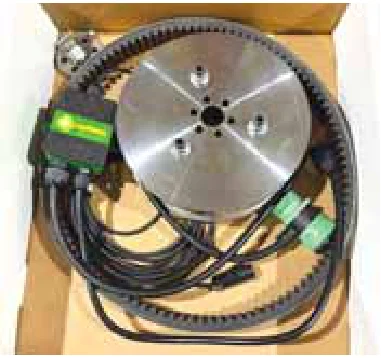
AgTronics offers its Dura-Cool Fan Drive at half the cost of the OEM option by replacing variable-drive units with direct-drive, constant-ratio mechanical drives.
“I’m a farmer and always looking for a better solution,” says Jon Pigg of AgTronics.
“I replaced multiple fan drives over the years. They’re a troublesome component, and I wanted something better.”
The Dura-Cool Fan Drive eliminates common failure points in the Deere Vari-Cool system used on 9-liter engines. Hydraulic pistons, electronic solenoids, and variable-speed components are removed.
“It delivers consistent cooling with no fan speed surging or sudden shutdowns, fault codes or downtime,” says Pigg.
“The Deere Vari-Cool was engineered for precision, not for long-term durability in harsh field conditions.”
He has operated his bolt-on mechanical drive system on his own equipment and on neighbors’ equipment for the past two years, and he started selling it this spring.
“It requires virtually no maintenance aside from a belt,” says Pigg.
“It’s easy to install for anyone with decent farm mechanic skills. There’s no need to change programming. Just plug in our controller, and it makes the ECM happy.”
AgTronics offers a 9 L drive for $2,100, compared with an OEM drive that costs over $4,000 plus the cost of a technician to install. Pigg plans to introduce a 13.5 L drive soon.
Contact: FARM SHOW Followup, AgTronics, P.O. Box 514, Quitaque, Texas 79255 (ph 806-759-0649; [email protected]; www.agtronics.net).