Practical ideas from FARM SHOW MagazineSubscribe · Free issue · Send us your shop tip
Subscribe to FARM SHOW
Issues / Vol. 49, No. 4 (2025)

Vol. 49, No. 4 (2025)

Money-Saving Repairs & Maintenance Shortcuts · Printed section pp. 32–35

40 selected entries · Complete text of selected entries

This issue’s section includes reader tips and feature-length shop stories. Held items and editorial notices are not reproduced.

Archive text: prices, coupons, availability and contact details reflect the original publication, not current offers. Reader methods are not universal instructions; follow manufacturer guidance and proper safety practices.

Reader shop tips

From the archive · Full text
Reader shop tip

Todd Boehm

Todd Boehm, Denmark, Wis.

“The gearbox mount bolts kept coming loose on my Deere 1209 haybine. Even double-nutted and torqued to 200 lb-ft, I’d lose bolts with less than 30 acres cut. I installed Nord-Lock cam-toothed washers and never lost another bolt. The bolts are 5/8 in. dia., so the washers were a decent amount of money, but now there’s no more replacing bolts and welding broken brackets due to lost bolts.”

From the archive · Full text
Reader shop tip

James Minix

James Minix, Morrison, Tenn.

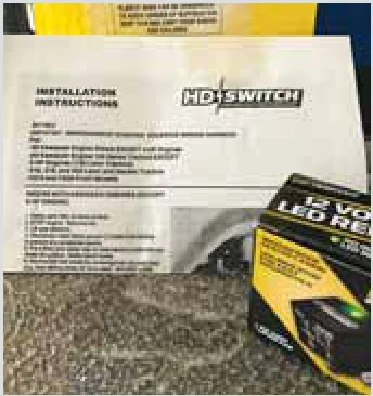
“I installed a starter improvement wiring harness for old Deere tractors with Kawasaki engines. It made an immediate improvement in my 1996 Deere 325 lawn tractor. I hadn’t even known they existed—well worth the $25 investment.”

From the archive · Full text
Reader shop tip

Richard Turner

Richard Turner, Belington, W.Va.

“When I’m working under a tractor with a wrench and it takes a long time, my neck hurts. I use a six-pack of paper towels under my neck, and it stops the hurt.”

From the archive · Full text
Reader shop tip

Bruce Porkka

Bruce Porkka, Atlantic Mine, Mich.

“I had a double-acting steering cylinder leaking on a Case 1390 tractor. I’d read about SealLube in the “Best, Worst Buys” section of FARM SHOW. I used the additive as directed, and it worked great. I appreciate it’s a Centerline, Mich., product.”

From the archive · Full text
Reader shop tip

Steve Crouse

Steve Crouse, Patten, Maine

“I welded a 3 by 3 piece of angle iron on the full width of the edge of my welding table with the V pointed down. It makes it easy to join round pipes, other angle irons and rectangular tubes. Just lay them in the V, line them up and tack them.”

From the archive · Full text
Reader shop tip

Mike Parenteau

Mike Parenteau, Pine Bush, N.Y.

“I use cotton swabs, old toothbrushes and t-shirt rags for cleanup after changing the oil in my lawn mower, tractor and snowblower. They get me into most nooks and crannies. I used old coffee cans to store the supplies, one for each. My father-in-law instructed me never to toss old toothbrushes—he was right.”

From the archive · Full text
Reader shop tip

Robert Mitchell

Robert Mitchell, Chrisman, Ill.

“One life annoyance is the straws on aerosol cans. Once you pull the straw out, it’s almost impossible to keep from losing it. Now, I carefully remove the straw, spray it with whatever is in the can, and slide it back into the tape. The straw lubricates the tape, and it will be held until the next time you need it.”

From the archive · Full text
Reader shop tip

Pete O’Brien

Pete O’Brien, Ballston Lake, N.Y.

“Putting tire chains on ag tractors can be challenging. Many a person has been injured or worse when jacking up a vehicle to put tire chains on and snug them up. A tip many in this area use is to cut off the first crosslink. This way, the chains may be installed easily inside a farm shop or outdoors, even when stuck. You’ll lose approximately 10% traction, but it’s safer than jacking up large vehicles. You’ll still gain 90% traction with tire chains over not installing them.”

From the archive · Full text
Reader shop tip

T.R.

T.R., W.Va.

“When putting tire chains on my tractor, I put the end of the chain on the tire over the slot in the rim. Next, I feed a heavy cord through the chain on the inside of the tire. Then, I feed the two ends through the slot in the rim and then through the chain on the outside of the tire and tie it tight. I do this at each slot in the rim. The chain won’t fall out of place when it rotates to the bottom, and it can be easily hooked.”

From the archive · Full text
Reader shop tip 1 of 3

Berg Farms

Individual tip 1 of 3 from this reader’s published contribution.
Berg Farms, Colfax, Wis.

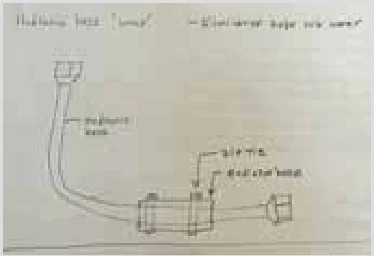
“There are times you can’t avoid hydraulic hoses rubbing each other. To reduce damage, I slit a piece of radiator hose lengthwise and put it over both hoses at the area of contact. A zip tie is used to secure the radiator hose.

From the archive · Full text
Reader shop tip 2 of 3

Berg Farms

Individual tip 2 of 3 from this reader’s published contribution.
Berg Farms, Colfax, Wis.

“A vice mounted to a pedestal, which is mounted or poured into a concrete floor, makes a sturdy vice.

From the archive · Full text
Reader shop tip 3 of 3

Berg Farms

Individual tip 3 of 3 from this reader’s published contribution.
Berg Farms, Colfax, Wis.

“Air-hose reels eliminate a lot of hose damage and are very handy.”

From the archive · Full text
Reader shop tip

Cal Miner

Cal Miner, Willmar, Minn.

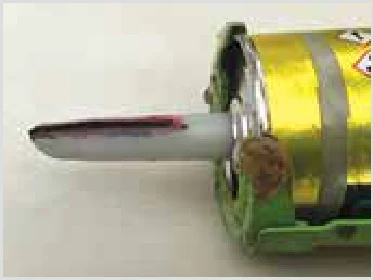
“When using a caulking gun, you can lose track of where the angle cut is on a caulking tube. I put a black line on it to the point so when the tip gets messy, I just have to look at the line and I know what angle it’s from.”

From the archive · Full text
Reader shop tip

Matthew Whyatt

Matthew Whyatt, Charlo, Mont.

“I had to remove the CV axles from an older side by side that were rusted and seized to the differential. I don’t have a slide hammer, so I looped a strap around the axle between the upper bearing cup and the differential and tied the other end to a sledgehammer. I swung the hammer against the strap to pull the axle free.”

From the archive · Full text
Reader shop tip

LeRoy Ellis

LeRoy Ellis, Reliance, S.D.

“I have an IH 560 gas tractor. It wouldn’t run except sometimes when the weather was warm. I overhauled the carburetor to no avail. I was advised to replace the condenser in the distributor, and it immediately started and ran.”

From the archive · Full text
Reader shop tip

Jeffrey D. Hootman

Jeffrey D. Hootman, Jeromesville, Ohio

“I was given an Ariens rototiller with a worn-out gas engine. After reading an article in FARM SHOW, I converted it to run on 110 AC. It does what I need it to do.”

From the archive · Full text
Reader shop tip 1 of 2

John Grawburg

Individual tip 1 of 2 from this reader’s published contribution.
John Grawburg, Lakeview, Mich.

“I have a Kubota ZG20 zero-turn mower that’s at least 15 years old. The PTO is really hard to reach and hook up. After many years and turning 80, I learned to lift the seat and connect from above.

From the archive · Full text
Reader shop tip 2 of 2

John Grawburg

Individual tip 2 of 2 from this reader’s published contribution.
John Grawburg, Lakeview, Mich.

“My 3-pt. York rake follows the front of the tractor up and down. I put the wheels a couple of feet behind it. I used a 3/8-in. chain for the upper link. Problem solved.”

From the archive · Full text
Reader shop tip 2 of 3

John Rochester

Individual tip 2 of 3 from this reader’s published contribution.
John Rochester, Charlotte, N.C.

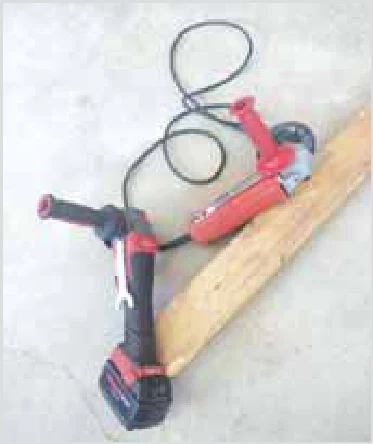
“I made myself a portable bolt-on workbench with a backstop to steady the work. The backstop needs to be shorter than the work to steady the square. I use a weight to hold the work because clamps get in the way of the saw.

From the archive · Full text
Reader shop tip 3 of 3

John Rochester

Individual tip 3 of 3 from this reader’s published contribution.
John Rochester, Charlotte, N.C.

“I capped live wires and wrapped both ends of the tape on the wire itself. Then, I put a cable tie over the ends. Hopefully, this will hold the tape after it ages and the glue goes bad.”

From the archive · Full text
Reader shop tip

Martin Sauer

Martin Sauer, Eagle River, Wis.

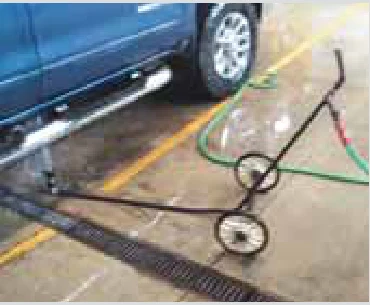
“I made a low-tech underbody wash for our fire department. With all the road treatments here in northern Wisconsin, we wash the underside after just about every call. Most of the components were acquired from dumpster diving. I prefer to use high-volume over high-pressure to remove the salt and sand.”

Shop feature stories

From the archive · Full text
Feature story

Rebuilt Welder Rides On Shop Built Trailer

Featured source: Frank Surber, Peacock, Texas

Frank Surber isn’t afraid to tackle any repair or building project.

Early in 2025, he says, “I decided to get my 1972 Miller Big 40 welding machine running that I hadn’t used for 12 years. After cleaning the points, changing the oil and filter, draining the coolant and refilling it, putting in a battery and clean gas, it started right up,” Surber says.

“The big problem was that gas was pouring out of the carb, so I put in a new one, also an ignition switch, a choke cable and wiring from the alternator to the switch. The gas tank leaked from a hole rusted in it; some of the wiring was rat or mouse-eaten, and only two of the range selections still worked due to broken connectors.

“I removed the top cowling, pulled the gas tank, repaired the broken range selections and dropped on a temporary gas tank. It ran like a charm, so I used it for a week to power my carbon arc gouge while working on a dozer.”

Surber says he needed a way to move the welder around without always having to use his backhoe, which led to another project.

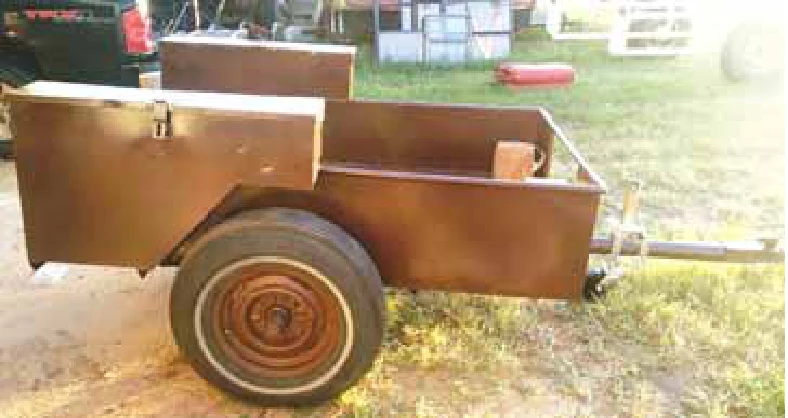
“I’ve got a large amount of scrap and other miscellaneous junk that I use for different projects, so I decided to build a little trailer to haul the welder,” he says.

Not one to draw up plans, Surber first visualizes a completed project, then gathers pieces and starts measuring and cutting. His trailer build grew from an old metal frame that used to hold sheet steel. It rides on an old steering axle and wheels from a ‘48 Chevy truck. For tires, he put new inner tubes in a pair of 40-year-old white walls from a camper trailer.

The welder slides onto the trailer floor guided by two pieces of angle iron. Supplies are carried in two bedside toolboxes from an old pickup. With the frame, floor and side complete, Surber primed and painted it, then added a new hitch coupler and a tongue jack.

“Now I’ve got a heavy-duty trailer that will take my refurbished heavy-duty welder anywhere I need it,” he says.

Contact: FARM SHOW Followup, Frank Surber, Peacock, Texas.

From the archive · Full text
Feature story

Quick Way To Check If Hitch Is Loose

Featured source: Dale McLaen, Rutland, N.D.

Dale McLaen, Rutland, N.D.: “Here’s a quick visual check to see if the ball on your hitch or any other critical fastener has started to come loose. Take paint and make a straight mark on the ball, receiver and nut. If you glance at it later and one part of the line has moved, you’ll know something is loose. You can fix it before it becomes a problem.

“I do the same thing on any wheel lug nut or other big nuts, like ones on the end of a disk gang. The mark is easy to notice. Without it, you can’t tell if the nut is loose just walking by. You may not know it until the nut and whatever it’s holding falls off.”

From the archive · Full text
Feature story

Shop Vice Does It All

Featured source: Dexter Brahn, Ionia, Iowa

Dexter Brahn has made his shop vice more useful by adding additional tools and storage to keep things close by when working.

He has storage for metric and standard wrenches and sockets, as well as screwdrivers and crescent wrenches.

There’s a blade balancer, extra sandpaper, grinding wheels, a tabletop with a magnetic dish, an arm to hold a helmet, tubes that can hold a welding gun and an electric drill, and hooks that can hold other hooks or clamps as needed.

The table and balancer arm swing out of the way, and he has a work support that can adjust both in and out as well as up and down, that conveniently stores away in the back.

With the add-ons, Brahn is able to save time and keep tools at hand and organized in his shop.

Contact: FARM SHOW Followup, Dexter Brahn, 1324 220th St., Ionia, Iowa 80645.

From the archive · Full text
Feature story

Concrete Stain Remover Works Without Water

Featured source: Shannon Duffy

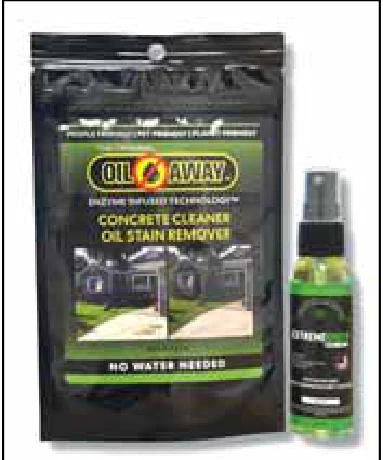
“Oil Away™ is a dry, enzyme-infused powder formulated to remove petroleum-based stains from unsealed concrete surfaces without the need for scrubbing, pressure washing, or even water,” says Shannon Duffy, COO at Oil Away.

“Apply it directly onto oil spots in your shop, garage, barn or driveway and let the enzymes do the work. Over time, they break down the petroleum compounds, effectively lifting the stain out of the concrete.

“While cat litter is often used as a quick fix, it’s just an absorbent—it soaks up surface-level oil but leaves much of the stain embedded in the pores of the concrete. Pressure washing, on the other hand, can create a big mess, often spreading the oil rather than eliminating it, and may even damage unsealed concrete surfaces over time.

“Oil Away utilizes specialized enzymes to break down oil at the molecular level, penetrating deep into the pores of the concrete where traditional methods can’t. The result is a deeper, more complete clean; no water, no scrubbing, and no residual mess,” says Duffy.

To use, first wipe the oil stain with a microfiber rag. If you’re using the Pre-Treat, spray it directly onto the oil stain, letting it sit in place for 15 to 30 seconds to allow the enzymes to start breaking down the oil. Next, use a microfiber rag to wipe away the Pre-Treat and any top-layer residue from the concrete surface, allowing it to dry completely.

It’s now primed for Oil Away. Simply apply it to the stained area with a push broom and walk away. The enzyme-infused product uses a time-driven process, which means the longer the product remains on the oil stain, the better it works. A second application might be necessary for tougher stains.

Duffy believes that Oil Away makes sense for almost everyone.

“It’s an ideal solution if you deal with machinery, tractors and tools that tend to leave their mark on your concrete,” Duffy says.

“Oil Away is biodegradable, eco-friendly, made in the USA, and safe for people, pets and the planet. You’ll be left with cleaner concrete surfaces and more time to focus on the work that matters.”

Oil Away is priced at $24.99 per 5-oz. pouch, which can cover up to 40 sq. ft., depending on how porous the concrete is. Bundled with the Pre-Treat, the cost is $27.99.

FARM SHOW Magazine readers can enjoy 20% off website orders by using the code FARMSHOW20 at checkout.

Contact: FARM SHOW Followup, Oil Away ([email protected]; www.oilaway.us).

From the archive · Full text
Feature story

AI Tool Delivers Repair Support

Featured source: Rosella Risso and Andrea Rodella

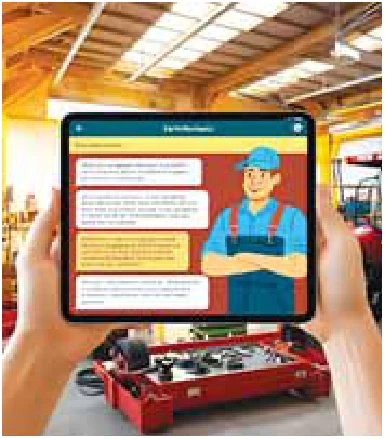
Case New Holland (CNH) is using an artificial intelligence (AI) driven chatbot assistant tool to assist its machinery dealers in supporting their customers. This cutting-edge tool saves time by offering accurate information to address technical repair-based questions.

“The AI Tech Assistant was created to help serve our agriculture and construction dealer and service networks and was designed in-house to solve customers’ problems and issues quickly and easily,” says CNH Head of Agriculture Parts & Services Rosella Risso.

“It troubleshoots and enables technicians to provide fast and accurate answers.”

The first-of-its-kind tool was developed using dealer feedback. In basic terms, it simulates conversations to provide a diagnosis and repair plan for CNH brand machines.

The AI Tech Assistant covers 100% of the CNH portfolio, including older and legacy machines, bridging knowledge gaps by quickly providing technicians with diagnostic and troubleshooting answers. Information is derived from an internal service of operators and service manuals, catalogs, and other collected data supporting 35 languages and 1 1/2 million input pages.

“The more often this AI technology is used, the more accurate the results become,” says CNH Head of IT Data & Innovation Andrea Rodella.

“The tool will eventually be more intuitive and conversational with users to simplify many portal tools into just one.”

Service support teams will retain oversight control to confirm the accuracy of answers.

The AI Tech Assistant has been rolled out in North America, Australia and EMEA, and is being used by over 6,000 dealer employees in more than 1,500 authorized agriculture and construction dealership groups. A pilot phase is ongoing in LATAM and some APAC countries, including India and the UAE. To date, the assistant has answered over 200,000 questions.

“In the future, we’re also hoping to have this service center live in an app and be voice-activated,” Rodella says.

“It’ll expand its AI capabilities (autonomy, reasoning) through continuous development based on the latest scientific research.”

Participating dealers currently have access to the technical platform. The customer cost is included in their pricing package.

Contact: FARM SHOW Followup, CNH Industrial America LLC, 711 Jorie Blvd., Oak Brook, Ill. 60523 (ph 630-887-2233; www.cnh.com).

From the archive · Full text
Feature story

Sturdy Stair Kit For Attic Access

Featured source: Ed Ingalls, The Villages, Fla.

Tri Line Attic Solutions of The Villages, Fla., manufactures high-quality attic access solutions for people who struggle with ladders.

“Five years ago, my wife and I moved to The Villages,” says Ed Ingalls, president and chief executive officer.

“It’s the world’s largest retirement community with around 80,000 homes and up to 300 to 500 homes built monthly. I worked seven days a week for most of my adult life, and the idea of slowing down and enjoying life was appealing, but the reality of doing so was not aligned.”

Instead, Ingalls started a new company focused on maintenance and home repairs.

“My business took off, and I found myself booked out over 3 mos. As my customer base grew, people began asking me to get their holiday items out of the storage space above their garage and return them after the season. I quickly found that at 60 years old, it wasn’t easy to navigate the narrow steps and unstable fold-out ladders.”

He began working out a solution for easier attic access.

“Most of my customers could climb stairs, just not those fold-out ladders. They needed a set of real stairs with wide, deep steps.” The catch, he discovered, was that these stairs needed to be retractable.

“So, I developed a set of stairs built to the same standards as a regular set of stairs, where the run of the step, the rise of the step, and the angle of the stairs were the same or very similar to what people already navigate and are familiar with.”

Ingalls developed a concept for a simple set of stairs that works without expensive motors, cables, or a power source.

“I based the idea on an SUV tailgate being leveraged up and held up yet easily opened and closed by hand.”

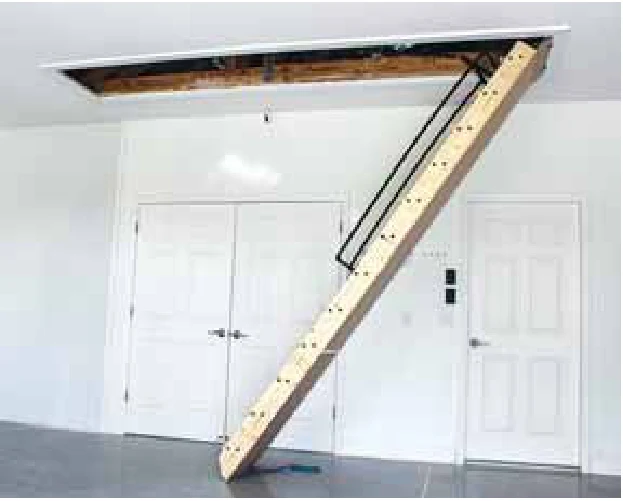
The Tri Line Safe Steps aren’t ladders but stairs that retract into the ceiling with wide, deep steps.

“We climb stairs like this daily and think nothing of it,” Ingalls says.

“You can easily navigate Safe Step Stairs as most of your foot can be firmly planted on each step. There isn’t another product like them anywhere.”

They’re designed to be easy to open with a light pull-down of about 20 lbs. To close them again, lift them about 2 ft., and they’ll retract to the ceiling. They come with handrails, though most people can climb them hands-free.

After two years of formulation and development, Ingalls introduced Safe Step Stairs to the market. It’s a fully built product that his team installs throughout central Florida.

“We also offer them in kit form across the U.S. and beyond. Hundreds of installed stairs are spread across the USA, and we get daily inquiries about the product.”

About half of kit customers build and install Safe Step Stairs themselves, while others hire local handymen.

“The kit comes with a comprehensive installation manual, and we have many installation videos. Anyone experienced with small power tools can build and install our stairs,” says Ingalls.

“We tell our customers that if they’re comfortable cutting a hole in a wall and installing a door, they’ll likely be capable of building and installing Safe Step Stairs.”

Pricing before tax is $1,399 for 8-ft., $1,499 for 9-ft. and $1,599 for 10-ft. stairs. All mechanical components are manufactured in Monticello, Ill., and kits ship out in two to seven days. The wooden components aren’t included, as they’re cheaper to buy locally. Each set comes with a two-year warranty.

Ingalls says, “Our customers are encouraged to call with questions before purchasing. We’re thrilled to provide our customers with personal build and installation support.”

Contact: FARM SHOW Followup, Tri Line Services, LLC (ph 217-433-1394; [email protected]; www.trilineatticsolutions.com).

From the archive · Full text
Feature story

DIY Bucket Camera

Featured source: Larry Goodman, Ionia, Mich.

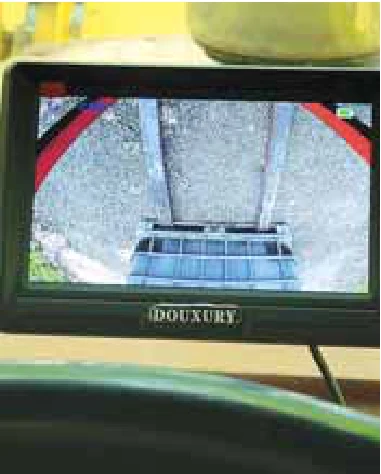
Larry Goodman had no good way to see the forks attached to the bucket of his backhoe. He purchased a wireless backup camera with a strong magnetic base and placed it inside the bucket, and placed the monitor on the windshield. It saves him from getting in and out of the cab when using the forks.

Camera systems are available online from Amazon starting around $80.

Contact: FARM SHOW Followup, Larry Goodman, Ionia, Mich. 48846 ([email protected]).

From the archive · Full text
Feature story

Made-It-Myself Ramp Lift

Featured source: Larry Goodman, Ionia, Mich.

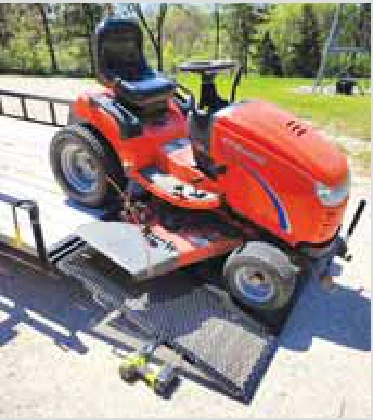
Larry Goodman, Ionia, Mich.: “I purchased a trailer to haul my mower, but the 4-ft. ramp was on too much of an angle to load. The mower deck was too low, so I installed a bracket on the ramp with a scissor jack to raise it.”

Using a battery-powered impact with an extension, he can raise the ramp and load the tractor.

“It works great,” says Goodman. Contact: FARM SHOW Followup, Larry Goodman, Ionia, Mich. 48846 ([email protected]).

From the archive · Full text
Feature story

Recovery Products Built To Last

Featured source: Morgan McAllister, Lindon, Utah

The Weigh Safe Recovery product line is designed to make towing and other emergency efforts easier.

“A few years back, I needed to pull some trees and fence posts out of my yard, but I didn’t have a good tie down for my strap,” says Morgan McAllister, Weigh Safe vice president of products.

“I ended up tying it to my hitch. After a few pulls, the strap broke at the knot. It broke a few more times, so I knew I was doing it wrong.

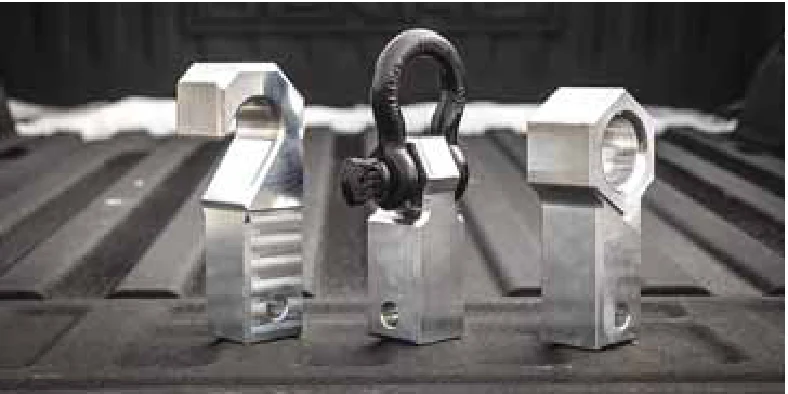
“Fast forward, and we had a piece of remnant material after machining our hitches that we didn’t have a use for. Thanks to some downtime in production, we ended up designing our rugged hooks and shackles that fit in the remnant piece of aluminum. It recycled the material, kept our team busy, and, best of all, let us sell the best-looking pure machined recovery products.”

McAllister has found through personal experience that Weigh Safe’s Recovery products work precisely as designed.

“I’ve pulled out a few things now with the Shackles. No more breaking straps.”

He’s eager to share that form remains as much a priority as the function for each piece.

The Recovery Hook ($70) offers added security with a durable, rust-proof design that can help you get out of nearly any situation.

The Recovery Soft Shackle ($25) is well-suited for off-road towing and vehicle recovery situations.

The Kinetic Recovery ropes, ranging from 5/8 in. to 1-1/4 in. in diameter and lengths of 20 ft. to 30 ft., are made from premium, heavy-duty nylon fibers. This allows them to stretch and absorb energy for a smooth pull-out for stuck vehicles. Each size features reinforced eyelets on both ends, with protected sheaths for added durability. The ropes are rated for breaking strengths up to 54,200 lbs., depending on the style. The ropes retail for $55 to $185, depending on length.

Other products in the Recovery line include a Hard Shackle Hitch ($80), Soft Shackle Hitch Ring for Vehicle Recovery ($70), Cerakote Weigh Safe Soft Shackle Ring ($110), and the Cerakote Weigh Safe Recovery Hook ($110).

“Weigh Safe’s Recovery products have been tested, tried and proven with the most rigorous tests and proven as a true force in the market,” McAllister says.

Contact: FARM SHOW Followup, Weigh Safe, 420 N. Geneva Rd., Lindon, Utah 84042 (ph 801-820-7020; [email protected]; www.weigh-safe.com).

From the archive · Full text
Feature story

LED Headlamp Shines Bright

Featured source: NightBuddy

Holding a flashlight while trying to make a repair is never easy. Traditional headlamps often have a narrow beam of light.

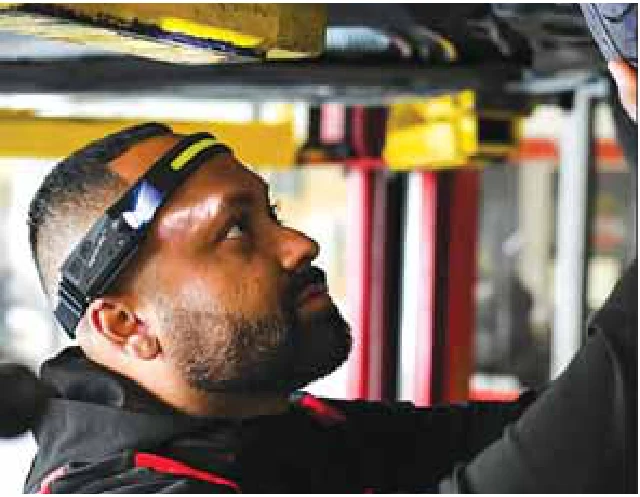
The NightBuddy™ headlamp offers 230 degrees of LED light that can reach over 300 ft. Instead of a single bulb, the NightBuddy uses an LED strip to create its expanded lighting.

The 350-lumen headlamp is lightweight and has an adjustable strap to keep it secure and comfortable for extended periods. The rechargeable battery can stay lit for up to 8 hrs. A wave sensor allows you to turn it on and off with a wave of your hand, even while holding a tool or part.

With five lighting modes, it can be used in less bright, bright, red light, side beam and strobe modes. A red-light mode reduces glare and repels bugs while being easier on the eyes in low light.

“From the moment I turned it on, I was impressed. The headlamp is very user-friendly, and adjusting the settings is a breeze. It’s light, comfortable and doesn’t slide around. A solid purchase,” says Mike E. on the company website.

NightBuddy comes with a 30-day no-questions-asked warranty and free U.S. shipping. The list price on the website is $50, but we found it discounted for $35. It’s also available at Amazon.

Contact: FARM SHOW Followup, NightBuddy (www.nightbuddy.co; Facebook: Night Buddy; Instagram: nightbuddy.co).

From the archive · Full text
Feature story

Wood Shop Safety Add-Ons

Featured source: Bill Niichel, Pueblo West, Colo.

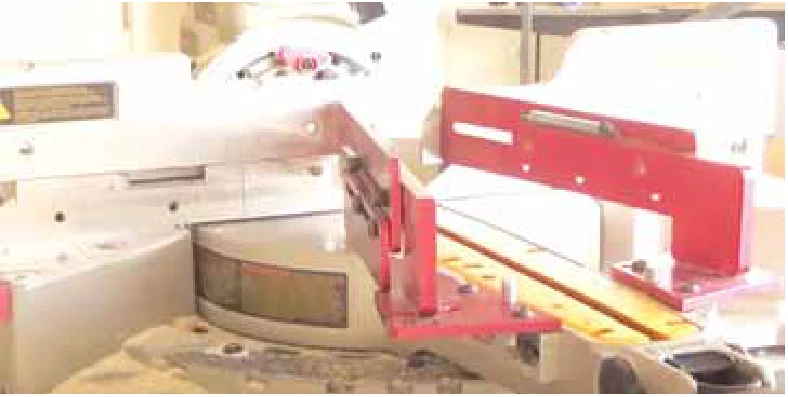
Save’Em System products are designed for wood shop safety. Bill Niichel, who has a lifetime of cabinetmaking experience, designed attachments for miter and table saws.

“My attachments are an alternative to stop saws,” says Niichel.

“They give a woodworker a choice that lets them use their existing equipment, even Saw Stop saws, more safely.”

Niichel has designed a system of hold-downs, guards and pushers to keep fingers away from blades. These work on practically any 10-in. table saw or miter saw, as well as tabletop routers and shapers. They provide complete control of the piece being cut or shaped without a push stick. They keep fingers outside what Niichel describes as the danger zone—any place closer to the blade or cutters than 6 in.

“With these tools, the left hand starts the cut, but before it enters the danger zone, it’s out of the picture,” says Niichel.

“The right hand is always the pusher but never enters the danger zone.”

Save’Em System table saw attachments include the Right Hand Pusher ($189), Left Hand Hold Down ($137), Anti-Kick Back Wheel ($189), 3-Bearing Hold Down ($239) and Panel Saw Guide ($197).

The Right Hand Pusher rides the rip fence, is spring-loaded to ride above the table and adjusts for the thickness of the stock.

The Left Hand Hold Down holds the board to the table and against the rip fence. It’s spring-loaded, so it doesn’t have to move over every time you cut. An entire 3-in. board can be ripped into 1/4-in. wide strips without ever moving the Hold Down.

The Anti-Kick Back Wheel mounts on the front end of the rip fence and holds the board down and against the fence. Once the board reaches the wheel, the left hand is no longer needed to hold it down. The wheel automatically adjusts from 1/8 to 1 1/2-in. boards. Pull a pin, and it’ll hold down 1 1/2 to 2 3/4-in. boards. If the stock is larger, the wheel can be moved out of the way.

The 3 Bearing Hold Down works as well on the router table and shaper as it does on the table saw. The adjustable spring pressure eliminates bumps and glitches with no vibration from the cut for smooth edges.

The Panel Saw Guide allows a small shop to make most of the cuts a regular big panel saw would make in a large, professional shop.

“Instead of paying thousands for a large panel saw, you can buy this one for around $200 and make 90 percent of the cuts you could make with the big one,” says Niichel.

“Plus, there are a lot of angle and bevel cuts that you can’t make on the big one.”

Save’Em System attachments for miter saws include the Left Hand Hold Down ($189) and the Swinging Guard ($197). The Left Hand Hold Down allows the operator to make cuts with the miter saw that are too dangerous to make on a table saw. Very small cuts can be made very precisely and safely. The unit comes on and off in seconds. No knobs to turn; just set it on and lift it off. It ensures there’s always a guard between the saw and the hand.

The Swinging Guard keeps the hand away from the blade. Niichel explains that miter saw blades are extremely dangerous because of the direction in which they turn.

“It can pull your hand right into the blade,” he says.

“If it catches your little finger, you will most likely lose all your fingers or even part of your hand.”

Contact: FARM SHOW Followup, Save’Em System, 516 S. Meredith Dr., Pueblo West, Colo. 81007 (ph 719-641-5274; www.savemsystem.com).

From the archive · Full text
Feature story

Rope In A Can Is Handy In The Field

Featured source: Chris Rodgers

Drawing from over 20 years of hunting experience and a career as an electrical lineman, Chris Rodgers invented a handy carry-around tool.

“Many people pack rope in their truck, camper or 4-wheeler, and no matter what, it’s always a tangled mess,” says Rodgers.

“We thought we could come up with a better way.”

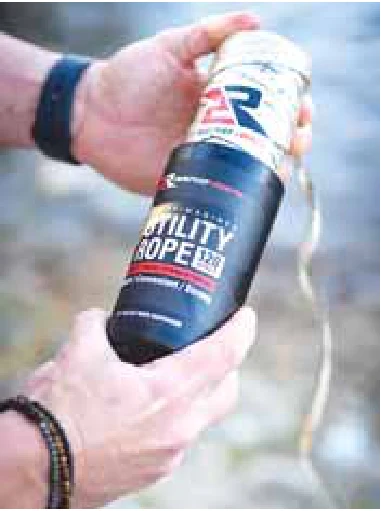
The better way turned out to be Rapid Rope, featuring two sizes of reusable plastic, shatterproof canisters that hold 50+ or 100+ ft. of coiled rope. The small canister is perfect in a backpack for camping or hunting, and the larger canister fits into a work truck’s standard cup holder.

Rapid Rope is rated for over 1,000 lbs. of test cord strength and is cross-stitched every 1/4 in. to prevent unraveling when cut. The top of the canister features an integrated cutter blade to cut any desired length. The rope can be pulled from the canister in any direction, even upside down, without unspooling.

“Just take out as much as you need, wrap it around the cutter, and pull,” Rodgers says.

“You can even do it with one hand. The rope doesn’t come apart but stays right there for the next time you need it.”

He says it’s become popular for outdoorsmen, farmers, workshops, hiking, gardening and having it available in the garage.

“We like to refer to it as dental floss on steroids,” Rodgers laughs.

“You never have to worry about carrying a knife or having a mess of rope to untangle.”

Rapid Rope is manufactured in Idaho and distributed through a network of farm, ranch and hardware stores.

The 70-ft. mini canister, including rope, sells for $19.95, and the 120-ft. canister retails for $24.95. The 120-ft. refills are priced at $14.95. S&H is free on domestic orders over $85.

Contact: FARM SHOW Followup, Rapid Rope (ph 800-974-4703; [email protected]; www.rapidrope.com).