Practical ideas from FARM SHOW MagazineSubscribe · Free issue · Send us your shop tip
Subscribe to FARM SHOW
Issues / Vol. 44, No. 6 (2020)

Vol. 44, No. 6 (2020)

Money-Saving Repairs & Maintenance Shortcuts · Printed section pp. 32–35

36 selected entries · Complete text of selected entries

This issue’s section includes reader tips and feature-length shop stories. Held items and editorial notices are not reproduced.

Archive text: prices, coupons, availability and contact details reflect the original publication, not current offers. Reader methods are not universal instructions; follow manufacturer guidance and proper safety practices.

Reader shop tips

From the archive · Full text
Reader shop tip

John Countryman

John Countryman, Yelm, Wash.

“I wanted to drive several grounding rods into the ground. But instead of using a sledge hammer, I cut the bit end off one of the chisels I use on my air chisel and welded a socket onto it. Now I can just fire up my air compressor and let the air chisel drive the rods into the ground. Using an air chisel works great as long as there aren’t a lot of rocks in the soil.”

From the archive · Full text
Reader shop tip 1 of 4

Milan Hochstetler

Individual tip 1 of 4 from this reader’s published contribution.
Milan Hochstetler, Cumberland, Va.

“I made my own paint can shaker by using the electric motor off an old ice cream freezer. I removed the paddle that stirred the ice cream and used JB Weld to attach a wood block to the motor drive. I use a velcro strap to hold the can in place. It turns slowly around in a circle. The instructions on the paint can say to shake the can for 2 min., but I usually allow at least 5 min.

From the archive · Full text
Reader shop tip 2 of 4

Milan Hochstetler

Individual tip 2 of 4 from this reader’s published contribution.
Milan Hochstetler, Cumberland, Va.

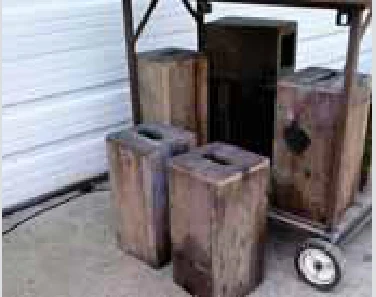
“I used 2-in. boards to build several boxes that serve as portable workbenches. Handhold slots cut into the tops of the boxes make them easy to move around. When I’m working on a bigger project, I might use 3 or 4 boxes at the same time to hold material in place.

From the archive · Full text
Reader shop tip 3 of 4

Milan Hochstetler

Individual tip 3 of 4 from this reader’s published contribution.
Milan Hochstetler, Cumberland, Va.

“The rope that opens my overhead garage door was small and hard to grip, so to improve the grip I attached golf balls to the rope at 1-ft. intervals. I drilled a hole through each ball, then ran the rope through the hole and tied a knot above and below the ball to keep it in place.

From the archive · Full text
Reader shop tip 4 of 4

Milan Hochstetler

Individual tip 4 of 4 from this reader’s published contribution.
Milan Hochstetler, Cumberland, Va.

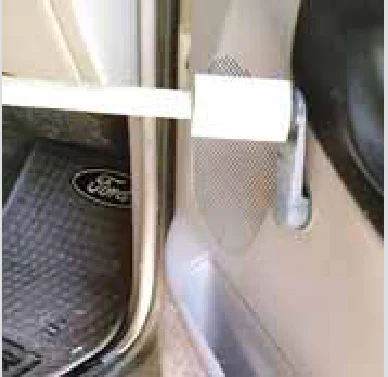
“My pickup has manual crank windows, and when I’m behind the steering wheel I can’t reach all the way over to open the passenger window. I attached a short piece of pvc pipe over the handle, so I can insert a broom handle inside the pipe that lets me crank the window up or down. I use my left hand to hold the broomstick handle steady and my right hand to rotate the handle. Works great.”

From the archive · Full text
Reader shop tip

Claude Hieneman

Claude Hieneman, Raceland, Ky.

“After selling my Deere dealership I built a garage and continue to work on small engines and chainsaws. But at 83 years old I have trouble yanking the pull cord fast enough to start chainsaws.

“To solve the problem, I made a wooden pump handle-type handle that pulls the rope. The saw’s pull cord handle slips through a length of cable attached to the end of the lever. I just push down on the handle to start the saw. I can crank with one hand and work the throttle and choke with the other. It provides the extra leverage I need and works great. I C-clamp the saw to my workbench.”

From the archive · Full text
Reader shop tip 1 of 2

Ready Davis

Individual tip 1 of 2 from this reader’s published contribution.
Ready Davis, McKinleyville, Calif.

“I run a repair shop and one idea that has really helped me a lot in recent years is using my pneumatic hammer on frozen bearings and rusted shafts. Helps get jobs done faster.

From the archive · Full text
Reader shop tip 2 of 2

Ready Davis

Individual tip 2 of 2 from this reader’s published contribution.
Ready Davis, McKinleyville, Calif.

“One of the best things I’ve done this year is spending more time with customers, teaching them how to sharpen chainsaw chains. Having a sharp chain really reduces fatigue and cost, and increases performance. People appreciate it.”

From the archive · Full text
Reader shop tip

Trevor Firth

Trevor Firth, New South Wales, New Brunswick, Canada

“My wife couldn’t start our self-propelled, 21-in. self-propelled mower using the pull cord, so I came up with a way to use a cordless drill to do the job. The pull cord assembly acts on a disc that’s held in place by a 21mm hex nut on top of the engine. I removed the plastic cover to expose the nut and put a socket on it. Then I installed a 3/8-in. square drive shaft on an old cordless drill. To start the mower my wife just runs the drill at low speed.”

From the archive · Full text
Reader shop tip

Duane Kuesel

Duane Kuesel, Elmwood, Wis.

“I prolong the life of the hydraulic lines on my front-end loader by slipping steel electrical conduit over them. It saves the rubber from being peeled off when pushing brush and tree branches. Plastic conduit could also be used.”

From the archive · Full text
Reader shop tip

Greg Balzer

Greg Balzer, Magnolia, Ill.

“I launder the felt chainsaw air filters on my Stihl saw by blowing them out, treating them with Shout stain remover, and putting them inside a sock before they go into the washing machine.”

From the archive · Full text
Reader shop tip

Marvin Boike

Marvin Boike, Maynard, Minn.

“My Cub Cadet lawn mower kept breaking the mower deck belt. The belts were expensive at over $70 each. I solved the problem by putting a lighter spring on the belt tensioner and the belts stopped breaking.”

From the archive · Full text
Reader shop tip

The Eastwood Company

The Eastwood Company, www.eastwood.com; ph8003439353 (as printed)

Eastwood says its gas tank sealer kit is an inexpensive way to easily repair worn gas tanks. It keeps rust out of your vehicle’s fuel system and seals minor leaks. Works in tanks containing gasoline, gasohol, or diesel. The kit includes 2 pints of gas tank sealer, a bottle of Fast Etch rust remover, and Metal Wash to remove any fuel varnish in the tank. A 4-piece kit sells for $41.97 plus S&H.

From the archive · Full text
Reader shop tip

Eliot Evans

Eliot Evans, Eliot, Inc., Joice, Iowa (www.eliotinc.com; ph 641 588-3546)

He sells a Make Sense Tap Adapter that’s designed to perform tapping jobs faster in hard-to-reach, tight spaces where standard wrenches don’t fit taps, or where a socket extension is too short or too long to fit. You just slide the adapter onto the tap so you can use a standard wrench to turn the tap. Allows easy access to an engine block, for example. Tap Adapters come in 11 different sizes, which you can keep organized in an included aluminum stand.

From the archive · Full text
Reader shop tip

Gary Lee Meeks

Gary Lee Meeks, Augusta County, Va.

“I got a nail hole in one of my rubber garden hoses so it was shooting out a small stream of water. To plug it, I cut a 1-in. long piece of the sticky rope that you use to plug holes in tires. It was a little tedious to just push one thickness into the hole but it stopped the leak and I didn’t have to get a new hose.”

From the archive · Full text
Reader shop tip

Ted Lacy

Ted Lacy, Worley, Idaho

“The best $16 I’ve ever spent was buying two transmitters for the Liftmaster door opener on my shop’s big roll-up door. I put one transmitter on my utility tractor and the other one in my pickup. Sure beats getting on and off the tractor to open and close the big door.”

From the archive · Full text
Reader shop tip

Charles MacDonald

Charles MacDonald, North Lancaster, Ont.

“Over the years, my brother Ken and I have owned 3 Wallenstein wood splitters. We’ve always been pleased with their performance and ruggedness. One feature common to all of them is that the splitting wedge never came closer than 1 1/2 in. from the backstop. This isn’t a problem with most wood species, which just break apart by that point. But field elm, field ash, along with some other tough woods would not split entirely. If you reversed the log to try to finish the split, the cutting edge would take a different path than what was needed.

“We solved the problem by adding a block to the backstop which decreased the gap to just 1/4 in. Even the toughest elm splits easily now. We added strips to the back of the block so it fits over the original backstop, making it easy to remove when it’s not needed.”

From the archive · Full text
Reader shop tip

Barry Williams

Barry Williams, Cooks Mills, Ill.

“I am 78 years old and have a Kubota B7800. My legs are short and my knees are bad. I added a step on my tractor. I used two 5/8- in. bolts in holes already in the frame, along with two pieces of 1-in. square tubing and two pieces of angle iron, some gripstrut, and paint to match.”

From the archive · Full text
Reader shop tip

Gary Parsch

Gary Parsch, Hope, Mich.

“At age 73, climbing into the seat of my 1951 John Deere B with fenders was a tight fit, so I hinged the seat to flip up to the left. I now have lots of room for getting on and off.”

From the archive · Full text
Reader shop tip

Marvin Martin

Marvin Martin, Elkton, Ky.

“On a Wrangler 4500 loader the hoses wanted to rub as they went through the frame at the articulation joint. I double wrapped the hoses with a piece of ratchet strap and secured them with zip ties temporarily. I then wrapped wire around the ratchet strap and tied it off, securing to the frame on one side. I used medium tension on the wires. I had to remove the front side access cover to reach the hoses.”

From the archive · Full text
Reader shop tip

Don Jaster

Don Jaster, Bruce, Wis.

“In your last issue, two separate readers complained about Deere riding mower features that stop the mower blades when you shift into reverse. My advice is to just take a look at the wiring. Riding mowers are generally not over-engineered so there’s probably a microswitch attached to the linkage of the reversing mechanism that shuts off the blades. On my MTD mower, the engine actually shuts off. There’s a microswitch under the shroud on the shifter. You can either just bend the switch out of the way, or loosen it so the shifter doesn’t hit it. Depending on how your machine is wired, you might just cut off two wires and connect them together.”

From the archive · Full text
Reader shop tip

Chuck Staley

Chuck Staley, Charter Oak, Iowa

“To the reader frustrated with his X750 Deere mower that shuts down when he shifts into reverse, just remove the two wires that run to the button you push when backing up and connect them together. Then you’ll be able to back up without the blades ever stopping.”

From the archive · Full text
Reader shop tip

Steve Faber

Steve Faber, Tiffin, Ohio

“I’ve found that I can easily break beads on tubeless tires using my trailer tongue jack. A short piece of bar stock placed along the edge of the rim makes it more effective.”

From the archive · Full text
Reader shop tip

Tom Weleske

Tom Weleske, Hallock, Minn.

“I have a question for other readers: I have been using automatic transmission fluid for the gas mix in chainsaws and other equipment for more than 25 years with no problems at all. I have been told, however, that this isn’t good for the motors. Have I just been lucky? What if I do this in newer equipment?

“A 2-oz. bottle of oil mix costs a dollar or more. ATF is a fraction of the cost and I’ve always got some around. Would like to hear what people think.”

From the archive · Full text
Reader shop tip

Mark Yax

Mark Yax, Solon, Ohio

“I’ve found that if you cut off the tops of detergent bottles and use them upside down, they make great little almost spill-proof containers for holding cutting oils, glues, stains, and paint. Handy to keep around the shop.”

From the archive · Full text
Reader shop tip

Melvin Malvitz

Melvin Malvitz, Sturgeon Bay, Wis.

“When I’ve got a nail that’s hard to drive because of tight access, I insert a metal rod inside a metal tube so I can pound on the rod to drive the nail. This idea has saved me a lot of time and frustration.”

Shop feature stories

From the archive · Full text
Feature story

Handy Walk-Behind Shop Lift

Featured source: Milan Hochstetler

“I use my home-built walk-behind lift in my shop to raise anything that’s too heavy to lift, and at my age that includes a lot of different things,” says 89-year-old Milan Hochstetler, Cumberland, Va.

The 6-ft. high forklift is made from angle iron and rides on 4 small caster wheels. The forks are raised and lowered by using a cordless drill to operate a winch mounted on back of the unit. A pair of welded-on handles are used to steer.

“The forks can be raised up to 4 1/2 ft. high. I can use them by themselves to do the lifting, or place a plywood platform on top of them,” says Hochstetler.

“Works great to lift big gas cans up to the hood on my tractor so I can fill it with fuel.

“I made the winch out of a short length of pipe, which I fastened to the shaft of an old garden tiller gearbox that slows the winch down. A cable fastened to the pipe goes up and over a pulley to raise or lower the forks.”

Contact: FARM SHOW Followup, Milan Hochstetler, 174 Vogel Rd., Cumberland, Va. 23040 (ph 804 492-4295).

From the archive · Full text
Feature story

Used 12-Volt Coil Keeps Tiller Running

Featured source: Roger Podoll

After Roger Podoll’s Troy-Bilt tiller went through a flood, the coil was shot. He got the tiller going again with a 12-volt coil and a battery from a cordless drill.

“I cleaned out the tiller and changed oil, but there was no spark. The coil was bad,” says Podoll.

“My Kohler dealer said a replacement coil would cost $100 and take 3 weeks to arrive. I looked around the shop and realized I had everything I needed to get it going again.”

A 12-volt coil with bracket had been salvaged from a 1989 motor home. To supply the coil with power, Podoll replaced the condenser and used a 12-volt cordless Milwaukee tool battery.

“I had noticed previously that the charger for Milwaukee Tool batteries was very similar to a standard 2-prong plug,” says Podoll.

“All I had to do was grind down the one oversized prong.”

The modified plug gave him 2 contact points for the battery. After mounting the coil to the motor and replacing the condenser, he strapped the battery in place and wired the coil and battery together.

“Starting the old Kohler engine is much easier, taking only one pull, “ says Podoll.

“I think you could use any old 12-volt coil on many engines. However, the Milwaukee is the only battery I’ve found with the 2 prong charger.”

Podoll did have some concern about the spark plug running too hot with the power source.

“I ran 2 tanks of fuel through the tiller and checked the plug, and it looked normal,” he says.

“The battery life is more than an hour. When it drops power, I have an excuse to take a break.”

He notes that working on the original coil would have required pulling the flywheel.

“This external coil was way cheaper and will be easy to work on,” says Podoll.

Contact: FARM SHOW Followup, Roger Podoll, W8772 State Rd. 21, Wautoma, Wis. 54982 (ph 920 295-2357).

From the archive · Full text
Feature story

Diesel Modules Boost Horsepower

Featured source: Allan Shepard

“A person could spend more than $30,000 to buy the extra horsepower you get from a Case IH 450 tractor compared to a Case IH 350, or they could spend about $2,000 for one of our performance modules and get the same extra power,” says Allan Shepard of Diesel Power Modules.

“We’ve been producing modules since 2003 that provide money-saving fuel efficiency and warranty-friendly performance for all types of diesel engines.”

Shepard says his company’s products work on farm tractors, construction equipment, medium and heavy-duty trucks, and even some recreational vehicles.

“They’re designed to improve fuel economy and boost horsepower by up to 30 percent,” Shepard says.

“Our average diesel pickup owners see a 3 to 5 mpg improvement.”

Unlike some other modules on the market, Shepard says their devices don’t flash the ECM, which makes them warranty friendly. Instead they’re designed with proprietary linear load-based technology to receive data from the ECM and then optimize the manufacturer’s signal to the engine, improving fuel efficiency and power output.

“The fuel efficiency alone ensures a quick return on a buyer’s investment,” Shepard says.

With DPM’s plug and play connectivity, there isn’t a need to cut, splice or modify existing engine wiring. Shepard says all modules are field-tested, Dyno-proven and carry a lifetime warranty. They’re made in the USA with a 90-day 100 percent money-back guarantee and are easily transferable to newer machines with the same engine and emissions specifications. Module prices for ag engines are $1,933 and prices for pickup diesels range from $250 to $600. Heavy-duty truck modules range from $500 to around $1,800.

Contact: FARM SHOW Followup, Diesel Power Modules (ph 855 244-4111; www.dieselpowermodules.com).

From the archive · Full text
Feature story

Electric Power Steering Added To Kawasaki Mule

Featured source: John Kokur

John Kokur, Carlisle, Iowa, updated his 1993 Kawasaki Mule with electric power steering, spending a total of only $160.

“I got the Mule from my father-in-law when he bought a newer Polaris Ranger equipped with power steering,” says Kokur.

“The Ranger was much easier to steer, especially when backing up to a trailer or maneuvering in tight areas.

“I investigated power steering kits for my Mule, but at $600 to $700 they cost more than I wanted to spend. I remembered an article in FARM SHOW (Vol. 41, No. 5) about someone who added electric power steering out of a car to a smaller tractor. So I went to a salvage yard and found a 2006 Toyota Prius. I removed the steering column assembly and steering computer module, and cut the power and the car control harness to use as pigtail connections to the module.”

He removed the factory Mule steering column, as well as the roll cage and front plastic for access to the back of the dash. After he cut off all the factory Prius mounts, he made brackets to attach the Prius column to the frame and dash, and also made the Prius column more vertical and tilted it slightly to the right of the Mule’s original location.

“This lessened the angles of the steering shaft U-joints, and also gave me more room to enter and exit the Mule,” says Kokur.

With the steering column in place, he started working on the steering shaft.

“The Prius used a small shaft between the column and the rack and pinion, which was a splined two-piece slip shaft. I separated the two pieces, and luckily, the half that hooked up to the Prius’ column was the female half. I measured and cut the factory Mule’s shaft, and, to my amazement, it fit nicely into the female shaft from the Prius. I had to marry the two shafts together because none of the splines were the same size from the Toyota to the Mule. After attaching the shafts to the column and to the Mule’s rack and pinion, I welded them together.”

Next, he attached the steering module to an out-of-the-way spot under the dash and then wired it to the battery.

“I wanted to retain the Mule’s steering wheel to keep the vehicle looking original. I found a round steering shaft adapter on eBay for $15 and it almost fit right out of the box,” says Kokur.

“I ended up grinding out the splines of the adapter with a carbide burr and slipping it on the Prius column where the steering wheel would normally fit. I then cut the Mule steering shaft about an inch and a quarter below the splines for the steering wheel, and ground it down to fit inside the large side of the adapter. After tapping it all together, I welded both sides. A piece of 1 1/2-in. heavy-duty radiator hose clamped to the Prius’ steering column camouflages the shaft and adapters.”

The conversion worked perfectly.

“It used to take both hands to turn the steering from lock to lock with the Mule sitting still, but now I can steer with one finger,” says Kokur.

“You can hardly tell the steering column has been replaced from just looking at the machine.”

Kokur says he spent a total of $160, saving a fair amount of money over a pre-made kit and a whole boatload over a new Ranger.

Contact: FARM SHOW Followup, John Kokur, 4869 178th Ave., Carlisle, Iowa 50047 (ph 515 229-7537; [email protected]).

From the archive · Full text
Feature story

Handy Portable Power Units Run On Cordless Batteries

Featured source: KC Innovations

Whether you want to start a vehicle’s dead battery or you just need a portable AC power unit, you’ll be interested in these 2 new products from KC Innovations, Loogootee, Ind. Both make use of commonly available DeWalt, Milwaukee or Makita cordless tool batteries.

The EZ Start comes with a 60-amp circuit breaker/switch, and heavy-duty jumper cables. To operate the unit just hook up the cables, install a tool battery, and flip a switch.

“EZ Start eliminates the need for jumper cables and a second vehicle, or having to drag around a heavy 12-volt battery,” says Doug Knepp.

“You just install a tool battery and hook up the cables. It’s small enough to fit in your car’s trunk.

“There are portable power packs on the market, but as far as I know they’re limited to one battery brand. Jumper cable kits equipped with a built-in battery are also available, but you can’t use the battery for anything else. Also, a jumper kit with its own battery has to be charged periodically or else it won’t have power when you need it. And if left in a discharged state for too long, the battery will be ruined. Cordless tool batteries recharge in only about a half hour.”

The EZ Start sells for $119.95 plus S&H.

The Han-D-Power II operates off one or two 18 or 20-volt batteries (not supplied), and contains an inverter that supplies portable AC power. It consists of a compact 10 by 9 by 6-in. metal box equipped with slide-in brackets for batteries. The unit has 3 ports - two 110-volt AC outlets and a USB port.

“It provides electric power anywhere you want it, whether you’re in the field or camping in the wilderness. There’s no need to drag a heavy generator around or start a gas engine,” says Knepp.

“Works great to operate any electric-operated tool under 600 watts including heavy-duty, high-wattage tools such as a hammer drill. Also, it has a pure sinewave power source so you can safely use it to charge your laptop computers and iPhones, or even cell phones.”

How long the batteries last will depend on the application, says Knepp.

“If you want to charge a cell phone the batteries will last for several days. To provide power to a big tool that operates on 600 watts, the batteries will probably last only for 1 to 2 hrs.”

The Han-D-Power II sells for $249 plus S&H. The company is looking for dealers.

Contact: FARM SHOW Followup, KC Innovations, 6699 North 1200 East, Loogootee, Ind. 47553 (ph 812 636-3684; [email protected]).

From the archive · Full text
Feature story

Wall-Mounted “Waterless Urinal” For Shops

Featured source: Brian Laine

Tired of leaving your shop to go out in the cold, rain or snow to relieve yourself? Shop Relief may be your answer, says Brian Laine, Arlington, Wash. ShopRelief is a waterless fold-out urinal for your shop. Installed between studs, it appears as a flush stainless steel panel against the wall. To use it, pull out the chute. When done, just push it closed. The unit drains through a hose that goes inside your wall space and then to the outside. It doesn’t require any plumbing or use any floor space. You just cut a rectangular opening in your drywall between studs, drill a hole on the outside bottom of the wall, run the discharge hose out into a holding container or buried hole filled with some rock. The urinal attaches to the wall with 4 screws.

“The urinal can be installed into walls with standard 16 in. on-center 2 by 4 construction, or any spaces that are larger than this,” says Laine. Sells for $295 plus $18 shipping. A package of 10 deodorizer blocks sells for $19.99 including free priority mail domestic shipping. Contact: FARM SHOW Followup, TechnoVersions LLC, 7921 Wade Road, Arlington, Wash. 98223 (ph 425 879-2890; [email protected]; www.technoversions.com).

From the archive · Full text
Feature story

Utility Box Made From Grill Cover

Featured source: Dennis Gingrich

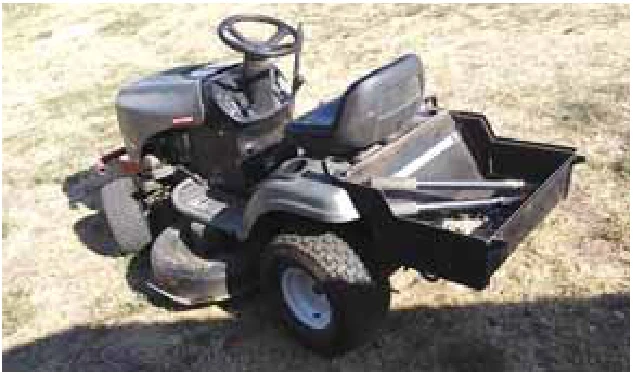
Dennis Gingrich, Gering, Neb., converted the lid of an old barbecue grill into a handy utility box that’s mounted on back of his Sears riding mower.

“I use this 18 hp. tractor for a lot of different jobs other than mowing,” says Gingrich.

“Our farm has a windbreak of 70-year-old cedar trees that my dad planted, and I’m gradually clearing brush and dead tree limbs away so I can mow under the trees. I throw a chain around a bunch of cut-off limbs, and this little tractor drags them away without complaint.

“One day I headed for the job site while trying to balance a chainsaw on the tractor’s floorboard, a hedge clippers on my lap, and a gas can between my knees. It was obvious that I needed a better way to haul stuff.

“Then I spotted the lid off an old Weber barbecue grill, and noticed the angle on front of the lid matched the angle of the apron on back of the tractor. I drilled matching holes in the apron and grill lid, then attached the lid to the tractor by bolting on a couple of reinforcing steel straps. I also bolted a metal brace on back of the tractor, above the hitch, for support.”

Contact: FARM SHOW Followup, Dennis Gingrich, 910 Westwood Dr., Gering, Neb. 69341 (ph 308 436-5925; [email protected]).

From the archive · Full text
Feature story

Sheds Built From Salvaged Barns And Bins

Featured source: Jack Ziegler

When Jack Ziegler and his son Colton were offered an old pole barn and several grain bins for free, they started thinking of ways to use them. They decided to turn them into several different buildings, including a portable “hoop shed”, a drive-through grain bin equipped with a garage door, a firewood storage bin, a firewood “carport”, and a pair of dog houses, one fitted with a large glass wall on front.

“A neighbor’s pole barn blew down in a wind storm so we salvaged the tin and wood,” says Jack.

“The wind was so strong that it pulled the barn’s 6-in. square poles right out of the ground and laid the building upside down. We tore the barn apart and saved all the wood and tin, as well as the bolts and screws.

“We also got 6 grain bins free from a neighbor who was tearing down his farm building site. Two 20-ft. dia. bins, two 18 ft., and two 14 ft.”

They bolted together several bin rings to build the 15-ft. wide by 24-ft. long portable hoop shed, which they use to store small vehicles such as their Polaris Ranger and several lawn mowers. The shed, which has an open front and a full wall with an aluminum door on back, rides on a pair of skids made from 6-in. square pole barn poles. They used 2 by 4’s and steel to build 2-ft. high walls and bolted the bin rings onto them to form the roof. A roof-mounted solar panel powers a night light.

A 20-ft. bin was turned into a drive-through shed that’s equipped with a hand-operated garage door on one side and a cutout door on the other side. The shed is used to store motorcycles and snowmobiles. Another 20-ft. bin is equipped with only a garage door.

“We bought one garage door cheap on Craigslist and were given the other one,” says Jack.

“One door is insulated and the other is fiberglass. Both doors were installed inside 2 by 4 frames, and their overhead tracks are supported by 2 by 4 frames suspended from the bin’s roof.

“We used a metal cutting saw to cut out the door openings. But first we sank a pair of steel posts in the ground inside the bin, and bolted horizontal 2 by 6s onto them to support the bin’s wall.”

The cutout doors are equipped with rebar handles and rubber rollers on the inside to latch the door.

They store firewood in one hoop building, which has an aluminum door at one end, with an attached metal screen to protect it from falling wood.

“We fill 3/4 of the building with firewood and park the log splitter in the remaining space,” says Jack.

They also store firewood in several bins, placing the wood on pallets and installing roof ventilators to help dry the wood.

“We bought the ventilators at a lumber yard closing sale for $2 apiece,” says Jack.

“We cut a hole out of the middle of a 55-gal. drum lid and bolt the ventilator onto it, then bolt the lid to the bin’s roof. If the bin has no cap, we just cut an opening in the roof and bolt the ventilator on.”

The men used 2 by 4’s from the pole barn, and grain bin sheet metal, to build their firewood “carport”.

“The roof keeps the wood dry, and the open sides let air circulate,” says Jack.

“If we want, we can quickly remove the sheet metal to speed up the drying process.”

Contact: FARM SHOW Followup, Jack Ziegler, 61366 129st St., Mapleton, Minn. 56065 (ph 507 340-3364; [email protected]).

From the archive · Full text
Feature story

Ford N-Series Oil Filter Adapter

Featured source: Eric Rego

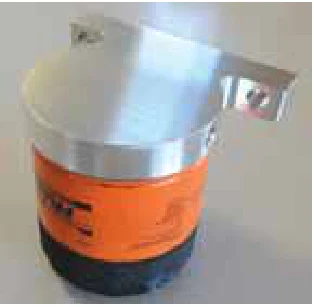
A new adapter from Maple Springs Farm lets Ford N-Series owners use spin-on filters. The simple, no-tools filter change eliminates the hassle and mess of the original cartridge style oil filter found on Ford 8N/9N and 2N tractors. It also slashes filter cost and provides better filtration.

“Our adapter orients the filter vertically,” explains Eric Rego, Maple Springs Farm.

“When a vertically-oriented filter is spun off, oil is retained in the filter, making for an almost mess-free change. By filling the new filter before installing it, it is primed, and oil pressure builds faster on start-up.”

Rego emphasizes that Ford N owners will be able to purchase filters with known efficiency. Many cartridge filter manufacturers do not publish efficiency data. Ford N’s use bypass filtration intended to slowly scrub the oil to remove fine wear particles. This makes a high level of efficiency very important. Modern, synthetic media, spin-on filters lend themselves well to a bypass system.

At $4 to $6 each, recommended spin-on filters are also significantly less expensive than the traditional cartridge filters. Depending on the source, they can cost from $8 to $16 each.

“The cost of the $39.98 adapter can be recouped just from savings over several oil changes,” says Rego.

“Our adapter uses 3/4-in. 16 threads commonly used with spin-on automotive filters. This makes replacement filters readily available from virtually any auto parts store or big box store.”

Maple Spring Farms (Vol. 42, No. 6) carries a wide variety of Ford, Oliver, Case, Troybilt, Cummins and Cummins repower parts, service tools and more.

Contact: FARM SHOW Followup, Maple Springs Farm, 1828 Cty. Rd. PB, Verona, Wis. 53593 (ph 608 658-2072; [email protected]; www.msfparts.com).

From the archive · Full text
Feature story

“Lift Box” Helps Reach Shop’s Upper Level Storage

Featured source: Al Hernke

“Storing extra wheels and tires in upper level storage area in our shop was always a two person job with the skid steer fork lift. So I made a metal lift box with an electric winch that’s easy for one man to use,” says Al Hernke of Cannon Falls, Minn.

The 42-in. square floor of the lift box is made of welded steel bar grate supported by angle iron framing and four 6-in. square metal feet. The same material is used on three sides, with the fourth left open for loading and unloading. A safety chain across the opening keeps the items from falling out.

To lift the box, Hernke built a sturdy metal U-shaped frame out of 1 1/2-in. tube steel. It’s welded securely to the top of two side panels and extends 2 ft. above the top of the box. The box is raised and lowered by an electric winch that’s mounted on a metal beam between two rafters about 6 ft. in from the side wall of the shop. The lift cable attaches to an eye hook in the center of the box frame with a swivel that allows the box to rotate while it’s raised. The winch is raised, lowered and stopped by a hand-held control on the winch power cable.

“The setup isn’t anything fancy, but it sure works great to lift wheels, tires and anything else that’s heavy to our upper level storage,” Hernke says.

“With the hand-held control I can lift and rotate the box when it’s just off the floor and do the same when it’s raised to the storage area.”

Contact: FARM SHOW Followup, Hernke’s Inc., 37020 County 1 Blvd., Cannon Falls, Minn. 55009.