Practical ideas from FARM SHOW MagazineSubscribe · Free issue · Send us your shop tip
Subscribe to FARM SHOW
Issues / Vol. 39, No. 3 (2015)

Vol. 39, No. 3 (2015)

Money-Saving Repairs & Maintenance Shortcuts · Printed section pp. 36–39

36 selected entries · Complete text of selected entries

This issue’s section includes reader tips and feature-length shop stories. Held items and editorial notices are not reproduced.

Archive text: prices, coupons, availability and contact details reflect the original publication, not current offers. Reader methods are not universal instructions; follow manufacturer guidance and proper safety practices.

Reader shop tips

From the archive · Full text
Reader shop tip

Paul Miller

Paul Miller, Gardiner, Mont.

“A friend of mine ran over my wheelbarrow, breaking off one handle. I had an ax handle that was broken off at the head. I drilled holes in the ax handle, aligned it with the other handle, and screwed it onto the remaining broken off section. It is very comfortable to use. If I can find another ax handle, I’ll ask my friend to run over the other side.”

From the archive · Full text
Reader shop tip

David A. Simpler

David A. Simpler, Elkton, Md.

“I always used to have rags in different places around my shop. It was sometimes unsafe to have a pile of rags laying around while welding or using a cutting tool, or just plain aggravating when trying to find a rag.

“I now used a dog food storage hopper to hold rags. You can mount it on any wall and just load it up, pulling a lever to get a rag out whenever you need one.”

From the archive · Full text
Reader shop tip

Joe Macha

Joe Macha, Plainview, Texas

“When replacing wheel bearings on equipment, I pack the new bearings with grease as usual. I then fill the hubcap with heavy gear oil before pressing back on. This seems to make the bearings last much longer.”

From the archive · Full text
Reader shop tip 1 of 2

Ray Cimino

Individual tip 1 of 2 from this reader’s published contribution.
Ray Cimino, Eatonville, Wash.

“I always keep a roll of aluminum foil around. Comes in handy when you need to prop something up, like maybe hold small pieces for glueing or welding. Just wad up a piece of foil and form it into the size you need.

From the archive · Full text
Reader shop tip 2 of 2

Ray Cimino

Individual tip 2 of 2 from this reader’s published contribution.
Ray Cimino, Eatonville, Wash.

Also works good to put under an uneven leg of a shop tool that’s rocking. Very handy.”

From the archive · Full text
Reader shop tip

David Lapp

David Lapp, Elmridge Machine & Gear, 94 Fairview Rd., Lititz, Penn. 17543 (ph 717 664-1079)

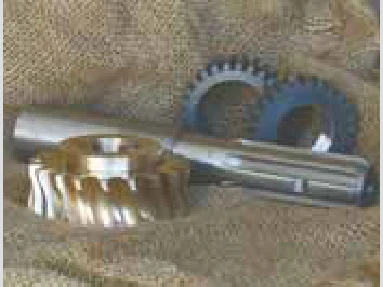
Elmridge Machine specializes in producing custom or hard-to-find spline shafts and spur, helical, or worm gears.

“Send us the original part and explain the application. We will test the hardness of the piece and decide on the best material for the purpose, take careful measurements, and reproduce a gear to those specifications. Heat treatment and finish grinding processes follow as needed,” says Lapp. Replacement gears are available for restoration of antique tractors, custom-build applications, or to get an older machine running again for which parts are no longer available.

From the archive · Full text
Reader shop tip

Mack Myers

Mack Myers, Kirbyville, Texas

“As I get older I can’t lift as much as I used to, so I try to come up with ways to make life easier. I recently equipped a 2-wheeled dolly with a battery-operated diesel transfer pump. It really comes in handy for refueling tractors and other diesel-powered vehicles.

“A 12-volt battery sets on a wooden shelf at the middle of the dolly, with the transfer pump and its discharge hose mounted above it. There’s a 5-gal. container at the bottom. When refueling, I stick a 20-in. length of pvc pipe into the container to serve as a suction hose.

“This setup eliminates the need to haul heavy containers around by hand and do any lifting, and there’s no need for an electric outlet to operate the transfer pump. I bought the pump and hoses at Harbor Freight for $104 (with a 20 percent off coupon) and already had the dolly and battery.”

From the archive · Full text
Reader shop tip

Douglas Strouse

Douglas Strouse, Mason, Mich.

“I use a 5-gal. bucket with a 1/8-in. dia. hole in the bottom to water new trees. Water runs out slowly and soaks into the ground without running off. Cat litter pails work good because they come with lids.”

From the archive · Full text
Reader shop tip

David Nolt

David Nolt, McVeytown, Penn.

“Whenever I’m installing cup-type hydraulic cylinder seals I first apply heavy grease. Then I use nylon ties or clamps to compress the ring and put it in the freezer for an hour. The seal will then slip easily into place.”

From the archive · Full text
Reader shop tip

Herbert Brown

Herbert Brown, Saint Peter, Minn.

“Over the years I’ve owned several different brands of cordless drills, but on all of them I find that if the chuck is hand tightened the bit can easily slip. A big jaw pliers can be used to tighten the bit, but that can be very dangerous because of the twist. I’ve tried grinding the flat side of the bit shank, which sometimes helps. Anyone else have a solution?”

From the archive · Full text
Reader shop tip

Jim Monaghan

Jim Monaghan, Chelsea, Mich.

“Here’s an easy way to remove a stubborn bolt. Center punch the bolt head to make a dent in it, then use a small drill to make a starter hole in the head. Then use another drill the same size as the bolt and drill it out.”

From the archive · Full text
Reader shop tip

Dale Stodel

Dale Stodel, Vermontville, Mich.

“On older equipment, nuts and bolts can get rusty enough to break on disassembly. Whenever I know in advance that I have to work on old equipment, I squirt penetrating oil or brake fluid every couple of days onto the fasteners and then tap them with a 1-lb. ballpeen hammer. I’ve never had a nut hold out longer than 2 weeks, and usually I can break the nut loose in a week or less.”

From the archive · Full text
Reader shop tip 1 of 2

Gerald Schmidt

Individual tip 1 of 2 from this reader’s published contribution.
Gerald Schmidt, Cape Coral, Fla.

“When a bolt head broke off on my Ford 555 backhoe-loader tractor, I placed an oversized nut over the broken bolt and then welded it on in place of the head so I could remove the bolt. Worked great.

From the archive · Full text
Reader shop tip 2 of 2

Gerald Schmidt

Individual tip 2 of 2 from this reader’s published contribution.
Gerald Schmidt, Cape Coral, Fla.

“Here’s a tip to make acrylic enamel catalyst paint last longer. Blow into the can and then quickly place a lid on it. The carbon dioxide in your breath will make the paint last another 30 days or so, and if you put the can inside your freezer it’ll last even longer.”

From the archive · Full text
Reader shop tip

Kerry Kligora

Kerry Kligora, Mineral Point, Wis.

“I made this shop stool for my father-in-law last Christmas. The seat is from an old Massey Harris tractor and is supported by a spring tine off an old cultivator. I used 2-in. sq. tubing to make the base and mounted it on 3 caster wheels. I painted everything Oliver green and white, since Oliver is my father-in-law’s favorite brand.

“The seat is comfortable and stable but sits a little too high for doing real low work. However, my father-in-law says it works great for working on his dump truck, and even better for when the guys come over for a beer.”

From the archive · Full text
Reader shop tip

Brad Miller

Brad Miller, Ridgeville Corners, Ohio

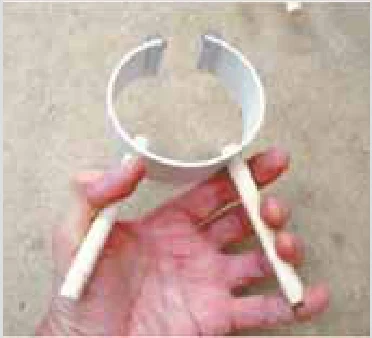
“Here’s a way to make some handy spring clamps. A short length of pvc pipe and 2 dowel rods are the only materials required. Drill 2 holes through the pipe at a 90 degree angle from each other. The holes should be slightly smaller than the diameter of the dowel rods so the rods will fit snuggly into them and serve as handles. The thicker the pvc is or the wider the piece that you’re working on is, the more squeeze pressure you’ll have.

“Split lengths of vinyl tubing can be added to keep the pipe’s sharp edges from marring the surface of your project.”

From the archive · Full text
Reader shop tip

Russell Rogotzke

Russell Rogotzke, Springfield, Minn.

“I get frustrated trying to hook up hydraulic hoses whenever it warms up and a lot of pressure develops in the hydraulic line. I solved the problem by making a device out of a 3-in. C-clamp. I removed the swivel and drilled a depression in it so the tip of the coupler stays aligned. Then I welded iron onto the other end to hold the hose. A metal guard welded onto the clamp keeps any spraying oil away from me as I’m relieving the hose pressure.

“Without this device I’m tempted to use a hammer, which damages the tip. Or, I have to loosen the connection which makes a mess, and then I have to retighten it. This eliminates all of that frustration. Be sure to buy a good clamp because it can take a hard turn of the clamp to get the job done.”

From the archive · Full text
Reader shop tip

Don Nelson

Don Nelson, Hildreth, Neb.

“I bought a used electric-over-hydraulic lift from a local machine shop for $650 and modified it for use as a service lift, which I use when working on my 3 Grasshopper riding mowers. The lift came with a 2 by 4-ft. top plate, and to make it big enough for the mowers I welded 39 in. of material on each end and 10 in. on each side. I used 1-in. sq. tubing to build a frame for the enlarged table and welded it onto the lift’s original 2 by 4 base frame.

“I have a sideline business mowing cemeteries, town yards and country yards so I use this lift a lot to do general service work on the mowers. To operate the lift I just plug in the cord and step on a pedal. It’s rated at 1,500 lbs. but has no problem lifting my mowers, which weigh 1,620 lbs. each.”

From the archive · Full text
Reader shop tip

William Thompson

William Thompson, Chariton, Iowa

“I slide baby socks over the ends of my tractor’s hydraulic couplers in order to keep dirt and chaff out. Rubber bands hold the socks on.”

From the archive · Full text
Reader shop tip 1 of 3

Roman Bontrager

Individual tip 1 of 3 from this reader’s published contribution.
Roman Bontrager, Myerstown, Penn.

“I’ve had problems with slow radiator leaks on older vehicles over the years, but have found that AlumAseal Radiator Stop Leak Powder works great (www.amazon.com).

From the archive · Full text
Reader shop tip 2 of 3

Roman Bontrager

Individual tip 2 of 3 from this reader’s published contribution.
Roman Bontrager, Myerstown, Penn.

“I needed to drill holes into a plaster ceiling in order to mount a row of lights. I was working in a clean area so I needed to contain the dust, chips and debris as much as possible. So I cut an old basketball in half and poked a hole through the middle of it with my concrete bit, and then drilled the holes in the ceiling. I pressed the half basketball up tight against the ceiling as I worked, and the dirt fell into it. No dust.

From the archive · Full text
Reader shop tip 3 of 3

Roman Bontrager

Individual tip 3 of 3 from this reader’s published contribution.
Roman Bontrager, Myerstown, Penn.

“I mounted a used X-ray machine’s ceiling track in my shop. Where the X-ray machine had been mounted to the track, I bolted a double angle iron with an eye bolt. Then I hooked my shop hoist into the bolt. It works just like a miniature crane bay and lets me lift and move 500 lbs. the full length and width of a 10-ft. sq. area.”

From the archive · Full text
Reader shop tip

Bob Moty

Bob Moty, Crystal Lake, Ill.

“I was a welder for 35 years and invented and/or made many things. Before I spray painted any of the pieces I built, I used the following process to keep the paint from peeling.

“After welding I would first scrape off the weld spatter, then wipe it down with lacquer thinner or a similar solution to remove the oil and grease. Then I used a gas torch to ‘sweat’ the metal. To see what I mean, take a gas torch and slowly move it across some clean, unpainted metal, and you’ll see the moisture come to the surface and evaporate ahead of the flame.

“When you’re finished, the metal should be lukewarm but not hot, to the point that you can lay your bare hand on it comfortably for about 5 seconds. Then spray paint it immediately, and you’ll never have a problem with paint peeling again.”

From the archive · Full text
Reader shop tip 1 of 2

Michael Myers

Individual tip 1 of 2 from this reader’s published contribution.
Michael Myers, Kirbyville, Texas

“I use a 30-ft. sq. shop to do maintenance work on my tractors and other equipment. The shop’s small size means I’m often cramped for space. So I built several features into the shop to provide more room.

“My 4 by 8-ft. rolling table is made from treated pine. The table has a plywood top and rides on four 4-in. caster wheels that I bought at Harbor Freight. I can easily roll the table around anywhere inside or outside the shop. I bored a hole into one end of the table so I can install a big umbrella when working outside. I use outlet strips with the shop’s electrical outlets so I can hook up to 2 or 3 power tools at a time while I’m working at the table.

From the archive · Full text
Reader shop tip 2 of 2

Michael Myers

Individual tip 2 of 2 from this reader’s published contribution.
Michael Myers, Kirbyville, Texas

“I bought 4 overhead cranes from Harbor Freight and installed them in the shop. The cranes ride on tracks spaced about 8 ft. apart and have a capacity of 880 to 1,500 lbs. apiece. I’m 67 years old, so it’s getting harder to bend up and down when performing maintenance work on riding mowers. I use the cranes to lift the mowers onto my rolling table, where I can work on them at a comfortable working height. The cranes cost $120 to $140 apiece.”

From the archive · Full text
Reader shop tip

Wayne Beggs

Wayne Beggs, Lincolnton, Ga.

“I recently bought a 1954 Farmall H tractor that had been sitting inside a shed since 2000. All the tires on it were flat, and one of the 16-in. wheel rims on front was in bad condition after sitting in the dirt all that time. It was very difficult to get the tire off the rim because you can’t put the wheel on a regular tire changing machine because there’s no center hub on the wheel. I decided to cut the center out of another rim and fit it to the Farmall rim. That would let me use a tire changing machine instead of having to do the job by hand, which is how it has been done over the past 60 years on Farmalls.

“I went to a junkyard and found a solid 16-in. Deere wheel rim. I cut out the center of the wheel and drilled holes to match the mounting tabs on the Farmall rim. I also enlarged the hole at center to fit the Farmall hub.

“This modification makes changing the front tires an easier and safer job.”

Shop feature stories

From the archive · Full text
Feature story

Medicine Bottle Parts Holder

Featured source: John Gass

Retired Illinois steamfitter John Gass says he’s been working in farm shops since he was a kid.

“I grew up on a farm 30 miles from town, so when machinery broke down or we needed something, we learned to fix it ourselves or build what we needed,” Gass says. His latest shop invention is a simple rotating caddy that has 16 containers to hold nuts, bolts and small connectors. The containers, which are old plastic medicine bottles, are arranged in rows of 4 on each quadrant of a 6-in. dia. pvc pipe. They’re attached with screws and a 1/2-in. washer that hold the covers tightly to the pipe. His caddy rotates on a 2-ft. long threaded metal bar that extends through the pipe. It’s held tight with double nuts against bearings bolted onto pieces of plywood on each end. Gass mounted the caddy on a simple metal frame that’s secured to the wall of his shop. A handle on one end of the bar easily rotates the caddy to whatever group of containers he wants to open.

“I’ve seen homemade caddies that use glass baby food jars with screw off tops, but the covers are made of lightweight aluminum and are easily mis-threaded,” Gass says.

“When that happens, a person either has to find another cover or take it off completely. I made my caddy with medicine bottles because those plastic safety covers are virtually indestructible. It’s a real handy place to store a lot of small pieces in my shop.” Contact: FARM SHOW Followup, John Gass, 153 Frog Hill Road, Franklin, Ill. 62638 (ph 217 370-8902; [email protected]).

From the archive · Full text
Feature story

Tool & Die Shop Sells Industrial Equipment, Too

Featured source: Robert Hanson

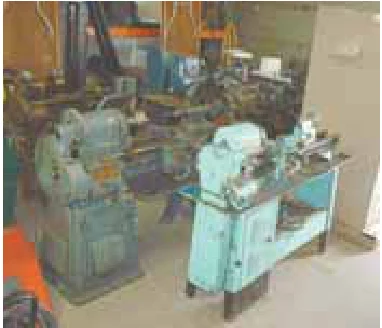
Robert Hanson is an unusual fellow. He can help design a new product, reproduce an obsolete part, or he can sell you a secondhand milling machine or metal lathe and teach you how to do it yourself. His company, Manufacturing Solutions, does all types of fabrications in wood, metal, plastic and stone, operating a nearly 2,000-sq. ft. machine shop.

“One of our bragging rights is building a braking system for a F-117A Stealth Fighter and a fuel cell testing system for the Delta 2 rocket program,” says Hanson.

“We’ve done everything from building a prototype for an aircraft ice detection system now used by the FAA to building rubber band guns or equipment for a farm or ranch.” Hanson has been doing machining for the past 17 years. His shop is fully equipped with manual and CNC lathes and mills, sheet metal fabrication equipment, heat-treating ovens, MIG and TIG welding and woodworking tools.

“We do precision machining,” says Hanson.

“We have all the tools and toys every machinist dreams about.” Matching new tools to his changing business, Hanson would often look for high quality secondhand industrial equipment. Often times while looking at one piece of equipment, he would see other pieces also for sale for a good price and buy them as well. As different jobs and different needs developed, he ended up with surplus equipment. For the past 7 years he has been selling those tools along with other things he found for a good price.

“I pick up a lot of equipment on the East Coast and fill a semi at a time,” says Hanson.

“We have everything from restaurant equipment to tools for working on wood, metal, pneumatics, hydraulics and electrical systems.” Today he has a 6,000-ft. showroom, 1/2-acre of motor homes, and a Quonset-style fabric roof storage building with another 3,000 sq. ft. of stuff.

“We’ll buy, sell or trade almost anything,” says Hanson.

“A lot of it is by word of mouth. Last year we sold 24 vertical milling machines ($800 to $3,000) and 17 metal lathes ($700 to $2,200) and even more the year before.” In addition to on-site sales, Hanson sells a variety of items through Craigslist. Recent listings included milling machines, lathes, a Kawasaki motorcycle and a beer cooler. A good share of the tools he sells have 3-phase motors.

“Just about any piece of industrial shop equipment is 3-phase, even new equipment,” he says.

“Most people don’t have 3-phase power, so we sell and install different lines of static or rotary phase converters.” Hanson notes that a converter allows customers to get a good deal on a machine and run it on their single-phase power. He points out that while a rotary is more expensive, it works with hard starters like a lathe or air compressor.

“Once you make the plunge on a 15 hp rotary converter, you can generally run an entire shop off it,” says Hanson. Industrial 2nd Hand’s website doesn’t have a listing of products on-hand. Hanson suggests stopping by if in the area or simply calling if you need a lathe or milling machine - or even a beer cooler. He offers training on equipment as well.

“In a few hours, I can train someone to run a milling machine,” says Hanson.

“We work with a lot of farmers and ranchers who want to make their own repairs.” Contact: FARM SHOW Followup, Manufacturing Solutions, 2130 Dyess Ave., Rapid City, S. Dak. 57701 (ph 605 343-3933; [email protected]; www.industrial2ndhand.com).

From the archive · Full text
Feature story

Battery Tester For DeWalt 18-Volt Cordless Batteries

Featured source: Elam Stoltzfus

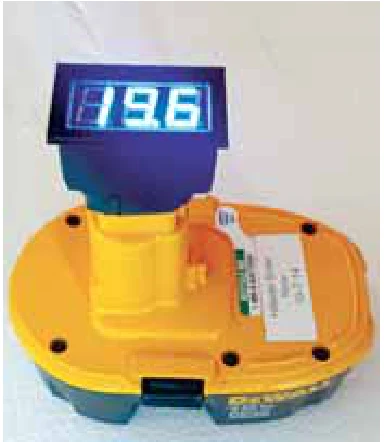
Anyone who uses DeWalt 18-volt cordless tools will like this new digital battery tester put together by Elam Stoltzfus of Kirkwood, Penn. The unit attaches to the posts on any DeWalt 18-volt battery and shows the voltage in big, brightly lit numbers on top.

“It tells you exactly how much voltage is left in the battery. As far as I know there isn’t anything like it on the market,” says Stoltzfus. He says DeWalt’s 20-volt cordless batteries come with 3 built-in indicator lights that show you when the battery is running low, but they don’t show you the actual voltage.

“The company’s 18-volt cordless tools don’t even have the indicator lights,” says Stoltzfus.

“So if you have multiple batteries laying around and don’t know if they’re charged or not, you have to install them in the tool to find out.” Stoltzfus bought a 12/24-volt meter and a plastic adapter with 2 metal prongs on it. He soddered the volt meter leads to the metal prongs and then glued the adapter onto the bottom of the volt meter.

“Everything is molded and sealed inside the tester,” says Stoltzfus.

“I came up with the idea because we’re Amish, and we started using modified DeWalt 18-volt LED lights in our house instead of propane-operated lights. The lights we buy come with a fluorescent bulb tube, which we replace with an adapter that lets us screw in the LED bulb.

“We might have 4 or 5 batteries on hand as backups for the lights at any time. The lights come with an automatic shut-off when the battery runs low. With the voltage tester we can quickly find out which batteries need to be charged.” The battery tester sells for $35, with free shipping anywhere in the U.S. (Pennsylvania residents have to pay a 6 percent sales tax.) Contact: FARM SHOW Followup, Elam L. Stoltzfus, 5465 Street Rd., Kirkwood, Penn. 17536 (ph 717 529-0173).

From the archive · Full text
Feature story

Sandblaster Cabinet Made From Old Dishwasher

Featured source: John Gass

“I build or fix alot of things in my shop, so when a friend asked me if I wanted an old commercial dishwasher that he was throwing away, I jumped at the chance,” says retired Illinois steam fitter John Gass.

“Within a few days I figured out how to make it into a real nice sandblasting cabinet.” The 30-in. high and wide dishwasher cabinet opened with double doors on 2 sides and had racks on 2 sides that pulled out to load and unload dishes. Gass built a 4-legged stand to position the washer 2 ft. above the floor. Then he re-worked one of the inside racks so it holds small parts that he’s sandblasting. He completely removed the opposite rack so that side had a flat wall. About 10 in. from the bottom of the empty sidewall he cut 2 round openings and added protective rings with gloves on the inside. That provides access so he can reach inside to hold the spray gun with one hand and use his other hand to hold the parts he’s working on. His hands are protected with heavy-duty rubber gloves and his arms with welding leathers that he sews to the top of the gloves. Gass cut an 18 by 18-in. opening above the hand access ports so he can see what he’s working on inside the cabinet. The opening is covered with 1/4-in. safety glass that he can replace if it gets fogged over or pitted. He put a light fixture in one of the top inside corners and for ventilation he ran an old vacuum cleaner hose through the top and hooked it to a shop vacuum. Gass removed the washing mechanism from the floor of the machine and installed a 1-in. dia. drain.

“As far as sandblasting cabinets go, this is about the strongest one I’ve ever seen,” Gass says.

“Even some of the heavier-duty models that you can buy have sides that are flexible. The sides of my dishwasher/blaster are completely solid.” Gass uses the sandblaster a couple times a week to clean parts for cash registers that he’s restoring or removing chrome from pot bellied stoves that he’s fixing. He uses silica sand on some parts and soda ash for others. Most of the sandblasting he does requires 160 to 170 lbs. of air pressure which he gets from a commercial compressor in his shop. Contact: FARM SHOW Followup, John Gass, 153 Frog Hill Road, Franklin, Ill. 62638 (ph 217 370-8902; [email protected]).

From the archive · Full text
Feature story

“Swing-Out” Shop Exhaust System

Featured source: Kerry Kligora

Kerry Kligora, Mineral Point, Wis., does a lot of welding in his shop. To help get rid of the welding fumes, he installed a “swing-out” vacuum exhaust system that he built out of pvc pipe and the air pump from an old Jacuzzi hot tub.

“It allows me to vacuum as close to the welding area as possible, and swings out of the way against a wall when I don’t need it,” says Kligora. The exhaust system sets about 7 ft. above the shop floor on a wall above the working area. It consists of 2-in. dia. pvc pipe and elbows that hook up to a 1 hp, 110-volt air pump from a Jacuzzi hot tub. A 3 1/2-in. dia., accordion-style vent tube (the air induction tube off a car) hangs down from the end of a horizontal 5-ft. length of pvc pipe. The pipe is supported by a cable and pivots 180 degrees on a male and female threaded coupler.

“It’s really handy to use. I swing the pipe out from the wall whenever I need it, which allows me to extend the vent tube as close to the welding area as possible,” says Kligora.

“The cable is tight when I’m using the system, but sags otherwise so I screwed a shelf bracket to the wall to support the vent tube.

“The air pump pulls plenty of air through the 15 ft. of piping and gets rid of 80 percent of the fumes. If I want, I can wire up the vent tube at an angle and suck fumes just 3 to 4 in. from the welding area so it doesn’t get too hot. I can also put the vent tube over or near the exhaust stack on skid loaders and tractors while working on them in the shop.

“I came up with the idea because I want to keep my shop doors shut while I do welding work during the winter. I don’t like to turn on the shop’s main exhaust fan because too much hot air is lost. The vent tube only sucks a small amount of air from the immediate area where I’m welding. It could be a little wider, so I plan to fashion a bigger hood from lightweight plastic that will help gather the exhaust from a wider area. The vent tube extends 4 1/2 ft. down, but I can reach up and push it in for storage so it’s only 18 in. long.” The pump is screwed to a piece of plywood that’s screwed to the wall. Kligora attached the pvc tube to the pump by drilling pilot holes into a flange on the pump, and then screwing the tube on with three 1-in. sheet metal screws.

“The pump rotates at 3,200 rpm’s and pushes about 800 cu. ft. per min., so it has a lot more suction than you’d think for such a small pump. You can often find such pumps free on Craigslist,” says Kligora. He already had the air pump, which had a cracked housing.

“I had everything else I needed except for one or 2 pvc fittings,” he notes. Contact: FARM SHOW Followup, Kerry Kligora, 2138 County Rd. E, Mineral Point, Wis. 53565 (ph 608 553-2062; Kerry. [email protected]).

From the archive · Full text
Feature story

“Whiz Twister” Twists Electrical Wires Together

Featured source: Merle Robinson

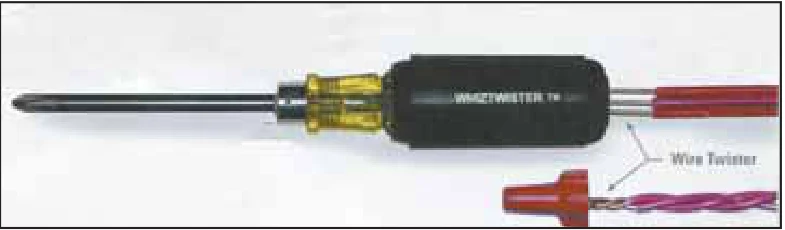
Invented by a retired electrician, the new Whiz Twister combines a screwdriver with a wire twisting drive tool. The twisting mechanism is inside the handle.

“It makes twisting electrical wires together a much easier and faster job, producing safe and secure connections. It works great for all your wire twisting needs,” says Merle Robinson. The Whiz Twister is designed to twist or untwist up to four no. 12 electrical wires, and can accommodate wire sizes ranging from 10 to 18 ga. To twist the wires you first strip about 3/4 in. of insulation off the wires, then insert the wires into holes in the handle and turn.

“Steps” in the twisting mechanism accommodate different size wires. Once the wires have been twisted together into one wire, you can remove it and then twist on a plastic connector cap.

“It makes a nice, tight twist and works great for everything from electrical wire for houses to electric fence wire,” says Robinson.

“It really comes in handy when you’re doing remodeling and electrical work. It works faster than a pliers and also doesn’t scar the wires like pliers can.” The Whiz Twister is available in 2 models. Model WT100 comes with a magnetic bit holder, 1/4-in. nut driver, and interchangeable multiple size bits. It retails for $30. Model WT83593 is a Phillips screwdriver without a magnetic bit holder or nut driver. It retails for $20. Both models can also be used to twist 14, 12, and 10-ga. electric fence wire. They can’t be used to twist phone or speaker wire. Contact: FARM SHOW Followup, Merle Robinson, P.O. Box 538, Hesston, Kansas 67062 (ph 620 327-5115 or 620 327-7440; [email protected]; www.whiztwister.com).

From the archive · Full text
Feature story

“Reefer” Engines Make Low-Cost Gensets

Featured source: Joas Bontrager

Joas Bontrager pairs low hour Kubota engines repurposed from reefer trailers with new generators to make low cost gensets. Gensets are also available with new motors if preferred.

“We offer dependable, Kubota, diesel-powered generators from 9 to 68 kW in size,” says Bontrager.

“We also have natural gas-powered gensets up to 150 kW in size.” In the case of the used engines, Bontrager strips them down and replaces component parts such as wiring, air filters, oil filters, etc. Engines are equipped with auto-start systems or can be started manually. They can also be run on vegetable oil when temperatures are above 50 degrees.

“These are solid, compact units rebuilt from the ground up,” says Bontrager.

“A common size is the 25 kW model, which is priced at $5,450. With a new engine, it would sell for about $9,000.”

The engines are also available by themselves. Bontrager says they are used to repower cars, trucks and tractors. They also can be mounted on a skid to power belt-driven equipment.

“A 4-cylinder 40 to 48-hp engine runs about $1,800,” says Bontrager.

“We ship by truck freight.” He points out that if using vegetable oil for fuel, it does require a catalyst/additive. He is a dealer for a catalyst that he has found works well.

“The catalyst will work with vegetable oil in any diesel engine, not just the ones I sell,” says Bontrager.

“Just call for pricing of the quantity you need. Contact: FARM SHOW Followup, Joas Bontrager, 11630 West 450 North, Middlebury, Ind. 46540 (ph 574 642-1256).

From the archive · Full text
Feature story

360-Degree Welding Table Makes Big Jobs A Snap

Featured source: John Martens

When John Martens was building large liquid fertilizer caddies, he needed a way to handle the big frames. His 360-degree table and hoist made it easy.

“I manufactured 135 carts over an 8-year period and the table was a big help,” says Martens.

“I can clamp frames in place, weld them up, and attach wheels. Using the overhead hoist, I can then pick the caddy off the table, set it down on the floor, and roll it out the door.” The welding table is made from 4 by 6-in. steel tubing. At one end, the table is attached by a pipe-in-pipe bearing to an irrigation wheel gearbox with forward and reverse drives. It’s powered by a 3/4 hp electric motor. A large pulley from an Oliver model 40 combine on the gearbox drive, slows motor speed.

The other end of the table also is attached to a pipe-in-pipe bearing. Both ends are supported by 3 by 3-in., 1/4-in. angle iron legs.

“I put adjustable screws made from threaded rod between the legs and the floor,” says Martens.

“The rods have steel pads that rest on the floor. The rods turn through 2 nuts welded together at the base of each leg. They make it easy to adjust the height or level the welding table ends.” Martens put a goose leg in the table to accommodate the design of the fertilizer caddies. He points out that it could be any design; however, it continues to work with other projects as well.

“This past winter I used it to weld a frame for a neighbor’s picnic table,” says Martens.

“I just made the clamps I needed to hold the piece in place.” Contact: FARM SHOW Followup, John Martens, 45156 Road 3 W, Sanford, Manitoba Canada R0G 2J0 (ph 204 736-2723).

From the archive · Full text
Feature story

Deere Lawn Tractor Parts

Featured source: Dave Kendrick

“My son started collecting lawn tractors and the hobby pretty much got out of control,” says Dave Kendrick of J & D Lawn Tractor.

“The next thing he knew he had enough equipment to open a parts business, and here we are 10 years later, still going strong.” Anyone needing new or used parts for Deere lawn tractors from the early 1960’s to the current models would do well to call Dave or his son, Jon.

“We’ve parted out about 200 tractors, and we’ve got parts inventories for another 50 to 60 tractors from dealerships that have gone out of business,” Kendrick says. All of J & D’s parts are inspected, tested and carefully packed for shipment to customers. Their inventory has a wide range of transaxles and parts for 110, 112, 200, 300 and 400 series Deere garden tractors. Parts for Kohler engines from 8 to 16 hp are one of their specialties, including cylinder heads, bearing plates, flywheels, starters, carburetors and complete engine blocks. They carry engine rebuild kits, new replacement starters, valve guides, gasket and seal sets, pistons, rings and connecting rods. Hoods, air cleaners, fender pans, grills, headlights and tail lights are also available, as well as hundreds of manuals for older model Deere tractors and Deere attachments. Kendrick says there always seems to be a call for manuals because most used tractors aren’t sold with a manual.

J & D locates old machines and parts inventory from a variety of sources. Kendrick says “I’m always going to auctions, estate sales and checking out dealers to see what’s available. We also buy parts inventories of dealers who’ve gone out of business and we stock new OEM parts as needed. If someone doesn’t want to pay the high price for a new replacement part, chances are good we’ve got a used part at a lower price that will fit their needs.” J & D also has an inventory of 30 to 40 refurbished and rebuilt lawn tractors for sale. Most are used Deere models from the 1960’s that have been mechanically checked and are in good working condition. They carry a large stock of attachments including lawn mowers, snow blades, snowblowers, wheel weights and garden equipment. Kendrick says tractors and attachments are priced separately so buyers can choose the model they need, add an attachment or set of weights if they want, or buy any item individually. Although J & D started as a business serving customers in their immediate area, their service area has grown dramatically.

“We’ve got a website that gives a general listing of what we have for sale, and we get calls and e-mails from people all over who are repairing or rebuilding machines,” Kendrick says.

“In the past few years we’ve shipped parts all over the U.S. and to many countries overseas.” Contact: FARM SHOW Followup, J & D Lawn Tractor, 1254 N. 2150th Ave., Mendon, Ill. 62351 (ph 217 440-8365; www.jndlawntractor.com).

From the archive · Full text
Feature story

Quick Fix For Ford Hydraulic Clutch

Featured source: Lauris Bailey

Lauris Bailey fixed the hydraulic clutch in his 1987 Ford F350 when the local dealer couldn’t. Bad hydraulic clutches in that vintage Ford are so common that Ford puts out a repair kit. However, once repaired, it can’t be repaired again.

“The problem is Ford started building the firewall too thin, and over time it flexes when you push in the clutch,” explains Bailey.

“The hydraulic reservoir on the other side of the firewall malfunctions. The repair kit is a flat plate that is installed between the reservoir and the firewall.” The mechanic at the dealership saw that the plate was already in place. Over time the firewall had started to flex again.

“I could push the clutch most of the way down, but I couldn’t change gears,” says Bailey.

“The tube from the reservoir was not delivering enough fluid to the slave cylinder. It didn’t have enough throw to release the clutch plate. Sometimes I could shift for awhile, and other times I would have to fool with it.” Bailey figured that if the problem was firewall flex, he would give it some backbone.

He bought a new reservoir and tube and measured from the firewall to the engine side of the radiator support bracket. It was just 3 ft. To stiffen the firewall, he went to a salvage yard and bought a 3-ft. long, 3/4-in. rod and screwed 2 nuts on either end. He then installed the rod between the firewall next to the reservoir and the radiator support.

“I screwed the nuts on either end out half a turn at a time until the rod was secure and then locked them in place by screwing out the second set of nuts,” says Bailey.

“Over time, the firewall flexed again, and I screwed the nuts out a little more. Bailey says the first fix lasted for months, and the second allowed him to cut and haul firewood with the truck throughout the summer.

“Hydraulic clutches were the worst idea Ford ever had, and I’ve driven them all my life,” says Bailey.

“This was just the best way to deal with a poor idea of a clutch.” Contact: FARM SHOW Followup, Lauris Bailey, 173 Bailey Hill Rd., New Sharon, Maine 04955 (ph 207-778-4005).