Practical ideas from FARM SHOW MagazineSubscribe · Free issue · Send us your shop tip
Subscribe to FARM SHOW
Issues / Vol. 34, No. 4 (2010)

Vol. 34, No. 4 (2010)

Money-Saving Repairs & Maintenance Shortcuts · Printed section pp. 36–39

33 selected entries · Complete text of selected entries

This issue’s section includes reader tips and feature-length shop stories. Held items and editorial notices are not reproduced.

Archive text: prices, coupons, availability and contact details reflect the original publication, not current offers. Reader methods are not universal instructions; follow manufacturer guidance and proper safety practices.

Reader shop tips

From the archive · Full text
Reader shop tip

Edwin Lillebo

Edwin Lillebo, Presho, S. Dak.

“I’ve noticed reports from several FARM SHOW readers who’ve had trouble with gas getting into the crankcase on Deere Gators. That gas washes oil off the cylinder walls, shortening the life of the engine if not destroying it. A sure-fire cure for this problem is to install an in-line fuel shut-off. If the gas can’t get out of the tank during non-use, it can’t get into the engine.”

From the archive · Full text
Reader shop tip

J.L. Findley

J.L. Findley, Letohatchee, Ala.

“I use the clear lens out of a welding helmet as a layout and sketch tool. I engrave inch and fraction marks out the back side, then blacken them in with magic marker and wipe off the excess before it dries. It’s cheap, you can see through, and all corners are square. One last thing – it fits in a shirt pocket.”

From the archive · Full text
Reader shop tip

Merle Dorn

Merle Dorn, Kensington, Kan.

“I found an old wheelchair in the trash and found a second use for it. The cart under my welder was bad and the wheels were too small. I took the seat out of the chair and replaced it with a piece of plywood. My welder fit in the seat very well, with plenty of room for the leads, welding rod and all my clamps. On back of the chair I have hooks to hold 75 ft. of 220-V extension cord, which I unwrap when I need to weld outside the shop. The large wheels roll easily over rocks and rough ground.”

From the archive · Full text
Reader shop tip

Aaron Barneson

Aaron Barneson, Elk Mound, Wis.

Aaron says he made cheap, bolt-on toolboxes for tractors using military surplus ammo cans. They’re heavy-duty and weather tight. You can bolt them on anywhere. Ammo cans are available at surplus stores and at many sites on the internet.

From the archive · Full text
Reader shop tip

William Griessler

William Griessler, Delanson, N.Y.

“I have read where some of your readers have had problems with their Deere 6 by 4 Gators with a Kawaski engine. I’ve had the same problem with gas draining into the crankcase, diluting the engine oil. I contacted a couple Deere dealers but with no success. I finally cured the problem myself by lowering the electric fuel pump 21 1/2 in. It’s now lower than the carburetor so that gas cannot siphon back to the carburetor and get into the oil.”

From the archive · Full text
Reader shop tip

Nick Neuburger

Nick Neuburger, Galt, Ca.

“Here’s a way to keep a spray nozzle clear after doing a small touch-up paint job and there’s still paint in the can. In order to keep paint from drying in the nozzle and plugging it up, first turn the can upside down and spray until it’s clear of paint. Then, in order to further keep the nozzle clear and operable, place a drop of oil on the nozzle opening. It works every time.”

From the archive · Full text
Reader shop tip

Connors Farm Inc.

Connors Farm Inc., Danvers, Mass.

“I made a chainsaw ‘tree’ to hold and organize the saws in my shop. I took a tree trunk that measures about 16 in. dia. and 6 ft. tall and mounted it standing straight up on a flat metal plate. Then I made slots all around the tree trunk to hold my saws. Looks good and helps keep the saws sharp.”

From the archive · Full text
Reader shop tip

Wayne Wiederrich

Wayne Wiederrich, Saco, Mont.

“Here’s an idea that saves time when changing sickle sections. I modified a vice grips to knock out the sickle section rivets and bolts. I just brazed a half nut and a #50 chain rivet to the side of the vice grips. I place it against the rivet to be removed and hit it with a small hammer. A real time saver.”

From the archive · Full text
Reader shop tip

Dan Morrison

Dan Morrison, Transfer, Penn.

“I use 3/4-in. thick, 4 by 8-ft. sheets of oak veneer plywood to make wall units and entertainment centers. To cut straight without splintering, I came up with the idea of laying the plywood sheets on top of a 1-in. thick sheet of blueboard on a concrete floor.

“I find that cutting through the plywood and about 1/8 in. into the blueboard eliminates any chance the plywood will pinch the blade. It also keeps the bottom of the plywood sheet from splintering. Splintering on top of the sheet is minimal when ripping. When making crosscuts, I tape the surface of where I’m going to cut with 2-in. masking tape to minimize splintering.

“Cutting on top of a blueboard sheet also keeps the bottom of the plywood sheet from getting nicked or scratched up, as is often the case when you drag the plywood over a table saw.

“I lay a 12-in. wide by 8-ft. long strip of plywood over the plywood I’m cutting to serve as a straight edge guide for the saw.”

From the archive · Full text
Reader shop tip

Borgeson Universal

Borgeson Universal, Torrington, Conn.

Borgeson is a leading manufacturer of steering universal joints for both cars and pickups.

“Your readers who own 1994 to 2002 Dodge Ram pickups may be interested in our newest aftermarket offering,” says Jeff Grantmeyer.

“After you’ve replaced the sorry OEM steering shaft that come on these trucks you’ll eventually become fed up with Dodge’s replacement parts. The new Borgeson ‘Dodge Box’ offers a larger piston diameter for more available power assist; quicker ratio for easier parking and less turns lock-to-lock and a modern variable valve that allows for stable highway driving and effortless parking and maneuvering.” The Dodge Box bolts directly to the stock mounting location. It fits the original pitman arm and the stock hoses and pump. It includes an adapter to work with all Borgeson replacement steering shafts. A Borgeson steering shaft is required to install the steering box (ph 860 482-8283; www.borgenson.com).

From the archive · Full text
Reader shop tip

Tom Daniels

Tom Daniels, Arco, Minn.

“I’d like to offer help to Wayne Harley in Penn., who had a problem with gas leaking into the crankcase on his 2007 Deere 6 by 4 Gator equipped with a Kawasaki engine (Vol. 34, No. 2). I had the same problem. My mechanic and a small engine specialist determined it was caused by stale gas that wasn’t completely burning. Since then I’ve used a gas stabilizer in the fresh gas and haven’t had any problems. I’ve had this problem only with Kawasaki engines.”

From the archive · Full text
Reader shop tip 1 of 2

Lanny Vail

Individual tip 1 of 2 from this reader’s published contribution.
Lanny Vail, Bowman, N. Dak.

“The booster fuel pump on our 1951 Oliver diesel tractor that feeds the main fuel injection pump was leaking fuel into the engine oil. Not being able to find a new or rebuilt tractor pump to fit, I went to our local NAPA parts dealer and found a fuel pump for a 1950’s 216 Chevrolet engine that had the right size diaphragm but the wrong size housing. I took the diaphragm from the new pump and it fit perfectly into the old 4146 AC pump’s housing.

“Problem solved. No more fuel in my tractor’s engine oil.

From the archive · Full text
Reader shop tip 2 of 2

Lanny Vail

Individual tip 2 of 2 from this reader’s published contribution.
Lanny Vail, Bowman, N. Dak.

“For Ford 9N, 2N, and 8N tractors, the newer Hy-Tran oils that go into the rear end and hydraulic system are a little thin for the tractor’s lift system to work smoothly. One solution is to mix your own oil by combining 1 gal. of rear-end oil with 1 gal. of STP oil treatment. This will result in a Hy-Tran type of oil that has about the same consistency as the fluid that came in these tractors from the factory when new.”

From the archive · Full text
Reader shop tip

Stuart Baker

Stuart Baker, Madison, Wis.

“The attic in my garage has a very low ceiling, and as a result I was continually bumping into the ceiling lights with my head and breaking off the bulb. I had some construction site pigtail light receptacles, so I wired them into a duplex plug and replaced the bulb with a screw-in outlet adapter. Now I just plug in the light and it dangles from the fixture. The whole thing is very light, and the plug easily supports the weight and holds it in place. It just swings out of the way if I bump into it.”

From the archive · Full text
Reader shop tip 1 of 3

Bruce Ashick

Individual tip 1 of 3 from this reader’s published contribution.
Bruce Ashick, Pembroke, Ont.

“The rubber on the crimp rollers in my Deere mower-conditioner started coming off in pieces. To solve the problem I removed the rollers, stripped off the rubber, and then welded straight 3/4-in. sq. rod on the rollers to replace the rubber. The spacing of the bars is very important, and when welding you don’t want to warp the rolls with heat. The mower-conditioner still runs just as quiet as it did with the rubber crimp rollers, which surprised me.

From the archive · Full text
Reader shop tip 2 of 3

Bruce Ashick

Individual tip 2 of 3 from this reader’s published contribution.
Bruce Ashick, Pembroke, Ont.

“The rubber gearshift boots on my tractors kept tearing and getting hard, even though the tractors are stored in a shed when not in use. To solve the problem I took a heavy rubber tube and cut round boots, leaving a hole for the shift lever, and slipped them over the original boots. They’re still in good shape.

From the archive · Full text
Reader shop tip 3 of 3

Bruce Ashick

Individual tip 3 of 3 from this reader’s published contribution.
Bruce Ashick, Pembroke, Ont.

“I built my own arc air gouging tool from an old welding lead, some small steel tube, and air hose. It lets me burn carbon rod with air blowing on the end, which lets you remove old cracked weld in seconds or gouge 1 to 1 1/2-in. plate steel for welding up cracks.”

From the archive · Full text
Reader shop tip

Ken Hardesty

Ken Hardesty, Battery Equalizer (ph 888 851-4431; www.batteryequaliser.com)

“Battery Equalizer was developed 25 years ago and is used by the U.S. military. It will double or triple the life of any vehicle’s battery. It’s a water-based product that reverses the built-up sulphation that kills batteries as they get older. As a result, the battery will gradually return to like new condition.

“Use it as a regular top-up fluid. A 12-oz. bottle will treat up to 4 batteries and sells for $19.95 plus S&H.”

From the archive · Full text
Reader shop tip

Rick Arnzen

Rick Arnzen, Kelso, Mo.

“Don’t throw away that old ironing board – it just might be the handiest portable tool bench around. Ironing boards are lightweight and easy to handle, especially the newer ones. I find they work great for storing tools any time I’m working alongside a truck, tractor or car.

“For example, if I’m working under the hood I keep my wrenches on the ironing board instead of having to bend over for them on the floor. And when I’m done, the ironing board folds up out of the way. I got the idea when I went camping one time and took an ironing board with me. I used it alongside my barbeque grille to hold my utensils.”

From the archive · Full text
Reader shop tip 1 of 2

Larry Genge

Individual tip 1 of 2 from this reader’s published contribution.
Larry Genge, Glovertown, Newfoundland; ph 709 533-2798, [email protected]

“I built this 20-ton press from scrap metal, using 10-in. channel iron for the side posts and 6-in. channel iron for the bed. I can use 3 different sizes of interchangeable dies with it, ranging from 3/4 to 1 1/2 in. The hood springs off an old car help raise the bed. My cost to build it was next to nothing - the biggest expense was $100 for the jack. I got the channel iron in return for repairing someone’s road tractor, which was a day’s work.

From the archive · Full text
Reader shop tip 2 of 2

Larry Genge

Individual tip 2 of 2 from this reader’s published contribution.
Larry Genge, Glovertown, Newfoundland; ph 709 533-2798, [email protected]

“I got tired of the flimsy handles coming unscrewed on my imported drill press. The press had three short, thin screw-in handles that stuck out at an angle and provided no leverage. The handles pulled hard, and I couldn’t keep them tight because the threads often stripped where the handles were screwed on.

“To solve the problem I replaced the handles with a big 12-in. dia. wheel that came off a valve. The wheel has four l1 by 1/2-in. dia. metal handles welded on with knobs, scrounged from hydraulic control levers, friction-fitted to the ends. When using small bits with the drill press I just hold onto the wheel, but when using large bits I hold onto the handles to get more leverage. The improvement in the way my drill press handles now is beyond belief.”

Shop feature stories

From the archive · Full text
Feature story

Keyway Solves Feederhouse Drive Problem On Deere Combines

Featured source:

“Our new variable speed drive sheave repair solves a problem with the lower feederhouse drive on many Deere combine headers. It also saves a lot of money,” says Martin Meister, Double M Machine, Inc., Fairbury, Ill. The drive is used on Deere 6620, 7720, 8820, 9400, 9500, and 9600 combine models, which were made from the late 1970’s up through the late 1990’s.

“The problem is that the original keyway that drives the cam inside the feederhouse wears to the point where the feederhouse no longer works,” says Meister.

“Without repairing the keyway you have to buy an entire new drive assembly at a cost of $750 to $800. We rotate our new keyway 90 degrees from its original position. It restores the drive to like-new condition.” Sells for $105 plus S&H. Contact: FARM SHOW Followup, Martin Meister, Double M Machine, Inc., 614 W. Pine, Fairbury, Ill. 61739 (ph 815 692-4676; [email protected]).

From the archive · Full text
Feature story

Crane Makes Big Jobs Easy

Featured source:

Not too many welding shops have their own full-sized construction crane. But Royal Weber, who has a crane at his shop in Nokomis, Ill, says you’d love it if you had one. He picked up an old crane for next to nothing because it had a frozen Buda engine. He had a truck that had been hit by a train but still had a good engine. He traded the truck for the crane and kept the engine. He installed it in the crane which now works perfectly, positioned off to the side of the opening to his shop. Weber says it’s great for handling very heavy pieces of steel and equipment. The crane pivots 360° so he can pick up steel and other parts from his inventory and move them to the front of the shop where he does his work. Contact: FARM SHOW Followup, Royal Weber, 19234 E. l28th Rd., Nokomis, Ill. 62075 (ph 217 563-8504).

From the archive · Full text
Feature story

Roll Bars Turn Car On Its Side

Featured source:

Kees Koster really dislikes working on the underside of a car. His answer is to turn the car on its side with his custom made roll bars.

“I got the idea from a commercial unit I saw at a car show,” explains Koster.

“Using a battery powered drill and some pivot arms, they laid a Mercedes safely on its side. I came up with a simpler version, and it didn’t cost $1,500 like the show model.”

He first takes the wheels off one side of the car and then attaches roll bar brackets to both hubs. The brackets are pieces of curved pipe.

“I welded two of them to each of two rims that matched the rotors on the car axles that I wanted to lay on its side,” explains Koster.

“I then put a chain around the front wheel on the opposite side and lift, being careful to keep the chain away from the car body panels.”

With the car “rolled” over, he could easily work on it. However, he recognized a couple of ways to improve the process. One was to modify the brackets so they could be used on other cars. To do so, he cut away most of the rims and torched two holes in what remained.

“When I want to work on a different car, all I have to do is find two discarded rotors that matched the car,” says Koster.

“Once I’ve burned two holes in the rotors, I can bolt them to the brackets.”

Koster says to safely roll the car over, the brackets need to be attached to the car with at least four if not five bolts. Using matching rotors makes that easy to do as the bolt holes match up exactly.

He also realized that as the car was rolled, it placed tremendous torque on the steering wheel. Simply engaging the steering wheel lock is not enough. However, attaching a straight edge such as a 2 by 4 to both brackets eliminates the problem.

A third problem involved lifting the car. Instead of hoisting it from a wheel on the soon to be “high” side, he now removes the former lift wheel and bolts a steel bar to the under-frame. Using a bar slightly longer than the underside of the car is wide gives him a lift point that is safely re-moved from the car body. Finally, he puts two posts under the car to hold it in place.

“It works great, especially for working on the exhaust system,” says Koster.

“I only take the battery and engine oil out, though you do need to empty heavy objects out of the trunk. I’ve had a car sit on its side like that for a month at a time and have it start right up when returned to all four wheels.” Contact: FARM SHOW Followup, Kees Koster, 131 Cogmagun Rd, RR # 1, Center Burlington, Nova Scotia Canada B0N 1E0.

From the archive · Full text
Feature story

“Mower Tilt” On The Market

Featured source:

When FARM SHOW first profiled Arthur Wright’s Mower Tilt (Vol. 32, No. 6), all he had was a prototype. Since then, the retired West Virginia coal miner has lined up a company to make and market the device.

“I struck a deal with Ohio Steel, and they have lined up distribution through Northern Tool and a couple of other major national chains,” says Wright.

He encourages other FARM SHOW readers with product ideas to pursue marketing them.

“No matter what age you are, if you have a good idea, pursue it,” he says.

“I did, and it’s paying off for me. It has been wonderful for me and my family.”

Wright sent me one of his units to try. It works great!

Now called the Ohio Steel Mower Tilt, it gives easy and safe access to the underside of a mower deck on the lawn or in the shop.

The Tilt consists of a 10 in. long by 4-in. wide powder coated steel plate. You secure the plate to the lawn with a 12-in. cork screw stake inserted through a hole in the plate, and slip the mower handle down and under the curled end of the plate. A quick release pin on a lanyard slips through two holes in the curl to lock the mower into place.

My U-bar lawn mower handle is a fold over style with a crossbar midway. Securing the crossbar instead of the end of the handle gave me even more access to the under deck.

If you prefer working in the shop, the plate comes with two holes predrilled for 1/4-in. screws. Simply mount the plate to an open wall and secure the mower to the plate with the open under deck facing out for maintenance or storage.

Suggested retail price on the Mower Tilt is $14.99, but it is widely available for $12.99 at various websites including Northern Tool & Equipment.

Contact: FARM SHOW Followup, Northern Tool & Equipment (ph 952 894-9510 or 800 221-0516; www.northerntool.com).

From the archive · Full text
Feature story

“Wheel Holder” Makes Painting Wheels Easy

Featured source:

“I needed a way to paint car wheels so I made my own wheel holder. I just set the wheel in and clamp it down, and then I can turn the wheel in any direction without marking the paint,” says Loren Smith, Spring Valley, Minn. The wheel holder mounts on a tripod and is made out of 2-in. dia. pipe that rides inside a short length of 2-1/2 in. dia. pipe, which allows the wheel holder to rotate. An adjustable crossbar on top of a rectangular metal frame is used to hold the wheel tight. It’ll hold wheels from 8 to 16 in. dia.

“It works great for painting wire spoke wheels,” says Smith.

“I used to restore cars and painted a lot of Ford Model A wheels with wire spokes. I can clamp the center of the wheel and turn it in any direction I need to get the proper angle for painting the spokes. The only part that touches the paint at all is in the center, where the wheel is clamped on.

“A pair of short metal pegs extend up from each lower corner of the frame and go up against the inside of the wheel, while the crossbar clamps down on top of the wheel. A slot and wing nut on both sides of the frame are used to raise or lower the unit according to the size of the wheel.” Contact: FARM SHOW Followup, Loren Smith, 16033 Co. Rd. 5, Spring Valley, Minn. 55975 (ph 507 421-9996).

From the archive · Full text
Feature story

Turbocharge Kits For Kubota RTV’s, Deere Gators

Featured source:

People always want more power from their equipment, especially at higher elevations. In the case of Kubota RTV’s and Deere Gators, the potential is there, suggests Ted Meyer, Stone’s Farm Service (SFS). Gaining extra power on a Deere Gator or Kubota RTV is as easy as installing an SFS turbo kit.

“We do a lot of tractor pulling, and the majority of the teams use Kubota RTV’s as work vehicles because they’re so durable and well built,” says Meyer.

“The two complaints is that they need more power and that they stop too aggressively when you back off the foot throttle.”

With extensive experience putting turbochargers on 4020 Deere tractors and 6.9-liter diesel pickups, Meyer and the SFS team developed a turbo kit for the RTV’s and later for Gators as well. They also developed a “coast valve” for the Kubota RTV 900 and 1100. It bypasses or modulates the hydrostatic pressure during deceleration.

“Performance wise, the turbos deliver up to a 50 percent or better gain depending on what elevation you are at and how the injection pump is adjusted,” says Meyer.

“The coast valve lets you shift much more easily between ranges.”

Meyer says installation is straightforward and simple with both turbos and coast valve.

“The turbo installation instructions include how to adjust the injection pump and information on adjusting the transmission as well,” says Meyer.

“The bolt-on turbos can be can be installed in 30 min. or less.”

Both turbo kits are listed at $1,998. Coast valves are listed at $139.99.

Contact: FARM SHOW Followup, Ted St., Greensburg, Ind. 47240 (ph 812 614-7878; [email protected]; www.sfsspecialties.com).

From the archive · Full text
Feature story

Sanding Blocks Made Of Solid Grit

Featured source: Klingspor Abrasives

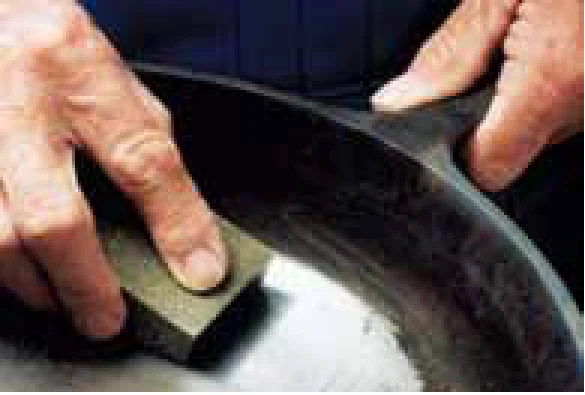
“Unlike sandpaper, they’ll never run out of sanding power,” says Dolores Richardson, Klingspor Abrasives, Hickory, N.C. about new Sandflex sanding blocks. The rubberized abrasive blocks contain silicon carbide grit all the way through. Each block measures 3 in. long by 2 in. wide by 5/8 in. thick. There are 3 different grades. You just use it like a rubber eraser.

“As the block wears down it won’t dull or lose its scrubbing power because you’re always exposing more grit,” says Richardson. Sandflex blocks can be used in water or oil.

“They’re not as abrasive when wet so they work great to clean stainless steel sinks, or to clean the bottoms of pots and pans. It’ll work on anything with rust or tarnish including scissors and barbeque grills,” says Richardson. Sandflex blocks, either fine, medium or coarse, sell for $3.95 apiece plus S&H. A 3-pack of 1 fine, 1 medium, and 1 coarse sells for $9.95 plus S&H. Contact: FARM SHOW Followup, Klingspor Abrasives, P.O. Box 2367, Hickory, N.C. 28603 (ph 800 726-3359; [email protected]).

From the archive · Full text
Feature story

Teeter Totter Service Ramp For Garden Tractors, ATV’s

Featured source:

“It provides me with a safe and easy way to clean the deck and sharpen the blades on my riding mower. I wouldn’t be without it,” says Graham Keeney, International Falls, Minn., about his home-built, drive-on service deck. The ramps hold the tractor about 2 ft. off the ground and are made from corrugated and nonskid metal. They’re 10 ft. long by 10 in. wide. The deck’s legs are made from 2 1/2-in. sq. tubing, with skid plates allowing the unit to be pulled around Keeney’s shop or yard. What makes the service deck unique is how it tilts to the ground for loading, and then tilts back to a horizontal position once the riding mower reaches a tipping point.

“The deck is balanced to stay in an angled position when not in use, but levels out to a horizontal position as soon as the riding mower reaches the deck’s ‘overcenter’ point,” says Keeney. A small, 1-way hydraulic cylinder positioned under the ramp softens the up-and-down motion. The cylinder is attached to a bracket with a pair of metal pins that allow the cylinder to pivot as the ramp tilts.

“I restricted the flow inside the cylinder so the cylinder moves nice and slow,” says Keeney. He also uses the ramps to drive a garden tractor or ATV into a pickup bed. Contact: FARM SHOW Followup, Graham Keeney, 3913 Hwy. 11, International Falls, Minn. 56649 (ph 218 283-2360).

From the archive · Full text
Feature story

Rebuilder Specializes In “Everything”

Featured source: Garnet Townson

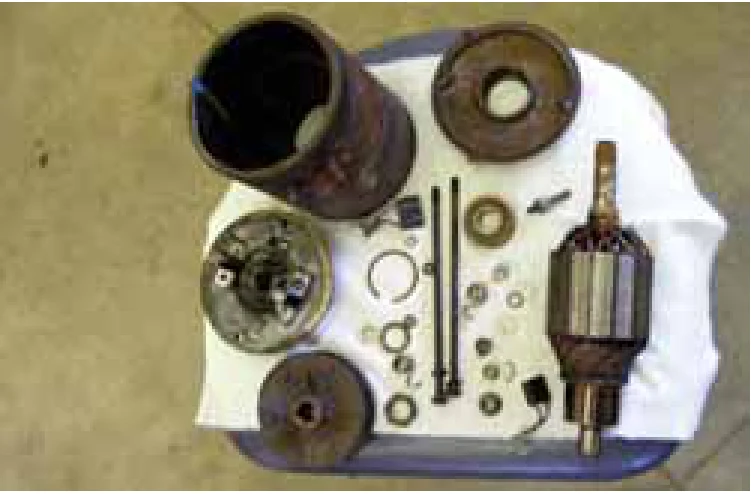
Garnet Townson will rebuild almost any electrical component you send him from cars, tractors or trucks. Alternators and starters are his specialty, but he will attack winch motors, starters, magnetos and others. If it can be fixed on a bench, he’s probably done it, says the Class A mechanic. Increasingly, the older the component, the better.

“Ironically, it’s getting harder to get parts for newer equipment,” says Townson.

“More and more companies would rather sell assemblies or even entire units rather than individual parts.”

With older parts, it’s often a matter of knowing where to look, he says.

“I know companies that carry old parts in Canada and the U.S.,” says Townson.

“You just have to root and dig.”

He suggests calling or writing first for an estimate on parts and labor before sending anything to him. That way he can do some research, if needed.

“I like to have the year and model with the model number if possible,” he says.

“At the least, I need to know what it’s from and the make and model of it. While he works on lots of late model equipment, Townson says he has seen some unique items over the years.

“I’ve worked on International magnetos from 1915 and 1916, starters out of the 1920’s and even a generator from a 1918 Gray Dort car.”

Old or new, Townson gives estimates based on the difficulty of getting parts, cost of parts, and condition of the item to be rebuilt.

Contact: FARM SHOW Followup, Garnet’s Rebuilding, 2176 Hwy 654th W., R.R. #1, Callander, Ont., Canada P0H 1H0 (ph 705 752-5576; [email protected]).

From the archive · Full text
Feature story

Net Turns Fan Into Dust Collector

Featured source:

Add an Air Net from Lee Valley Tools to a standard house fan, and you’ve got a slick portable dust collector for your shop. The netting used was originally developed for industrial use to protect workers from air-borne particles.

The Air Nets come in two sizes. One fits round fans up to 18 in. in diameter and the other fits round fans up to 24 in. in diameter and square fans up to 20 in. across. To use, simply attach the Air Net to the fan and point the fan away from the work area.

The material traps particles as small as 5 microns. Air infiltration depends on size and speed of the fan. As dust collects, the net discolors, first at the seams.

“When you see discoloration, it’s time to wash,” says Wally Wilson, Lee Valley Tools.

“Using the Air Net around something like drywall dust, you might not notice discol-oration. However, if the fan starts to draw heavy, that is also a good time to machine wash. The nets are made with very robust materials.”

Wilson emphasizes the net is not meant to be a substitute for dust masks or respirators. The Air Nets are priced at $56.50 and $76.50 for the medium and large sizes, respectively.

Contact: FARM SHOW Followup, Lee Valley Tools Ltd., P.O. Box 1780, Ogdensburg, N. Y. 13669 (ph toll free U.S. 800 871-8158; toll free Canada 800 267-8767; www.leevalley.com).

From the archive · Full text
Feature story

Air Compressor “Shop Seats”

Featured source:

Randy Hopkins turned an old air compressor into a pair of handy roll-around shop seats. He cut a 12-gal. compressor tank in half and attached tractor seats to the top.

“The seats are at just the right height for working in my garden, shop or garage,” says Hopkins. He removed the compressor’s motor before cutting the tank in half. He bolted the tractor seats on top and then painted everything IH red and added IH decals. He cut off half of each closed end and welded them to the bottom of the open end to keep tools and parts from rolling out. Wheels and a short handle on back make them easy to roll around. Contact: FARM SHOW Followup, Randy Hopkins, 9765 E. 2600 N. Rd., Potomac, Ill. 61865 (ph 217 286-3418).