Arnold Ross
“To reduce maintenance on our Hesston 1014 hydroswing mower, we raised the tractor drawbar about 8 in. That lets it float a lot more so it doesn’t run into ridges or terraces as you cut. It’s made a big difference.”
Money-Saving Repairs & Maintenance Shortcuts · Printed section pp. 38–39
17 selected entries · Complete text of selected entries
This issue’s section includes reader tips and feature-length shop stories. Held items and editorial notices are not reproduced.
“To reduce maintenance on our Hesston 1014 hydroswing mower, we raised the tractor drawbar about 8 in. That lets it float a lot more so it doesn’t run into ridges or terraces as you cut. It’s made a big difference.”
“When replacing a hose or wire on a piece of equipment, especially if it’s long or hard to get to, attach a piece of wire to the one end before pulling the old hose out. This makes it easy to pull the new hose, or wire, into place.”
“When I have to drop a transmission out of a big truck, I don’t trust transmission jacks. They don’t seem too safe. So I came up with my own method.
“I use a pipe across the top of the frame with holes drilled in line with the sides of the transmission. I run a steel cable under the transmission and up through the holes in the pipe and roll up a few feet of cable on the pipe. Then I unbolt the transmission and drop it down by unwinding the pipe with pry bars fitted into holes on the ends of the pipe. The more holes you put in the ends of the pipe, the more precisely you can pull the transmission into place.”
“Here’s how I repair loose U-joints. I coat a loose cup on a joint with JB Weld and put it into the yoke. Then just give it a day to harden. It’ll be like new.”
While reading FARM SHOW, I read about a guy with antifreeze in a crankcase. It brought back memories for me of a problem I once had.
In about 1950, my father purchased a truck for field to farm use. It was sold cheap because it had a cracked block water jacket. He wanted it for its steel box and excellent hoist.
Time and harvest prevented any repairs so he just drained the antifeeze out and rinsed the cooling system. We filled it with rainwater and threw away the radiator cap. In the morning, we loosened the oil drain plug and drained off the accumulated water, retightened it, and cranked it up. We drove it a lot during the day and the only thing we noticed was the crankcase breather pipe steamed a lot. We checked the water during the day and added as needed. We used that 6-cyl. GMC for 20 years, then it was sold at our farm auction in 1976 to a neighbor for what we paid for it originally. The neighbor knew how well it worked.
We never used the truck in winter – only spring, summer and fall. I surely loved that unloading hoist because it made jobs so easy. As kids we diverted the breather pipe up to the air cleaner and the steam from the water in the crankcase made that engine run good, just like in a rain. The high humidity sure made a noticeable difference in performance. Like a primitive water injection system.
It was just one more example of farmers using ingenuity to solve a challenging problem.
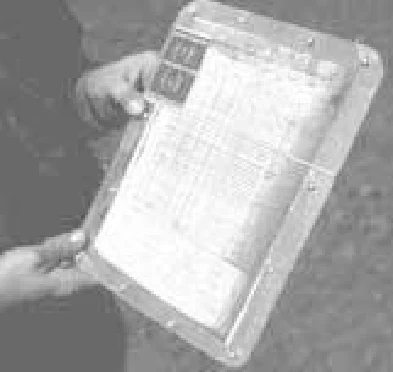
Constant use of spec sheets and manuals resulted in grimy, grease-covered pages that were hard to read. Richard came up with a way to protect valuable pages. He “sandwiches” important pages between two pieces of plastic window pane, bolting them together. They’re easy to read, can be quickly taken apart, and no amount of handling will damage them.
“Here’s a little tip which may help some others. ATV tires should be inflated to the same level and you should have the same size tires on all wheels. Otherwise, it can be difficult to handle. Sometimes, when you replace a tires, one tire might be smaller or larger than another. To solve the problem, after inflation, I measure from the rim to a level surface, such as the floor. I over-inflate smaller tires to match the larger tires, even though the pressure may be greater than the desired level. The machine handles better this way.”
“We specialize in parts and service for Oliver-Cletrac crawler tractors, featuring new, used and rebuilt parts. We have most of the mechanical parts available for the following models: HG, OC-3, OC-4 & 46, and OC-6. Parts availability for larger and older models varies according to the age and popularity of the machine. We’re regularly adding new and rebuilt parts to our line.
“We also rebuild engines, spot turn units, steering brake bands (relining),carburetors, Wico magnetos, water pumps, starters, generators, and distributors. Many more services are also available.
“There are still thousands of these machines in use or owned by collectors.”
Roger built an air hose reel from strap iron.
“The hose was always strung out on the floor and rolling it up was a problem,” he says.
“I went to the store to buy a reel for it but when I saw the price, I came home and built my own.”
He used lengths of scrap strap iron 1/8 in. thick by 1 in. wide, bent to form a reel. He fastened the bent straps to a length of galvanized pipe, fitted on one end with a $2 swivel valve from the hardware store. This is where the line comes in from the air compressor. He plumbed his 100-ft. air hose into the pipe with a 1/4-in. pipe fitting.
To bend the straps used on the reel, Bennett used a press he built a few years ago. The press is made from 6-in. channel iron. He powers it with a 12-ton hydraulic jack, mounted on the top beam of the frame. The jack base is a 1/2-in. steel plate with a 2-in.
solid steel shaft welded on the bottom where he attaches his tools. When he releases the jack, it and the base are pulled up away from the work by cables attached to a spring he salvaged from an old Hesston hay stacker. The adjustable height work table sits on a steel rod inserted in holes punched in 1/2 in. steel flat iron he welded on the sides of the channel iron frame.
“I use it to bend flat iron, press off bearings and that type of thing,” he says. He’s building a bigger press using a truck hoist hydraulic cylinder.
Cutting steel is easier now that he mounted his chop saw on a table. To make the table, Bennett built an angle iron frame to fit around the base of the saw. The frame is welded to a pipe which slides into a larger pipe welded to an old wheel. This makes the table height adjustable. He also has a couple of adjustable support rollers to hold up heavy materials while he cuts it.
Bennett also put together a portable torch cart. It’s built from the wheels and stub axles from an old trailer sprayer. He even used the 16-in. tires from the sprayer. He built a frame on which he mounted the stub axles. The frame, with handles for moving around by hand, can accommodate acetylene and oxygen tanks for welding and the propane tank he uses for cutting. A length of pipe makes a tongue, which he uses to pull the cart behind his 4-wheeler or pickup.
Contact FARM SHOW Followup, Roger Bennett, RR 1, Box 58, Elkton, S. Dak. 57026.
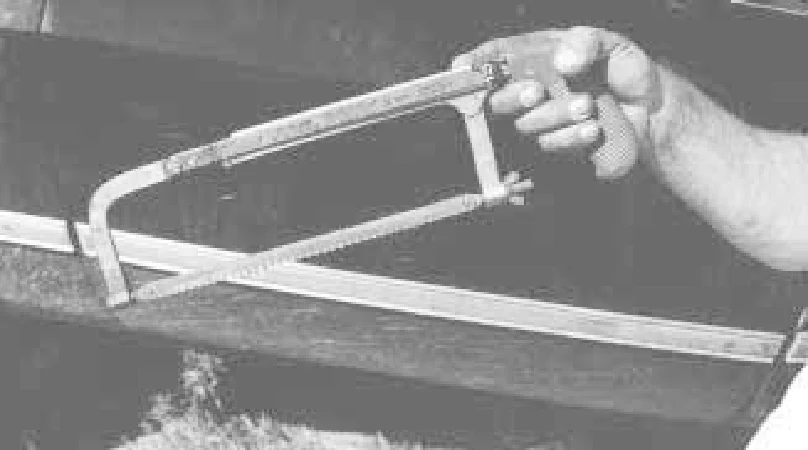
When Jim breaks a hack saw blade, he never has to scurry around looking for a replacement. He has several spare blades taped to the hack saw. He slips one end into the plastic handle and tapes the loose end to the saw. He says they never get in the way because they fit so snugly to the saw.
“The Tool Tree” is designed to keep all types of farm and yard tools together in one space-efficient place.
Glyn and Joy Newman of Whitewood, Sask., grew frustrated with the mess their tools made in their garage and shop.
“We had everything stuffed into five-gal-lon pails and they were always falling over,” Glyn confesses.
“Joy suggested that we hang our tools on the wall but I didn’t like that idea.”
Instead, Glyn set about designing a storage system built from a 1-in. sq. tubing. Through trial and error, he learned how to balance the unit and make it so all types of tools would fit. The Tool Tree is painted black. The base serves as a stand for straight-handled tools such as rakes, hoes and brooms while the top section has hooks for scoop shovels, snow shovels, and any other tool capable of being hung.
Newman came up with three different models, which use varying amounts of floor space and accommodate different quantities of tools. The deluxe model can hold more than 30 tools. It has nine accessories available for expansion purposes.
The base unit comes with 4-in. long pieces of various-sized sq. tubing inserts and angle iron for sizing the handle holders on the base. These materials may be used alone or in combination with each other as required.
“The Tool Tree” comes with a lifetime guarantee. A free information package is available on request.
The three models of base units sell for $49.99, $64.99, and $119.99, respectively, and accessories range in price from $6.99 to $22.99.
Contact: FARM SHOW Followup, Glyn Newman, Box 929, Whitewood, Sask., Canada, S0G 5CO (ph 306 735-7619, 2361, or 7615).
Desperate situations call for innovative solutions.
That’s how Carroll Kallevig managed to repair a leaking buried water line without having to spend hours trenching to dig it up. At the same time, the owner of Kallevig Pump Service, Irwin, Iowa, also saved his customer hundreds of dollars.
“To get the water back on in a hurry, we simply slid smaller diameter plastic tubing into the leaking pipe,” he says.
He’s made this repair dozens of times since then with great success. One satisfied customer, Marlin Petersen, Kirkman, Iowa, alerted FARM SHOW, saying it was a great way to avoid expensive trenching.
Says Kallevig: “If the leaking pipe isn’t full of hard deposits and is otherwise still intact, we can push rolled plastic pipe through it for several hundred feet.”
If the original water line was 1 in. steel, he uses 1/2-in. rolled black plastic pipe. For 1 1/4-in. steel pipe, he uses 3/4-in. plastic. For a longer line, Kallevig says some excavation may be necessary.
“You can push the plastic line only so far and then you need some help,” he says. So if the repair will be more than 200 ft. or so, he digs up the old line in one or two spots and cuts out enough pipe so a worker can help feed the plastic line through.
The longest distance he’s run one of his repair lines is about 500 ft. That was a line that ran under a highway and buried power lines to a house.
“Replacing the line would have taken hours, and we’d first have had to have the utility company come out and mark their lines for us. And going under the highway would have been very costly.”
Kallevig says there’s no real trick to making this kind of repair.
“I always taper the end of the line so it will slide past any obstructions in the line. If there are elbows in the line, you can’t push the plastic line through them.” But, Kallevig says,“ you can dig them up and make a curve in the line or push a new line in at the corner and then connect the two.”
If water lines run under pasture or alfalfa fields, Kallevig recommends using heavy sheet metal or 1 1/2 or 2 in. angle iron to make a covering over any bare plastic tubing where you’ve dug up the line to make a place to push or connect to another line.
“Gophers have a tendency to dig into the trench and may chew up the plastic line if it’s not protected,” Kallevig says.
Contact: FARM SHOW Followup, Carroll Kallevig, Kallevig Pump Service, 106 Cora, Box 302, Irwin, IA 51446.

Fred Gibbs, Greeley, Colo., made his own 100-ton hydraulic press using a 1/2 hp electric motor and hydraulic pump off a “Perfect Circle” center pivot irrigator.
He used 10-in. I-beam to make a 6-ft. high press frame and mounted the pump, electric motor, and oil resevoir on top of it. A junked 10-in. dia. hydraulic cylinder does the work.
“It’s a nice looking unit that cost me very little to build because I got the irrigation components cheap,” says Gibbs.
“I use it to press bearings and gears on and off shafts and to repair gearboxes for center pivot sprinklers.
“The Perfect Circle irrigation system had an electric motor, hydraulic pump, and reservoir on each tower. Each motor ran continuously. If one of the towers got behind, a valve would open to move that tower forward until the valve closed. There are a lot of these old power units on the market that can be bought cheap.”
Gibbs also made his own easy-to-use bulk oil system that mounts on a steel frame above the press. There are four barrels, with two containing hydraulic oil and the other two containing motor oil. The barrels are mounted two high, with a gas pump nozzle and hose connected to each of the bottom barrels.
“It’s a gravity flow delivery system that delivers oil directly to our tractors or to filler cans on a drain rack that’s mounted on the shop wall below the barrels,” says Gibbs.
“The drain rack consists of a 12-in. dia. length of pipe cut in half, with expanded metal grating on top of it. It bolts to the wall. A length of clear tubing connects each pair of barrels to serve as a site gauge for filling.”
Contact: FARM SHOW Followup, Fred O. Gibbs, 1001 O St., Greeley, Colo. 80631 (ph 970 454-3311).
North Dakota farmer named Bob Heinzman is an inventor who runs a manufacturing plant, along with his brother. Years ago FARM SHOW featured his mini-tree spade for transplanting large trees without the need for a big truck (that business is currently for sale).
Now Heinzman and his brother have come up with a new product which they are offering to manufacturers. It’s a “failure detector” for seals. An electric circuit attaches to the seal at the point of maximum wear and tells the operator when it should be replaced.
The circuit simply runs a continuous resistance test on the seal. When the electrical resistance changes due to wear, a signal is given to the operator.
The circuit can actually be sprayed into seals as a polymer film that’s as thin as .002 in. thick. Different formulations are available for a variety of seal materials.
“We’ve had a lot of interest from major manufacturers. We think ‘smart machines’ - which can diagnose their own maintenance needs - are the wave of the future. This system not only monitors seals, it also monitors itself so that if a circuit is damaged in any way and not functioning, it will tell you,” says Heinzman.
Contact: FARM SHOW Followup, Bob Heinzman, Mid Dakota Corporation, Box 728, Garrison, N.Dak. 58540 (ph 800 327-7154 or 701 337-5619; Web site: www.ndak.net/~dakseal/dakseal/).