
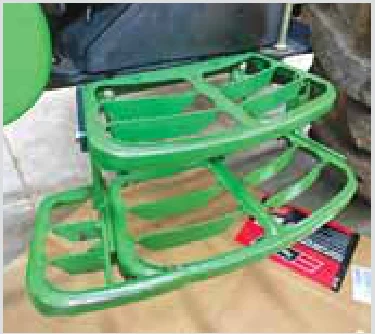
“As I got older, I wanted safer steps on my John Deere tractor when I’m climbing on and off. The top step is 25 in. off the ground, and that’s too far for me with my bad back. I added another step 6 in. below the OEM step, at 19 in. off the ground.
“I hung the lower step from the upper one using straps made from 3/8 by 1 1/2-in. flat bar and 1 1/2-in. channel iron on each side.
“For additional support, I made braces that run at an angle from the tractor to the lower step. The braces use tangs (clips with slotted ends and mounting holes) and 1/2-in. round stock cut on the radius. Two tangs mount to the bolts that attach the upper step to the tractor, and two tangs also mount to the rear of the lower step.
“Once the tangs were in place, I cut the round stock to fit between them and tacked it into the slotted ends.
“I’ve found that using tangs and round stock is the easiest way to brace things without having to bend the end of a piece of steel to fit.
“The lower step was a big help for climbing into the cab; however, backing out and down was still tricky since it isn’t a normal 8-in. step. I decided to widen the lower step. I bought another step from John Deere and cut away about 75%. I welded and bolted the remainder to the side of the lower step. That’s proven to be a big help.”
Reproduced from the published FARM SHOW entry. Prices, coupons, availability and contact details are historical, not current offers. Reader methods are not universal instructions: follow manufacturer guidance, proper supports and safety practices, and consult a qualified professional when needed.
Comments and votes
Have you tried this idea? Mark it helpful and share how it worked in your shop.