
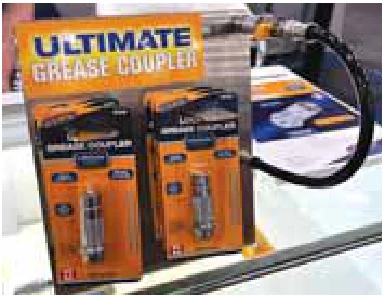
Univer-Co developed a clean and handy tool to consistently apply grease where it’s needed most.
When bearing, roller or bushing grease nipples become worn and rounded, it can be frustrating to secure a grease gun coupler in the correct position to move grease through a zerk fitting.
The UC2121 lock-on coupler from Univer-Co uses a revolutionary mechanism with a four-jaw lock to hold the coupler in place to a maximum pressure of 10,000 psi. It’s made of premium steel and comes with a 1/8-in. NPS thread, fitting all makes and models of grease guns.
“They seal completely and never pass any messy grease around the edges,” says Richard Labelle, Univer-Co Sales Manager.
“It has an integrated release valve to remove it from the nipple. Just pull back on the locking flange, and it lets go.”
The unique coupler also comes standard with an inline pressure release valve in case the downstream pressure becomes too high and threatens to break the zerk or coupler. Simply open the valve and allow some grease to escape, lowering the pressure and releasing the coupler.
A hands-free reach-and-release hook is also available for hard-to-access places and keeps fingers clear of obstructions.
The lock-on couplers are manufactured in Quebec and are available through a network of dealers across North America.
Prices range between $40 and $60 CAD ($30 to $45 USD) plus S&H.
Contact: FARM SHOW Followup, Univer-CO Inc., 713 Montee Douglass, Napierville, Quebec, Canada J0J 1L0 (ph 450-245-7152; [email protected]; www.univer-co.net).
Reproduced from the published FARM SHOW entry. Prices, coupons, availability and contact details are historical, not current offers. Reader methods are not universal instructions: follow manufacturer guidance, proper supports and safety practices, and consult a qualified professional when needed.
Comments and votes
Have you tried this idea? Mark it helpful and share how it worked in your shop.